
On the bus

Yesterday, because of the holiday, CalTrain was running on the Sunday schedule. I had taken CalTrain to Millbrae, transferred to BART and took BART across the bay to Berkeley, where I went to some used bookstores and then went to the Berkeley Sacred Harp singing in the evening. But CalTrain stopped running early, so when I finally got back to Millbrae I had to go down and take the 391 bus to San Mateo.

As my friend E has pointed out, many of the people who ride buses are what E calls “the working poor,” people working low wage jobs who maybe can’t afford a car. Last night, there were maybe ten people on the 391 bus: an older white guy who hadn’t shaved recently, a teenaged black couple who were totally absorbed in each other, a tall black man who was neatly dressed, and several other people who could easily have fit the description of “working poor.”

The tall black man sat just behind me. “Praise God, God is good,” he chanted sotto voce. “God is my anchor, all power to him.” At first I thought he was singing, and maybe had come from a prayer meeting or hymn sing; I had just come from singing white gospel music, so it was a natural thought for me to have.

A small man with brown skin and a Hispanic accent was sitting behind the tall black man, and greeted him by name, adding, “How you doing?”

“Oh, hi,” said the tall black man, “good to see you, good to see you. I’m just coming back from seeing my mother. She’s dying, they say she’s only got a few weeks to go. I wish I could take her place. But God is good, if it’s her time to go, God will take her.”

Now I knew why the tall black man had been saying what he did. The small Hispanic man behind him listened to him, and talked a little bit about his own mother, who had died recently. They compared how their mothers had fallen into decline, the sort of thing I remember doing when my mother was dying and I wound up talking to someone who also had a dying mother.

The tall black man was holding it together pretty well, but his mother’s imminent death was obviously causing him great pain. “God is good,” he kept saying, not to try to convince himself of the fact — he obviously believed that his God truly was good — but rather to talk himself down from the brink of crying aloud.

“God is good,” said the tall black man, and then told how he had been in prison, and on parole for years and years, and his battles with alcohol, “and through it all, God was there for me, God pulled me through.” You could tell from the way he said it that that was what his God did — his God would pull you up out of the gutter as many times as you failed and fell down into the gutter. His God was always there to help him conquer the devil. The small Hispanic man nodded sympathetically, and talked calmly about his own battles with alcohol. I can’t say that I was eavesdropping, because the two men made no effort to talk confidentially. No one else on the bus was talking, and we could all hear the conversation of the two men.

“Do you drink now?” said the tall black man.

“No, not any more,” said the small man.

“Put it there,” said the tall black man, and they shook hands. “Do you go to church?” The small man admitted that he was a Baptist, and the tall man nodded and said, “You keep going to church and praising God.”

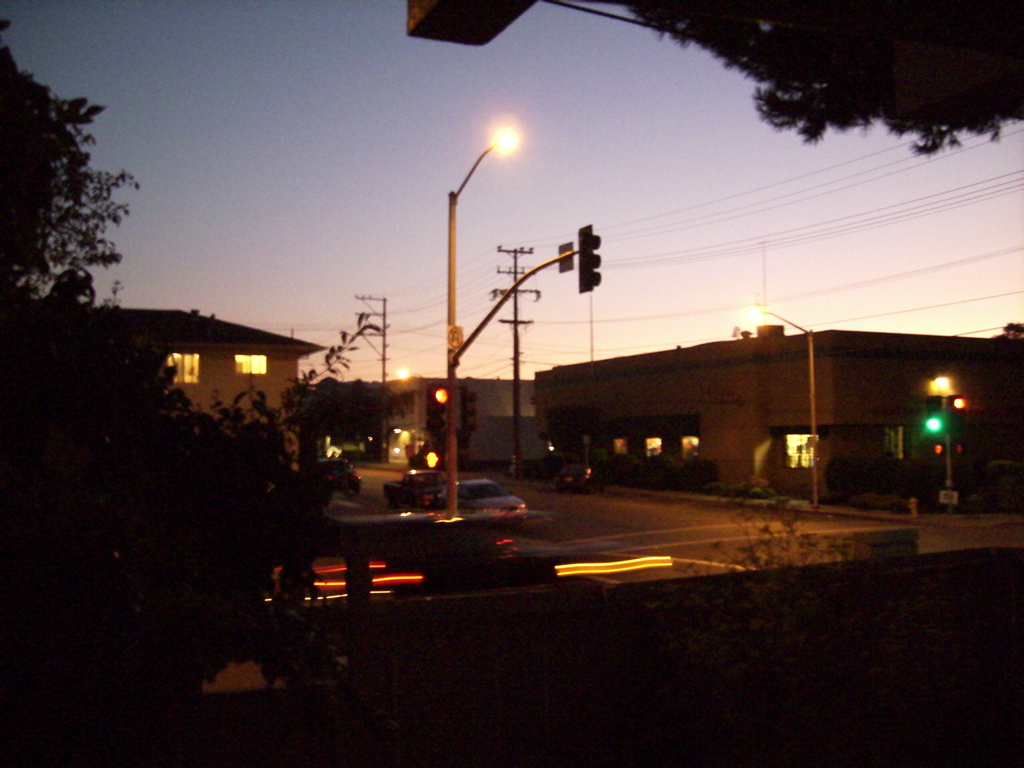
Then it was my stop. I got off the bus, walked down the dark, mostly empty streets, and was home by 11:25.
On the sidewalk

I’m sitting in a coffee shop in downtown San Mateo. There are two young women with clipboards standing just outside the door, accosting people as they walk down the sidewalk. They probably have some petition to sign. No, I take it back, they are giving out some kind of brochure or newsletter. One of the young women has stopped someone, and she is talking as fast as she can, making lots of eye contact, opening her notebook.

I can’t quite read their t-shirts, but I have this feeling they are asking for donations. I’m ready to leave, so now I must plot my exit strategy. I’ll wait until one or both of them is talking to someone, put my head down so my hat brim hides my eyes, and stride purposefully out the door. Now if I were with Carol, she would make a point of talking to them, because as a former newspaper reporter she is always curious about things like this. But I’m a soft touch, and I know it, and I don’t want to give any money to any more causes, so I will try to get out of here without making eye contact with these two young women.

Wish me luck. Here I go.

Sunday morning

The choir I just joined, the Labor Heritage Rockin’ Solidarity Choir, performed “A Musical Biography of Pete Seeger” at the First Unitarian Universalist Society of San Francisco this morning. We were the main event in their worship service. After being introduced by their choir director, we filed up onto the stage at the front of their worship space, dressed in our black t-shirts and black pants. This “musical biography” combines narration and semi-staged dramatic vignettes, with songs which Seeger either wrote or made famous.

About ten minutes into our performance, the congregation applauded one of the songs. I was a little surprised; I could hear the bass section well and I knew we had not been at our best. But from where I stood I couldn’t hear the rest of the sections very well, I had no idea how the choir as a whole sounded. Then came the dramatic vignette where Seeger goes before the House Un-American Activities Committee, and when he is asked if he ever joined the Communist Party, he pleads the First Amendment, saying that he shouldn’t have to answer any questions relating to his freedom to associate. The congregation applauded for that, and I realized that they really liked what they were seeing and hearing.

I was a little surprised by this, because I kept hearing all the things the bass section did wrong — we fumbled some key entrances, we weren’t all singing in unison a few times, all the moments when we messed up. I was also all too aware of my own shortcomings as a singer — I don’t have the breath control I should, I’m not a confident enough singer that I can always stick to the written music when the singers around me are singing wrong notes, I sometimes lose my concentration. But the congregation didn’t care. They sang along with familiar songs like “Guantanmera,” and “If I Had a Hammer.” The soloists were very good; the speakers were moving; the message behind this musical biography was deeply moving; and, in spite our technical and musical faults, our section sang with feeling and power, and though I couldn’t really hear them I assume the rest of the choir did too.

The congregation gave us a standing ovation at the end of the worship service. That surprised the heck out of me, although that standing ovation wasn’t really for our choir as performers — that ovation was more for the power of Pete Seeger’s career as a singer and community activist, as captured by the script written by our music director, Pat Wynne. I shouldn’t have been surprised, of course. This kind of thing happens all the time in worship services and amateur musical performances in which an important message is delivered with genuine feeling. But when you’re standing at the far end of the bass section, and you can’t really hear, and all you can do is concentrate on singing the right notes when you’re supposed to, you may not be aware of what’s happening around you.

Hummingbirds

We put up a hummingbird feeder a couple of weeks ago. I had been hearing hummingbirds calling all around our apartment, I had even seen a few whiz by, but I hadn’t really seen any up close. I filled the feeder with the sugar solution that is recommended to attract hummingbirds, and hoped that maybe one or two would come once in a long while so I could better look at them.

This morning, I sat at our kitchen table reading and looking up at the hummingbird feeder. There was at least one hummingbird there every five minutes. A couple of times, two of them came at the same time, and then one would chase the other away — even though there’s room for three hummingbirds to feed at the feeder, they apparently don’t like to share.

Although it’s hard to see the hummingbirds clearly enough to identify them because the light comes from behind them, the ones I could identify clearly have all been Anna’s Hummingbirds (Calypte anna). I’ve seen at least one female and at least one male. Anna’s Hummingbirds are supposed to be year-round residents in this part of the world, so with luck we’ll have hummingbirds visiting our feeder all year long.

One faith perspective on teen suicide

In the past five months, three teenagers have committed suicide in Palo Alto (more on this from the San Francisco Chronicle). On Monday evening, six people from different faith traditions were on a panel to talk about how persons of faith might respond to this community tragedy.

I attended the panel on Monday night, and listening to what people said raised an interesting question for me: What might we as Unitarian Universalists say about teen suicide? Here are some of the things I thought about:

— As Unitarian Universalists, we do not see suicide as sinful or evil; that is, if a teen commits suicide, we would consider it to be a tragedy, but we would not say that that teenager (or parents/guardians and extended family) was committing a sin.

— As Unitarian Universalists, we would be unlikely to blame God or any deity for teen suicide (assuming we believe in God or a deity of some kind). We would understand suicide to be a human problem which has its source in what we as humans do.

— As Unitarian Universalists, we support gay, lesbian, bisexual, transgender, and questioning persons fully; we do not think there is something wrong or sinful about GLBTQ persons. We are also aware that some research indicates a much higher suicide rate among GLBTQ teens, and therefore we would want to be extra supportive of GLBTQ teens.

— Coming from our Universalist heritage, we know that all persons are worthy of love, and have inherent worth and dignity. If someone wants to commit suicide because of terminal illness, that’s one thing — but when a healthy teenaged person commits suicide, we are struck by the tragedy of losing a unique person who is worthy of love and who has inherent worth and dignity.

I know some of you will have additional thoughts and meditations teen suicide, and please feel free to add them in the comments below.

Religious literacy: Assessment grid

After getting lots of help from commenters on my list of topics that should be included in religious literacy for Unitarian Universalist (UU) kids, I’ve taken the next step and created a “Religious Literacy Assessment Grid”.

This grid lists each suggested topic for religious literacy, assigns that topic to an age group (with grid squares colored light orange), and begins to offer some suggestions for assessing children’s knowledge of each topic. As always, your comments are welcome.

Within a week, I hope to have another list for your comments. Another of our big four educational goals for UU kids involves teaching basic religious skills that are appropriate for UU kids to learn (e.g., mediation, public speaking skills, etc.), and this list would cover some of the basic religious skills we’re thinking are central to our tradition.

Clean elections

I just attended a meeting titled “Palo Alto Passion-Raiser for Fair Elections,” billed as “an event tailored for politically active people and intended to build a local coalition to work for passage of the California Fair Elections Act in June 2010.” This event was co-sponsored by our church’s Social Action Council, and by my count drew 136+ people, including 3 current California State Assemblymembers, and one former Assemblymember.

The former Assemblymember was Sally Lieber, who served from 2003 through 2008. Of all those who spoke in support of the bill, I liked what she said best. Speaking as a former state legislator, she said she supported reforming the way elections were funded because of her own experience: “It’s tough being told, ‘You have to spend at least two hours per day doing fundraising.’ It’s tough being told, ‘I love your bill, it’s a great bill, but if I vote for it, it will damage my fundraising efforts.’ “

Summer evening

It was hot today. The weather station at San Francisco Airport recorded a high of 91 degrees Fahrenheit, and I’d bet it hit 95 degrees at our house. About the middle of the afternoon I saw one of our downstairs neighbors. We both agreed it was hot. She said it was so hot she was having a hard time staying focused on doing housework. I admitted that the heat had gotten to me and I had given up on housework.

Since I wasn’t getting any housework done, I decided I wouldn’t stay around the house. I got on the train, transferred to BART at the Millbrae station, and headed over to Berkeley. I walked up to Telegraph Ave., then threaded my way through the street-chaos generated by the resident freaks, weirdos, and college students of Telegraph Ave., making my way down to Moe’s and Shakespeare & Co., the two bookstores remaining on the avenue.

I turned into Shakespeare & Co., with its narrow aisles and mis-matched bookcases. As I turned towards the mysteries, a small bearded man stepped backwards and ran into me; I apologized, but he didn’t notice me at all, and continued asking the clerk, “Are these the only chess books you have?” The clerk said, “Yes, they’re all on that shelf.” The small man said, “But what about these here?” The clerk said, “Yes, those there, yes they continue down to that shelf.” I wandered from the mysteries towards the science fiction books. A young woman and her guitar blocked one end of the science fiction aisle. She answered her cell phone: “Hello? … Oh, hi! … I’m here in Shakespeare & Co, you know that used bookstore? … Yeah. I’m looking for something new to read. I was trying to read Kafka, but I didn’t like it, which is strange, because it’s this really well-written book, so now I’m trying to find something else….” I turned the corner into the pocket fiction aisle, and there was a small handwritten sign saying, “Hey, kid, don’t look up here, this is where the adult books are.” Sure enough, in shelves about seven feet off the ground, there were some forgettable mass-market porno paperbacks, back from the days when there was no Internet porn, including an old copy of Emmanuelle that smelled moldy. I eavesdropped on a conversation that the clerk was having with one of the customers; actually, it was more of a monologue, where the clerk analyzed the motivations of the 9/11 bombers, speculated that Osama bin Laden is probably dead by now, or at least in very poor health, and in his pleasing tenor voice gave details of the Jayce Lee Dugard case, including the fact that the alleged abductor, Philip Garrido, had been spouting some kind of crazed religious nonsense on the Berkeley campus when he was confronted by two campus police officers, and that was what led to the discovery of Dugard. This conversation motivated me to move on to the Political Science section, and then to glance through the titles on the True Crime shelves. I heard the customer say to the clerk, “At least she [meaning Dugard] will have a normal life now,” and the clerk responded, “Well, relatively normal, considering what she’s been through. Apparently she considered the guy as some kind of god. And she had two children with him.” I kept browsing for a while longer, but in the end all I bought was a collection of Chinese poetry in translations by David Hinton.

I walked across the street to Moe’s bookstore. The book selection was less entertaining. The people-watching was far less interesting. The only conversation I overheard had to do with Ackermann functions, and frankly I did not understand what the two guys were talking about. But I wound up buying more books, probably because I wasn’t distracted.