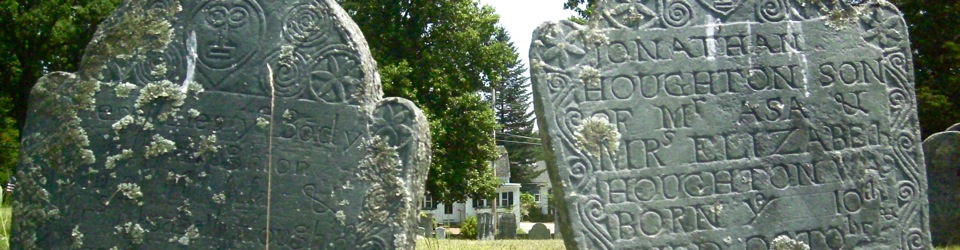
Number 163 at the bottom

So on Sunday, a personal problem came up that made me cranky and upset — enough so that I had lots of crazy dreams and didn’t sleep well that night. To make it worse, Carol is back east right now, so I couldn’t talk with her about it. I woke up with a bit of a sore throat, feeling as if I was starting to come down with a cold. I called Carol and she calmed me down. But I still felt as if I were coming down with a cold — headache, aches and pains, sore throat, tired. The problem still loomed large in my thoughts.

I almost didn’t go to my Monday evening Sacred Harp singing group, but finally I decided I would go anyway. Sacred Harp singing carries on a long tradition of unaccompanied hymn singing that has been practiced in North America continuously since the 1720s. This is not whitebread church hymn singing, this is full-throated white spiritual singing, maybe not quite the thing you want to sing when you’ve got a bit of a sore throat. But I thought I would go, and leave when I started to feel tired.

You never know who’s going to show up at a Sacred Harp singing. We usually get 15 or so people on Monday evenings, but this week maybe 25 people showed up. A woman with the reputation of being a strong alto singer was visiting from Portland, and all the better regular singers seemed to show up this week. There were only four basses, two of whom were good strong experienced Sacred Harp singers, and two of us who most definitely were not. There I was, sitting on the front bench, where I didn’t belong, sitting there only because there weren’t enough experienced basses; there I was, feeling ill and tired, thinking that I would sing two or three songs and then go home.

That alto from from Portland was a powerful singer, and some of the regular singers were in fine voice, and the emotional temperature of the room kept rising. I got carried along. One of the experienced basses stood up and said he’d like to lead number 236; this is a long complicated anthem composed by William Billings in 1787, with several solos by the bass section; I had never sung it before; yet somehow I managed to sight-read the whole thing and never get lost and only hit one or two wrong notes; not due to any great musical skill on my part, but just getting carried along by the other singers. The emotional temperature kept rising. Someone stood up to lead number 365, a complicated lengthy song dating from 1765, with repeated chords based on open fifths, what rock guitarists call power chords, and with fuguing sections and polyphony, and somehow I managed to keep my place all the way through. I had to keep my place and keep singing; there was no choice not to; I had forgotten about going home early.

The other experienced bass stood up to lead number 163b, a slow, short, simple song. It was simple, but the trebles would hit some high notes in the sixth bar, and then the altos, especially that alto from Portland, would bend some long notes on a little descending run, and those altos would drive the tenors and us basses to blow out some high notes in the tenth and twelth bars — the only thing I can compare it to is when good jazz or blues musicians get going, and the different musicians keep pushing each other to get more intense with every repeating chorus — except this wasn’t jazz, and this wasn’t professional musicians, this was just us sitting around and hitting these emotional climaxes. And there was no one to hear us singing but us, and maybe God if you believe in a God who bothers to listen to us humans singing.

By this time, I was sweating with the effort of singing with such intensity, and my shirt was sticking to the back of the bench. We got done singing number 163b, and the leader paused for a moment in the sudden silence, looking a little stunned. He said quietly, “Wow. Thank you.” I thought maybe his legs were shaking just a little.

That was the high point. The rest was pretty good, too. By the time we got done, I was no longer cranky and upset, and I no longer felt the least bit ill. My problem was still there, it was still serious, but it no longer loomed large. It would be a good idea always to remember that singing, even amateur singing done not for performance but for the sheer joy of it, can heal you.

AM talk radio does a show on Unitarian Universalism

Did I scare you with that headline? Don’t worry, the talk radio station in question is KGO in San Francisco, and since it’s a San Francisco radio station, we’re not talking about Rush Limbaugh and other right wing commentators. If there’s such a thing as left-of-center AM talk radio, KGO is it.

On Sundays, KGO has a weekly radio show called “God Talk,” hosted by Brent Walters, who actually has a post-grad degree in religious studies. Yesterday, Walters did a three-hour show on Unitarian Universalism, which you can find online here. Thanks to Richard, a member of the Palo Alto church, who found this online. However, as Richard points out, “be aware that this is a rolling weekly archive, and if you wait a week it will be gone.” [Update: Victor has now put an audio file of this radio program up on his Web site (with commercials and news edited out) at: http://uustpete.org/RadioShow.mp3 Thank you, Victor!]

Brent Walters had posted an advance summary of the show online, and I’ll include it below the fold… Continue reading

Two new children join our class, and we play some games

Series of entries in my teaching diary about an experimental Sunday school class. First entry.

Earlier this week, Amy, our parish minister, said she wanted to talk with me about the worship service. “We’re going to have some dancers, and I’d like the children to see them,” Amy said, “but we’re also welcoming newcomers, too.” “Why can’t the children stay in for both?” I said. I thought it would be good for them to see the newest members of the church sign the membership book and be recognized, and I also thought they’d like to see the dancers. We both knew that the children would be getting religious education whether they were in Sunday school or in the worship service, and I assured Amy that those of us who were teaching wouldn’t mind — if we needed more time we’d run late, or some teachers might just as soon have a little less time to fill.

As it happened, the worship service started late to begin with, at about seven minutes past eleven. I always like to sit in the very back during worship services so I can observe how the children respond. The prelude, “Calm As The Night (Still Wie Die Nacht)” by composer Carl Bohm, played on cello and piano, lived up to its name: it was calming. Worship associate Wynne Furth opening the service with a very short poem “written a thousand years ago by Ono no Komachi, and translated by Jane Hirschfield who lives near here.” When she lit the flaming chalice, Wynne said she remembered the very first time she lit a match; she had waited after her parents said she was ready, until she herself felt she was ready to light a match. I thought what she said was short, matter-of-fact, and charming, and I wondered how the children perceived it.

When the new members were welcomed, I noticed that one boy in the very back row was busy coloring and one girl in the second to last row did not seem to be paying attention. This was not surprising: these were younger children, so most of what they could see was the back of the chair in front of them. I often think how much of what children see in church is the back of the chair in front of them. (a) Fortunately, the dancers made a point of extending their dance down the length of the center aisle; the boy who was coloring looked up as the dancers got closer to him, and once he looked up he didn’t go back to his coloring. Continue reading

MySpace vs. Facebook

Reader Joe sent me a link to a fascinating story on NPR’s Website — Facebook skews towards white people; MySpace skews towards non-white people:

“I have friends who are white,” says 19-year-old Diego Luna. “They are my white people friends and they are mostly on Facebook. That’s why I use Facebook. My brown people are on MySpace.”

The class laughs nervously at his description, and then they agree. Benito Rodriguez, 16, adds, “Not to be racist or anything, but there’s more white kids on Facebook.”

Furthermore, Facebook skews towards more affluent people. MySpace, on the other hand, attracts more artists and lots more musicians.

Anybody want to guess how many Unitarian Universalist churches have MySpace pages?

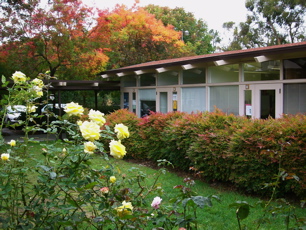
Fall color in Palo Alto

That’s the office wing here at church, with roses in full bloom in the foreground, while at the same time leaves on trees and shrubs are turning bright red and orange. The recent rains and humidity have made the grass look much greener (in-ground sprinklers just aren’t as effective as rain).

(My office is the one with the lights on.)

Video history

Joe, a reader of this blog, writes: “I thought you might like seeing a video of the Palo Alto Unitarian Church from 1958, “The Groundbreaking and Construction of the Church Main Hall and Buildings.” This film was shot by Donald Borthwick and William Kellogg from March to July 1958. In 2007, Rae and Elton Bell had the 8mm film digitized and transferred onto a DVD to show at a celebration at the Unitarian Universalist Church of Palo Alto (UUCPA). I added the music and uploaded it to Google Video.”

Those of you who aren’t part of UUCPA may find this excruciatingly boring (unless you’ve worked in construction, in which case you’ll be saying to yourself over and over again, Boy I can tell this was before the days of OSHA). So watch a minute or two, and notice that the church is being built far from the center of Palo Alto, but along a road where cars pass several times a minute. This was where you were supposed to build churches in the late 1950s: at the edge of suburban development along a fairly busy road (gas was cheap in the 1950s, and public transportation was considered passe).


The fellow wearing the clerical robe at the beginning is Rev. Danford Lyon, then minister of the church. Thanks for uploading the video, Joe!

We play “Zip, Zap, Zoop,” and we talk about conscience and the voice of God

Series of entries in my teaching diary about an experimental Sunday school class. First entry.

The children went to the first fifteen minutes of the worship service with the adults as usual. It took a long time for the worship service to get going this week. We started three minutes late, the announcements went on for four minutes, and we wound up taking about five minutes to greet the people around us and introduce newcomers, so it was 11:12 before the worship service really started. Fortunately, this week’s worship associate, Kay Brown, told a wonderfully effective children’s story. She started by saying that the story took place “far, far away, ten thousand miles away, in the land of India, where I was born.”

The story was about a man who made his living by selling caps (Kay put a baseball cap on her head to show the kind of cap she meant). He carried around some 50 caps in a big basket calling, Who wants to buy a nice cap? Red ones, green ones, all kinds of caps! Then the man walked under a tree in which some 50 monkeys lived. The monkeys saw the caps and wanted them. They climbed down out of the tree, and each took a cap. They liked the red caps best, said Kay, “because the red caps matched their red rear ends.” The man called to the monkeys to return his caps, for if he could not sell the caps, he would earn no money and his children would starve. He pleaded with the monkeys, but the monkeys just laughed. The man grew sad, and then angry, and when he realized the monkeys would not give his caps back no matter what he said, he grew disgusted and threw his own cap on the ground (Kay demonstrated this with the cap she was wearing. Lo and behold, all the monkeys imitated the man and threw their caps on the ground where he could pick them up. “The moral of the story, parents and children,” Kay said in conclusion, “is this: children will do what adults do, not what you say.” (I can’t remember the exact wording of Kay’s moral, but it was something like this.) I found it to be a very satisfying story — it was a familiar story told in a personal way, it was fun for children, and the moral was not simplistic. I liked that the moral was really two morals in one: it told adults that words are not enough; and it alerted children that they should pay more attention to what the adults in their lives actually do, as opposed to what those adults say. I thought to myself that I might want to take some time to talk about this story with the children in class.

We went off to our regular room. I was surprised to find that several of the things I had set up had been put away — the candle we were going to light was gone, the markers and crayons I had ready for the project were gone, the snack was gone. We found the candle and the markers had been put away in the closet in our room. I went off in search of matches and snack while Melissa said the opening words with the children. I grumbled a little bit, but there wasn’t much we could do. This is always one of the challenges of teaching Sunday school: things move around when you’re in shared space.

I got back to our room in time for check-in. There were just four children today: Dorit, Andrew, Perry, and Monty (attendance was light in most age groups at the first worship service as well). There were five adults today: Lee, Melissa, Lucy, Amy (our parish minister) and me. Lucy is Dorit’s and Andrew’s mom, and she said, “Is it OK if I come to class? I like it in here.” Of course we said it was OK for her to come to class. Amy has been wanting to visit the Sunday school for a while, and since we had a guest speaker today she was able to come.

After we had each checked in, Dorit asked if we could play “Zip, Zap, Zoop.” Continue reading