The Unitarian Universalist Association Board, and many other Unitarian Universalists, want to move the 2012 General Assembly scheduled to be held in Phoenix, Arizona, in protest of the recent Arizona law that directs state and local officials to track down illegal immigrants. However, apparently Unitarian Universalist ministers in Arizona and Las Vegas voted unanimously to oppose this move. They would like us all to come to Arizona and engage in public demonstrations against the law instead. As an extra added incentive to listen to the Arizona ministers, I would point out that the cancelation fees alone would cost the UUA something like $650,000 (to say nothing of the added expense of finding another venue at this point).
An obscure Palo Alto Unitarian
While researching something completely different, I came upon an obituary in the 1919 volume of The Pacific Unitarian for Helen Kreps. She had been encouraged to enter the Unitarian ministry by Rev. Florence Buck, interim minister in 1910 at the old Palo Alto Unitarian church. By 191, she was a highly promising student at Pacific Unitarian School for the Ministry (now Starr King School for the Ministry) when she died in the great influenza epidemic. I make no claims for the historical importance of this story, but its poignancy makes it worth reprinting here.
From The Pacific Unitarian, vol. 28, no. 3, March, 1919, p. 65:
Helen Katharine Kreps
(Editorial Note. — The above article by President [Earl Morse] Wilbur came just too late for our last issue. Since it was written the deeply lamented death of Miss Kreps ended her heroic struggle. Dr. Wilbur now adds a tribute to her memory.)
About three years ago I received from a young woman in Palo Alto, of whom I had never heard, a request for information about courses of study in our divinity school. Shortly afterwards a member of the staff at Stanford university told me that one of their finest graduates was coming to us to study for the ministry, and mentioned her name with high praise. Later in the spring a slight, girlish-looking person appeared at the school, accompanied by her mother, to make final arrangements for the proposed course of study. Thus I first came to know Helen Kreps. She entered as one of our students in the autumn of 1916, and was thus in her last year when death snatched her from us. Continue reading
“The Man with the Hoe”
The Universalist poet Edwin Markham wrote the poem below; he first presented it at a public reading in 1898, and it was first published in the San Francisco Examiner on 15 January 15 1899. The poem was republished many times thereafter, and reportedly earned Markham a quarter of a million dollars over his lifetime.1 When you read it, you’ll see that it is a poem based on the Universalist notion of the supreme worth of every human being.
In the early 20th century, Markham moved to Staten Island, New York, where he lived on Waters Ave.,1 not far from where my father lived at that time. My father still remembers Markham’s visit his elementary school. Markham lived in Staten Island until his death in 1940.
The Man with the Hoe
Written after seeing Millet’s World-Famous Painting
God made man in His own image,
in the image of God made He him. — Genesis.
.jpg)
Bowed by the weight of centuries he leans
Upon his hoe and gazes on the ground,
The emptiness of ages in his face,
And on his back the burden of the world.
Who made him dead to rapture and despair,—
A thing that grieves not and that never hopes,
Stolid and stunned, a brother to the ox?
Who loosened and let down this brutal jaw?
Whose was the hand that slanted back this brow?
Whose breath blew out the light within this brain?
Is this the Thing the Lord God made and gave
To have dominion over sea and land;
To trace the stars and search the heavens for power;
To feel the passion of Eternity?
Is this the Dream He dreamed who shaped the suns
And marked their ways upon the ancient deep? Continue reading
It rained today
It rained again today. So I said to a long-time California resident, “It’s raining! When I moved out here, I was promised that it only rained in the winter. I thought our high rents out here paid for no rain. Doesn’t this void my warranty? Can’t I get my money back?”
Smiling, he said, “It rains eleven months of the year here. And we have land slides, wild fires, the occasional tornado, and the Bay Bridge collapses in earthquakes.”
“So this doesn’t void the warranty?” I said.
Still smiling, he just shook his head. “Land slides, wild fires, earthquakes, tornadoes, this is a terrible place to live. I keep telling this to people, they should stay in the eastern half of the country, they really don’t want to live out here.”
It rained today, and now everything smells fresh, and the trees look a little greener, and the white cumulus clouds drifting by overhead are beautiful.
Recycled garden beds
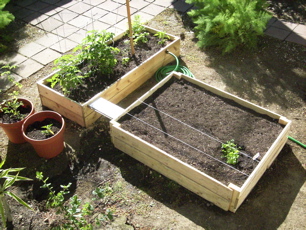
We completed two garden beds today, both made out of recycled wood, and filled in large part with compost (made by the city) from yard waste. Because we live in a hundred-year-old house, it’s probable that there’s lead in the ground from lead paint, which is why we decided to use raised beds with soil brought in from somewhere else. In the photo below, the nearest garden bed is made from a pallet that we got for free from a store across the street; the further garden bed is made from recycled wood that Carol got at Urban Ore when she was over in Berkeley last month.
Comparing church fundraisers
It’s always interesting to me to see which fundraisers raise the most money for the least amount of work. Sometimes, the simple easy fundraisers raise more money than the complex difficult fundraisers. For example:
The youth group here at the Palo Alto church is raising money to go to New Orleans for a service project. The ice cream social (ice cream donated by a local merchant) grossed $775 for two hours of work. The New Orleans theme dinner grossed $750, with much higher expenses, and three or four times as much work.
The end of spring
The rains continued right up to the last week of April, which everyone keeps saying is unusual. Everything is still green: the hills in the distance, the unmowed verges along the roads. But now it seems that the rains have ended at last, and the summer-dry season is setting in. As I drove across the Dumbarton Bridge to the East Bay, I noticed that the green hills on the other side of the Bay are already fading to gold in places. And the long grass along part of the road near the church is fading from a brilliant green to a light golden-green, its heavy seedheads nodding in the sun. Soon the hills will fade a golden-brown, and the ground will be parched dry; in the mean time, though, flowers bloom everywhere, the air is thick with pollen, and trees are beginning to set fruit. Another writer living in a Mediterranean climate said this about this time of the year:
My beloved spake, and said unto me, Rise up, my love, my fair one, and come away.
For, lo, the winter is past, the rain is over and gone;
The flowers appear on the earth; the time of the singing of birds is come, and the voice of the turtledove is heard in our land;
The fig tree putteth forth her green figs, and the vines with the tender grape give a good smell. Arise, my love, my fair one, and come away.
Song of Solomon, 2.10-13, KJV
When covenants do make sense
As I continue to think out loud about covenant in liberal religious congregations, I can think of three cases where having a covenant makes a lot of sense:
(a) Congregations that can trace their institutional roots back to churches that historically had covenants as their central organizing principle. For Unitarian Universalist congregations, this probably means tracing institutional roots back to the mid-19th century or earlier, to churches of the New England Standing Order. The concept of covenant would have to have been kept alive in some form since then; e.g., the New Bedford, Mass., Unitarian church grew out of a Puritan church that had a covenant up through the 19th century, and later maintained that covenant in the way in which newcomers were allowed to join the church as full members (i.e., newcomers have always had to sign a statement stating they would uphold certain moral standards).
(b) Congregations that otherwise derive from churches of the old New England Standing Order, e.g., the Unitarian Universalist Society of Geneva, Illinois (see first post in this series for details).
(c) Congregations that were not originally Puritan, but were nevertheless initially organized around covenant as a central organizing principle. I believe some of our newest congregations were intentionally formed around covenants.
In each of these three cases, in order for covenant to remain viable as a central organizing principle, the covenant must:— be kept theologically fresh by the minister(s) or other theologically sophisticated persons; be constantly presented to new members; and be a part of the day-to-day life of the congregation. That is, in order to be viable, a covenant must be a living document.
Third in a series on covenant. Part one.
Let’s get rid of covenant, part two
Following up on yesterday’s post on covenant, here are two more reasons to get rid of covenant as an organizing principles of Unitarian Universalist congregations:
(5) Enforcement of covenant has become increasingly difficult in Unitarian Universalist congregations. Yahweh/God enforced covenants in the Bible, and he would send plagues, dissension, etc., etc., if his covenant was violated. The Bible stories about covenant served as models for Puritan covenants, although the ultimate enforcer would more probably have been understood to be Christ/God or Trinity/God. For the Puritans, enforcement by a deity was not enough, and covenants were also enforced by human theocracies with power to tax, fine, and/or imprison.
In the absence of general belief in an enforcing god, and in the absence of theocracies (no, the Unitarian Universalist Association is not a theocracy, not by any stretch of imagination), there really is nothing left to enforce the provisions of a covenant except the good will of the people involved. Therefore, it would seem to me that contemporary Unitarian Universalist covenants at best have no more power and authority than bylaws, annual meetings, minutes, all the familiar trappings of associationism; at worst, covenants have significantly less power and authority than does associationism because at least most bylaws have distinct rules for disciplining members by removing them from membership.
In short, most Unitarian Universalist covenants are unenforceable, given our current theological situation.
(6) Covenant as currently constituted in United States Unitarian Universalism is less flexible and more hierarchical than associationism.
Covenantalism has evolved in a hierarchical direction in U.S. Unitarian Universalism. I think many people believe that the covenant embodied by Article 2, “Principles and Purposes,” of the Unitarian Universalist Association takes precedence over the covenants of local congregations; and that the covenants of local congregations must explicitly include the “Principles and Purposes.” Yet at the same time, probably many Unitarian Universalists, if they stopped to think about it, would feel uncomfortable with this kind of hierarchy.
Mind you, hierarchy is not necessarily bad; from an organizational standpoint, hierarchy makes a great deal of sense, and it makes more sense the larger an organization gets. But a hierarchical organization must also retain a great deal of flexibility, and this is where I believe current hierarchical covenantalism breaks down. Our hierarchical covanentalism requires that any new congregations reach certain standards. Hierarchical covenantalism also requires that for a person to be considered a Unitarian Universalist, that person must belong to a local congregation that meets those standards (i.e., must sign on to the covenant of a local congregation that properly adheres to the covenant in Article 2 of the UUA bylaws). Our present organizational structure rules out new-fangled “house churches” and old-style fellowships; this structure tends to rule out storefront congregations operating outside the implicit “franchise system” of the UUA; and this structure has little provision for online religion, congregations that don’t meet weekly, etc. There is a methodological rigidity built in to our current hierarchical covenantalism; associationism is inherently more flexible.
Second in a series on covenant. Part one. Part three.
One final point of interest: If we are going to build a world-wide movement of religious liberalism — and some of us are still committed to such a movement — then associationism, not covenantalism, will continue to be the means of doing so. Associationism is designed to allow the sharing of information and resources while allowing a great deal of local autonomy; the local congregation, and the local association, find the best way of running their organizations given the current local circumstances, yet they also commit to regular communication and sharing with national and international associations. Under associationism, the Transylvanian Unitarians maintain their hierarchical system of bishops, the Phillippino Universalists maintain their unique form of polity (which I don’t quite understand), United States Unitarian Universalists can continue with their hierarchical covenantalism, and each of these groups can participate as equals in the world-wide association of religious liberals. Sometimes I do worry that United States Unitarian Universalists (U.S. UUs) will try to impose their covenantalism on other religious liberals; we are a fairly smug lot, we U.S. UUs, with paternalistic tendencies. If we must continue with covenantalism in the United States, let’s not try to export it overseas.