This just in…

I obviously lead a sheltered life, but fortunately I have people who let me know what’s going on out in the big, bad world. Niko sends a link to an entry in “The Daily Kos,” about some folks on the religious right who are trying to smear a North Dakota senator for being (gasp) a Unitarian Universalist. I suppose I should be offended or something, but the whole thing is so silly I just had to laugh. Not as funny as silly hats, but still pretty funny.

This happened way back in November — as I say, I lead a sheltered life. Thanks for the link, Niko!

Interlibrary loan

According to today’s print version of the New Bedford Standard-Times, a senior at UMass Dartmouth received a visit from federal agents after ordering a book through interlibrary loan:

NEW BEDFORD — A senior at UMass Dartmouth was visited by federal agents two months ago, after he requested a copy of Mao Tse-Tung’s tome on Communism called “The Little Red Book.”

Two history professors at UMass Dartmouth, Brian Glyn Williams and Robert Pontbriand, said the student told them he requested the book through the UMass Dartmouth library’s interlibrary loan program.

The student, who was completing a research paper of Communism for Professor Pontbriand’s class on facism and totalitarianism, filled out a form for the request, leaving his name, address, phone number and Social Security number. He was later visited at his parents’ home in New Bedford by two agents of the Department of Homeland Security, the professors said.

The professors said the student was told by the agents that the book is on a “watch list,” and that his background, which included significant time abroad, triggered them to investigate the student further.

“I tell my students to go to the direct source, and so he asked for the official Peking version of the book,” Professor Pontbriand said. “Apparently, the Department of Homeland Security is monitoring interlibrary loans, because that’s what triggered the visit, as I understand it.”…

The student told Professor Pontbriand and Dr. Williams that the Homeland Security agents… brought the book with them, but did not leave it with the student, the professors said.

I find it sad that the Department of Homeland Security saw fit to include the “Little Red Book” on their watch list. I actually own a “complete and unexpurgated” version of Mao’s “Little Red Book,” published as Quotations from Chairman Mao Tse-Tung in 1967, by Bantam Books. It’s a dated collection of quotations from Mao’s political speeches and longer theoretical works, meant to be used as part of a larger political indoctrination program. These days, it just reads like a historical artifact, and it’s hard to imagine terrorists taking it seriously.

Unfortunately, this incident reinforces my sense that the Department of Homeland Security is looking for trouble in all the wrong places. Mao’s “Little Red Book” on their watch list doesn’t make sense. Targeting an undergrad at UMass Dartmouth, a school not known for revolutionary tendencies (to put it mildly) seems silly.

Worst of all, although they brought it with them, the agents didn’t even leave the book so the poor student could write his term paper. That action has the faint stench of censorship. It’s the sort of thing Mao’s government agents would have done, back in the days when the “Little Red Book” was widely read in China.

Moral of the story: if you want to read Mao’s “Little Red Book,” don’t go through interlibrary loan. Just go to the library that owns a copy, and read it there.

untitled

For the first time in five days, I managed to take a long walk. Evening meetings and snow and early sundowns have kept my walks short.

I walked over the bridge to Pope’s Island. The water in the harbor looked black and gray, winter colors. One or two small gray-white chunks of ice floated near shore. I came around the tree next to the marina building, and saw four black-and-white ducks calmly swimming fifty feet from shore: Buffleheads, three males and a female. I’ve seen a dozen or so cautious Buffleheads nearly every time I’ve walked on Pope’s Island; usually swimming away from me as fast as they can. These four, howver, were not nearly as wary, so I stood and watched them for a while. I like the look of Buffleheads: the neat black-and-white males, the black female with her white cheek patch.

A lot more ducks were swimming at the far end of Pope’s Island: thirteen, no fourteen more Buffleheads; then another six; two dozen in all. I walked across the bridge to Fairhaven. A hundred or so pigeons who had been resting on the docks by the old Seaport Motel started up all at once, wheeled acorss the sky, and settled back down. There was another duck behind them. I headed down to the edge of the water to see what it was, cursing the fact that I had left the binoculars at home; but the duck, whatever it, was right in the sun. A Ruddy Duck? Another female Bufflehead? I couldn’t be sure.

On the other side of a little stone pier, just past a skin of ice, were still more Buffleheads, maybe another two dozen. Half a dozen Scaup were diving and feeding near them; perhaps Lesser Scaup. The sun was getting close to the New Bedford skyline, low enough now that the surface of the water looked almost creamy white in places. Clouds moving in from the west. Overhead, a thousand black specks of starlings wheeled in synchronized flight; they started up the hundreds of gray and white pigeons who wheeled counterclockwise below them.

Back across the harbor via the north side of the bridge. A gaggle of gulls sat at the Fairhaven end of the bridge: Ringbills, Great Black-backed, Herring, and Bonaparte’s Gulls. A few Canda Geese, too. The gulls and geese didn’t like the looks of me, and most of them sprung into the air, screaming and splashing and flapping, gray and white and black against the black water. One yearling gull didn’t move, hunkered down on the dark gray pebbled beach, nearly invisible until it swayed ever so slightly. The gulls and geese settled down out on the water near a pair of black-and-white ducks: not Buffleheads, but probably Common Goldeneye.

It was good to see the wild ducks in the harbor; mostly I just see gulls, starlings, and pigeons. By the time I got back, it was getting pretty dark: the city streets, shades of black and gray, warmed here and there with red brick.

Zinging the Living Tradition

Back in the mid-1960’s, Rev. Christopher Raible issued a little pamphlet with parody lyrics to familiar hymns in the then-current hymnal, Songs for the Celebration of Life. His booklet, titled Songs for the Cerebration of Strife, included such classic parodies as “Coffee, Coffee, Coffee” to the tune of “Holy, Holy, Holy,” and “God Rest Ye, Unitarians,” with its refrain of “Glad tidings of reason and fact.”

It is time for new parodies of Unitarian Universalist hymns. I do not have the skill of Christopher Raible, but I offer these four parodies in the hope that I’ll challenge someone else to write something that’s actually funny….

“Spirit of Strife”
to the tune of #123

Spirit of strife,
come unto me,
live in my soul,
give my life the shape of conflict.
My mind is closed,
my heart’s a stone;
I will not feel
any friendship or compassion.
I will not yield!
I will not budge!
Spirit of strife,
come to me, come to me.

“Where Is That Blasted Church?”
sung to the tune of #113

Where is that blasted church?
I cannot find it, though
I called them up and asked them: Please,
do tell me how to go.

Where did they build their church?
Out on the edge of town;
so visitors, and newcomers,
can never track them down.

Where is our holy One?
Perhaps she’s lost like me;
that Unitar’an Univers’list
church she’ll never see.

Wake Now, My Husband
sung to the tune of #298

Wake now, my husband, you’re snoring too loud
The man in front of us just turned around,
Minister’s staring, I’m turning bright red.
But you won’t wake up, t’ the world you are dead.

Your head has rolled back, you’re starting to drool;
I whisper in your ear, “Wake up, you fool!”
You stir and straighten, and then try to fake
That through the sermon, you’ve been wide awake.

Lest I be accused of gender bias, I will say that the only reason I chose “husband” is because it scans better.

“We Are a Gently Doubting People”
sung to the tune of #170

We are a gently doubting people
And we are doubting, doubting all our lives.
We like discussions never-ending,
But a firm answer — well, answers give us hives.

We will consider ev’ry viewpoint,
And we will never, never let things rest;
We won’t reach a firm conclusion,
We’d rather argue, argue with great zest.

If you want to be obscure, you can substitute “We are an aporetic people” for the first line.

Hsiao p’in

What’s a hsiao p’in, you ask? In China in the 1500’s, a number of writers began to write short prose pieces that were casual, spontaneous, informal. Reacting in part against the longer, cool, formal writing of the preceding century, they developed a shorter, warmer, individualistic style of prose writing. For subject matter, they wrote about their travels, they wrote about paintings and literature, they wrote little character sketches and breif biographies, and they wrote many pieces that are essentially personal-sounding letters meant to be read by a wider audience.

Sounds a lot like some people who write blogs. Last month in this blog, I said I tend to write for this blog as if I were writing a letter to someone. I’ve also done a little travel writing for this blog, and I do write about arts and culture. Maybe what I’m doing is a kind of Western hsiao p’in.

Nor is this kind of writing limited to blogs. My sister Jean, a writer, has been working with her husband Dick, a photographer, on exhibits that combine Dick’s photographs with short prose pieces by Jean–not unlike Chinese colophons for paintings. Gary Snyder, know for his poetry, has published a number of books of short prose pieces, some of which read like hsiao p’in — maybe intentionally so, since Snyder is well-read in Far Eastern prose and poetry.

I know I’m tired of overly ambitious long novels. I’m also tired of overly ambitious contemporary American poetry, which mostly sounds overly mannered to me. I like reading (and writing) informal, unconventional, short prose. Not that I want to call this a trend. Nor do I want to have a trendy name for it. Let’s just read these things, and write this way, and leave it at that.

For more on Chinese hsiao p’in, I’ve been reading Vignettes form the Late Ming: A Hsiao-p’in anthology, trans. intro. Yang Ye, University of Washington, Seattle, 1999.

Early “Flower Communion” in the U.S.

Some Unitarian historical trivia for you…

Just by chance, I happened across the odd fact that Maja Capek spent time here in New Bedford. Maja Capek was married to Rev. Dr. Norbert Capek, the Unitarian minister Czechoslovakia who was killed by the Nazis in the Dachau concentration camp. Maja Capek managed to escape Czechoslovakia when Norbert and their daughter Zora were captured by the Gestapo, and she settled in New Bedford’s North End, where she became a part of North Unitarian Church.

North Unitarian Church started as a Unitarian mission in the 1890’s among the millworkers and recent immigrants in New Bedford’s North End. It was originally called “Unity Home,” and it was similar to a settlement house. Before long, a Unitarian congregation gathered at Unity Home, and became a legal, corporate entity in 1920. First Unitarian continued to own the building, but the North Unitarian congregation now had a separate existence. It is said that at one point the membership of North Unitarian exceeded that of its parent church.

At the time Maja Capek arrived in New Bedford, there was a large Eastern European community in the North End; perhaps that is what attracted her to this city. Mrs. Capek quickly became the director of Unity Home. North Unitarian Church was listed by the American Unitarian Association (AUA) as a separate congregation beginning with the 1942-43 Yearbook. In that first listing, Maja Capek is listed as minister (!), “Unity Home Chapel Society” is listed as the congregation’s name, and 1941 is listed as the date the congregation originated. Presumably 1941 is when North Unitarian Church first affiliated as a spearate organization with the AUA.

It may well be that Maja Capek led the very first Flower Celebration in the United States with the North Unitarian Church in New Bedford; at least, that’s what David Rankin, minister at First Unitarian from 1968-1974, wrote in 1969. (The Flower Celebration, a distinctly Unitarian liturgical innovation, is widely known in the U.S. as the “Flower Communion,” but see the article by Isa Fiserova in the May, 2002, issue of Quest for an indication that the Czech Unitarians did not call it a “communion.”) You can read more about the saga of North Unitarian in the history section of the First Unitarian Web site.

My congregation, First Unitarian, is the inheritor of North Unitarian Church. Pretty cool to think that a minister of First Unitarian, I am following in the footsteps of Maja Capek. If any of you, my readers, have additional information about Maja Capek’s time in New Bedford, please let me know.

Update, June 30, 2006: Despite Rankin’s statement, I have been able to find no other evidence that Maja Capek led the first Flower Celebration here in New Bedford. Unless such evidence turns up, I’ll have to go along with First Parish Cambridge’s claim that they hosted the first U.S. Flower Celebration.

4′ 33″

If you have a fast connection, you can download a performance of John Cage’s 4′ 33″, in full orchestral version, all three movements. But be warned, it’s a 38.5 MB file.

Best bits: the close-up of a first violinist trying not to smile during the first movement; conductor Lawrence Foster wiping his brow at the end of the first movement and grinning impishly; the close-ups of the small alarm clock placed prominently on the conductor’s desk.

The post-performance commentary by the BBC Four announcers begins with, “Well that’s one of the most extraordinary performances I have ever experienced here in Barbican Hall,” and gets funnier from there. I especially like the comment, “You could cut the tension with a knife,” and the comments about the people who always cough during performances managing somehow to keep from coughing during this performance.

Ah yes, this BBC performance brings back a happy memory. A few years back, when I was the Director of Religious Education at First Parish in Lexington, Lee Ridgway, then music director of that congregation, played 4′ 33″ as the prelude to a regular Sunday worship service. It was remarkable. Lee walked out, took his seat at the organ, opened the music, and sat there. Suddenly you could hear all those half-heard sounds that are always partially drowned out by the prelude: people chatting with their neighbors, people walking in and sitting in the creaking pews, doors swinging shut, paper shuffling as people leafed through the order of service. Then Lee closed the music, and Ellen Spero began the opening words; a few startled heads turned towards her suddenly, as those people wondered if they had missed the prelude altogether. A bravura performance by Lee.

(In case you’ve never heard 4′ 33″ before, in the piano version, the performer comes out, sits at the instrument, and… sits at the instrument for 4 minutes and 33 seconds. For Cage, the music in the piece arises from the sounds that are always present but that we usually ignore. And yes, it’s also a very funny piece of music.)

Oh, Krazy!…

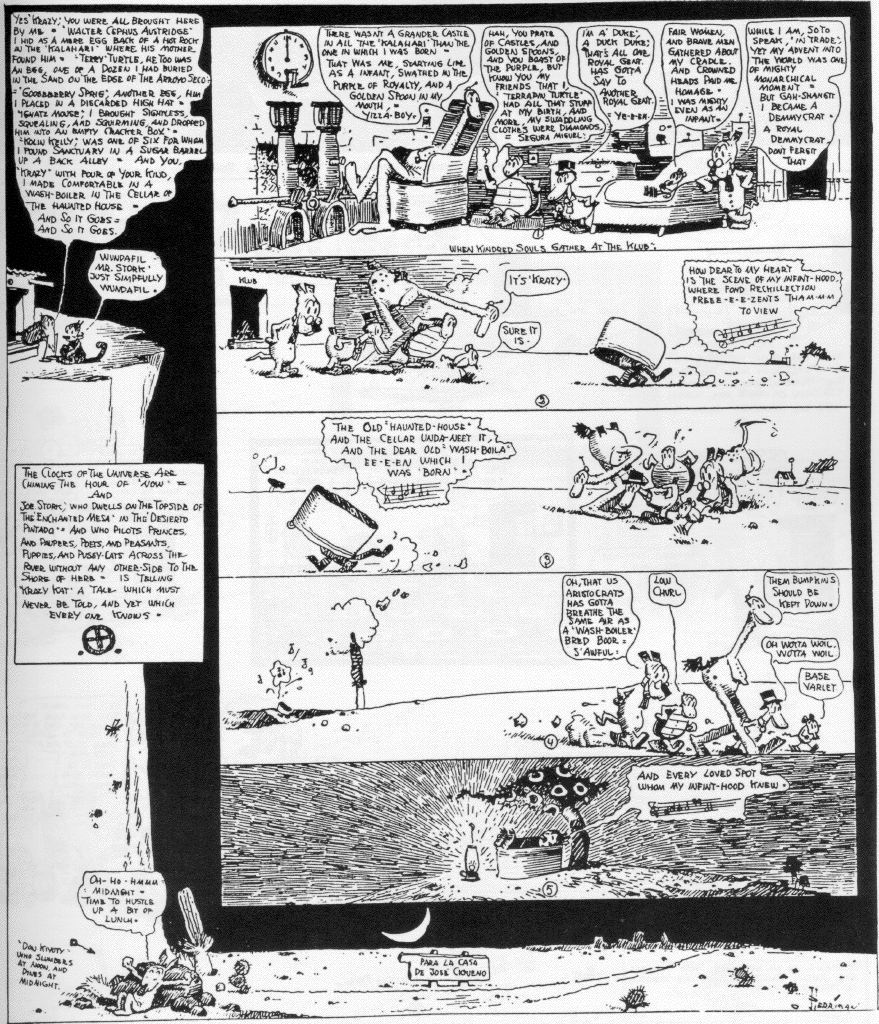
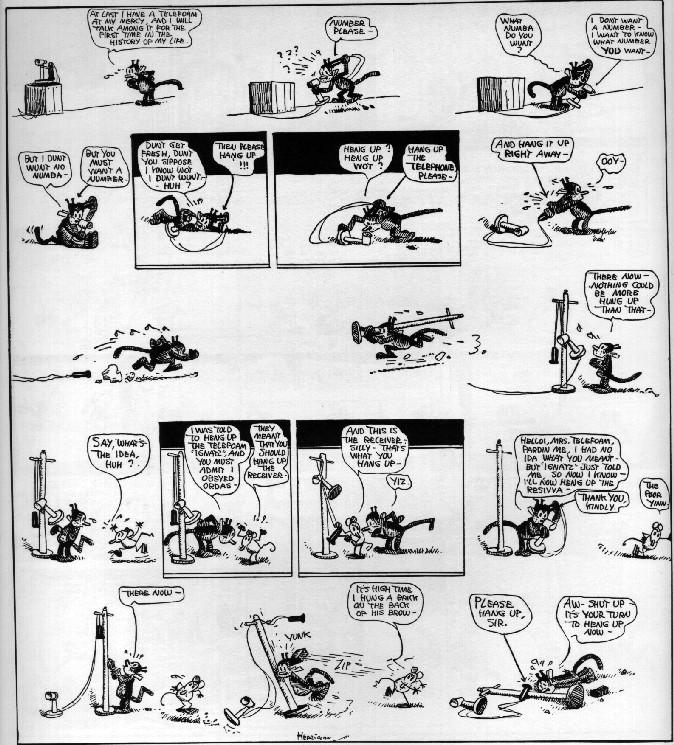
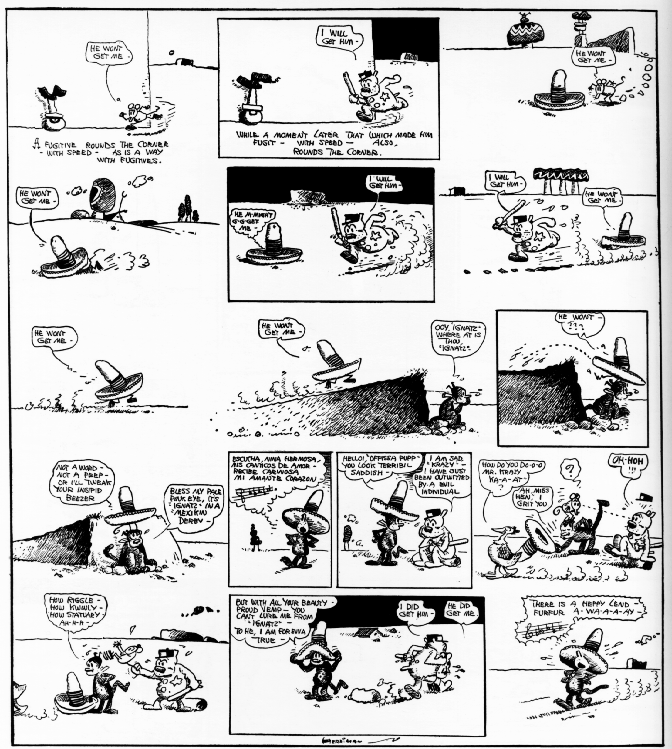
For you Krazy Kat fans out there, a few online files of complete Krazy Kat cartoons at an overly didactic academic site devoted to “comic strip theory.” Skip th’ didacticism and head straight t’ th’ cartoons: “The clocks of the universe are chiming the hour of now…”The telephone comes to Krazy Kat’s house in Coconino CountyKrazy Kat finds himself under a sombrero

And a selection of color and B&W pages at Coconino world (click on “gallery”).

Green Spring

On my afternoon walk today, I decided to head out and cross the harbor via Pope’s Island. Just as I got in sight of the swing bridge, it began to close: the gates came down, and pretty soon the bridge started to turn so some boat could pass. I looked to see what boat it was. It was a fair-sized ship, about a hundred yards long, helped along by a tugboat. I kept walking towards the bridge, until I could read her name in white letters on the green bow: Green Spring, a ship in the Green Reefers line; you could see “Green Reefers” in big white letters on her side, and the rakish “GR” painted on her smokestack. The black and white tugboat accompanying her through the bridge, and tied to her stern, was named Jaguar. Jaguar’s skipper gave two short toots as they went through the bridge.

Once Green Spring got through the bridge, you could see Jaguar’s propellors churning up the water, stopping Green Spring’s forward motion, starting to swing the big ship’s stern over towards the Maritime Terminal dock. Jaguar tooted her whistle now and then; presumably to signal what she was going to do next, though I thought that he two ships must have communicated mostly by radio. Once Green Spring’s forward momentum was stopped, Jaguar untied from her stern and maneuvered over to her starboard side, about a third of the way up from her stern. From there, Jaguar began to nudge Green Spring’s stern around Fish Island and towards Maritime Terminal. Tiny little Jaguar pulled her, nudged her, pushed her gently back, and back, and back. Every now and then you could see the wash from Green Spring’s propellors helping Jaguar pull her backwards towards her berth.

It was more than twenty minutes from the time Green Spring passed through the bridge until she approached the dock; I stood in the sun, watching her slow stately progress over that short distance; watching Jaguar nudge and pull and ease her into her berth. A fellow walked up, unshaven, knapsack on his back, coat open, and stood beside me, also watching. He kept up an intermittent commentary, so softly I had to keep asking him to repeat himself; I think he was talking more to himself than to me. He said something about, what if she broke away and hit the bridge we were standing on? Where we stood was a little lower than Green Spring’s after deck; I had already thought briefly about what would happen if she hit us. “You know it’s gotta happen,” said the unshaven man. He went on to say something about aircraft carriers. “What’s that?” I said. “I don’t know what the Nimitz would be doing here though,” he said.

Another man, walking purposefully, paused a little ways away, watched for a few minutes. The bright late afternoon sun shone down. The longshoremen caught the heaving line, and hauled the first stern rope up onto the wharf. Once it was looped over the massive cleat on the dock, the crew of Green Spring, clad in blaze-orange jumpsuits and white hard hats, turned on the winch and pulled the slack up out of the water. The unshaven man gave up and walked away; I didn’t see the other man leave but after awhile I noticed he was gone; I stayed to watch a little longer.

Jaguar pulled her stern out a little, swinging the bow in. After two abortive tries, the longshoremen threw the heaving line back up to the crew, who sent two more stern ropes to them. Watching this, I missed them getting the first bow line tied off to the dock. By now, I had been standing there for a good forty minutes. The sun was sinking ever lower, the cold was starting to seep in. The crew started to winch the bow in towards the dock. Good: I’d seen enough; as far as I was concerned, Green Spring was safely berthed.

On my way back a half an hour later, I saw that the gangplank ran up to Green Spring’s deck, that no crewmembers stood on her deck any longer. I imagined that one or two of the ship’s officers were up at the U.S. Customs House a block from our apartment, taking care of whatever paperwork had to be taken care of; I imagined most of the crew wandering New Bedford, maybe finding a friendly bar; I imagined one crew member, unlikely as it seems, visiting the Whaling Museum to find out how mariners of the past once fared. Tomorrow, the crew will be back on deck; the semi trucks will be backed up to the loading dock next to the Maritime Terminal building, the crew will be at the ship’s cranes swinging cargo onto the dock, the forklifts driven by longshoremen will be whizzing back and forth, they will be loading the reefer trucks and one by one sending them on their various ways.

For a picture of tugboat Jaguar, visit this tugboat fan page, and scroll down almost to the bottom of the page.