Boxes

We moved into this apartment in late August, 2005 — over fourteen months ago. Last night, I was looking for a potato masher. I know we have one, or at least we had one. Maybe it had gotten lost in one of our many moves over the past few years. Then I remembered that there was at least one box of dishes that we had never unpacked.

I brought it out from the closet where we had unceremoniously dumped it, and began unpacking it. I found Carols’ old “Victory Garden” mug, another mug that says “REDUCE REUSE RECYCLE,” what’s left of the old plates and bowls that my mother made me buy for my first apartment back in 1979 (Carol says they are ugly, which is true, so they got stored in an unused cabinet), half a dozen bowls and plates that came from my grandmother’s house in Staten Island (also stored in that previously unused cabinet), a quiche dish that we never use, two of Carol’s favorite soup bowls, a pretty green plate with a raised floral design that Carol had found at a yard sale years ago, another plate from a yard sale with pink roses twined around the outer edge, the rest of the large white dinner plates.

One of the large white dinner plates, right in the middle of the pile, had shattered. None of the other plates or dishes had been broken, and I am at a loss to explain how that one plate broke while the others remained intact.

I also found some glass mixing bowls deep in the box, and three plastic travel mugs that read “Ferry Beach.” I did not find the potato masher.

Autumn watch

When I sit down at our dining table, I look right out our second floor window into the red leaves on the maple tree across the street. The north side of the maple is already bare. The other trees in the courtyard across the street lost all their leaves a week ago.

The wind is backing around into the north, and as I sit watching the wind slowly strips one red leaf at a time and sends it fluttering up the street. Red leaves dot the wet stone paving blocks in the street below.

The red maple leaves look particularly brilliant, almost glowing, on this dark, grey, wet day. It’s one of the most beautiful times of year.

happy birthday abs

NaNoWriMo, day one

…this is for all you who are doing the same thing…

I logged onto the National Novel Writing Month Web site to update my word count. I thought the connection was going to time out before my user page would load. Obviously, the NaNoWriMo site is seeing a lot of traffic presumably people are madly updating their user profiles or something.

As far as my own writing project (I can’t really call it a novel), it is continuing along nicely in its non-linear way. Current word count stands at 5,245 — which means that I’m a tenth of the way towards my goal, and it’s only the first day of the month. I’ll attribute some of that to my own (non-pathological) hypergraphia. But I attribute more of my progress to using WordPress blogging software as a kind of simple CMS. The chronological ordering of the blogging software allows me to arrange and rearrange chunks of writing, as I figure out the chronology of the writing project. I’m also assigning categories to different chunks of writing based on various topics, and assigning authors based on the principal personality in each chunk of writing.

I’m making this sound hopelessly complex, but it’s really not. It’s as if I’m writing on big index cards which I then file according to chronology; and it’s as if I’m using different color index cards for different topics; and somehow the index cards can also be sorted out according to principal personality (and a few other categories). Or to put it another way, instead of developing an elaborate filing system with character files, scene files, etc., I’m just using blogging software to automate all that. The end result is that it’s easy to make big changes really fast in response to the developing writing — how freeing!

NaNoWriMo starts in 1 hour and 25 minutes

Most of you probably think that what’s most important about October 31 is Hallowe’en. But around the world, thousands of people anxiously await the beginning of National Novel Writing Month, which begins at midnight tonight.

Yes, NaNoWriMo is the month when thousands of would-be authors sit down and churn out pages and pages of fiction. The idea is simple:– for people who have always wanted to write a novel, NaNoWriMo provides a structure for actually sitting down and writing that novel. The would-be novelist gets a deadline (November 30), a minimum number of words to write (50,000), and therefore a daily writing target (1,666 words a day). The point is not to produce a finished novel, but to get through the first draft of the novel.

Not everyone writes a novel, though. Last year, my older sister decided to produce a non-fiction book during NaNoWriMo. She figured non-fiction was harder to write than fiction, so she decided she only needed to write 45,000 words during NaNoWriMo — still enough prose to fill a book.

This year, I’ve decided to take on the NaNoWriMo challenge. I’m not exactly going to be writing a novel (no, I’m not going to tell you about my project here), but I do plan to write 50,000 words in all. I figure I have a one-in-two chance of actually reaching this goal. If things get crazy at work, I won’t be able to reach my goal. And writing 2,000 words a day is a stretch for me — my usual output is 500 words a day. On the other hand, I’ve already got 3,500 words written and November hasn’t even started yet.

Participating in NaNoWriMo is a stupid thing for me to do, really. My life is full enough as it is, I don’t need to write 1,666 words a day. But I’m thinking it’s maybe a kind of spiritual discipline, a kind of self-flagellation for a religious liberal. Or maybe it’s not a spiritual discipline at all, maybe it’s my descent from being blogging-maniakku into becoming a writing-otaku.

Storm warning

The storm warning went up on Friday, a red flag with a centered black square on the flagstaff over the Wharfinger’s Building.

At 3 a.m. Saturday morning, I was awakened by the wind driving rain against the roof and skylight.

David and I could feel the wind blow the car around on the drive out to Barnstable yesterday morning. The afternoon drive back was worse: vicious gusts of wind lashing rain against the windshield. I fought the steering wheel and complained out loud about the idiots who insisted on driving above the speed limit in spite of the weather.

This morning dawned bright and clear. I checked the NOAA website, and read the forecast discussion:

…Strong winds likely to cause damage today. Extremely strong center of sfc lopres located off SWrn Quebec as of 08Z this morning with sfc obs near the center reporting slp of around 969 mb. This will mean a very tight pressure gradient for southern New England today resulting in widespread wind gusts of 50 to 55 mph with locally higher speeds. Expect many reports of downed trees by late this afternoon and many folks without power. Driving will be quite difficult at times.

Carol called, saying she had started to drive back to New Bedford but the wind blew her car half into the other lane on the highway. She’s going to wait until tonight.

The wind stripped leaves off even the sheltered trees on William Street and piled them in an ankle-deep drift on the sidewalk in front of our apartment entrance. Small branches lay here and there on the street.

At church, I asked Ned if his boat were out of the water yet. Yes, he said. And he saw five or six boats blown up on the beach at Padanarum Harbor this morning. The wind kept blowing the inner doors to the church open. Ghosts, just in time for Hallowe’en, said Ned.

On the walk back from Pope’s Island this afternoon, I had to lean into gusts of wind. I watched one or two gulls beating upwind, but most of the gulls had found places to sit.

Forget broadcast TV…

…and check out Chasing Windmills, a Web-based video series. Pretty good concept, decent acting, interesting script (if a little too, shall we say, interior). Personally, I like the surrealism, and the contemporary black-and-white noir filming style. But the reason you should really watch Chasing Windmills is that it’s a whole new way of doing a video series, starting with the fact that it’s a daily video blog. But there’s more….

The second season of Chasing Windmills officially kicked off today. This is the biggest experiment we have taken on so far. We have 8 people who will play characters, and each character has a blog through which the audience can interact…. The audience interacts with the characters through their blogs, and the characters are influenced by the dialogue. Interactivity through influence. [Link]

A couple of warnings: First, remember that these are video files so if you have a dial-up connection, forget it. Second, this series is not for kids, with foul language, sex scenes, etc. (not as bad as The Sopranos though).

District conference

Off to the district conference today, a conference which focused on social justice issues. Vicki Weintein, minister at our Norwell (Mass.) church did a wonderful presentation on integrating social justice into your congregation. Vicki pointed out some things that should be obvious, but that we sometimes forget about (at least that I sometimes forget about). She said that if you want to get people to help you with your social justice project, guilting them into it won’t work as well as “evangelizing” them: telling them how working on your particular social justice project has changed your life, and by the way when you look at someone else you see something in them that is like what’s in you that was transformed by this work. She said that social justice can be fun (radical concept for us New Englanders for whom fun might be an alien concept). And she said that we have to be open to what we are going to get from the people whom we happen to be helping — because social justice is not a one-way process where the priveleged we help out the poor oppressed them, it’s a two-way process where we who do the social justice benefit as well (obviously, there are sometimes some boundaries that come with certain kinds of social justice work, but you get the idea).

On a less serious note — at lunch, I happened to sit beside an old friend, and I began talking about the new YouTube video featuring the bizarre purple alien being who promotes seven cosmic principles, which happen to be just like the seven principles from the Unitarian Universalist Association bylaws (here’s the YouTube link if you haven’t seen it yet). “OK, it’s really stupid, but it’s funny,” I said, “and what I like best is the fact that the bizarre purple space alien is standing in front of this U.S. Pentagon emblem, which is just surreal. It keeps you from taking the video too seriously.”

“Um, well,” said my friend, “I’m actually the guy who made that video.”

“You’re ‘alienhelper,’ the person who created that video?!” I gasped. “Of course, I should have known it was you! So… how did you make it?”

“It was easy,” he said. “One Saturday morning A—- was away, and I had this idea, so I got really wired on coffee and went to work. First I recorded the soundtrack, speeded it up, and raised the pitch. Then I used one of those cheapo $80 Web cams from Logitech. I used Vlogit software to edit the video and add titles. Vlogit has a green screen feature, so I set up some green construction paper, pointed the Web cam at it, and used this little purple alien finger puppet to sort of act out what was on the soundtrack. Then I substituted the Pentagon image for the green screen.”

End result? 200 views in 2 days. The Live Journal UUs picked it up: 2000 views in 13 days. Whoa. This is what we call viral marketing — inexpensive marketing that spreads like a virus.

Cider

Last Thursday, I bought a half gallon of apple cider at the downtown farmer’s market. I made sure it had no preservatives. On Monday, I took it out of the refrigerator, and broke the seal. By this evening, it was foaming nicely, and I just tried a glass: it’s lightly carbonated, tart, and much of the sweetness is gone. It’s still a little too sweet, though, so I’ll leave it out overnight to turn a little more. It is so nicely fermented that I suspect that our kitchen has now become well colonized by yeast that have escaped from our bread-baking.

What better way to celebrate the coming of late fall than by drinking home-fermented cider?

On reading Kenko

The colder autumn weather has finally begun. While I was on spiritual retreat in Wareham early in the week, I managed to take a couple of long walks. My morning walk on Tuesday took me through an old tennis court at the retreat center, now unused except for one small corner where someone has painted a classical, concentric labyrinth. A line of milkweed stalks had managed to grow up through a crack in the pavement during the summer. By the time I walked past them, the stalks were yellowed, and the few leaves that were left were gray, curled, and dead. I find milkweed plants to be most beautiful when they have died from frost:– the curled leaves take on fantastic shapes, the gray pimpled seed pods burst open releasing the seeds with their white downy parachutes that will enable the wind to spread the seeds far afield.

In the middle of the woods — I had gotten off the path chasing some small brown woodland bird — I came across a few ferns that still had a little green. Most of the ferns in the forest had been bitten by frost, curled and brown. Yet in this one clump, presumably more sheltered, I found one frond mostly green, another frond mostly yellow with a touch of faded green, another frond brown at the top and yellow lower down, and the rest of the fronds brown and curled and dead. A month of autumn visible in one clump of ferns.

On my way to Agawam Cemtery, a couple of miles away, I passed a cranberry bog looking reddish purple in the slanting afternoon light. The berries had already been ahrvested, but the bog had a quiet beauty nonetheless.

In 1330 in the Tsurezuregusa, the Japanese writer Kenko said:

Are we to look at cherry blossoms only in full bloom, the moon only when it is cloudless? To long for the moon while looking on the rain, to lower the blinds and be unaware of the passing of the spring — these are even more deeply moving. Branches about to blossom or gardens strewn with faded flowers are worthier of our admiration. Are poems written on such themes as “Going to view the cherry blossoms only to find they had scattered” or “On being prevented from visiting the blossoms” inferior to those on “Seeing the blossoms”? People commonly regret that the cherry blossoms scatter or that the moon sinks in the sky, and this is natural; but only an exceptionally insensitive man would say, “This branch and that branch have lost their blossoms. There is nothing worth seeing now.” In all things, it is the beginnings and ends that are interesting….

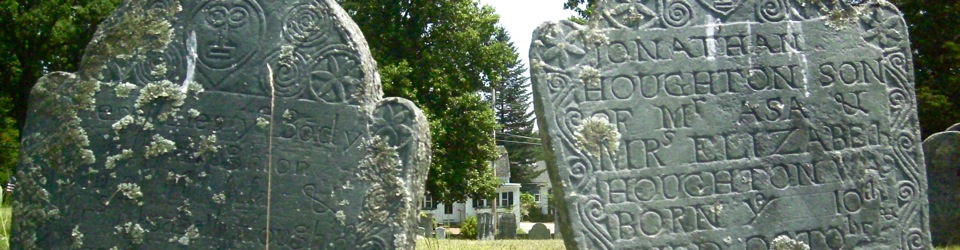
When I got to Agawam Cemetery, I searched out the oldest gravestones. You can tell the general age of New England gravestones from their shapes, and the type of stone from which they are cut. I found twenty or thirty slate stones that clearly dated from the last half of the 18th C., mostly from the Federal era but some earlier. Most of the 18th C. stones in Agawam Cemetery are shallowly carved and covered more or less in lichen, and in most cases the lichens completely obliterate the inscription. The inscriptions half seen, half guessed at and half covered in lichen, are just as fascinating as stones where the entire inscription is visible. On one of the most beautiful stones, the inscription was no longer visible, the inscribed surface was actually flaking away; the beauty lay in its deterioration.

Walking back from the cemetery to the retreat center, I walked through suburban houses on their tight little lots. Since this is a seaside town in which the population explodes in the summer, “No Trespassing” signs appear everywhere. I passed a new house going in, a bulldozer parked beside the house, the entire lot scraped clean, showing the poor, sandy soil. The pine and oak woods that used to cover the land here were cut down for farming, grew back up again when the farms failed, and now the woods are being cut down once again for summer houses and gated communities.

More than one sign at the beginning of a road declared: “Members and Their Guests Only.” If they didn’t have those signs, the pressure from the growing population would mean the property owners would have invaders constantly traipsing through their land, past their summer house, headed for the sea. Can we say that the suburban houses, the gated communities, the signs are any less beautiful than the pine and oak woods they replace? For how long can the houses and signs last — a century or two, at most, before they fall into rack and ruin and something else replaces them. Although with global warming, what may well replace these houses is the open ocean, raging under the influence of huge coastal storms. Kenko never anticipated global warming completely changing the normal cycle of the seasons, nor did he ever anticipate that cherry blossoms might stop blooming entirely in their ancestral range.