Category: Religion in society

  • Roll Down like Waters

    Sermon copyright (c) 2024 Dan Harper. As delivered to First Parish in Cohasset. As usual, the sermon as delivered contained substantial improvisation.

    Readings

    The first reading was a poem by Clint Smith, “For Your First Birthday.”

    The second reading was from the Hebrew Bible, the book of Amos, chapter 5, verses 21 through 24.

    I hate, I despise your festivals, and I take no delight in your solemn assemblies. Even though you offer me your burnt offerings and grain offerings, I will not accept them; and the offerings of well-being of your fatted animals I will not look upon. Take away from me the noise of your songs; I will not listen to the melody of your harps. But let justice roll down like waters, and righteousness like an everflowing stream.

    Sermon: “Roll Down Like Waters”

    The birthday of Rev. Dr. Martin Luther King, Jr., is a time for everyone in the United States to refer back to his writings and speeches and reinterpret them once again. We do this every year, and by this point in the history of the United States, it can seem like there’s nothing left to say. Maybe we should just skip it this year. The thing is, preachers love to quote Dr. King, because he was such a good writer — such a good stylist — and there’s something incredibly satisfying about saying aloud his words. Being a preacher myself, there’s no way I’m going to pass up this opportunity to read aloud something written by Dr. King. So, like it or not, you’re going to get yet another sermon about Dr. King and his legacy — even if I have nothing original to say.

    Yet people continue to find novel and interesting ways to interpret King’s thinking. For example, King famously said that he wanted his children to live in a land where “they will not be judged by the color of their skin but by the content of their character.” Recently, this quote has been used by some conservative politicians and pundits to help bolster the claim that we should not teach critical race theory or the history of racism in our schools. This is certainly a creative use of King’s words, but it’s probably not what he intended.

    On the other side of the political spectrum, liberal politicians take pleasure in invoking King’s words, but they tend to do so selectively. For example, they pass lightly over King’s pointed critique of capitalism, as when he said: “We have deluded ourselves into believing the myth that Capitalism grew and prospered out of the Protestant ethic of hard work and sacrifice. The fact is that capitalism was built on the exploitation and suffering of black slaves and continues to thrive on the exploitation of the poor — both black and white, both here and abroad.” [The Three Evils of Society, 1967] In today’s society, it would be political suicide to criticize capitalism quite so openly. And so political liberals creatively interpret King by leaving out some important parts of his message.

    And I think something we all tend to forget these days is that King was a progressive Christian minister. Today, Christianity’s reputation has suffered as a result of the clergy abuse scandal, the hypocrisy of Christians who demonize LGBTQ people, the refusal of the largest Christian denominations to allow women clergy, and for many other reasons. We live in a time when progressive Christians feel the need to apologize for being Christian. As a result, I think many of us, including Unitarian Universalists, either try to apologize for King’s progressive Christianity, or try to ignore King’s supposedly outdated religious convictions.

    It’s a mistake to dismiss his religious convictions so readily. King was a serious intellectual, earning his doctorate degree from Boston University in systematic theology with a dissertation titled “A Comparison of the Conceptions of God in the Thinking of Paul Tillich and Henry Nelson Wieman.” (Weiman, by the way, was a very progressive Christian theologian who late in life joined a Unitarian church.) With his progressive Christianity in mind, let’s look at one Bible passage that King repeatedly invoked. This was the passage we heard in the second reading today, from the Hebrew Bible, the book of Amos, chapter 5, verses 21 through 24.

    The words we ehard are not the words of the human prophet. Amos was giving the actual words of his god, whom Amos knew as Yahweh. And Yahweh is not happy with humankind. God tells humankind that they have strayed from God’s core ethical and moral teachings. In particular, God calls out the privileged people who rule over the country where Amos lived. God tells the privileged people that they “trample on the poor” and “afflict the righteous,” that they take bribes and “push aside the needy.”

    Amos was probably a real person. At the time he lived, the historic land of Israel was split into two countries, the northern kingdom and the southern kingdom. In those days, there was no distinction between politics and religion, for that distinction only dates back to the European Enlightenment. So the power of King Jeroboam II and the power of the official cult of Yahweh were the same thing. Thus, by repeating the words of his god, the prophet Amos was taking on the entire establishment. Amos’s prophecy makes clear that the king’s rule was against the will of God. The cultic leaders wrongly interpreted the will of God — so says Amos.

    This helps us understand why Amos reports God as saying, “I hate, I despise your festivals, and I take no delight in your solemn assemblies.” God is telling the humans in charge of the northern kingdom that they were doing things that were completely against the will of God; no amount of festivals or church services or solemn assemblies on the part of the humans could make God ignore what they were doing wrong. As to what they were doing wrong, the Biblical scholar Norman Gottwald sums it up like this:

    Amos was attacking “the patriotic and pious … reaction that had gained currency among the upper classes during the prosperous reign of Jeroboam II. The greedy upper classes, with governmental and judicial connivance, were systematically expropriating the land of commoners so that they could heap up wealth and display it gaudily in a lavish conspicuous consumption economy.” [The Hebrew Bible: A Socio-Literary Introduction, Gottwald, 1985]

    Knowing this, we can better understand how King might find the book of Amos attractive. From the perspective of Black Americans in the mid-twentieth century, the American establishment had kept Blacks in low-paying jobs that supported the increasingly comfortable lives of the elite, all of whom were then White. And just like the greedy upper classes used their religion to maintain their position during the reign of King Jeroboam II, the elite White rulers of mid-twentieth century America used their interpretation of the Christian religion to maintain the status quo that benefited them.

    If you remember King’s famous “Letter from Birmingham Jail,” he was responding to well-to-do ministers who were part of the White establishment of Birmingham, Alabama. These White ministers criticized the Civil Rights Movement in a public statement in which they called King and his allies “extremists.” King responded directly to this criticism by telling these Christian ministers: “Was not Amos an extremist for justice: ‘Let justice roll down like waters and righteousness like an everflowing stream.’” Later on in that same letter, King told these White ministers:

    “So the question is not whether we will be extremists but what kind of extremists we will be. Will we be extremists for hate or for love? Will we be extremists for the preservation of injustice or for the extension of justice? Perhaps the south, the nation and the world are in dire need of creative extremists.”

    This helps us understand why King quoted Amos so often. No doubt in the days of King Jeroboam II, the greedy upper classes called the prophet Amos an extremist. In much the same way, King was called an extremist in his day. Both of them said things that were uncomfortable to hear. And that discomfort was intended to provoke people to take action. I would go so far as to say that if we don’t feel uncomfortable when we hear King’s words, we’re not paying attention.

    But sometimes King translated the passage from Amos differently than the version we so love to quote. The Hebrew word “mishpat,” usually translated as “justice,” can also be translated as “judgement.” So in his essay “Paul’s Letter to American Christians,” King wrote: “Yes America, there is still the need for an Amos to cry out to the nation: ‘Let judgement roll down as waters, and righteousness as a mighty stream.’”

    This translation, while equally valid, sounds more challenging. “Let judgement roll down” — in fact, this almost sounds threatening, and it may better translate the sense of the original. The prophet Amos was telling the people of his day that their God would judge their actions. Amos saw himself as spreading the words of Yahweh, and Yahweh was telling the people in power that they must stop supporting injustice. The purpose of the book of Amos is for the rich and powerful to realize that, despite the stories they liked to tell themselves, all was not well in their land.

    Martin Luther King spread a similar message to America in the 1950s and 1960s. While the American economy was booming in those years, Black Americans were mostly excluded from prosperity. In response, King preached the message that his God wanted all persons to be treated with love and dignity; and while King was most focused on how America treated Black Americans, his message included persons of all races who were treated unfairly. King preached the uncomfortable message that if some people were excluded from prosperity, then his God would let judgement roll down like waters.

    In our own time, Black Americans still face job discrimination, and people of all races face increasing economic inequality. This can seem overwhelming. Yes, we have made progress since King’s day, but so much remains to be done before we have true equality in America. But I will leave you with the thought that King’s message was ultimately a hopeful message. Speaking at the National Cathedral in March, 1968, King said, “We shall overcome because the arc of the moral universe is long but it bends toward justice.” When King said this, he was paraphrasing the great abolitionist and Unitarian minister, Theodore Parker. Back in 1853, Parker preached a sermon in Boston where he said: “I do not pretend to understand the moral universe. The arc is a long one. My eye reaches but little ways. I cannot calculate the curve and complete the figure by experience of sight. I can divine it by conscience. And from what I see I am sure it bends toward justice.”

    No wonder Martin Luther King paraphrased this passage from Theodore Parker so frequently. I understand this as a message of hope. When Theodore Parker preached this sermon, slavery was the law of the land, and it seemed impossible that America would ever put an end to it. A century later, Martin Luther King paraphrased Parker’s words, and Jim Crow was the law of the land, and it seemed impossible that America would ever put an end to it. Yet we did put an end to slavery, and we did put an end to Jim Crow, and we can and will put an end to the other injustices that still confront us.

    The arc of the moral universe may be long, and from where we stand today we do not see where it finally comes to rest. Yet we know deep within ourselves that we are moving towards justice — slowly, perhaps, but inexorably. We have not yet overcome injustice. But some day, sooner rather than later, we shall overcome injustice and build a land where we let justice roll down like waters, and peace like an everflowing stream.
  • What about land acknowledgements?

    Sermon copyright (c) 2023 Dan Harper. As delivered to First Parish in Cohasset. As usual, the sermon as delivered contained substantial improvisation.

    Reading

    The reading this morning is a poem by Lucille Lang Day. The poet says her “mother, who was one-quarter Wampanoag, was raised from age seven by a couple who taught her that Native American ancestry was something to hide.” The poem tells a little bit about how she found out about this family story that had been intentionally suppressed.

    “I Always Knew It” — link to the full poem

    Sermon — “What about Land Acknowledgements?”

    I’d like to talk with you this morning about land acknowledgements. A land acknowledgement is one of those statements, which are now commonly given at the beginning of events, or which appear on websites of organizations, that go something like this: “We acknowledge we gather on land that is the traditional and ancestral homeland of the so-and-so people.” Sometimes these land acknowledgements consist of just a bare statement that Native Americans once lived wherever you are. But the more interesting land acknowledgements include some of the history of the Native Americans in question.

    At this point, I could go into the ethical, moral, and political arguments for and against land acknowledgements — and there is real debate about their value. (1) Yet while these ethical, moral, and political arguments about land acknowledgements might be fascinating to some, I’d rather start with the stories of some of the individual Native Americans we’re thinking about acknowledging. So I’d like to tell you some stories about Native Americans from Cohasset.

    (A word about terminology: Since we’ll be talking about the time before the United States of America was a country, it’s anachronistic to refer to “Native Americans,” because there was no country called America. Since the Native American groups that currently exist in our area often refer to themselves as “Indians,” I’ll use the term “Indian.”)


    Our story begins in the early seventeenth century as Europeans first began to make contact with the Indians who lived in coastal Massachusetts. Some time in the years 1616 to 1619, a contagious disease wept through the Indians who lived here on the South Shore. Scholars continue to debate about what, exactly, the disease was. It could have been smallpox, measles, or some other highly contagious disease from Europe for which the Indians had no immunity. (2) A huge percentage of the coastal Indians of Massachusetts died — no less than four out of five Indians died, and in places as many as 19 out of 20 died.

    Because so many of their people died, the Indians living along the coast found themselves vulnerable to attack by their traditional enemies from further inland. This helps explain why, in 1620, the Wampanoag Indians in the Plymouth area were keenly interested in allying themselves with the Pilgrims. That military alliance lasted for about fifty years, until King Phillip’s War in 1675. After that war, Indian military power in southeastern New England was essentially broken. The Indians who remained here had to figure out to adapt to European social norms.

    By 1640, there were about 300 Europeans living in Cohasset — then called the Second Precinct of Hingham. (3) The history of Cohasset in the eighteenth century tends to focus on those Europeans. But Indians also continued to live here, and I’d like to tell you about three of them.


    Mary Judah

    First, I’d like to talk about Mary Judah.

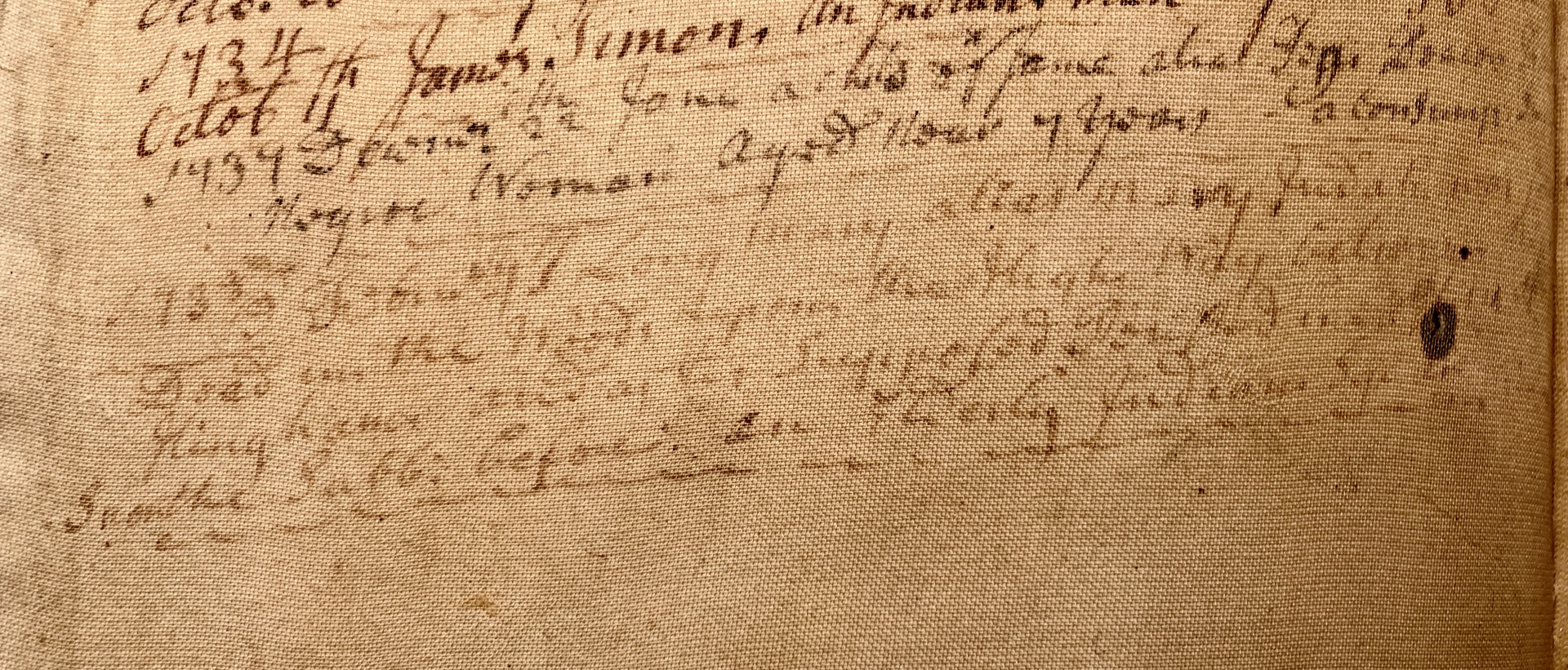
    Our church was formally organized in 1721, and the first minister’s record book contains a sad entry for Mary Judah from which we can reconstruct a bit of her life: “Feb. 1, 1739 [New Style]. Long Mary, alias Mary Judah, was found Dead in the woods upon the High Way between this & Hingham and as tis supposed Perished in a storm of cold & snow the Sabb[ath] before. An elderly Indian [woman].” (4)

    February 1, 1739, was a Sunday, meaning Mary Judah’s body wasn’t found for a whole week. If she had been enslaved, surely her enslavers would have noticed, and gone to search for her. Or if she had lived with someone else, again they would have noticed. So it seems she was an elderly woman living entirely alone. Since she was older, Mary Judah would have been born in the mid-seventeenth century, a time when the Indians of Cohasset were still living in the traditional way. Most likely, Mary Judah was keeping to the old Indian ways as best she could. As a result she wound up living on the margins of European society, both economically and politically — eking out a subsistence existence in the face of encroaching European agriculture, with essentially no political rights, though at least she was not enslaved.

    Photo of an old handwritten record book.
    Minister’s record of Mary Judah’s death. Image copyright (c) 2024 First Parish in Cohasset, used by permission; all rights reserved.

    Sarah Wapping

    The second person I’d like to talk about is Sarah Wapping.

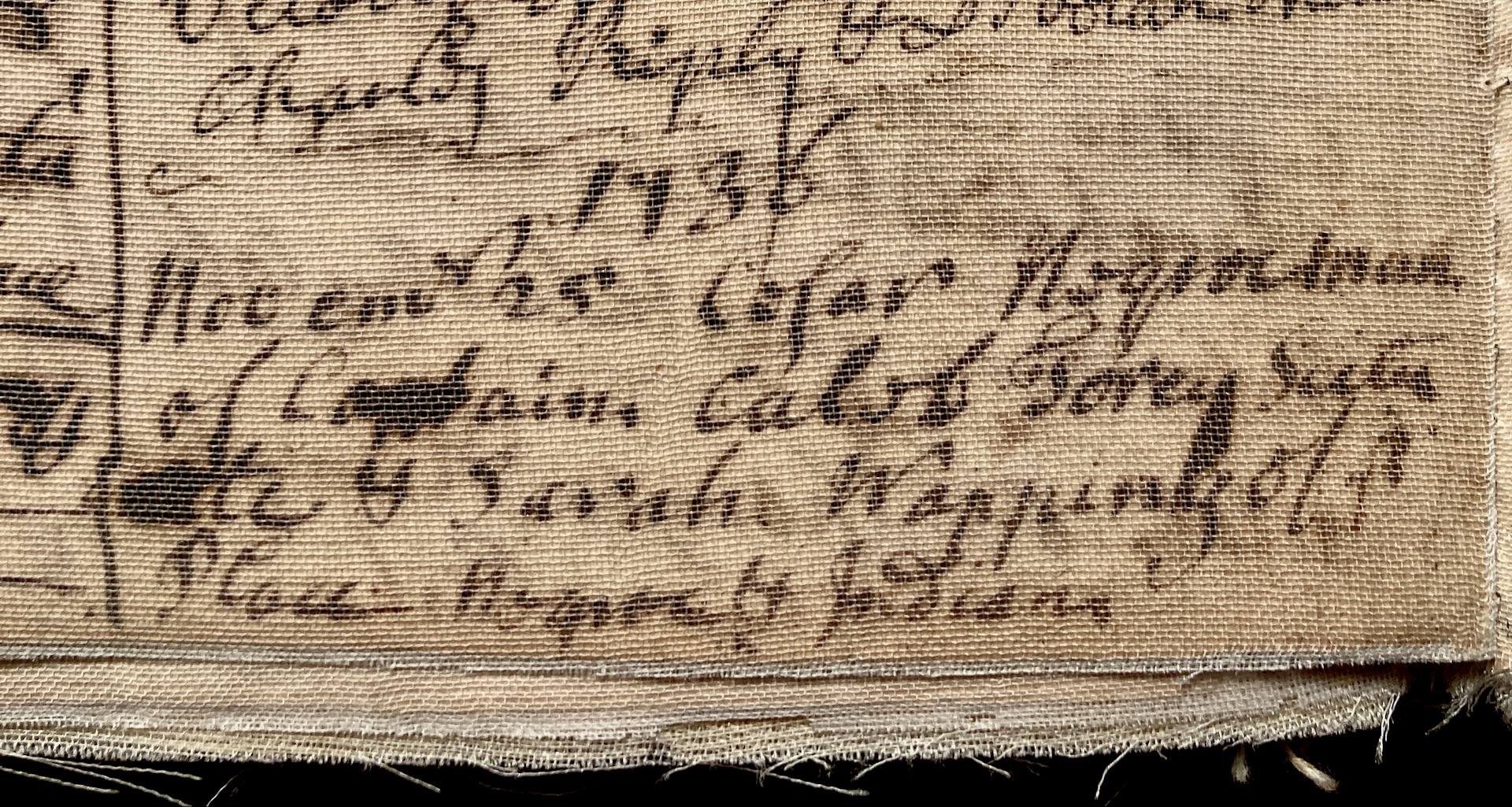
    On November 25, 1736, the minister of our church wrote in his record book that he officiated at the marriage of Sarah Wapping, an Indian from Cohasset, and “Cesar,” a man of African descent (who, according to the custom of the time, was allowed no last name). Cesar was enslaved by Captain Caleb Torrey of Scituate, and his and Sarah’s marriage intention was recorded in the Scituate town records. (5) We can assume that Sarah was either enslaved, or functionally became enslaved upon her marriage.

    After her marriage, Sarah attended services at our church here in Cohasset; we can assume that she went to live with Cesar and his enslaver, but for some reason Sarah was willing to walk several miles to the Cohasset church each Sunday. Sometime in 1736, she decided to join our church. Remember that in 1736, this congregation was one of the established Christian churches of Massachusetts Bay Colony; we became Unitarian a century later, but back then we were a liberal Christian church.

    There are many reasons why Sarah Wapping, an Indian living in Cohasset, might decide to become a Christian, that is, become a member of one of the established churches of Massachusetts Bay Colony. First and perhaps most obviously, Sarah Wapping probably felt genuine sympathy with the Christian ideals of the church. Beyond that, she may have been attracted to our church’s eighteenth century covenant. In that old covenant, church members promised to one another “that with all tenderness & Brotherly Love we will with all faithfulness watch over one anothers Soul.” To someone who was enslaved, perhaps that covenant offered a recognition of their essential humanity, or as we’d say today, their inherent worthiness and dignity.

    More pragmatically, becoming a member of the church may have been a smart move for Sarah Wapping, in that it helped to raise her social status in the community. Many people in those days were reluctant to become members of the church, because they would be held to a higher standard of moral behavior; men, in particular, were likely to put off becoming church members until they knew they were dying, at which time they didn’t have much opportunity to engage in sinful behavior. Thus if you became a member of the church, you entered a morally elite group, which gave you a certain social status.

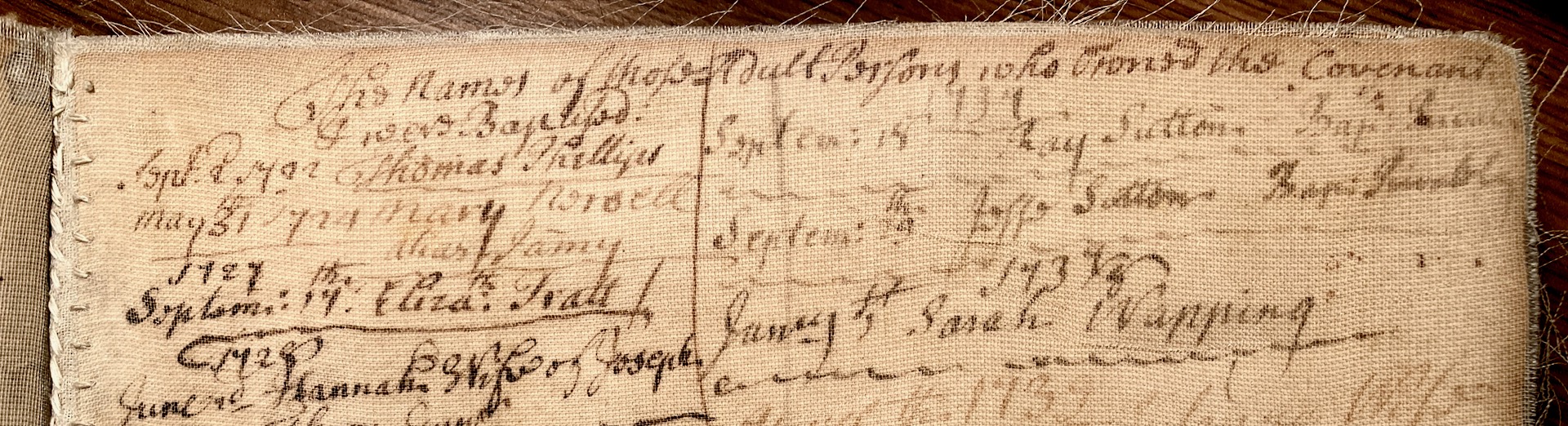
    Sarah Wapping was baptized and formally joined the church on January 7, 1738 (N.S.) — 296 years ago today. The fact that Sarah Wapping had to be baptized before joining the church tells us that she probably didn’t come from a Christian family; otherwise she would have been baptized as a child. So it seems likely that she was raised in a traditional Indian family.

    In the months before January 7, Sarah would have met with the minister at least once — probably more than once — as part of her preparation for baptism and full church membership. On January 7, she would have been required to stand up before the rest of the church and give a public statement of her moral failings. This would have happened in the old meetinghouse, which stood south of here on Cohasset Common, across from the present Parish House.

    That’s all I was able to find out about Sarah Wapping. After this event, she apparently disappears from the historical record. But we can speculate that she probably had children. Her children would have been born into slavery, and they were might have been considered black, while also maintaining their connection with the Indian communities in southeastern Massachusetts. Sarah’s children, or at least her grandchildren, would live to see slavery abolished in Massachusetts in the late eighteenth century. It is entirely likely that at least some of her descendants live in southeastern Massachusetts to this day.

    Photo of a part of a handwritten document.
    Minister’s record of “The Names of Those Adult Persons who Owned the Covenant” — Sarah Wapping’s name is at lower right. Image copyright (c) 2024 First Parish in Cohasset, used by permission; all rights reserved.
    Photo of part of a handwritten document.
    Minister’s record of Sarah Wapping’s marriage. Image copyright (c) 2024 First Parish in Cohasset, used by permission; all rights reserved.
    Part of a microfilmed handwritten document.
    Digitized copy of the marriage records of the Town of Scituate, with Sarah Wapping’s marriage intention.

    Naomi Isaac

    The third person I’ll tell you about is Naomi Isaac.

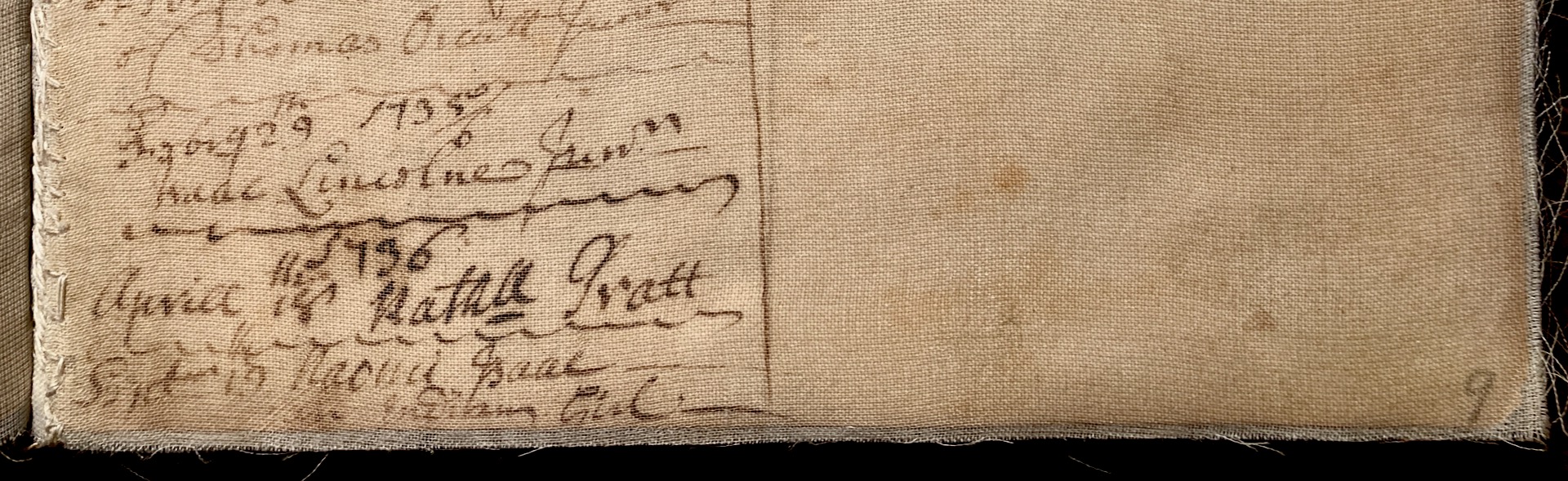
    On September 19, 1736, Naomi Isaac, another enslaved Indian, became a member of our church. I was able to find out a bit more about Naomi Isaac, and based on some admittedly slender historical evidence, I’ve pieced together a hypothetical life story for her.

    Naomi Isaac became a church member about the same time Sarah Wapping got married; the two women would have been rough contemporaries. When Naomi joined the church, the minister’s record book refers to her as “an Indian girl.” If we guess that she was roughly eighteen years old, she might have been born somewhere between 1716 and 1720. Since she did not need to get baptized before she joined the church, it seems probably that she came from a family of Christian Indians.

    Assuming she had been raised as a Christian, her decision to join our church was not as big a step as it was for Sarah Wapping. Naomi Isaac must have liked the religion in which she had been raised, and wanted to commit more deeply to it. Then too, like Sarah Wapping after her, Naomi Isaac might have been attracted to our congregation by the wording of the covenant. She may also have desired the increase in social standing church membership would bring.

    As did every church member, Naomi Isaac would stood in front of the hundred or more people who came to services each Sunday and confess her moral failings. Again, this was in the old meetinghouse. At about 25 by 35 feet, that first meetinghouse was smaller than our present meetinghouse, and more intimate. I like to think that Naomi Isaac served as an inspiration for Sarah Wapping. We can imagine that Sarah Wapping was in the congregation that day, looking down from the balcony where enslaved people and Indians had to sit (but no more than twenty feet away from the pulpit), watching as the young Naomi Isaac become the center of attention of the entire church.

    On February 7, 1737, four and a half months after Naomi Isaac joined our church, someone named Naomi Isaac got married to a man named Caesar Ferrit in Dorchester. I could not confirm that this is the same Naomi Isaac. In fact, in the mid-nineteenth century, there was a romantic story told of how Naomi was the ward of a rich man in Boston who had arranged a wealthy marriage for her, but she chose instead to marry Caesar Ferrit, the coachman for the rich man; and some have interpreted this to mean that this second Naomi Isaac was White. (6)

    I think there may be a tiny nugget of truth in that romantic story, some of which got covered over by later romance. Naomi Isaac of Cohasset was either enslaved or an indentured servant. I speculate that her master moved to Boston, taking her with him. Then she decided to marry Caesar Ferrit against the wishes of her master. I like to think my speculation is correct, because it shows both Caesar and Naomi to be resourceful and forceful people. I also imagine that Caesar managed to purchase Naomi’s freedom, for she was able to leave her master and go with him. While I believe my interpretation fits the historical evidence, I cannot say with complete certainty that Naomi Isaac of Cohasset is the same woman as Naomi Isaac who got married in Dorchester — yet I think later events in Naomi’s life bear out my interpretation.

    After Naomi Isaac and Caesar Ferrit married, they lived in Milton, where their first children were born. Around 1750, they moved to Natick, where their youngest children were born. The town of Natick had been founded for the so-called “praying Indians,” that is, Indians who had become Christian. While Natick was intended to be an Indian town, in practice other non-White people wound up living there too — people like Caesar, Naomi’s mixed-race husband. But Caesar could also claim Indian ancestry. Although he had been born in the West Indies and came to Massachusetts later on, he said that he had two European grandparents — one Dutch, one French,— an African grandparent, and an Indian grandparent. (7)

    Naomi Isaac Ferrit appears in the written record eight times — first when she joined our church, next when she got married, and then in the birth records for six of the seven or so children she had. After the birth of her children, she disappears from the historical record. But let’s assume that she lived until April 19, 1775. In the early morning of that historic day, she would have helped her husband Caesar, then aged 55, get ready to respond to the alarm that the British regulars were on the move. She would have watched as Caesar, and their youngest son John, marched down the road towards Lexington with the rest of the Natick militia company.

    Caesar, John, and the rest of their company arrived in Lexington not long before British regular troops returned through the town on their retreat from Concord. The two Ferrits took cover in a house near the meetinghouse on Lexington Green, and from its cover fired upon His Majesty’s troops. The regulars searched the house to find those two snipers, and the Ferrits hid under the stairs in the cellar to avoid capture. In short, Naomi’s husband, and her child John, were two of the hallowed veterans of the Battle of Concord and Lexington, engaging in an act of bravery at great risk to their lives.

    Caesar Ferrit proved to be quite a Patriot. Although many veterans of the Battle of Concord and Lexington went back to their farms, in late April Caesar enlisted for a tour of duty in the Massachusetts army. Then later in the war, he enlisted once again. His military service was remembered for the rest of his life. In 1796, three years before his death, the town of Natick petitioned the state for a pension for him. (8)

    One of Naomi’s sons-in-law, Thomas Nichols, had a very different experience on April 19, 1775. Thomas was a free Black man who married Patience Ferrit, Naomi and Caesar’s second daughter. On April 19, 1775, Thomas was being held in the town jail in Concord, having been accused of “enticing” enslaved persons “to desert the service of their masters.” While his father-in-law and brother-in-law were firing at the British troops on Lexington Green, he witnessed the events of April 19 from the Concord jail. After being held for three months, the authorities found that there was no evidence to support the accusations against Thomas, so he was sent back to Natick. (9) The story of Naomi’s son-in-law shows how the Indian communities and the Black communities of Massachusetts became intertwined. And I wonder if Thomas really was helping other Black people liberate themselves, and managed to get away with it — if he was one of the early precursors to the conductors of the Underground Railroad. I like to imagine that he was.

    That’s all I was able to find out about Naomi Isaac. After the birth of her children, she apparently disappears from the historical record. Yet her legacy may live on in a very literal way. In our own time, descendants of the Natick Indians gather each year for the Natick Praying Indians Powwow, held on the last weekend of September. I like to think that some of Naomi Isaac’s descendants are among them.

    Photo of part of a handwritten document.
    Minister’s record of “The Names of Those Adult Persons who Owned the Covenant” — Naomi Isaac’s name is at bottom left. Image copyright (c) 2024 First Parish in Cohasset, used by permission; all rights reserved.

    This brings us back to the topic of land acknowledgements.

    I’ve spun out some stories for you about what might have happened to some specific individuals who were Cohasset Indians. I readily admit that my stories are partly speculative. Nonetheless, I believe there’s some truth in the stories I’ve just told. If we were to decide to offer a land acknowledgement, we might want to acknowledge the three women I’ve talked about this morning. And I’ll end this sermon with one of many possible land acknowledgements for our congregation:

    “We gather on land that is the traditional and ancestral homeland of Mary Judah, Sarah Wapping, Naomi Isaac, and other Indians of Cohasset. We think it’s likely at least some descendants of Sarah Wapping and Naomi Isaac, former members of our congregation, are still alive today. We acknowledge the many contributions these women and their descendants have made to our society, including their children’s service in the Revolutionary War. And we wonder how we can ever repay them.”

    Notes

    (1) According to “So you began your event with an Indigenous land acknowledgment. Now what?” reported by Chloe Veltman on National Public Radio, All Things Considered, March 15, 2023
    [https://www.npr.org/2023/03/15/1160204144/indigenous-land-acknowledgments] — some Native American leaders believe land acknowledgements are a waste of time, while others believe they are useful. It’s a complicated issue!

    (2) The debate is very much alive among epidemiologists. E.g., in 2010, a new possibility was outlined by John S. MarrComments and John T. Cathey, in “New Hypothesis for Cause of Epidemic among Native Americans, New England, 1616–1619” (Emerging Infectious Diseases, vol. 16 no. 2, Feb. 2010 https://wwwnc.cdc.gov/eid/article/16/2/09-0276_article). The authors of this study say: “Classic explanations have included yellow fever, smallpox, and plague. Chickenpox and trichinosis are among more recent proposals. We suggest an additional candidate: leptospirosis complicated by Weil syndrome.”

    (3) Bigelow, Narrative History of Cohasset, p. 106.

    (4) Woody Chittick, “Slavery in early Cohasset,” n.d.

    (5) Information from Family Search website.

    (6) The romantic story is in the Natick Bulletin, “Local Centennial Events,” June 18, 1875; quoted by George Quintal, Patriots of Color (Boston Nat. Hist. Park, 2004), p. 102.

    William Biglow, History of the Town of Natick, Mass. (1830) says this about Cesar Ferrit and his wife:

    “April 19th. — On this memorable morning, as one of the survivors lately expressed it, every man was a minute man. The alarm was given early, and all marched full of spirit and energy to meet the British. But few had an opportunity to attack them. Caesar Ferrit and his son John arrived at a house near Lexington meeting house, but a short time before the British soldiers reached that place, on their retreat from Concord. These two discharged their muskets upon the regulars from the entry, and secreted themselves under the cellar stairs, till the enemy had passed by, though a considerable number of them entered the house and made diligent search for their annoyers.

    “This Caesar was a great natural curiosity. He was born on one of the West India islands, and was accustomed to boast, that the blood of four nations run in his veins; for one of his Grandfathers was a Dutchman, the other a Frenchman; and one of his grandmothers an Indian, and the other an African. He married a white New England woman, and they had several children, in whose veins, if Cæsar’s account of himself be true, flowed the blood of five nations. His son John served through the revolutionary war, and is now a pensioner.”

    While this story seems to argue against Naomi Isaac Ferrit being the same as Naomi Isaac of Cohasset, its claims must be weighed against its late date, nearly a century after Naomi would have left Cohasset. Biglow gives no source for this anecdotal evidence, but if this story were told to him by Naomi’s descendants it could well have been to their advantage to have their mother posthumously “pass” as White; many people in Massachusetts considered it shameful to have Indian ancestry, and persons with Indian ancestry were regularly discriminated against, right up through the twentieth century. (Note, too, that Caesar’s wife’s is not named in this account.) For all these reasons, I’m inclined to place little trust in Biglow’s account.

    Also, I was unable to find anyone named Naomi Isaac anywhere in Massachusetts in the usual genealogical records, for this time period. This proves nothing in of itself, but is worth considering when evaluating other evidence.

    (7) J. L. Bell, “Thomas Nichols of Natick,” Boston 1775 blog, April 28, 2016. (https://boston1775.blogspot.com/2016/04/thomas-nichols-of-natick.html). See also the previous footnote.

    (8) J. L. Bell, “The Service of Caesar Ferrit,” Boston 1775 blog, April 30, 2016. (https://boston1775.blogspot.com/2016/04/the-service-of-caesar-ferrit.html).

    See also: entry on Caesar Ferrit in George Quintal, Patriots of Color (Boston Nat. Hist. Park, 2004), pp. 102 ff.; and entry on Caesar Ferrit, Massachusetts Soldiers and Sailors of the Revolutionary War: A Compilation from the Archives, Volume 5, Commonwealth of Massachusetts, Office of the Secretary of State, 1899, p. 632.

    (9) J. L. Bell, “Reviewing Thomas Nichols’s Case,” Boston 1775 blog, April 29, 2016. (https://boston1775.blogspot.com/2016/04/reviewing-thomas-nicholss-case.html)

    More resources on land acknowledgements

    “Beyond Land Acknowledgements: A Guide,” Native Governance Center website

    One current organization of Native Americans in our area which may include descendants of Sarah Wapping and Naomi Isaac: Praying Indians of Natick and Ponkapoag

    The Massachusett Tribe at Ponkapoag lists last names of tribal members in the 1800s. None of the last names mentioned in the sermon — Wapping, Isaac, Ferrit, or Nichols — appear on their list. However, the time frame they’re looking at is one or more generations later, and thus might include descendants of the people I mention.

    Other Native American groups in our area include the Cothutikut Mattakeeset Massachusetts Tribe, with ancestral lands in Bridgewater

    The indigenous people in Cohasset were most likely part of the Massachusetts people, not the Wampanoag people. There are several well-known Wampanoag groups in southeastern Massachusetts. Descendants of Cohasset Indians might have joined one or more of these Wampanoag groups, through marriage or in other ways.

  • Is It Religion? (part four) — Christmas

    Sermon copyright (c) 2023 Dan Harper. As delivered to First Parish in Cohasset. As usual, the sermon as delivered contained substantial improvisation.

    Readings

    The first reading is titled “Jingle Coins.” It’s a parody of “Jingle Bells” which Dan learned from the San Francisco Rocking Solidarity Labor Chorus:

    Dashing through the mall, I’m spending all the way,
    I’ve got to buy more gifts, it’s almost Christmas day!
    And then I go online and buy more useless stuff;
    I have no self-esteem which means I’ll never buy enough.

    Jingle coins, jingle coins, credit cards from banks,
    Retailers are in the black, and so we all give thanks;
    Jingle coins, jingle coins, money in their tills,
    Oh, what fun it is to shop, and to call it all good will!

    The junk I buy all comes from China and Hong Kong,
    Where there’s no overtime, workdays are twelve hours long;
    They get so little pay they almost work for free,
    So I can buy cheap ornaments to dangle from my tree.

    And when I get the bill, I’ll find out what I spent,
    Twelve thousand seven hundred bucks and fifty-seven cents.
    Who cares if I’m in debt, it doesn’t bother me,
    As long as I’ve got heaps of junk to stash under the tree.

    The second reading comes from the Christian scriptures, the Gospel according to Luke, chapter 18. This translation is by Robert W. Funk, Roy W. Hoover, and the Jesus Seminar.

    Someone from the ruling class asked Jesus, “Good teacher, what do I have to do to inherit eternal life?”

    Jesus said to him, “Why do you call me good? No one is good except God alone. You know the commandments: ‘You are not to commit adultery; you must not murder, or steal, and you are not to give false testimony; you are to honor your father and mother.’”

    And [the man] said, “I have observed these since I was a child.”

    When Jesus heard this, he said, “You are still short one thing. Sell everything you have and distribute the proceeds among the poor, and you will heave treasure in heaven. And then come, follow me.”

    But when [the man] heard this, he became very sad, for he was extremely rich.

    When Jesus observed that he had become sad, he said, “How difficult it is for those with real money to enter God’s domain! It’s easier for a camel to squeeze through a needle’s eye than for a wealthy person to get into God’s domain.”

    Sermon — “Is it Religion, pt. 4: Christmas”

    Back in 2010, I sang for a short time with the San Francisco Labor Chorus, and in the first reading you heard the words to “Jingle Coins,” a parody song they used to sing. I may not have remembered the words exactly right, but the opening lines went: “Dashing through the mall, I’m spending all the way, / I’ve got to buy more gifts, it’s almost Christmas day!”

    It’s easy to parody Christmas. It’s easy to see Christmas as just an excuse for buying lots of useless stuff, an excuse for consumerism. Honestly, that interpretation is not exactly wrong. Businesses do in fact see Christmas as an opportunity for selling more stuff to all of us. And equally honestly, it’s fun shopping for other people; it’s fun buying Christmas trees and holiday ornaments. It’s a cheerful thing to do.

    Christmas shopping is so fun and cheerful that American consumers are projected to spend a total of $1.2 trillion dollars on holiday shopping (see end note). Admittedly, holiday shopping also includes Hannukah spending and Kwanzaa spending and Diwali spending; but let’s be honest, in the United States nearly all of the spending is on Christmas.

    If we translate that into billions of dollars, that’s 1,200 billion dollars. If we look at the other top three holidays for total spending, Mother’s Day is in second place with total spending of 36 billion dollars, while Valentines Day and Easter are tied for third place with 24 billion dollars each. Total Father’s Day spending reaches about 23 billion; Super Bowl spending about 15 billion; Halloween spending about $10 billion; Independence Day about 9 billion; and St. Patrick’s Day is a measly 6 billion. I wasn’t able to find any information on the spending habits of other holidays, so presumably those other holidays have so little spending that it’s lost in the noise.

    Now, if you add together the non-Christmas holiday shopping events, the grand total comes to roughly 150 billion dollars. Compare that to 1,200 billion dollars spent for the winter holidays. We Americans spend eight times as much during the winter holiday shopping season as we do in all the other lesser holidays combined. We Americans spend an astonishing amount of money on Christmas.

    Every year, we’ll hear from devout Christians who tell us that this is A Bad Thing. These devout Christians will tell us: Christmas is supposed to be a religious holiday, not a consumer holiday. The most sincere among them might even refer to our reading from the Christian scriptures, reminding us that wealth may prevent us from living a truly Christian life.

    Every year, we’ll also hear from devout atheists who also tell us that all this Christmas spending is A Bad Thing. The devout atheists have a different explanation for why Christmas spending is A Bad Thing. They will point out that ours is supposed to be a secular society, and a religious holiday should not result in the biggest consumer spending event of the year.

    You will notice that we do not hear these kinds of arguments for any other holiday. Nobody thinks Mother’s Day or Valentine’s Day are religious holidays. A few devout Christians believe Halloween has religious implications, but they simply find their own ways to celebrate. Everyone acknowledges that Easter is a religious holiday, but it’s easy to ignore Easter if you want to.

    But you can’t escape Christmas. We see Christmas decorations in almost every store. We find Christmas logos on almost every online shopping site. Social media gets clogged with Christmas-themed memes. People start wearing red and green clothing and put reindeer antlers on their vehicles. The Town of Cohasset puts up lights around the Common, which no doubt are officially called “holiday lights,” but most people are going to think of them as Christmas lights. Christmas is everywhere. It has become an inescapable part of American popular culture.

    Thus, the question of whether Christmas is religion or not is actually quite important. What if the devout Christians and the devout atheists are correct, and Christmas is in fact religious? If that’s correct, then America is in fact a Christian nation — or at least we’re a Christian nation from Thanksgiving to Christmas. And if America is a Christian nation, that may make the devout Christians and the Christian nationalists very happy, but it will make the rest of us very uncomfortable.

    On the other hand, what if Christmas is not religious? What if Christmas actually has little or nothing to do with religion? That will make the devout Christians very unhappy, but it will also leave the rest of us felling a bit strange. If Christmas is not religious, if it’s actually a secular holiday, then why do we have these references to Jesus Christ, who is clearly a religious personage? Why do we talk about St. Nick, who is a saint, and who is therefore clearly a religious personage?

    Here in America, we have arrived at a majority agreement that Christmas is both religious, and it is not religious. While this is a majority agreement, it is not an absolute consensus that everyone agrees with. Most obviously, the devout Christians say Christmas is not religious enough, while the devout atheists say that Christmas is far too religious. Less obviously, but more importantly, a small but increasing number of Americans follow a non-Christian religion; from the point of view of a Muslim, or a Jew, or a Hindu, Christmas does indeed look religious. For people who belong to non-Christian religions, it might even seem dishonest to try and claim that Christmas is somehow not religious.

    Nevertheless, we still think of Christmas as both religious, and not religious. To be more precise, Christmas is based on a major Christian holiday. We cannot escape the fact that Christmas celebrates the birth of someone named Jesus, a religious prophet whom Christians consider the founder of their religion, and more, whom most Christians consider to be one of the personages of the triune God. At the same time, Christmas is 1.2 trillion dollars of consumer spending and parties and gift-giving and concerts and too many calories and too much drinking and classic movies and decorations and visiting family members and many other things that have nothing to do with Jesus or religion. Like it or not, Christmas both is, and is not, religious.

    The fact that Christmas is both religious and non-religious can lead to cultural conflict. Andrew Torba, a Christian Nationalist and ultraconservative, recently devoted an episode of his “Parallel Christian Society Podcast” to his anti-Semitic conspiracy theories about how people are trying to remove Christianity form Christmas. Torba is all bent out of shape because he found out that many of our favorite Christmas songs were — get ready to gasp in horror — written by Jews. I didn’t have the stomach to listen to listen to his podcast myself, but according to Religion News Service, a generally reliable source, Torba claims that this is all part of a conspiracy to turn Christmas into a winter holiday that Jews could also celebrate. Torba then said to his listeners, “Knowing this, how could you allow your household to be filled with this music?” (For the record, I know this, and I’m happy to fill my household with this music.)

    It’s distrubing that Torba is looking in all the wrong places for a conspiracy that’s trying to take Christianity out of Christmas. There is such a conspiracy, and it’s not a secret conspiracy to take Christianity out of Christmas, it’s an open conspiracy to turn Christmas into profits. The guilty party is consumerism. Businesses that produce consumer goods actually do want us to go dashing through the mall, spending all the way, and then to pretend what we’re doing is in the name of holiday good will. These businesses really would like it best if they could take the religion out of Christmas, because that would allow them to expand their markets even more, and maximize their sales. Jeff Bezos, the former CEO of Amazon, knows he can get more consumers to spend more money if he can convince them that Christmas is really a winter holiday that non-Christians should also celebrate — and they should celebrate by spending money on the Amazon website. How could Torba miss the fact that the real threat to a religious Christmas is actually consumerism?

    As it happens, Andrew Torba is the CEO of an alt-right social media site called Gab. He is, in other words, the owner of a consumer-oriented business. Torba is targeting the small market niche of alt-right ultraconservative Christian comsumers. This is how he makes his money. When you realize this, you also realize that his podcast might actually be a pretty good marketing strategy for promoting more people to use his company’s services. So of course he’s not going to point out how consumerism is a far bigger threat to Christmas than is singing “White Christmas” or “Let It Snow.”

    It’s not entirely fair of me to pick on Andrew Torba. His tiny little social media company is not in the same league as Amazon. Yet Andrew Torba and Jeff Bezos and all the other CEOs of consumer businesses all make money by manipulating the religiosity of Christmas in order to serve their own ends. Andrew Torba and Jeff Bezos and all the other CEOs of consumer businesses seem more motivated by profits than anything else.

    So the real question we are faced with is not whether Christmas is religious or not. If Christmas were just a simple religious holiday, instead of a holiday season worth 1.2 trillion dollars of spending, I would not be preaching this sermon. Think about it this way. There are three main holidays in the Christian calendar: Christmas, Easter, and Pentecost. There is no consumer spending associated with Pentecost. Therefore, there is no cultural conflict associated with Pentecost. As for Easter, even though there’s significant consumer spending on that Christian holiday, it’s an order of magnitude less than consumer spending at Christmas. As a result, there’s not much cultural conflict associated with Easter.

    It should be obvious that I’m not telling anyone that you should spend no money at Christmas. Go ahead and spend money on Christmas if you wish (as long as you’re responsible and keep your spending within your financial means); or don’t spend money on Christmas; that’s entirely up to you. I’m not trying to tell you what to do. Rather, I’m trying to make an observation about Christmas as a whole.

    The only reason that we’re even talking about whether Christmas is religious or not is that there’s so much riding on the question. Businesses that depend on Christmas for much of their profit want to have it both ways. When their customers celebrate Christmas as a Christian religious holiday, these businesses are only too happy to call it religion. If their customers celebrate Christmas as a cultural holiday, then these businesses are quite willing to go along with that interpretation. With the non-Christian population in the United States is rising, which is to say with an increasing number of people for whom Christmas holds no interest as either a religious holiday or a cultural holiday, these businesses are also quite willing to call the period from Thanksgiving to Christmas the “holiday shopping season.”

    Consumerism has put us into this odd situation where Christmas is both a secular cultural phenomenon, and a religious phenomenon, and an economic phenomenon. As a result, Christmas can make atheists and Jews and other non-Christians can sometimes feel as though Christians are forcing their religion on everyone else. Yet at the same time, some religious Christians (not Andrew Torba, but genuinely devout Christians) can sometimes feel as though the business of Christmas is forcing the religious aspects of Christmas to the sidelines. No wonder the culture wars have spilled over into Christmas.

    As for the rest of us, all this can make Christmas feel a bit overwhelming at times. It is not pleasant to watch the culture wars play out in Christmas. Couple that with the subtle pressure businesses put on us to spend more money at Christmas, it is no wonder that Christmas can sometimes feel overwhelming.

    I don’t have a solution to all this, but I do have a suggestion. In the weeks leading up the Christmas, let’s remember to be gentle with one other. When we talk with non-Christians who feel that someone else’s religion is being forced on them, of course we’ll have the sensitivity to not talk about Christmas. When we talk with devout Christians who feel that Christmas is being turned into something they do no like, of course we’ll try to be equally gentle with them. And when we talk with the people who feel overwhelmed by Christmas but who can’t escape it because it’s everywhere — in the supermarket, on Cohasset Common, on TV and all over social media — we can be equally gentle with them.

    And we should remember to be gentle with ourselves, too. As Unitarian Universalists, we might fit into any one of these categories — non-Christians, devout Christians, people overwhelmed by Christmas — and, being flexible Unitarian Universalists, we could even fit into all three of these categories at once. So let’s be gentle with ourselves. If you celebrate Christmas, take it at a pace that feels comfortable to you. If you don’t celebrate Christmas, find ways to escape from the pressure. If you ever feel overwhelmed, take care of yourself and find some way to relax. To paraphrase a famous Christmas song written by a Jewish songwriter, may you find some way to be happy tonight, perhaps with some beautiful sights, or just dreaming by the fire.

    End note:

    As pointed out by several who heard this sermon, the figure of 1.2 trillion in Christmas spending is a projection. Others have projected lesser amounts will be spent in the 2023 Christmas season. But all the estimates I’ve seen hover around one trillion dollars.