Tag: prayer

  • What Do You Do with Grief?

    Sermon copyright (c) 2025 Dan Harper. As delivered to First Parish in Cohasset. The text below has not been proofread. The sermon as delivered contained substantial improvisation.

    Reading

    The first reading was the poem “Forty” by Hoang Trinh, trans. Huynh Sanh Trong, from the book An Anthology of Vietnamese Poems: From the Eleventh through the Twentieth Centuries Hardcover, ed. Huynh Sanh Thong (Yale Univ. Press, 1996). (The poem is not reproduced here out of respect for copyright.)

    The second reading is a short poem by Lew Welch, number 2 from “The Hermit Songs.” (The poem is not reproduced here out of respect for copyright.)

    The third reading was a short poem by Nanao Sakaki titled “Why climb a mountain?” from the book How To Live on the Planet Earth: Collected Poems. (The poem is not reproduced here out of respect for copyright.)

    Sermon

    I wanted to talk with you this morning about grief solely because so many of you have spoken to me about your own grief. So this is a topic chosen, as it were, by the congregation.

    When speaking about grief, it’s easy to adopt a solemn and sad demeanor. However, I prefer a different approach. I’ll begin with some strictly pragmatic remarks about grief, and I’ll conclude with some thoughts about spiritual paths for handling grief.

    Here begin the pragmatic remarks.

    To begin with, we should recognize that grief is a normal part of life. Grief may not be fun, or pleasant, but it is not the same as trauma. Grief is normal, trauma is excessive. Grief can be associated with trauma, but trauma is when something happens to you that takes more than ordinary resources to cope with. If you’re dealing with trauma, I hope you’re able to get outside help; but what I’m going to talk about this morning is ordinary everyday grief.

    It sometimes seems that we only think of grief as something that happens when a person you love has died. However, there are many other things that can cause grief. In fact, grief isn’t necessarily sad — during weddings, people often cry from grief, but it’s happy grief, not sad grief. Most often, grief happens when suddenly life isn’t the same any more; or to put it more precisely, we tend to experience grief when we experience loss. Since things are constantly changing, guess what — that makes grief a frequent occurrence, and a normal part of life.

    Let me give you some examples of grief that does not involve someone dying.

    Many people experience grief in midlife, often in the late thirties or early forties. The first reading this morning, the poem titled “Forty,” expresses this kind of grief very well. I remember being in a group of older people and one younger man; the younger man was feeling downhearted because he had just turned thirty-six. Most of the older people dismissed his grief, laughing and saying, “Oh you’re not old yet.” But to himself, he was old compared to someone in their late teens. He was, in fact, experiencing the loss of his youth. It was good he was aware of his grief, and could talk about it; maybe it wasn’t so good that older people laughed at his sense of loss and grief.

    Next, here’s an example of what we might call good grief. When people leave a job they dislike and find a better job, they often experience grief. Even though you hated the old job that you left, there were probably a one or two things you liked about it — perhaps one or two co-workers you liked, or a place you went to lunch. Thus, even if you hated the job, you might experience some grief due to the change in you daily habits. It might be good grief — you now have a better job — but it’s still grief.

    Another example of good grief: I already mentioned people crying at weddings. People experience grief at a happy occasion like a wedding for the simple reason that a wedding represents a moment of huge change; familes change, habits change, social status changes. I have a vivid memory of one wedding at which I officiated. Both people in the couple cried the whole wedding service — not just looking a little weepy, I’m talking about tears streaming down their cheeks. Of course they were happy, but they were also aware enough to know that their wedding meant big changes; changes not just in their relationship, but in the relationship of everyone connected with them. So they cried, because they were aware of the loss. Their grief was good grief, but it was still grief.

    Grief can also arise from what’s going in in wider society. We live in a time in our country when an old order is being dismantled, and a new order is being constructed. The changes include everything from LGBTQIA rights, to the Department of Government Efficiency. As a result of all these changes, we have lost sight of old norms, and everything feels unfamiliar. We may support some of these changes, we may oppose some of these changes, but everyone is feeling grief, because the old order is passing away.

    Now, the funny thing about grief is that it’s additive. For example, if you feel good grief from a recent wedding, and sad grief from the passing of the old order in the United States, and good grief from losing a job that you disliked, and sad grief from the death of a pet — all that grief adds up. If, in addition to all that, someone close to you dies: well, you’ve got a whole lot of grief in your life. You may not be aware of all the grief in your life — you may only be aware of the big moments of grief, such as the death of a loved one — but all that background grief is also there. Thus if you experience a major loss on top of a lot of background grief, you can find yourself immersed in a large amount of grief.

    Because grief is additive, it’s not a bad idea to become more aware of all grief in your life. This is why I’m giving so many examples of what cause grief, and let me give a few more. The birth of a child can cause grief — it’s usually good grief, but it’s still a major change. Moving out of childhood into your teen years can cause grief; similarly, aging can lead to grief. Leaving home to go to college or the military can result in grief — usually good grief, but grief nonetheless. When children leave home and you become an an empty nester, it may be good grief or sad grief (depending on your relationship with your children), but it’s still a loss, which can cause grief. Retirement often results in major grief. You get the idea, and I’m sure you can think of other examples in your own life.

    Now the question becomes: what are we going to do with all that grief? In our culture, the usual approach is to ignore all the grief and loss in your life. This strategy can be quite effective for quite a long time, maybe for your whole life. But ignoring grief exposes you to the risk that some big grief will come along and put you over the edge, grief-wise. The opposite approach is to wallow in your grief. This seems to be an effective strategy for some people, but I can’t recommend it, because wallowing in grief can be really hard on the people around you. Thus, the best approach is probably to find some middle way between ignoring grief and wallowing in grief.

    As we consider how to find a middle way for managing the grief in our lives, we have to consider the fact that grief may never quite disappear. The most obvious example is when someone close to you dies: you grieve because you love them, and they’re no longer alive; the only way to stop grieving would be to tell yourself that you never loved them. Another obvious example is the grief that can happen when you’re no longer a child: obviously it’s good to grow up, but if you have even a partially happy childhood, growing up means losing a sense of magic, what we might call unicorns and rainbows. To not feel real grief at the end of childhood would be (in a sense) to betray the unicorns and rainbows and anything that was good about childhood. Yet while grief may not ever go away completely, the day usually comes when your feelings are no longer so raw. Or to put it another way, the day usually comes when you’ve gained whatever wisdom and self-knowledge has grown out of that grief. This is why a middle way is so important. If you wallow in your grief, it’s really hard to attain that wisdom and self-knowledge. And if you ignore your grief, again it’s almost impossible to attain that wisdom and knowledge.

    So to be practical for a moment, how can we get to that point of wisdom and self-knowledge, the point where grief is no longer so raw? I’m going to suggest two spiritual paths that may help get you to that point. Mind you, there are a great many paths and techniques that can help deal with grief, including: simply waiting it out; distracting yourself; thinking about others worse off than you; doing psychotherapy; joining grief support groups; and so on. Use whatever paths and techniques that work for you. I’m just going to mention two spiritual paths that may also help.

    The first spiritual path is hinted at in the poem by by Nanao Sakaki, the third reading this morning. Sakaki was a Buddhist, and his poem tells us how the individual self is a kind of illusion.

    This poem describes a classic spiritual path that can be found in different forms in many religious traditions. This is the spiritual path that helps us understand that none of us is an individual self that’s somehow separate from the universe; what I think of as my “self” is nothing more nor less than a tiny but integral part of the entire universe.

    This spiritual path has proved helpful to some people who are grieving: while not diminishing your individual grief, it puts your individual grief into a much wider perspective. A lovely example of this spiritual path from our own religious tradition is Ralph Waldo Emerson’s long poem “Threnody.” Emerson wrote this poem about his eldest child Waldo, who died at just five years old. Not surprisingly, Emerson experienced an enormous sense of grief upon Waldo’s death. In the first half of “Threnody,” Emerson expresses his great grief; but in the second half of the poem, a mysterious voice Emerson calls “the deep Heart” speaks:

    The deep Heart answered, Weepest thou?…
    Taught he not thee, — the man of eld,
    Whose eyes within his eyes beheld
    Heaven’s numerous hierarchy span
    The mystic gulf from God to man?…

    In this second half of the poem, the voice of the Deep Heart makes the poet realize how little he knows, and how little he understands the death of his child. It’s a sort of a Transcendentalist version of the Bible story of Job. In the first half of the Bible story, Job loses all his wealth, loses his family, loses his health, loses almost everything. In the second half of the Bible story, Job encounters God (who is similar to the Deep heart in Emerson’s poem), and God shows Job how much larger the universe is than his tiny human self. Both the book of Job and Emerson’s “Threnody” say much the same thing that the Buddhist Nanao Sakaki says in his poem about the mountain: our individual selves are actually quite insignificant in the grand scheme of things, yet they are also an integral part of the gran scheme of things. Indeed, the Buddhist spiritual practice of meditation can be used to achieve that same understanding. So can the Christian and Jewish practices of prayer, which can make us apprehend something that is far, far greater than our tiny mortal selves.

    For the right person, this spiritual path can really help deal with grief. However, like any spiritual path, this spiritual path is not for everyone. If it works for you, use it! Speaking personally, it doesn’t work for me.

    A different spiritual path that may help some people deal with grief is hinted at in the second reading this morning, the short poem by Lew Welch. In our own religious tradition, this is the spiritual path followed by Henry David Thoreau. Thoreau is best known for going to live in a cabin at Walden Pond. Part of the reason Thoreau went to Walden Pond was to write a book commemorating time spent with his brother John; John had died suddenly from lockjaw a couple of years before Thoreau went to Walden. Thoreau experienced great grief at the sudden death of his older brother. At times he managed his grief much the way Emerson did, looking towards some vast reality that transcended his self. But he also paid close attention to what was immediately in front of him. So he did things like measuring the water temperature of various wells and springs in town, comparing them with the water temperature of Walden Pond (the pond water was colder than the wells and springs). He liked to name many of the plants and animals with their scientific names — Lepus americanus, Apios tuberosa, Hirundo bicolor; and where Emerson’s poem refers only to generic sparrows, Thoreau’s book distinguishes between different species, like the song sparrow and the field sparrow.

    This is the spiritual path that Lew Welch describes in his poem. If you step outside and look closely, there might be three hundred things nobody understands, and how many can you find? Unfortunately, this spiritual path is often dismissed as not being spiritual; it is merely science and inquiry. Yet for some people, it is a true spiritual path. Robin Wall Kimmerer writes about this spiritual path in her book “Gathering Moss” when she describes spending an entire summer figuring out how one obscure species of moss manages to spread its spores; she discovered that the spores stuck to chipmunk feet, and that’s how they spread. To paraphrase Lew Welch, she managed to understand something that nobody understood before. Or I think about a scientific paper I once read on a small flowering plant called narrowleaf cow wheat (Melampyrum lineare). Botanist Martin Piehl spent three field seasons in the late 1950s carefully excavating the root systems of narrowleaf cow wheat, and, he reported, “after repeated attempts involving careful brushing away of sand, a thread-like rootlet was found attached to a host by a near-microscopic, hemispherical enlargement.” (1)

    Thoreau, Robin Wall Kimmerer, and Lew Welch would each fully understand that what they were doing was a kind of spiritual practice. Neither prayer meditation and prayer works for me, but the older I get, the more I find this spiritual path helps me handle grief. Unlike Martin Piehl or Robin Wall Kimmerer, I’ve never found something nobody’s ever seen; but the simple act of looking closely and finding things that I don’t understand helps me learn my place in the universe; and over time, this has helped me to move through grief to a place of greater wisdom and self-awareness.

    I don’t expect many people will want to bother with this last spiritual path, nor am I telling you about it so that you will try to follow it. But there are people who try the major spiritual practices — meditation, prayer, and so on — and when those spiritual paths don’t work, they think they have to either compromise their spiritual selves, or give up on spirituality altogether. If you’re one of those people, I wanted you to know that there are other spiritual paths. Not only that, but you might already be following a spiritual path — some kind of practice or discipline that gives you comfort in hard times, something that helps you understand your place in the universe, something that puts your life into a greater perspective.

    Often — not always, but often — we actually have the spiritual tools we need close to hand. And a major purpose of our free and open religious tradition is to allow people to come together in community to share their experiences of spiritual paths, and to affirm the diversity of spiritual paths that exist in the world.

    Note

    (1) Martin A. Piehl, “The Parasitic Behavior of Melampyrum lineare,” Rhodora Vol. 64, No. 757 (January-March, 1962), p. 17.
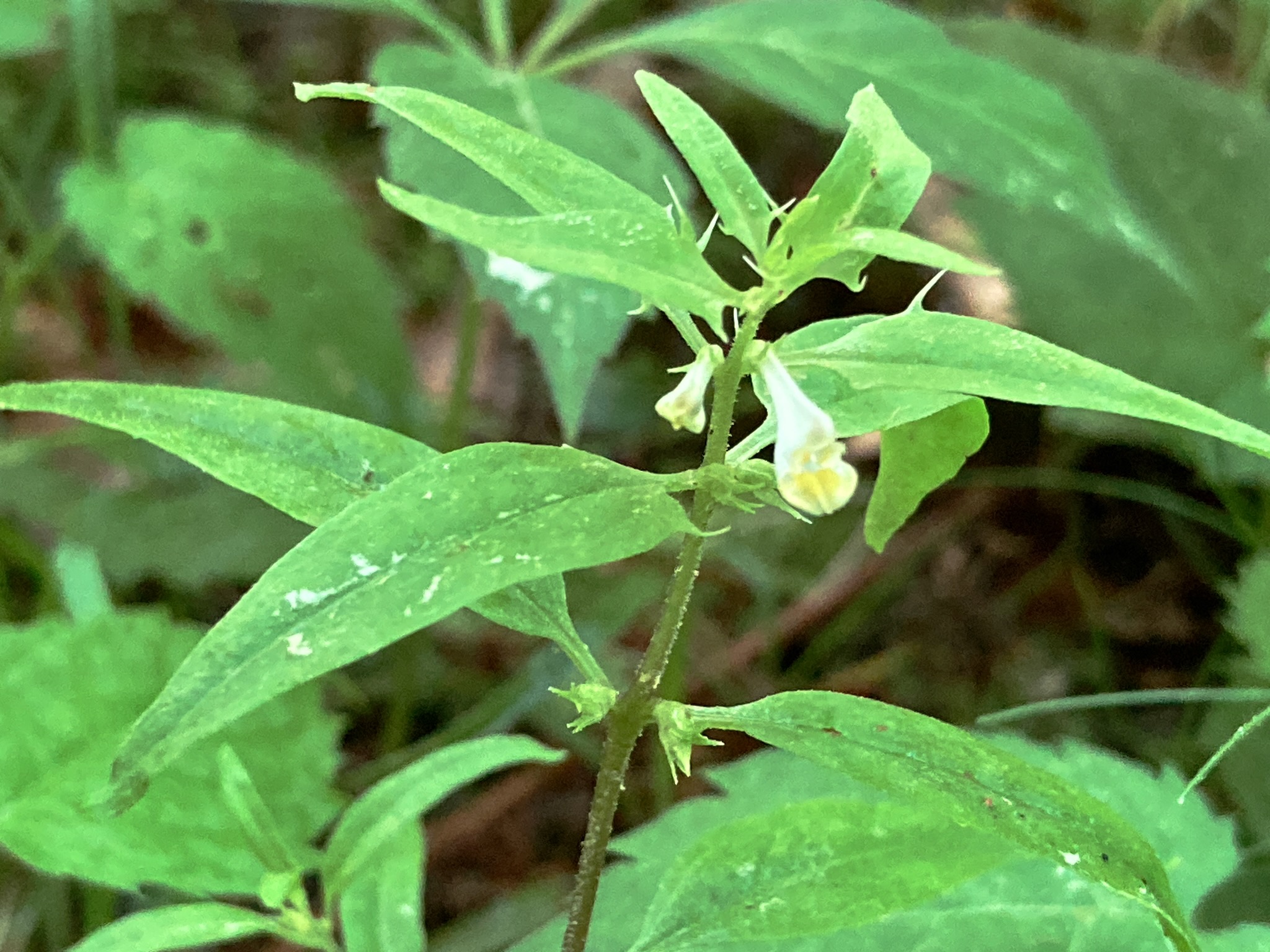
    A small woodland flower.
    Melampyrum lineare (photo copyright (c) Dan Harper 2024).
  • Inner peace

    Sermon copyright (c) 2025 Dan Harper. As delivered to First Parish in Cohasset. The sermon as delivered contained substantial improvisation. The text below may have typographical errors, missing words, etc., because I didn’t have time to make any corrections.

    Readings

    The first reading was from a commentary on Psalm 23 by Rabbi Adin Steinsaltz. This is an interpretation of the phrase, “He restores my soul.”

    “The root of the Hebrew word yeshovev, translated here as ‘He restores,’ sometimes means ‘to grant rest,’ but its basic meaning is ‘to return.’ When one’s soul is troubled or worried, it is not at peace, as though it is not in its natural place, but distanced and dislocated. When the soul returns to its true place, the result is inner peace.

    The second reading was from the Confucian classic, The Great Learning, translated by A. Charles Muller, professor emeritus of the University of Tokyo:

    The way of great learning consists in manifesting one’s bright virtue, consists in loving the people, consists in stopping in perfect goodness.
    When you know where to stop, you have stability.
    When you have stability, you can be tranquil.
    When you are tranquil, you can be at ease.
    When you are at ease, you can deliberate.
    When you can deliberate you can attain your aims.
    Things have their roots and branches, affairs have their end and beginning. When you know what comes first and what comes last, then you are near the Way [of the Great Learning].

    The third reading was “The Peace of Wild Things,” a poem by Wendell Berry:

    When despair for the world grows in me
    and I wake in the night at the least sound
    in fear of what my life and my children’s lives may be,
    I go and lie down where the wood drake
    rests in his beauty on the water, and the great heron feeds.
    I come into the peace of wild things
    who do not tax their lives with forethought
    of grief. I come into the presence of still water.
    And I feel above me the day-blind stars
    waiting with their light. For a time
    I rest in the grace of the world, and am free.

    Sermon: “Inner Peace”

    For us Unitarian Universalists, the third reading this morning, the poem “The Peace of Wild Things” by Wendell Berry, might be one of our most popular visions of how we might achieve inner peace. The poem tells us that when we are overwhelmed by despair and fear, we should go outside, find a pond where wild ducks and heron live, and there we can find peace.

    This poem reminds me of the book Walden by Henry David Thoreau. Walden tells the story of how Thoreau went and spent two years living next to Walden Pond, a small deep pond of clear still water. There’s a back story to Thoreau’s stay at Walden Pond. While he lived there, he was writing a book about a boat trip he and his brother had taken some years before. His brother had died of tetanus a couple of years before Thoreau went to live at Walden. I’ve always imagined that part of the purpose behind living right next to a pond “where the wood drake / rests in his beauty on the water” was to allow Thoreau to regain the inner peace that had been overwhelmed by his brother’s sudden death at a young age.

    Nor is this idea of finding peace in wild places limited to Wendell Berry and Henry Thoreau. Many of us in this congregation will say that when we need respite from the cacophony of current events and the stress of day to day life, we take a walk in the woods. We are lucky here on the South Shore that even though we live in an area with a high density of human population, we also have lots of relatively wild places where we can “come into the peace of wild things / who do not tax their lives with forethought / of grief.”

    As much as I personally like going outside to seek the peace of wild things (as Wendell Berry puts it), there are people for whom it doesn’t necessarily work to seek inner peace by being out in Nature. Some people just don’t find it peaceful to spend spend time outdoors. Then there are those who find it difficult to get outdoors, due to health or mobility limitations. There are also those who, because of our work or school schedules, find it difficult to get out into wild places except on weekends or holidays. What Wendell Berry calls “the peace of wild things” is one of my favorite ways to seek inner peace; but there can be times when it’s hard to do, and even though it works for me, it doesn’t work for everyone.

    This is going to be a theme for the first part of this sermon: There are many techniques for finding inner peace. But since we are all different, some techniques will work well for some people, but not others. And since we all change over time, a technique that works for you now might not work for you a few years from now; or a technique that didn’t work for you in the past might work for you now; or you might have a technique that you like but you just don’t have the time you need to devote to it right now.

    So with that in mind, let’s take a look at some techniques for finding inner peace. I’d like to start with an ancient Western technique for finding inner peace: prayer. In Western culture we usually think of prayer as a Christian practice, but it’s not that simple. Jews were praying before Christianity existed, and so were the ancient Greeks and Romans. Since both Jewish prayer and ancient pagan prayer predate Christianity, we should think of Christian prayer as just one subset of Western prayer practices and techniques. Today, there are humanists and atheists who pray, not because they believe in God — obviously they don’t — but because the technique of prayer is a part of our Western cultural inheritance.

    When we think of prayer more broadly, it tends to subvert the usual conceptions we have about prayer. Pop culture has reduced prayer to asking God for something you want. This is known as petitionary prayer, because you’re petitioning God for something. Scientists have even studied this aspect of prayer — what happens when people pray for someone who is sick, does it improve their health outcome? But petitionary prayer is only a part of the Western prayer tradition, and I’d like to look at two forms of Western prayer that are aimed at improving your inner peace.

    First there’s the technique called contemplative prayer, or as it has been popularized in recent years, centering prayer. The famous Trappist monk Thomas Merton did much to popularize this kind of prayer with his 1971 book titled “Contemplative Prayer.” As a Christian, Merton described centering prayer as a practice where you simply focus your attention on the Christian god. Non-believers use this prayer technique by focusing attention on this present world. So Henry David Thoreau, for example, wrote about sitting outside his cabin at Walden Pond and becoming “rapt in a revery” for hours at a time; I’d say that what Thoreau was doing was a type of centering prayer that focused, not on God, but on the natural world. Centering prayer is specifically designed to achieve inner peace through the contemplation of that which is good in this world.

    A second type of prayer that can help achieve inner peace is the practice of remembering others in your prayers. Traditionally, in Western folk practice, during your daily prayers you’d go through a mental list all the people whom you think might need or appreciate prayers. Sometimes this takes the form of petitionary prayer — petitioning God to heal someone from cancer, for example — but often it takes the form of simply thinking of people who are important to you. Humanists and atheists who pray aren’t going to petition God, but they may still devote part of their prayer time thinking of people they know who might appreciate their attention. Prayer lists like this aren’t specifically designed to achieve inner peace, but I’ve seen how people who remember others in their prayers do in fact achieve some degree of inner peace. This makes sense to me, because reminding yourself of how you are connected to other people you can be a calming influence. It’s a way of remembering the ties of love that bind you to other people and give your support. And while praying for people who are ill or facing other troubles may or may not help them, I’ve seen how it can have a calming effect on the person who is praying.

    So both centering prayer and old-fashioned prayer lists can help some people achieve inner peace. However, prayer doesn’t work for everyone. I’m one of the people it doesn’t work for. For some years, I tried many kinds of prayer, including centering prayer and prayer lists, and I finally concluded that prayer just doesn’t do much for me. But prayer does help a great many people achieve inner peace, and you can’t know if it works for you until you give it a serious trial.

    Next, let’s consider meditation and mindfulness as techniques for achieving inner peace. Meditation and mindfulness became popular in this country in the middle of the last century. Most of these meditation and mindfulness practices came from Hindu or Buddhist traditions. Transcendental Meditation, a hugely popular meditation practice in the 1970s and 1980s, came out of the Hindu tradition. Sitting meditation, which also became hugely popular in the 1970s and 1980s, was popularized in large part by Zen Buddhist practitioners like Alan Watts. People like Dr. Herbert Benson also created secular adaptations of meditation and mindfulness. In his 1975 book “The Relaxation Response,” Benson claimed that all you needed was some mental device to keep your mind from wandering, along with a passive attitude towards the process. According to Benson, you didn’t need the arcane mantras of something like Transcendental Meditation, nor did you need the elaborate religious structure of something like Zen Buddhism. Through such secular adaptations, many humanists and atheists have adopted meditation and mindfulness practices.

    Meditation and mindfulness are now a part of mainstream culture. Schools teach meditation to children and teens to help lower stress, and maybe find some inner peace. Some employers offer meditation classes and meditation rooms in the workplace. When you talk about achieving inner peace, many people assume that means meditating or engaging in mindfulness practices. This tends to annoy Christians and Jews who feel that prayer can offer the same benefits as meditation and mindfulness; how come it’s OK to teach Eastern religious techniques in the schools, but not Western religious techniques? I don’t want to get in the middle of that particular religious debate, but I do want to point out that meditation and mindfulness don’t work for everyone. Recent research has shown that a minority of people experience negative effects from meditation and mindfulness. I’m actually one of those people. I meditated for years, and meditation did help me achieve some degree of inner peace, but there were enough times that it didn’t make me feel good that I finally stopped.

    Sadly, then, although I gave both meditation and prayer a fair trial, although I had some success with both, eventually I wasn’t able to make them work. This, by the way, makes me feel inadequate as a minister; I’m supposed to be setting an example, yet here I am, a failure at both prayer and meditation, the two most popular techniques for achieving inner peace. Yet just be cause I failed doesn’t mean that you’re going to fail. If you’re searching for techniques to achieve inner peace, it’s worth trying prayer and meditation techniques.

    My failures with prayer and meditation have led me to an interesting conclusion that I think might be helpful to others. Part of my problem with both prayer and meditation arose because they are basically solitary activities. Yes, you can go to a meditation group, or you can join a prayer group, but prayer and meditation ultimately take place inside your head. I find this is also true in seeking out the peace of wild things: in Wendell Berry’s poem, he went out by himself to spend time with the wild drake and the heron. All this makes sense, because in order to achieve inner peace, you do need to spend some time in your head.

    Yet I began to realize what worked best for me were practices where I had to interact with other people. I think I first became aware of this through making music with other people. I’ve never found much inner peace in practicing music on my own, but I realized that doing music with other people was a fairly reliable way for me to achieve a degree of inner peace. Maybe in part this was because I’m not an especially good musician, and it was much more satisfactory to do music with people who are good musicians. Regardless of my own failings as a musician, I consistently found that when I did music with other people, I felt an increase in inner peace.

    Then I realized that the same thing was true of congregational life. When I was cooperating with other people in the congregation to make something happen, I could feel myself growing more peaceful. Although I didn’t have much success with individual spiritual practices like prayer or mindfulness or meditation, the experience of being part of a religious community did help me achieve inner peace. As more and more people began to say they were “spiritual but not religious,” I began to call myself “religious but not spiritual.” That is, although I was kind of a failure at individual spiritual practices, the communal and social aspects of communal religion did lead me to inner peace.

    I’ll give you some specific examples of communal religious activities that have helped me achieve at least some inner peace. And while you may skeptical about some of my examples, hold on to your doubts for a bit and I’ll try to explain.

    One obvious example of a communal religious practice that has provided me with some inner peace is being part of a congregation’s choir. I’ve sung in traditional choirs, once or twice with a gospel choir, with a folk music group, and now I play in this congregation’s bell choir. As I said before, I’m not an especially good musician, and I often find participating in choirs is difficult and frustrating — at the end of bell choir rehearsal, I often feel like my head is going to explode. Yet despite the frustrations, the sense of coming together with other people to do something I couldn’t do alone makes me feel less anxious and less alone, and ultimately moves me towards a feeling of inner peace.

    I also love being part of a team teaching in religious education programs. Last year, I taught in our OWL comprehensive sexuality education program with Mark and Holly; this year I’m teaching in the Coming of Age program with Tracey; and in the summer I help Ngoc run the ecology camp. Just like participating in a choir, teaching is often difficult and frustrating. Yet here again, despite the frustrations, I find I benefit the social aspects, both working with other adults and working with the kids. Teaching always takes me out of my own little personal concerns so that I feel a part of something larger than myself; that in turn lowers my levels of stress and anxiety; and that ultimately leads to a sense of inner peace.

    Another communal religious practice is committee work. I am not very good at committee work; I’m too impatient, and sometimes I find it hard to take the long view. But working with other people towards a common goal turns out to be good for me. If I can get past my impatience, if I can work through my frustrations, I eventually find I feel more peaceful when I’m a part a group working on a project together.

    I could go on, but you get the idea: working with other people to make a religious community function can lower stress and anxiety, reduce loneliness and isolation, and ultimately help us achieve a greater degree of inner peace. There may be a simple reason why this is so — perhaps it is merely because we humans are tribal animals, and we are meant to be working with others — and there may also be a deeper spiritual reason — we humans need to strive towards something greater than our individual selves.

    Whatever the case may be, I would argue that these days in-person contact and cooperation has become perhaps the most important benefits of religious communities. This is because we have so few opportunities to work together selflessly with others. We are increasingly isolated in today’s society. We increasingly buy everything we need online, so we don’t even have to go to the store any more. As a result, we’re in the midst of a well-documented epidemic of loneliness epidemic. Loneliness and isolation reduce your sense of inner peace, and yet there are fewer and fewer places where we can join with other people to work together on values-based projects. Because of this, while solitary spiritual practices like taking walks in the woods or meditating or praying still offer spiritual benefits, today the most important spiritual benefits come from being part of a religious community.

    We live in a strange world these days, where people on both sides of the political divide are convinced that they no longer have anything in common with the other side. We’ve gotten to this point in part because we spend so little time working together in face-to-face communities like First Parish. And with the diminishment of community life has come loneliness and isolation. We try to repair the damage through social media, but it turns out social media only makes things worse. It becomes a downwards spiral. The unsurprising result is a steep increase in anxiety and depression, political conflict, and a general feeling of malaise. Our lack of community involvement has greatly decreased our inner peace.

    So it is that I’ve come to believe that in this historical moment, the most effective technique for seeking inner peace is through community. It’s fine to seek the peace of wild things through solitary walks in the woods, but remember that Henry Thoreau actively participated in anti-slavery meetings while lived at Walden Pond. Prayer and meditation are well worth your while, but then you need a community to make sense out of the prayers and meditation. It is through being in community that we may transcend our troubles and worries, and return to the sense of inner peace.

  • Why I Don’t Pray (But Maybe You Should)

    Please note: I did not have time to fully correct the sermon text, so no doubt it’s full of errors. Sermon copyright (c) 2023 Dan Harper. As delivered to First Parish in Cohasset. As usual, the sermon as delivered contained substantial improvisation.

    Readings

    The first reading is by the Unitarian Universalist choral conductor and composer Nick Page:

    “I composed a piece of music called ‘Healing Prayer,’ to be sung by combined choirs and congregations. I wrote it because a dear friend had been diagnosed with leukemia. He asked that his friends neither visit him nor call him, but rather that we simply pray for him. And people prayed—even many who had never before given prayer a thought. My friend is now well on his way to recovery. I am far too scientific to say that our prayer healed him, but I know that those of us who prayed found a deeper connection to him, to each other, and to the world we live in — and I know that my friend also found that connection between self and all things. I also know that this connection was more than mere thoughts — it was tangible — as tangible as the medical treatment he also received.”

    The second reading is a poem by Denis Levertov, from her book Oblique Prayers (1984). The text is online here.

    Sermon: “Why I Don’t Pray (But Maybe You Should)”

    Back in 1999, I was serving on the Pamphlet Commission of the Unitarian Universalist Association. These days, pamphlets are produced by staff at the Unitarian Universalist Association, but back then they relied on volunteers to create pamphlets. We were working on a pamphlet titled “Unitarian Universalist Views of Prayer.” This was part of a series of pamphlets where we asked a variety of Unitarian Universalists to give their views on topics such a God, the Bible, prayer, and so on. Each pamphlet showcased the wide range of opinions that can be found among Unitarian Universalists, and part of the point was to show that we Unitarian Universalists don’t have a doctrine or dogma. We find our way to truth, not by having someone else tell us what is true, but through dialogue and through trying out ideas on other people and having our ideas modified and changed through our participation in a religious community. Ours is a pragmatic approach to religion, a pragmatism that is related to scientific method.

    Cathy Bowers was the Commission member charged with coming up with material for this pamphlet. She solicited brief essays on prayer from a wide range of Unitarian Universalists, who held a wide range of viewpoints. Cathy solicited an essay from Anita Farber-Robertson, and Anita wrote about a devastating illness she had had in her thirties, saying, “For the first time in my life, I understood intercessory prayer…. I asked my friend to pray for me. He did. I was astonished at its power.” Intercessory prayer is the classic type of prayer where we ask God or some other divine power for help in our lives.

    As a way of contrast, Cathy then got James Ishmael Ford, who is both an ordained Unitarian Universalist minister and an ordained Zen Buddhist priest, to write about prayer from the Zen perspective. James wrote, “I’ve found through ordinary attention I can know enough to find authentic peace and joy.” This type of prayer is sometimes know as centering prayer, or meditative prayer, and it need not have anything to do with God. in a similar vein, Cathy then asked Roger Cowan, an avowed humanist, about prayer, and he wrote: “I am a humanist who prays, who begins each morning with devotional readings and a time of silence and prayer.”

    And Cathy also got some people to write about types of prayer that we might not usually term prayer. Nick Page, the Unitarian Universalist choral conductor, wrote about how music became a form of prayer for him. We heard part of Nick’s essay in the first reading this morning, and he concluded by saying that he wrote his “Healing Prayer” composition “not because I believe in a higher power, but because I believe in a living universe with energies both powerful and subtle — all mysterious.”

    In the end, Cathy came up with a really good collection of seven different UU views on prayer. In typical Unitarian Universalist fashion, each of these seven people interpreted prayer in different ways, but each of them spoke movingly about the power of prayer. She presented these essays to us at the next meeting of the Commission. Everyone on the Commission (except me) spoke enthusiastically about the seven essays. I kept quiet for a while — Cathy was an old friend of mine, and I didn’t want to sound negative — but I finally asked: “Where’s the essay that says prayer is a crock of beans?” Because, as I pointed out, there were a lot of Unitarian Universalists — people like me — who don’t pray at all. If we were going to be true to the title “UU Views on Prayer,” then we needed to represent those of us who don’t pray.

    Cathy and the rest of the Commission readily agreed, somewhat to my surprise, and Cathy promised to contact several well-known Unitarian Universalist atheists and humanists to ask one of them to write a brief essay on why they didn’t pray. But she ran into a problem: no one seemed to be willing to write such an essay. One well-known Unitarian Universalist humanist just didn’t answer her inquiries. A well-known Unitarian Universalist atheist gave a reply that could be boiled down to, “What is this, some kind of joke?” Others were more polite, but all came up with excuses to not write about why they don’t pray.

    At that point, everyone on the Commission turned to me and told me that I’d have to write the piece about how prayer was a crock of beans. Now, I was in no mood to write anything. My mother had died a couple of years earlier, I had just started a new job, and I was trying to complete a master’s degree in my spare time. But they wouldn’t let me off the hook. “It doesn’t have to be long,” they said. “Just a paragraph.” So here is what I wrote:

    “I don’t pray. As a Unitarian Universalist child, I learned how to pray. But when I got old enough to take charge of my own spiritual life, I gradually stopped. Every once in a while I try prayer again, just to be sure. The last time was a couple of years ago. My mother spent a long, frightening month in the hospital, so I tried praying once again but it didn’t help. I have found my spiritual disciplines — walks in nature, deep conversations, reading ancient and modern scripture — or they have found me. Prayer doesn’t happen to be one of them.” Nearly a quarter of a century later, I have a different set of spiritual disciplines or practices or whatever you want to call them — but prayer still isn’t one of them. Every once in a while, I still try praying, and it still doesn’t do anything for me.

    However…. That brief essay only talks about personal prayers I might do for myself. If someone else wants me to pray for them, I’m more than happy to do so. So, for example, if I had known Anita Farber-Robertson during her thirties when she was so ill, and if she had asked me to pray for her, of course I would have prayed for her. Now I’m a minister, and when you’re a minister people ask you to pray for them all the time. Of course if someone asks me to pray for them, I will do so, and I will put my heart into it. I don’t believe the notion that dominates modern Western culture, that religious belief must underlie religious ritual. I agree with the ancient Greeks and Romans — you don’t have to believe in the gods in order to participate in religious rituals.

    In fact, for me as a Unitarian Universalist, I think it’s most accurate to say that religion centers on community, and that ritual exists to keep the community healthy. For us Unitarian Universalists, our main ritual is coming together once a week as a community; if we pray for each other, the biggest effect of those prayers is to help us draw closer to one another. While many of us are believers (and many of us are non-believers), our communal religion is primarily based on connections between people, and the connections we humans have with the rest of the world around us.

    Speaking as a Unitarian Universalist, then, if someone asks me to pray for them, it doesn’t matter whether I believe in prayer. It doesn’t matter whether prayer is part of my personal spiritual community. What matters is that someone has asked me for something that’s very simple to offer — a prayer. If I pray for them, I’m helping to strengthen the interdependent web of humanity. So if someone asks me to pray for them, I’m generally going to say yes. When Anita Farber-Robertson asked her friend to pray for her while she was so ill, he said yes. It didn’t matter whether he had a regular prayer practice, or whether he was like me, someone who never prayed. He prayed for Anita, and she found herself “astonished at its power.” This is the power of human interdependence.

    This raises the interesting question of what happens when someone prays for someone else. Anita wrote about the astonishing sense of power she felt from intercessory prayer. Was this sense of power real or imaginary? I can almost hear some of you thinking: “But scientific studies have shown that prayer [choose one] does / doesn’t work.” That misses the point. Prayer cannot be adequately studied with the kind of objective statistical analyses that science does so well. Prayer is about your very subjective experience. Anita felt the power of intercessory prayer, which we could also call the power of human connection. By contrast, I’m one of those people who doesn’t happen to feel the power of human connection if others pray for me or if I pray for others. I happen to feel the power of human connection in other ways. There is a great range of subjective experience among human beings, which is part of what makes it so difficult to be human.

    James Ishmael Ford, the Zen Buddhist priest and Unitarian Universalist minister, wrote about another kind of prayer from his perspective, saying: “I’ve found the beauty and mystery and grace of our existence are revealed in prayerful attention. Through attention we can come to know the connections.” Christians might call this type of prayer “centering prayer.” Secularists might call this “meditation.” These types of prayer involve stilling your thoughts, and simply paying attention. This is another way that we can become aware of the power of human connection, and indeed the power of our connection to nonhuman organisms and indeed to the non-living world as well. Many of us in this congregation find this type of prayer to be extraordinarily meaningful, providing shape and even purpose to your lives.

    As is true with other kinds of prayer, meditation or centering prayer doesn’t work for everyone. I meditated regularly for many years, then finally stopped because I sometimes had negative experiences, where meditation wasn’t calming; instead it threw me off balance. It turns out that negative experiences during meditation are fairly common, with perhaps a quarter of all people who meditate having had some kind of negative experience. As with intercessory prayer, people differ in their experience of centering prayer and meditation — for some of us, centering prayer or meditation is an essential part of our lives; for others of us, centering prayer and meditation don’t work.

    It is fortunate for us that we are Unitarian Universalist, so we don’t feel like I have to keep doing something that either doesn’t work for us, or leads to negative experiences. We are a pragmatic people, we Unitarian Universalists. If a Unitarian Universalist wants to learn centering prayer, the rest of us encourage them to give it a try. If it doesn’t work for them, they are still just as welcome in our community.

    Similarly, if one of us Unitarian Universalists asks the rest of this community for prayers — prayers for healing, prayers for getting life back on track, whatever the request might be — we as a community are going to pray for that person. This is what we do each week during our worship service when we listen to one another during the candles of joy and concern. While a few of us may be so creeped out by prayer that they really feel they can’t pray, it doesn’t matter, the rest of us can pick up the slack. Some among us may not believe in prayer but are still willing to offer up a prayer; if the recipient of the prayer feels it’s meaningful, then it’s meaningful.

    I’m sure the people sitting here this morning, or participating online, represent a wide diversity of views of prayer. We have Buddhists among us who might agree with James Ishmael Ford’s views of prayer. We have Christians among us who, along with Anita Farber-Robertson, may feel the power of traditional intercessory prayer. We have agnostics and atheists among us, some of whom pray, and other who think prayer is a crock of beans. We doubtless have some Pagans and New Age people among us who might or might not use the word “prayer” but who engage in some kind of prayer-like practice. A few us of are mystics like me, and as is typical of mystics our views are going to be all over the place. And I’m sure there are musicians among us who, like Nick Page, feel that making music is what they do for prayer.

    Yet even with this great diversity of viewpoints on prayer, we come together in community. We are bound, not by doctrine or dogma, but by the ties of community. If someone asks us for prayer, we’ll do our best to comply with their request . This is what community members do for one another. We do our best to support each other. Some of us are overwhelmed by life, and it’s all we can do to show up on Sunday morning, either online or in person — or maybe we don’t even show up on Sunday morning, but we still think about this community. Yet even when you feel overwhelmed by life, you can still be supported by this community. And maybe that’s the real power of prayer: it doesn’t require extraordinary effort. All you have to do is think of someone else, and if you want you can say a few words that sound like a prayer to you. It doesn’t seem like much. But the power of that tiny little act might astonish us with its power.