Tag: feminism

  • Changing Views of Motherhood

    Sermon copyright (c) 2025 Dan Harper. As delivered to First Parish in Cohasset. The sermon as delivered contained substantial improvisation. The text below has typographical errors, missing words, etc.

    Readings

    The first reading was the poem “Ella Mason and Her Eleven Cats,” by the Unitarian poet Sylvia Plath.

    The second reading was a poem titled “Mother’s Day” by Bruce Lansky, from his book If Pigs Could Fly and Other Deep Thoughts: A Collection of Funny Poems.

    Sermon

    The past decade or so in the United States has been an interesting time for those of us who consider ourselves to be feminists. Feminism has become a bad word, a pejorative term, so much so that now when I use the word I have to define what I mean. It actually has a very simple definition. A feminist is someone who believes that all genders are equally worthy as human beings. A feminist is someone who does not believe that there is one gender that is stronger, smarter, more authoritative than other genders. Or, as we used to say back in the 1990s, a feminist is someone who believes that women and girls are just as good as men and boys.

    For us Unitarian Universalists, feminism also has a religious dimension. We are the inheritors of the Universalist tradition. The old-time Universalists decided that if God really was good, then God would extend God’s love to all persons everywhere. These days, not all Unitarian Universalists believe in God; but regardless of our belief or lack of belief in God, we still remain convinced that all persons are equally worthy as human beings. Because of this, Unitarian Universalists almost have to be feminists — because of our religious worldview, we will affirm your inherent worthiness and dignity no matter what your gender is.

    Those of us who are feminists have a perspective on motherhood that differs in some respects from non-feminists. If you’re a feminist, you tend to see each woman or girl as an individual, as a separate and unique human being with distinctive talents and abilities. Traditionally, there was a tendency to equate motherhood and womanhood — if you’re a woman, then you have to be a mother. But those of us who are feminists recognize that the universe is more complicated than that. Some women want to be mothers, some women don’t want to become mothers, some women are ambivalent about motherhood, some women cannot become mothers regardless of their wishes. Just because a person is a woman, it does not mean they must be a mother. Our feminist worldview has changed our understanding of motherhood.

    I became very aware that I’m a feminist during last year’s presidential election cycle. This awareness hit me especially hard during the childless cat lady kerfluffle. If you’ve forgotten the childless cat lady kerfluffle, let me remind you of how it played out. Back in 2021, J. D. Vance claimed that the United States is run by “a bunch of childless cat ladies who are miserable at their own lives and the choices that they’ve made and so they want to make the rest of the country miserable, too.”(1) That is a direct quote taken from a video clip. The video clip of Vance saying this was posted on Twitter, and caused a bit of a buzz across various social media outlets. Perhaps the most notable social media buzz occurred when Taylor Swift posted a reply on social media in which she openly proclaimed herself a childless cat lady.

    Now it turns out that the cat-lady trope is not a new invention. According to Dr. Corey Wrenn, lecturer in sociology at the University of Kent, Great Britain, there is a long history of stereotyping feminists as cat ladies. Over a hundred years ago, women were seeking the right to vote were portrayed as cats in anti-suffragette propaganda. According to Corey Wrenn, “anti-suffrage postcards often used [cats] to reference female activists. The intent was to portray suffragettes as silly, infantile, incompetent, and ill-suited to political engagement.”(2)

    Knowing this helps give us some more insight into the cat lady we heard about in the first reading this morning, in Sylvia Plath’s poem “Ella Mason and Her Eleven Cats.” Before I talk about that poem, I have to tell you a little something about Sylvia Plath. First, of particular interest to us, Plath was a Unitarian: she grew up in Unitarian churches; in college, she described herself an “agnostic humanist”; and in her twenties, she called herself “a pagan Unitarian at best.”(3) Second, Plath was born in 1932, and based on what I’ve seen of that generation of Unitarian women (which includes what I saw of my Unitarian mother), I’d say many of those women were strong-minded feminists, even if they didn’t describe themselves using the term “feminist.” In short, Plath was both a Unitarian and a feminist; that is to say, in terms of her worldview, she was one of us.

    Plath’s short life — she died at age 30 — was not an easy life. While still a girl, she showed promise as a writer. But after a summer internship in college, she had a major depressive episode which culminated in a six month hospitalization. After recovering her health, she went to study in England on a Fulbright scholarship, where she met the poet Ted Hughes. They married, but Hughes turned out to be an abuser who physically assaulted her; he also conducted affairs with other women. After the birth of her second child, Plath separated from Hughes, only to die by suicide less than a year later.

    I know, this is a pretty grim story for a Mother’s Day sermon. I apologize.

    So on a more positive note, let’s consider Sylvia Plath’s poem “Ella Mason and her Eleven Cats.” This is a poem that’s both funny and serious. When the unnamed narrator of the poem was a girl, she and her friends used to go to spy on Ella Mason. They would peer into Ella Mason’s house, where they could see her eleven cats purring around her — this is the funny bit, with little girls peering in to Ella’s house to stare at all the happy cats. The little girls giggled when they saw the cats purring on antimacassars. The girls had heard that when Ella Mason was young, she had been a fashionable beauty, and so they make fun of her because by conventional standards Ella had thrown away her opportunity to get married. Now Ella is old, and she has to settle for the love and admiration of eleven cats. But in the final stanza of the poem, the girls have grown up, and as they begin to marry they look upon Ella Masson more kindly. They realize that they had misunderstood Ella Mason. Ella did not suffer from vanity, as the girls had assumed, but instead Ella possessed a sense of self-respect which allowed her to realize that in her case, her happiness did not require marriage.(4)

    The point of the poem is not that every woman should become a cat lady. Nor is the point of the poem that every woman should get married and have children. The point — as I see it — is that each of us has choices about how we’re going to live our lives. Many people make their life choices based on the expectations of society, while others among us make our choices based on knowing our deepest selves. Sometimes someone winds up making a choice that society disapproves of — when, for example, a woman chooses not to get married, causing little girls peer in her front door and giggle at her — but when they make that choice based on a deep knowledge of self, they are able to ignore the the disapproval of other people. In fact, given the diversity of opinion in human communities, no matter what choice you make, you can be fairly sure that someone is going to disapprove of it. Thus it is always best to make your choices based on a deep knowledge of who you really are.

    I see something of a parallel between Ella Mason and Taylor Swift. Swift, who is now 36 years old, has thus far chosen to focus on her career instead of marrying and/or having children. She knows that there are people who disapprove of her for not following a conventional path and putting aside her music to become a mother; but she also knows herself well enough to know that she is being true to her self. When Swift saw J. D. Vance’s comments about “childless cat ladies,” because she knew who she was and why she had made the choices she had made, she was able to post a very measured response on Instagram (in which she urged her followers to register to vote). And she was secure enough in her own self that she could sign her post “Taylor Swift / Childless Cat lady.”(5)

    So why am I talking so much about childless cat ladies on Mother’s Day? The point I’m trying to make is that there are quite a few people in our country who feel that the single most important role for all women is to bear children and be mothers. People with this viewpoint seem to find it quite threatening when some women — like Taylor Swift — prioritize their careers, putting off motherhood, or maybe choosing not to become mothers at all. They say they have a good reason to feel threatened: they see that the birthrate is falling in the United States, and they worry that the future of the human race is threatened by women who don’t have children. But I suspect that they are really worried because the old gender norms to which they have grown accustomed seem to be fading out — those old gender norms that say the primary purpose of women is to bear children and be mothers. And so they grow anxious when they see women who prioritize something other than motherhood.

    By contrast, we Unitarian Universalists do not assume that just because someone is a woman, their primary duty is to bear children and become a mother. We are also quite aware that some women who might want to become mothers cannot do so, for a wide variety of reasons. We are also aware that there are many different ways to become a mother: there are mothers who give birth to a child, there are mothers who adopt a child, there a mothers who become a mother by marrying someone who already has children.

    And finally, we even understand that there can be many kinds of mothers. For example, there are people who serve as mothers to children who are not their biological children, adopted children, or step-children. Sylvia Plath had a biological mother, but she also had a literary mother. The Unitarian novelist Olive Higgins Prouty adopted Plath as a kind of literary child, paying for Plath’s college education and paying for Plath’s medical expenses during her first hospitalization for mental illness.(6) Or in another example, some decades ago I knew a teenaged girl who had a difficult home life and got her mothering from a woman in her church community who was not her biological mother; this girl spent as much time as she could in this other woman’s household (and sadly, this teenager’s biological mother was actually glad that the girl spent so many of her waking hours away from their home; not everyone enjoys motherhood).

    As feminists, we understand that men can also be mothers. I remember a gay couple I once knew who had adopted children, and both men in that couple served as both mothers and fathers to their children. But I also think of a co-worker of mine back in the 1980s whose mother had died when he was an infant; from the way he talked about his upbringing, it was clear that his father had been both a father and mother to him. Most non-feminists probably wouldn’t admit that men can be mothers; but the evidence of my own experience shows that men can indeed serve as mothers.

    Once you adopt a feminist viewpoint, the category of “mother” becomes a little bit broader than just a biological woman who has biological offspring. Mind you, we who are feminists acknowledge the great importance of those women who physically give birth to infants. Giving birth is crucially important, it can put a huge strain on a woman’s body, and we are grateful for women who choose to give birth. But we also understand that motherhood, broadly construed, means more than physically giving birth. Motherhood encompasses all of the intensive nurturing that a human being needs to grow from infancy into adulthood; and this includes both physical, emotional, and spiritual nurture.

    It is actually quite astonishing how much nurture human beings need to get from infancy to adulthood. In contemporary Western culture, we like to pretend that all that nurture can be provided by a nuclear family with one mother and one father, but that really isn’t true. If we’re honest with ourselves, we know that it takes a much bigger community than that to provide the nurture that children and teens require. Lawrence Mbogoni, a retired professor from William Paterson University who was raised rural Tanzania, put it this way:

    “[The proverb] ‘It takes a whole village to raise a child’ reflects a social reality some of us who grew up in rural areas of Africa can easily relate to. As a child, my conduct was a concern of everybody, not just my parents, especially if it involved misconduct. Any adult had the right to rebuke and discipline me and would make my mischief known to my parents…. The concern of course was the moral well-being of the community.”(7)

    While Lawrence Mbogoni was speaking specifically of rural Africa, the same principle applies more generally to all human beings and all human communities. It does in fact take a whole village to raise a child. In rural Tanzania, that community was the village in which the Mbogoni family lived. In the industrialized West, where villages no longer exist except in fantasy, it is more difficult to find a community of adults who will help raise children and teens, who can help provide all the nurture that a child or teenager needs.

    But such communities do exist, and our First Parish congregation is one such intergenerational community. As a community, we know that a central part of our identity is to be the whole village that raises a child. We do not want to supplant a child’s own parents, but we are here to support and help parents. We see this happening at social hour, where there are many adults, not just parents, who know the names of First Parish children and who talk with the children. We see this in our Religious Education Committee, which includes two people who do not have children in the Sunday school, a grandparent-age person, and a high school student. We see this in programs like the current pen-pal program, where kids and adults get to know one another through exchanging weekly pen-pal letters. We are doing our best to be the kind of village that it takes to raise a child.

    This is how we help support motherhood. And our support of motherhood is firmly rooted in our feminist worldview. Our feminist worldview helps us understand that the rest of us can help take a little bit of pressure off the biological and adoptive mothers who are part of our community. Those biological and adoptive mothers know that they can come here to First Parish and for a couple of hours each week there will be a whole community of other adults who will help look after their children. Because if it takes a village to raise a child, that implies that motherhood is more than a full-time job for one person.

    Without denying the importance of biological and adoptive mothers (some of whom may be men), we recognize that entire communities also provide mothering. In such communities, the mothering provided by biological and adoptive mothers is supplemented by the mothering provided by elders who may be other people’s grandparents; by young adults who may still be thinking about whether or not to have children of their own; by child-free couples like my wife and I; and, yes, by childless cat ladies. We have embraced a changed definition of motherhood, where nurturing children is the responsibility — not just of two parents in a nuclear family — but rather of an entire village, and entire community,.

    So on this Mother’s Day, we honor and support biological and adoptive mothers. We also honor communities that provide the additional nurture that children need; we embrace the proverb that “it takes a village to raise a child.”

    Notes

    (1) My transcription of a video clip of Tucker Carlson interviewing J. D. Vance in 2021, as posted on X / Twitter by Ron Filipowski @RonFilipkowski on 22 July 2024 https://x.com/RonFilipkowski/status/1815503440983867598 accessed 9 May 2025.
    (2) Corey Wrenn, “Woman-as-Cat in Anti-Suffrage Propaganda,” posted on 4 December 2013 in the Sociological Images category on The Society Pages website https://thesocietypages.org/socimages/2013/12/04/the-feminization-of-the-cat-in-anti-suffrage-propaganda/ accessed 9 May 2025.
    (3) Details of Plath’s Unitarianism and personal theology from Wesley Hromatko, “Plath, Syliva,” Dictionary of Unitarian & Universalist Biography, Unitarian Universalist Study Network https://www.uudb.org/plath-sylvia/ accessed 10 May 2025.
    (4) I’m basing my interpretation of the poem’s last stanza on Valerie Doris Frazier, Battlemaids of Domesticity: Domestic Epic in the Works of Gwendolyn Brooks and Slyvia Plath (Ph.D. dissertation, Univ. of Georgia, 2002), pp. 119-120. Frazier writes: “When the speaker grasps at an answer for Miss Ella’s unmarried state, a sense of tension erupts in the last lines. Miss Ella’s flaw is apparently vanity, as the young women of the town have learned. But those in the town have misread the textual meaning, for there is a significant distinction between Narcissism and self-love. For narcissism means vanity or love for one’s physical body, but self-love which takes on a spiritual rather than physical quality means a concern for one’s happiness.”
    (5) Swift’s Instagram post, which includes a photo of her holding a cat, is here: https://www.instagram.com/p/C_wtAOKOW1z/
    (6) Hromatko; see also Lynn Gordon Hughes, “Prouty, Olive Higgins,” Dictionary of Unitarian & Universalist Biography, Unitarian Universalist Study Network https://www.uudb.org/prouty-olive-higgins/ accessed 10 May 2025.
    (7) Lawrence Mbogoni as quoted by Joel Goldberg, “It Takes A Village To Determine The Origins Of An African Proverb,” on the “Goats and Soda: Stories of Life in a Changing World” blog on the National Public Radio website, 30 July 2016 https://www.npr.org/sections/goatsandsoda/2016/07/30/487925796/it-takes-a-village-to-determine-the-origins-of-an-african-proverb accessed 10 May 2025.
  • Revising the UU principles and purposes

    Sermon copyright (c) 2022 Dan Harper. Delivered to First Parish in Cohasset. The sermon text may contain typographical errors. The sermon as preached included a significant amount of improvisation.

    First reading

    The first reading is the Principles from the bylaws of the Unitarian Universalist Association:

    We, the member congregations of the Unitarian Universalist Association, covenant to affirm and promote:

    The inherent worth and dignity of every person;

    Justice, equity and compassion in human relations;

    Acceptance of one another and encouragement to spiritual growth in our congregations;

    A free and responsible search for truth and meaning;

    The right of conscience and the use of the democratic process within our congregations and in society at large;

    The goal of world community with peace, liberty, and justice for all;

    Respect for the interdependent web of all existence of which we are a part.

    Second reading

    The second reading is the draft version of the revised Principles, Article II Study Commission:

    Values and Covenant.

    Love is the enduring force that holds us together. As Unitarian Universalists in religious community, we covenant, congregation-to-congregation and through our association, to support and assist each other in engaging our ministries. We draw from our heritages of freedom and reason, hope and courage, building on the foundation of love. Love inspires and powers the passion with which we embody our values. Inseparable from one another, these shared values are:

    Justice. We work to be diverse multicultural Beloved Communities where all people thrive. We covenant to dismantle racism and all forms of oppression within individuals and our institutions. We are accountable to each other for this work.

    Generosity. We cultivate a spirit of gratitude and hope. We covenant to freely share our faith, presence, and resources. Compassionate generosity connects us one to another in relationships of mutuality.

    Evolution. We adapt to the changing world. We covenant to collectively transform and grow spiritually and ethically. Evolution is fundamental to life and to our Unitarian Universalist heritages, never complete and never perfect.

    Pluralism. We celebrate that we are all sacred beings diverse in culture, theology, and experience. We covenant to learn from one another and openly explore the depth and breadth of our many wisdoms. We embrace our differences and commonalities with love, curiosity, and respect.

    Equity. We declare that every person has the right to flourish with dignity and worthiness. We covenant to use our time, wisdom, attention, and money to build and sustain a fully inclusive and accessible community of communities.

    Interdependence. We honor the sacred interdependent web of all existence. With humility we understand our place in the web. We covenant to care for and respect the earth and all beings by fostering relationships of mutuality. We work to repair the bonds we have broken.

    [The full text of the draft revision of Article II, including the “liberty clause” and other material, may be found here.]

    Sermon: “Revising the UU principles and purposes”

    This morning I’m going to talk with you about the organizational bylaws of the Unitarian Universalist Association, the association of congregations of which we are a part. Now talking about bylaws is not everyone’s idea of an interesting sermon topic. But before you check out mentally, or decide to take a nap, I’m going to try to convince you that these bylaws can have a direct effect on your personal spiritual life.

    Article II of the bylaws of the Unitarian Universalist Association outline the principles and purposes of the Association. Since our congregation is a part of the Unitarian Universalist Association, that means that our congregation affirms those principles and purposes. And since each one of us is an individual member of this congregation, there’s a sense in which each of us affirms these principles and purposes.

    And I hear people in this congregation frequently referring to one one section of Article II of the bylaws of the Unitarian Universalist Association. That’s the section known as the “Seven Principles.” For many people, the “Seven Principles” help give shape to their ethical commitments in the world. For example, I have heard people in this congregation talking about the inherent worth and dignity of all people — a phrase that comes from the Seven Principles — and using that phrase to justify an ethical decision that they’re making. Since Unitarian Universalism is a practical religion, our ethics tend to be at the center of our spirituality, so this is an excellent example of how the Seven Principles might have a direct effect on your individual spiritual life.

    For another example, my own spiritual life has as one of its centers “the Web of Life,” which the Unitarian Universalist theologian Bernard Loomer defined as follow: “the web is the world conceived of as an indefinitely extended complex of interrelated, inter-dependent events or units of reality.” The Seven Principles neatly summarize Loomer’s philosophical jargon in a more memorable phrase: “respect for the interdependent web of life.” So for my own individual spirituality, that memorable phrase helps me with my relationships with other people, and with my environmental commitments.

    So it is that these Seven Principles, this section of the bylaws of the Unitarian Universalist Association, actually have real-world effects. These Seven Principles actually help us with our spiritual lives, they help us shape our ethical commitments.

    These Seven Principles have served as touchstones for many Unitarian Universalists since 1987. The current wording of Article II was approved by a unanimous vote at General Assembly, the annual business meeting of the Unitarian Universalist Association. Article II was then revised slightly in 1987. Those votes in 1985 and 1987 were the culmination of a years-long process to revise the original wording of Article which had been voted in place way back in 1961. That old version of Article II contained six principles, and they had to be revised for a number of reasons. Those old Six Principles used gender-specific language, such as using the word “man” to refer to all human beings of whatever gender. Those old Six Principles also referred to the (and I quote) “Judeo-Christian heritage,” a phrase that annoys Jews because Judaism is not some modifier of Christianity, it is a separate religious tradition on its own. (1) By the 1980s, it was clear to everyone that we needed to get rid of the sexist language, and we needed to be more respectful of other cultures and religions which were our close neighbors. (2)

    It took about fifteen years for the weaknesses of the original Six Principles to become obvious. If we consider one generation to be about twenty years, that’s a little less than one generation. And there is a provision in the Unitarian Universalist Association bylaws that says that we shall review Article II, review our principles and purposes, at least every fifteen years — that is, we need to review our principles and purposes more frequently than once a generation. (This, by the way, is good advice for all of us; we should all review our individual principles and purposes on a regular basis.)

    The last time we revised the Principles and Purposes of the Unitarian Universalist Association was in 1987. That was 35 years ago. There have been quite a few changes in the world since 1987. While the Seven Principles have held up remarkably well, it does seem like it is time to review them carefully, to see if we can still fully affirm them.

    Personally, I think it is past time to revise the Seven Principles. I feel the Seven Principles had problems from the very beginning. Back in 1995, I was teaching a Sunday school class of fourth and fifth graders, and we spent one class looking at the Seven Principles. As we went over each principle, talking about what it meant and what it implied, the children began to notice that there were some seeming contradictions between several of the principles. I remember a child named Will — who was, to be honest, a bit of a troublemaker, because he was very bright and a good thinker and willing to say what he thought — Will pointed to the first principle, “The inherent worth and dignity of every person,” and the fourth principle, “the use of democratic process in our congregations,” and said these two principles could get in the way of each other. If there’s a close majority vote on an important issue, are we sure we’re respecting the inherent worth and dignity of those on the losing side? Will’s comment got at two important points: What do we mean by “democratic process”? and How do we reconcile the inherent worth and dignity of all individuals when one person’s needs or desires might directly conflict with another person’s needs?

    I remembered Will’s questions many years later when a level three sex offender, someone considered to be at high risk of re-offending, wanted to join the Unitarian Universalist congregation I was then serving. We made a rapid decision that we were not going to accept him in our congregation, because all the parents of children in the congregation said if he came, they would leave. The Seven Principles did not give us much guidance in this difficult situation.

    More recently, I’ve been thinking about unspoken assumptions that underlie parts of the Seven Principles. Take, for example, the principle that says we affirm “a free and responsible search for truth and meaning.” Of course we all support that general notion. But in recent years I’ve become increasingly aware of how this kind of principle can be perverted by ideologues. An ideologue can say that they’re simply engaging in a free and responsible search for truth, that they’ve found the truth, and that they refuse to work with anyone who believes differently than they do. That is what has been happening in the House of Representatives this past week, where a small group of ideologues, certain that they have found the truth, stalled the vote for a new Speaker of the House. So we might want to revise the notion of a “free and responsible search for truth and meaning” to make it less individualistic, to make it more relational. You really have to be a good listener, you have to engage with other people, before you engage in a personal search for truth and meaning. I’ll go further and say that your search should be for truth and meaning and goodness. Any search for truth and meaning should include ethical commitment, it should take into consideration all of humankind. If it’s just a personal, private search for truth, we are now seeing how that can create ideologues.

    In recent years, I’ve also become aware that the Seven Principles don’t really take into account the multicultural reality of the United States in the present day. This is perhaps best exemplified by the fifth principle, which affirms (in part) “the use of the democratic process … in society at large.” There is no question in my mind but that I support democratic process. But which kind of democracy? The largest democracy in the world is India, and India has a significantly different form of democracy than we do here in the United States. This becomes an important question because the sixth principle says that we affirm “the goal of world community.” Personally, I would assume that our goal of world community does not mean that we’re going to try to impose American-style democracy on India — but the Seven Principles don’t say one way or the other.

    That’s an example of an unexamined assumption in the Seven Principles. I’ve come to feel that there are many such unexamined assumptions in the Seven Principles. It is time we examined them.

    I trust you can see how all this has an impact on our personal spiritual lives. For starters, I certainly don’t want my personal search for truth and meaning to make me look like an ideologue — which makes me wonder whether my search for truth and meaning supports the greater good, or whether it can be divisive.

    So now you know why I, and quite a few other people, feel that we need to think about revising the Seven Principles. And that brings us to the Article II Study Commission, and their rough draft of a new set of Unitarian Universalist principles.

    The Article II Study Commission was established by the Board of Trustees of the Unitarian Universalist Association back in 2017. The bylaws require the Board to do this. Section C-15.1.c.6 of the bylaws states, “If no study process of Article II has occurred for a period of fifteen years, the Board of Trustees shall appoint a commission to study Article II for not more than two years and to recommend appropriate revisions, if any, thereto to the Board of Trustees for inclusion on the agenda of the next regular General Assembly.” (3)

    Back in 2017, the Board of the Unitarian Universalist Association did what the bylaws required them to do, and appointed a study commission to examine Article II. As a part of their charge to the Article II Study Commission, the Board asked for a specific focus. I quote: “We [the Board] therefore charge this commission to root its work in Love [that’s with a capital “L”] as a principal guide in its work; attending particularly to the ways that we (and our root traditions) have understood and articulated Love, and how we have acted out of Love.” We heard the new proposed draft of Article II as our second reading this morning, and clearly the Commissioners listened when the Board said to make Love-with-a-capital-“L” the focus of the draft revision.

    Now at this point I suppose I could offer some my personal opinions about the draft revision of Article II. But I don’t think I should do that. I’m going to follow the lead of one of my predecessors in this respect. Back in 1959, Roscoe Trueblood, then minister of this congregation, gave a sermon on the proposed merger between the Unitarians and the Universalists, which were separate denominations in those days. Roscoe Trueblood was very careful not to express his opinion on that subject, saying that he thought it best to present the issue and let the congregation decide for itself how to vote. So instead of offering my personal opinion, I’ll summarize arguments for and against adopting the draft revision.

    The reasons why we should revise Article II are fairly straightforward, and I outlined some of those reasons earlier. The current Seven Principles haven’t been revised since 1987, and they have begun to sound a bit dated. Most importantly, the Seven Principles do not take into account the new multicultural realities of the United States.

    The reasons why we should not undertake a major revision of Article II are also fairly straightforward. The Seven Principles have served us well for 35 years, and they continue to serve us well. Rather than the major revision proposed by the Article II Study Commission, incremental revision, or even no revision, makes the most sense.

    There are also reasons why some of us may not worry too much about this one way or the other. If you have been a Unitarian Universalist since before 1985, you may remember the old Six Principles, and you may remember that even though not everyone completely agreed with the new principles, the transition went pretty smoothly overall. If you’ve been a Unitarian or a Universalist for a really long time — longer than I have — you might even remember the old five points of Unitarianism, or the old Winchester Profession of Universalism, or one of the other affirmations of faith we used to have. Over the centuries, we have changed our statements of our religious principles a number of times. And each time, we seem to have survived pretty well.

    This brings me to my second-to-last point. None of our historic statements of religious principles has been perfect. Each of them has had some flaw, or several flaws. We should expect that of anything developed by human beings. We humans are limited, fallible beings; we can never make anything that’s perfect or permanent. Rather than expecting perfection, the best we can ever hope for is to make something that’s good enough.

    Since that is the case, whatever revisions we make of the principles of the bylaws of the Unitarian Universalist Association only need to be good enough. Or we may look at proposed revisions and decide that the old Seven Principles are good enough. I hope this makes the revision of Article II seem more manageable.

    The next steps are up to the members of this congregation. You may decide that some or all of the members of this congregation should learn more about the proposed revisions to Article II. Perhaps you’ll decide the members should vote on the issue at our congregation’s annual meeting. On the other hand, you may decide that the members of this congregation do not have a strong opinion about revising the Principles and Purposes of the denomination’s bylaws. If that’s the case, then you really don’t have to do anything — although remember that taking no action is a kind of decision.

    Now let me come to my final point. I would like to suggest to you that democracy and the democratic process are actually central to the spiritual lives of all Unitarian Universalists. We are committed to democratic principles precisely because we affirm the inherent worth and dignity of each and every individual; or, to use the terms of the draft revision, precisely because of how we understand love, because of how we act out of love.

    Democracy is central to our spiritual lives because the ideals of democracy show us how we might live in a more perfect world. Yet like most everything that has to do with our spiritual lives, democracy is not easy. It is not easy to act like everyone matters. Democracy is not neat and tidy. It is not neat and tidy to work with other human beings to try to live up to our ideals. Democracy is really all about learning how to be together with other human beings, how to work together even with the people we don’t like all that much, to live up to our shared ideals.

    Democracy can be one of the most difficult of all spiritual tasks, and also one of the most rewarding — because if we get it right, if we really are able to work together and co-exist together, we can actually create a better world. That’s sort of the ultimate goal in any spiritual practice, isn’t it? — not just to make our selves better, but to make the whole world better.

    Tons more information from the Article II Study Commission can be found here.

    Notes

    (1) For reference, I’m including the six principles from the 1961 UUA bylaws as an end note (outdated language is unchanged):

    “In accordance with these corporate purposes, the members of the Unitarian Universalist Association, dedicated to the principles of a free faith, unite in seeking:
    1. To strengthen one another in a free and disciplined search for truth as the foundation of our religious fellowship;
    2. To cherish and spread the universal truths taught by the great prophets and teachers of humanity in every age and tradition, immemorially summarized in the Judeo-Christian heritage as love to God and love to man;
    3. To affirm, defend and promote the supreme worth of every human personality, the dignity of man, and the use of the democratic method in human relationships;
    4. To implement our vision of one world by striving for a world community founded on ideals of brotherhood, justice, and peace;
    5. To serve the needs of member churches and fellowships, to organize new churches and fellowships, and to extend and strengthen liberal religion;
    6. To encourage cooperation with men of good will in every land.”

    (2) The Article II Study Commission offers their summary of Article II history here.

    (3) The full text of the UUA bylaws are online here.

  • Meaning in Our Meeting House

    Sermon copyright (c) 2022 Dan Harper. Delivered to First Parish in Cohasset. The sermon text may contain typographical errors. The sermon as preached included a significant amount of improvisation.

    Readings

    The first reading this morning is from an 1897 address given by Rev. William Cole, then minister of our congregation, about this history of this Meeting House:

    “What was the size and appearance of the meeting-house when finished, about 1755? Its dimensions were the same as those contained within the four walls of the present edifice. It has no tower, no porch. Three doors admitted you to its worship and exercises, one where the tower now stands, one opposite on the south side, and the third faced the pulpit.

    “Upon the roof at the north end was placed the belfry, without, at first, a bell—a modest belfry, something like the one on the ‘Old Ship’ in Hingham. The upper windows on either side of the pulpit were not in the original plan….

    “Within the church, steps as now led up into the gallery…. The gallery was divided in the front gallery by a partition. The south side was allotted to the women to use.

    “It is impossible to be sure about the arrangement of the different kinds of pews, though one would surmise that, when they spoke of pews, they meant the square box-pews, and by seats and seatlets [they meant] narrow pews. There appear to have been both kinds [of pews] in the church….

    “No carpet, no oil lamps, no cushions, and no stoves lent comfort to the people or beauty to the interior. No bell as yet called to worship or struck the hours of the day….”

    The second reading is a poem by Roscoe Trueblood, minister of this congregation who died in 1969. Had Roscoe Trueblood lived long enough, he would doubtless have been part of the feminist movement in Unitarian Universalism, and would have revised this poem with gender inclusive language.

    The Meeting House

    Here stands this house and we, for what it stands
    Are gathered in these calm beloved walls
    We called it church and now in turn it calls
    Us members, and it speaks some clear commands:
    We built the spire and raised it with our hands
    Now it points us to high dreams and enthralls
    Us with its beauty. And when grief appalls
    There is a spirit here which understands.

    So may this house be both effect and cause
    Both voice and echo, then voice again
    Antiphonal of man to God — to man:
    So may our values couched in truth and laws
    Find home and symbol safe from storm and flood,
    So may we surely call it, House of God.

    This poem was first published by First Parish in Cohasset, and is used with their permission.

    Choir anthem

    The choir performed “Chester,” a patriotic song by William Billings. This song could well have been sung in the Cohasset Meeting House during the Revolutionary War period. The text and scores are available on the Choral Public Domain Library website.

    Sermon: “Meaning in Our Meeting House”

    This year represents the 275th anniversary of the raising of this Meeting House. Many of you present here, or watching online, know far more about the history of this Meeting House than I do. But I’d like to talk with you about the meaning that can be found in this Meeting House, and how that meaning has changed over the years. I’ll start in 1750, when our Meeting House was built. From there I’ll fast forward to 1855, after a number of important changes had been made to this Meeting House. Then I’ll fast forward to 1980, when some of the most radical changes were happening here in our Meeting House. And finally, I’ll talk about some surprising changes that are happening right now, in 2022.

    Let’s begin by traveling back in time to 1750. In that year, our Meeting House embodied the social structures of the what was then called the Second Precinct of Hingham — we were not yet an independent town.

    In 1750, where you sat within the Meeting House, what you sat on, who you sat next to — all these things were dictated by your social status. If you were part of a well-to-do family, you sat with your family, and you most likely sat in the center of the Meeting House. Half the money needed to construct this Meeting House came from taxes, but the other half came from auctioning off the space in the Meeting House where you could have a pew. The old documents referred to this as owning “ground” in the Meeting House.

    If your family had a lot of money, you could afford to purchase ground in the center of the Meeting House. Then you could afford to build your family pew. You had to build the pew according to standards set by the proprietors of the Meeting House. But then, if your family was wealthy, the male head of your family would probably be one of the proprietors of the Meeting House, and so your family was one of the group that got to set the standards for pews.

    If your family had less money, you’d be able to afford ground in a less desirable part of the Meeting House — under the galleries, off to the sides, or maybe even in the front of the galleries. Quite a few of the less wealthy families could not afford to build a pew for themselves right away, so the old records talk about “seats” and “seatlets.” These would have been less expensive to build — quite literally, the cheap seats.

    And then there were the people who were not part of one of the land-owning families. This would have included itinerant laborers, enslaved persons, and free people of color, including both people of African descent and people of Native descent. It seems likely that the proprietors would not have allowed people in these categories to own ground within the Meeting House. But benches in the backs of the galleries were reserved for them.

    Our Meeting House also embodied the strict gender divisions of mid-18th century Massachusetts Bay Colony. In 1750, the Meeting House had three doors, and some of the histories suggest that women entered by the south door, men by the north door, and the minister came in the west door. Women who were not part of a land-owning family — that is, servants, enslaved women, perhaps indentured servants, and so on — had seats reserved for them in the south gallery. A partition carefully separated the women’s section from the rest of the gallery.

    In other words, your socio-economic status and your gender and your race determined where you sat inside the Meeting House. Yet there was another strict division that was present but not visible in the building of the Meeting House. This was the division between those who “owned the covenant,” that is, had formally joined the church, and those who were not church members. You could own a pew and be one of the proprietors of the physical Meeting House, and yet not be a member of the church proper. When you became a member of the church, you had a special spiritual status, and you had more direct access to the minister. Joining the church was a way for women and people of color to gain in status, to gain prestige that would otherwise be denied them.

    When I hear about these 18th century social divisions, our Meeting House begins to feel strange. While in many ways it still looks the same as it did back in 1750, the meaning we find in our Meeting House today differs substantially from the meaning they found.

    Now let’s jump forward in time to 1855. We’ll skip over the exciting events of the American Revolution, with the choir anthem this morning to remind us of those dramatic events — the closet in the Meeting House where ammunition was hidden, the reading of the Declaration of Indpenedence from the pulpit, and so on.

    By 1855, the Meeting House had been changed in a number of ways. The porch had been added to the front of the Meeting House in 1767; the tower and steeple in 1799. Stoves supplied heat to the Meeting House for the first time in 1822. Second Congregational Church had been organized in 1824, so town taxes no longer supported our congregation. The years from 1837 to 1855 saw the addition of the present pews, carpets on the floors, oil lamps, draperies blocking the windows behind the pulpit, and finally an organ in the west gallery. The north and south doors were long gone, and everyone came in together through the west door.

    These substantial changes in the appearance of the Meeting House were accompanied by substantial changes in the social structure of the congregation. The congregation was now separate from the town; we had become a so-called “voluntary association,” that is, participation in the congregation was a voluntary act. I think it is no accident that the old box pews were replaced by the present pews a dozen years after church and town were separated. The new pews, our present pews, embody a different way of thinking about who is part of the congregation. The old box pews, with their high walls, would have carefully separated families from one another. The new pews allow us to see and hear one another better, they show that we are all part of one congregation. Families still owned their own pew, and the wealthier people still got to sit in the best locations. But the new pews give more of a sense of being one people worshipping together.

    Interestingly, the congregation kept the old orientation of the pulpit. In the 19th century, some old meeting houses were converted into churches, by moving the pulpit from the long wall to the short wall of the building. That could easily have been done here when the new pews were installed. The pulpit could have been moved to the south wall, for example, with the main entrance through the tower, as in a conventional church. And in fact, the present stairs to the pulpit were probably added in 1838 — one architectural consultant thought that the door to the space under the pulpit on the south side is actually the door to one of the old pews.

    So the pulpit was indeed modified in the mid-19th century. But our congregation chose to leave the pulpit on the long wall, maintaining this building as a meeting house. The floor plan of a meeting house has the effect of keeping the preacher closer to the rest of the congregation. This seems to me to correspond with a growing sense of egalitarianism within our congregation. Cohasset, along with Hingham, became a hotbed of abolitionism, and in 1842 the congregation called as its new minister Joseph Osgood, an abolitionist. I like to think that the egalitarian impulses of abolitionism are the same egalitarian impulses that maintained this as a meeting house.

    By 1855, the interior of our Meeting House was much the same as we see it today. We’ve changed the carpet several times, there are not electric lights instead of oil lamps, and we get our heat from an oil-burning furnace instead of stoves. We also removed the heavy dark Victorian drapery that provided a backdrop to our pulpit, and in 1892 a new larger organ was built in the north gallery, replacing the old organ. Women gained the right to vote on parish affairs in the 1880s, and pew ownership ended about 1900, continuing the congregation’s trend of increasing egalitarianism. We changed the color of the walls more than once — in the 1960s, these walls were a pleasant blue color. But these are mostly minor changes, and if Joseph Osgood came back to preach here in the 1960s, I think he would have felt right at home. He would have felt comfortable in the building, and he would have felt comfortable with the social structures revealed in the appearance of our Meeting House.

    But in the 1970s, a series of radical changes swept through our Meeting House. These radical changes didn’t cause too many architectural changes, but these social changes drastically changed the way we used the Meeting House.

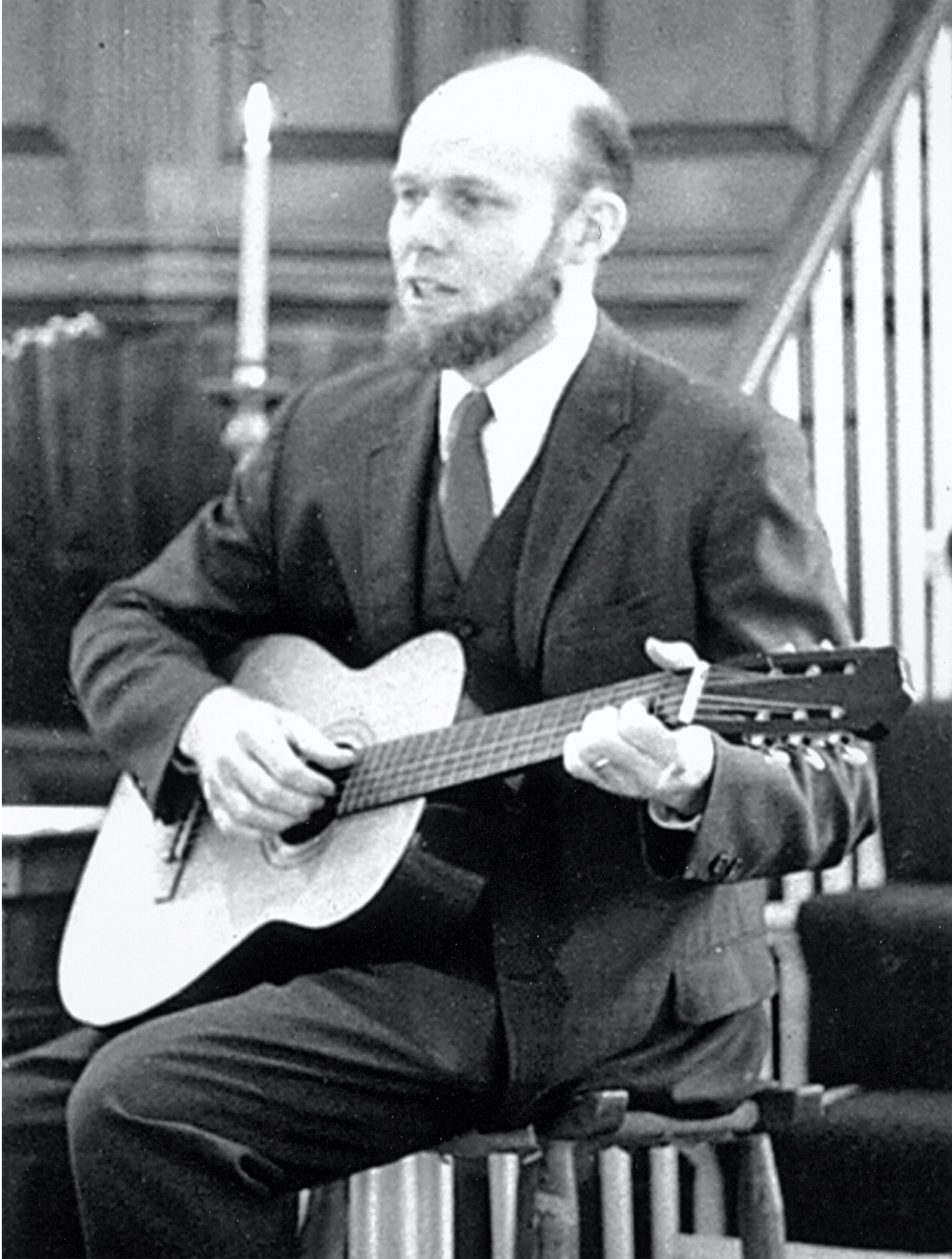
    Perhaps the most radical of these changes — I’d argue this was the most radical of all the changes to our Meeting House in its 275 year existence — was when the minister came out of the high pulpit and began preaching from the main floor. That minister was Edward Atkinson, who served this congregation from 1969 until his death in 1995. There’s a fabulous photograph of Ed Atkinson in our archives dating from the mid-1970s: he has a beard, he’s playing a guitar, and he’s sitting on a stool in front of the high pulpit. That one photograph encapsulates all kinds of stereotypes of the 1970s. [See a digitized copy of the photo below.]

    But we shouldn’t let the stereotypes obscure the truly radical act of a straight white cis-gender male minister stepping out of a symbolical position of great power, and coming down to the same level as the rest of the congregation. I’m inclined to understand this act as an embodiment of the feminist revolution that swept through Unitarian Universalism in the 1970s and 1980s. Male ministers, and men in general, began to understand the power they got just from being male. This helps explain why Ed Atkinson decided to step out of the high pulpit, out of the literal position of power.

    Second wave feminism brought other radical changes. We started lighting a flaming chalice in our worship services. This new religious ritual appears to have come from religious educators, ninety percent of whom were women. Lighting a chalice was an embodied ritual; it was something physical we did; it got us out of our heads and into our bodies. We adopted other new rituals that also got us out of our heads and into our whole selves including most notably lighting candles of joy and sorrow, and what we now call “Water Communion” that was originally called the “Water Ritual.”

    By the 1990s, we were no longer content to sit still for most of an hour and listen to the minister — the male minister — preach to us. We began to worship with more than just our heads; we began to worship with our hands and our bodies and our whole selves. This was a radical revolution in Unitarian Universalist worship. It is still continuing. We still spend a lot of time sitting and listening. But at least now we listen to as much music as the spoken word.

    Now let’s fast forward to the present day. Once again, we’re in the middle of a radical change in the way we use our Meeting House. That radical change is embodied in the livestreaming camera up in the gallery. You no longer have to be physically present in the Meeting House to participate in worship services. You can be in new Mexico, or in Wisconsin, or in Texas, or in Colorado, or Florida. Our Meeting House now exists online as well as in person.

    Our online presence is so new we don’t even know how it’s going to affect us. As one example of what I mean, I’ve been hearing from our members and friends at a distance that they would like to be able to participate in some way in the candles of joy and concern. Currently we mute the microphone during the candles of joy and concern, to preserve people’s privacy. But this seems to me to move us away from egalitarianism; we have unwittingly created a class of worshippers who cannot fully participate in our services. This at a time when our society is being polarized; this in a time when we need to embrace community and egalitarianism.

    And this leads me to the final point I’d like to make. It is we, the congregation, who create the meaning in this Meeting House. Yes, we are influenced by outside events — by abolitionism, by the second wave of feminism, by the online revolution. But we have a great deal of freedom in how we decide to respond to those outside events. We left behind the strict social divisions of 1750, while keeping the egalitarianism implicit in having our pulpit on the long wall. We embraced abolitionism in the mid-19th century. We embraced the feminist revolution in the 20th century.

    In the 275th year of this Meeting House, we find ourselves in another time of great change. What creative ways will we find to embrace online worshippers? The moral arc of our congregation has always bent towards greater inclusiveness, towards greater egalitarianism, towards greater justice. May we find ways to keep that moral arc bending in that direction.

    Man with beard sitting on a stool in front of the pulpit of First Parish in Cohasset. He is playing a guitar and wearing a three piece suit.
    Rev. Edward T. Atkinson circa 1974. Photo courtesy First Parish archives.