Sermon copyright (c) 2026 Dan Harper. As delivered to First Parish in Cohasset. The text below has not been proofread. The sermon as delivered contained substantial improvisation.
A three part series about free will — second sermon in the series — third sermon in the series
Introduction
[Dan Harper] Last spring, during the “Question Box Service,” someone asked for a brief theological history of First Parish. This sermon is a partial answer to that question. I found four readings — one from 1770, one from 1823, one from 1960, and one from 1998 — each one written by a different First Parish minister, each one representing one theological position from the past three hundred years. After Holly reads each of these readings, I’ll give a brief commentary on it.
Luckily, a number of First Parish ministers were quite good writers. Three of the four readings you’re about to hear came from published writings. I think you’ll enjoy hearing the distinctive voices of these four people.
Reading
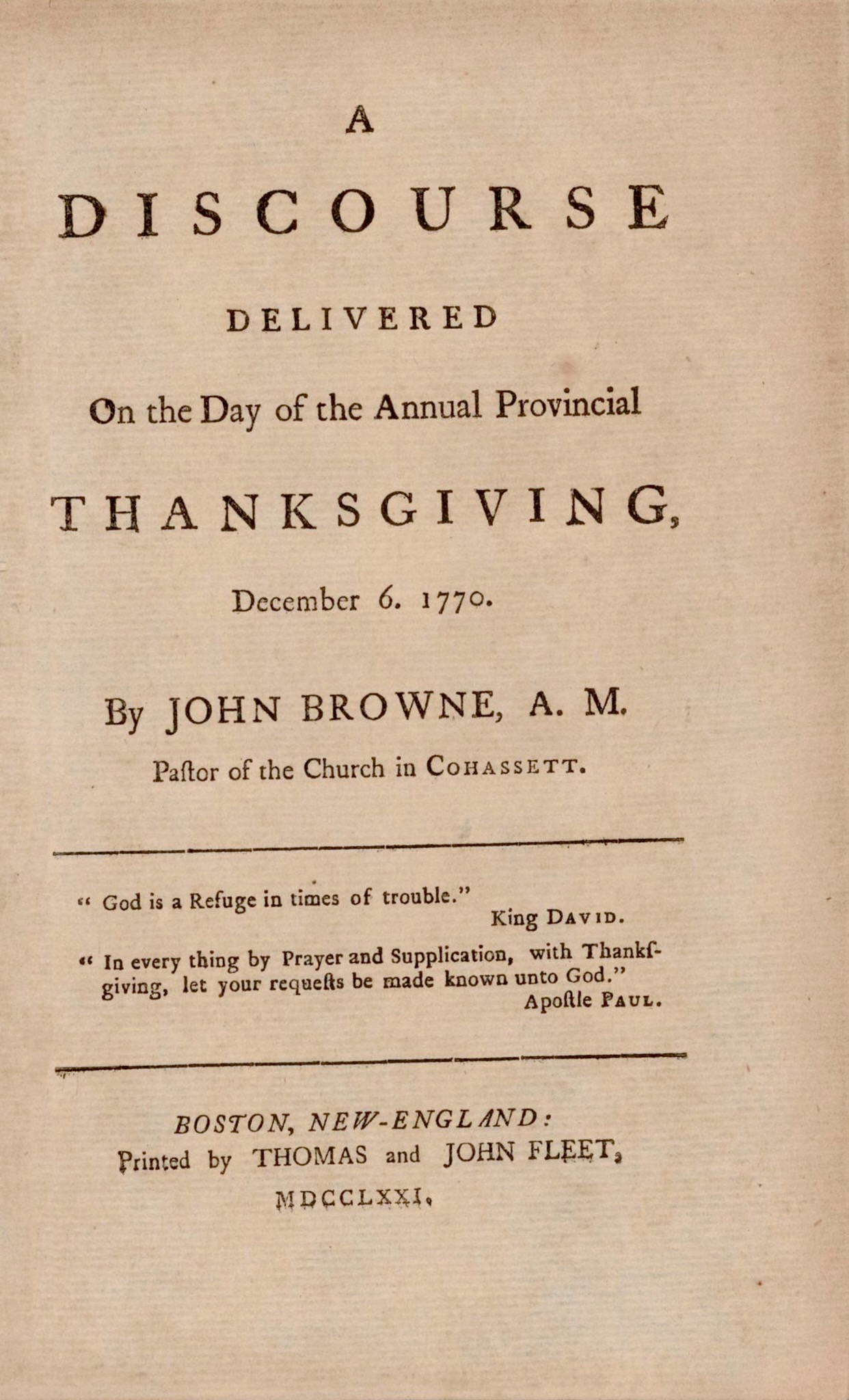
[Read by Holly Harris] The first reading comes from a sermon preached by Rev. John Browne to our congregation here in Cohasset on December 6, 1770. The sermon was titled, “A Discourse Delivered on the Day of the Annual Provincial Thanksgiving.”
“The consideration of God’s sitting at the helm of the Universe should ever dispose us to put our trust in him; and not greatly fear what man can do unto us. Never let it be said that the difficulties which we feel, or think we have reason to fear, cause us to be unmindful of our creator, preserver, and constant benefactor. It was once the expression of a very impious woman to her religious husband, when his property was invaded, his children destroyed, and his life endangered, ‘Curse GOD and die.’ But he replied in the greatness of his distress: ‘Thou speakest as one of the foolish women speaketh: What? Shall we receive good at the hand of God, and shall we not also receive evil?’ All that befalls the children of men is designed by their Maker to promote their happiness. The least glimmering of mercy amidst the greatest outward distress is sufficient to excite our gratitude, if we reflect properly on it.”
Commentary
[DH] Three decades before John Brown gave this sermon, Jonathan Edwards, a minister out in Northampton preached a very different kind of sermon. Jonathan Edwards titled his sermon “Sinner in the Hands of an Angry God,” and one sentence from that sermon will suffice to give you a sense of the whole:
“The God that holds you over the pit of hell, much in the same way as one holds a spider, or some loathsome insect over the fire, abhors you, and is dreadfully provoked; his wrath towards you burns like fire; he looks upon you as worthy of nothing else but to be cast into the fire; … you are ten thousand times more abominable in his eyes than the most hateful venomous serpent is in ours.”
John Brown believed in a very different kind of God. John Brown’s God was essentially good. John Brown’s God wants human beings to be happy. He admits that sometimes bad things happen to good people — sometimes God allows evil to befall us. But on the whole, John Brown’s God is trustworthy, merciful, and good. On the whole, John Brown’s God loves human beings.
Jonathan Edwards and John Brown represent the two sides of a great theological battle that raged in New England in the middle of the eighteenth century. On the one hand, people like Jonathan Edwards said that human beings are evil, that God despises us, that all human beings must throw themselves on the mercy of a wrathful and hate-filled God, even as that God is about to cast them into hell. On the other hand, people like John Brown said that both God and human beings are basically good, and that God’s love is more powerful that sin and evil.
There’s another important differences between these two theological positions. People like Jonathan Edwards believed that even before they were born, the majority of human beings were predestined by God to be sent to hell and eternal damnation. People like John Brown, on the other hand, believed that human beings had free will to choose goodness; in their view, God wanted to give humans every possible chance to show that they were worthy of God’s eternal love. This latter view was known as Arminianism, and nearly all Unitarian churches in New England come from this Arminian theology — this theology of humans having free will and being able to choose good.
Sadly, this theological battle continues to rage here in the United States. There are many right-wing Christians who believe that most human beings are loathsome insects that God is dangling over a fire. From what I’ve seen, such beliefs warp the people who hold them, encouraging them to despise poor people, women, immigrants, people of a different skin color. I continue to side with those who believe that human beings have infinite capacity for goodness, and infinite capacity for love.
Reading
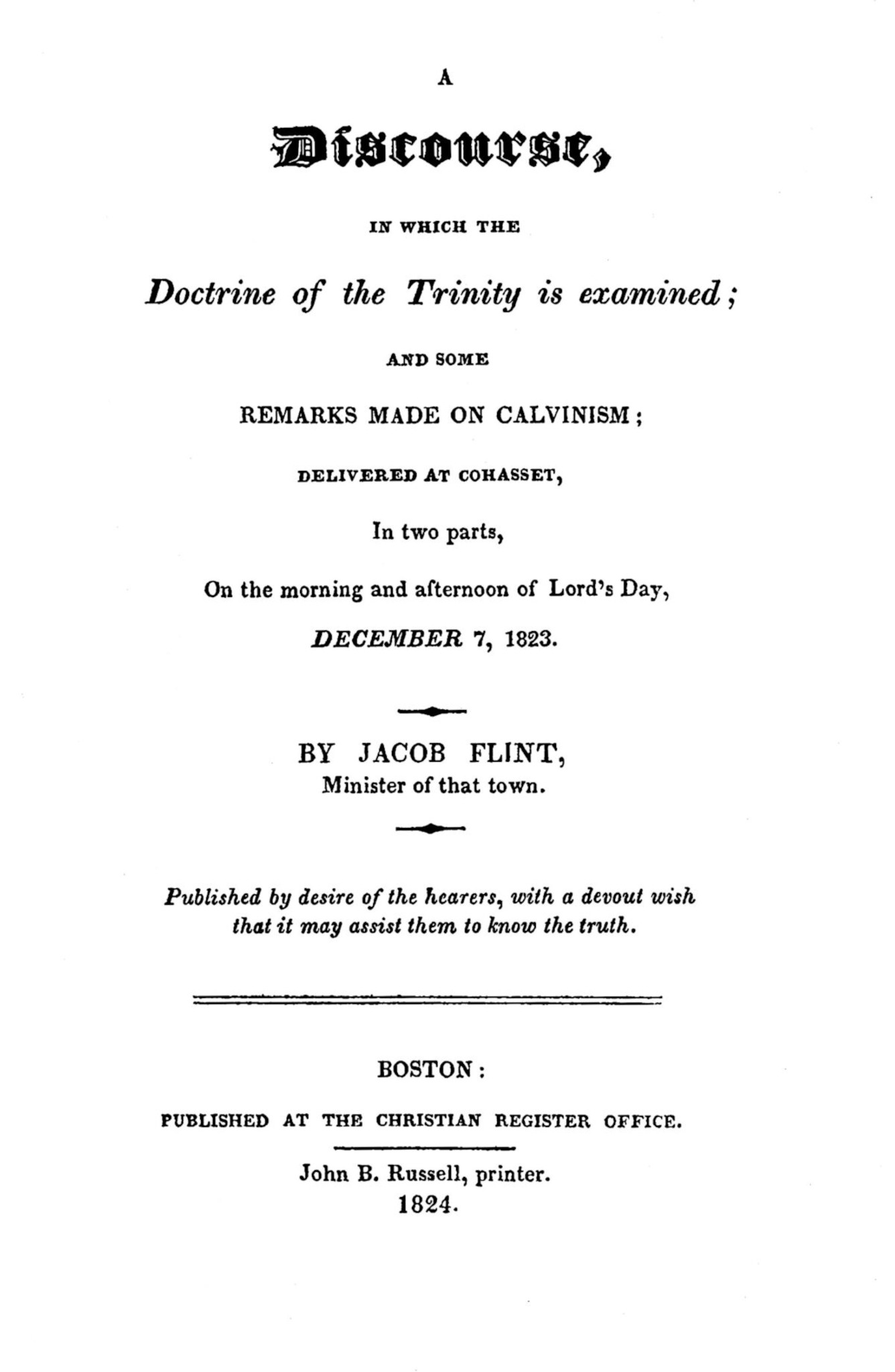
[HH] The second reading is from a sermon preached by Rev. Jacob Flint in the afternoon of December 7, 1823. The sermon was titled, “A Discourse in Which the Doctrine of the Trinity Is Examined.”
“The word ‘trinity’ cannot be found in the Old or New Testament; and there is not a word in any language among the tribes of men, which will express the existence of trinity in unity. The reason is, because such an existence is an impossibility in the nature of things. Professor Stuart is among the most able defenders of the trinitarian doctrine at the present day; and in his letters to Unitarians he states the question ‘How can three be one and one three.’ … ‘In no way,’ I necessarily and cheerfully reply. He still attempts to defend the doctrine. But he makes it only to be a distribution in the Godhead, and professes not to understand in what it consists. … In making Jesus, the Christ, [to be] God equal with the Father, we transgress the first of the ten commandments: ‘Thou shalt have no other God before, or beside me.’”
Commentary
[DH] By the early nineteenth century, the theological battle of the previous century had taken a somewhat different form. The Arminian camp — which included John Brown of Cohasset, and Ebeneezer Gay of Hingham, and Jacob Flint — the Arminians continued to believe that the universe was basically good, and that humans had the capacity to be good. Then their opponents, those in the Jonathan Edwards tradition, realized that the Arminians no longer believed in the Trinity; that is, they now refused to say that God was three persons in one. So the inheritors of Jonathan Edwards taunted them by calling them Unitarians. The Arminians decided that they liked that new term, and they began calling themselves Unitarians; even though the central element of their religious viewpoint was not the unity of God, but rather human freedom to choose goodness.
By the early 1820s, the Trinitarian party looked for towns where their party was in the minority, and then they would send in outside funding to set up a second, trinitarian church. Flint must have worried that the trinitarians were going to try this here in Cohasset, for on December 7, 1823, he preached a sermon in which he told his congregants that the doctrine of the trinity was ridiculous, and that they should all consider themselves Unitarians. Within weeks, a small number of trinitarians angrily withdrew from Flint’s congregation; outside money poured in, allowing Cohasset’s trinitarians to build a new building and hire a trinitarian minister.
When I read Jacob Flint’s 1823 sermons on Unitarianism, I agree with him on an intellectual level — I agree that the doctrine of the trinity doesn’t make intellectual sense. But I don’t feel the same need for intellectual purity that Flint seemed to feel. Day-to-day life can be difficult, and most of us have beliefs that maybe can’t be justified intellectually, but help us get through the days. When I compare Jacob Flint’s sermon to John Brown’s sermon, I find John Brown give me more help in getting through day-to-day life. When I’m confronted with the death of someone in my family, I don’t spend much time worrying about theological doctrines; but I find it comforting to be told that the universe is basically good, that even if I’m suffering evil now, on the whole things are going to be all right.
Reading
[HH] The third reading comes from a sermon by Rev. Roscoe Trueblood, preached to our congregation here in Cohasset circa 1960. The title of the sermon is “The Splinter in Your Brother’s Eye.”
“’Judge not, that ye be not judged,’ began Jesus. And immediately some interpretation is necessary. We know that he was not telling people not to judge anybody. He himself often judged people. Therefore, for a long time — since the early days of New Testament criticism, it has been certain that Jesus was simply saying, … Be careful how you measure people, especially their faults, and be sure to do it as you would want it done to you….
“And those who have read the Vedas of India or the writings of Zarathustra or the works of Mohammed, know that these and other scriptures come to the full support of Jesus on this point. Zoroaster urged that the common burdens and troubles shared by all human kind, ought to make destructive or vicious criticism impossible. Mohammed in his theory of the salt that dissolves in water and can be tasted at the surface, … or as deep as one can go, was saying that our common humanity ought to make us kind and to stir up a mutual sympathy. And, as you doubtless know, the Vedas many times over, present and describe this spirit of generous measurement and judgment, which this overflowing, ubiquitous spirit can present in the minds and hearts of all men. Why note the splinter in your brother’s eye — and consider NOT the plank that is in thine own?”
Commentary
[DH] Of all the ministers of this congregation whose sermons or other writings I have managed to get my hands on, I like Roscoe Trueblood the best. He was minister here from 1945 to 1949, and again from 1951 to 1968. To my mind, he represents the best of what I call Emersonian Unitarianism.
Ralph Waldo Emerson had a profound influence on Unitarianism. Emerson believed that all human beings can have a direct connection to truth and goodness, a direct connection to the divine. Emerson also believed that every human being should be responsible for themselves; to use one of his terms, we should be self reliant. This means both that we should each take charge of our own ethical decisions, and that we should take charge of our own spiritual growth. These two things go together. If you have a direct connection to the divine, a direct connection to truth and goodness, then you don’t need someone else to tell you how to be a good person — you can rely on your inner sense of how to be good. And if you can know how to be good, then you must take responsibility for your actions. I see this Emersonian influence in Roscoe Trueblood’s interpretation of the saying, “Judge not, that ye be not judged.” It is up to each of us to take care of how we judge others; we have enough access to the divine, each one of us, that we can take care in how we measure other people.
Emerson was profoundly influential in another way. Since he believed that all human beings had equal access to the divine, he felt that we can look at all religious traditions to find wisdom. It is thanks to Emerson that Roscoe Trueblood can say the wisdom we find in the Christian scriptures can also be found in the sacred writings of the Hindus, the Zoroastrians, the Muslims, in all great wisdom traditions.
I chose this excerpt from one of Trueblood’s sermons because he addresses issues that are of interest today. We live in a polarized society, where it’s considered normal and OK to go on social media and mock the opposing political party, to hateful things about anyone with whom one disagrees. Both liberals and conservatives are doing this — and moderates too. In response, Roscoe Trueblood would tell us that “the common burdens and troubles shared by all human kind, ought to make destructive or vicious criticism impossible.” And Roscoe Trueblood also draws our attention to the “spirit of generous measurement and judgment, which this overflowing, ubiquitous spirit can present in the minds and hearts of all.” When he says this, Roscoe Trueblood reminds me of Rev. John Brown — not only is the universe basically good, but human beings can choose to rise to the high level of the goodness of the universe.
Reading
[HH] The fourth reading is from a meditation by Rev. Elizabeth Tarbox, who was the minister of our congregation from 1997 to 1999. This is from her book “Evening Tide.”
“Where the light catches the tears in another’s eyes, where hands are held and there are moments without words, let us be present then, and alive to the possibility of changing. Let us seek to make another’s well-being the object of our concern. Let us seek to be present to another’s pain, to bathe another’s wounds, hear another’s sadness, celebrate another’s success, and allow the other’s story to change our own…..
“Let us not defend ourselves against the discomfort of unruly emotion, nor seek to close down our hearts for fear a new love will come to shake our foundations. Let us instead be open to discovering a new way of seeing an old problem, or appreciating the perfection of a seashell, or the possibility of friendship. For in giving ourselves to what we do not understand, we receive life’s blessings, and in taking care of another, we are cared for.”
Commentary
[DH] Elizabeth Tarbox is also in the Emersonian tradition. Like Emerson, she was a mystic who saw God in everything. Admittedly, it’s not clear to me how she conceived of God. I suspect she was a religious naturalist — that is, she did not spend much time worrying about supernatural things, but instead paid attention to her senses, and found the divine in what she found in this world. Curiously enough, this impulse towards religious naturalism extends back to the beginnings of our congregation. For the first half century of our existence, our congregation was under the influence of Rev. Dr. Ebeneezer Gay of Hingham, who once said that we do not need a Bible for there is another book which can always be studied: “The Heavens, the Earth and the Waters, are the Leaves of which it consists.”
Elizabeth Tarbox was more willing to embrace the full range of human emotions than the other ministers we’ve heard from. She was a product of feminist theology, and feminist theology taught us that emotions were just as much a part of religion as intellectual theology. This is not to say that Roscoe Trueblood and Jacob Flint and John Brown were unfeeling — but feminist theology gave us greater permission to feel our religion, not just think it. A history of the Middleboro Unitarian Universalist congregation, where Elizabeth Tarbox was minister before coming to Cohasset, describes the emotional impact of her sermons: “Parishioners were frequently so moved, they sat in voluntary silence after the postlude, often with tears streaming down their faces.” This is a far cry from Jacob Flint’s heady intellectual treatment of the doctrine of the Trinity.
Conclusion
[DH] I’d like to point out two theological concepts that seem to run through the entire history of First Parish in Cohasset.
First of all, we have long stood for religious liberty. I can find no evidence that we ever had a creed. We had a covenant; but it was entirely optional as to whether you signed the covenant or not. For much of our history, we have been tolerant of a fairly wide range of beliefs. The search for truth and goodness requires religious liberty.
Secondly, we have long believed that human beings have the capacity to make this world a better place; or conversely, to turn this world into a kind of hell on earth. That is to say, we asset that human beings have free will. Instead of blaming evil on some original sin and an abusive father-figure of a God, we have seen that much of the evil in this world comes from human beings, while the rest comes from the random chance of unfortunate occurrences.
Today, we also recognize that with great freedom comes both great power and great responsibility. We define ourselves by our actions. We do not believe that human beings have some pre-ordained essence: we do not have original sin, but nor are we essentially good; rather, we constantly define and redefine our own essence through our own actions. Personally, it is this religious problem I struggle with more than any other. It would be so much easier if I could just say — oh, I’m basically a good person — or even: oh, I’m basically sinful. Life becomes more difficult when we realize that it we who define who we are, by the way we act in the world. This is such important matter that I’m going to devote the next two sermons to it.
However, I won’t keep you in suspense. It really all boils down to what Roscoe Trueblood said back in 1960: “our common humanity ought to make us kind and to stir up a mutual sympathy.” In the end, that’s all there is to it: kindness and the mutual sympathy of human connection.