• Water Ritual, 2023

    Homily and moment for all ages copyright (c) 2023 Dan Harper. As delivered to First Parish in Cohasset. As usual, the sermon as delivered contained substantial improvisation.

    The Water Ritual

    [introduced by Dan Harper and Kate Sullivan]

    The water ritual helps us recognize how our common humanity connects us together. We symbolize that connection when we each pour a bit of water into a common bowl. The water ritual also reminds us that when we come together here in this meetinghouse we can become one in our common humanity.

    As you pour your water into the common bowl, think about where your water came from. Then think how your water connects you with everyone else here. Perhaps you brought water from your kitchen sink, precious water in this time of drought, water that connects you with everyone else who lives in this watershed. Perhaps you brought water from the ocean, and it reminds you of how you’re connected to all the creatures that live in the ocean. Think about where your water comes from, and how it connects you to other humans and non-human beings.

    Here’s how we will collect the water. Mary Beth will play music for us. When she begins playing, please use the center aisle to come up to the front of the Meetinghouse. When your turn comes, pour your water in the common bowl, thinking about where it comes from and how it connects you to the universe. Then please use the side aisles to return to your seat.

    We come from different walks of life, from different ethnicities and races, from different political persuasions. Yet in spite of our differences, we are all connected, we are all one people.

    Moment for All Ages

    [This is a slightly revised version of my “Connected by Water” — if you want the PDFs for the large numbers, click here then scroll down till you reach it.]

    We already heard how when we each pour water into the common bowl, it symbolizes that while we are separate individuals, we are also all connected. Now let me tell you how it is literally true that we are all connected through the changes of the water cycle.

    You probably know about the water cycle. When it rains, water falls from clouds onto the ground, and eventually it flows into a river, and all rivers flow down to the ocean. Water evaporates from the ocean and forms clouds, the clouds drift over the land, it rains, and the cycle begins again. You’re in the middle of this cycle because you drink about 2 liters of water every day, and then you sweat or urinate which puts water back into the water cycle. Water is constantly on the move through the water cycle.

    You probably know that water is made up of molecules, and that each water molecule is made up of two atoms of hydrogen and one atom of oxygen. Water molecules are incredibly tiny, so tiny you cannot see them. If you had 18 grams of water, or a little more than half an ounce, that would be about 6 times ten to the twenty-third (6×10^23) molecules. The molecular weight of water is approximately 18, and therefore 18 grams of water should have a number of molecules equal to Avogadro’s number, or 6.02 x 10^23.

    This is a fairly large number. I can show you what this number would look like. This would be 602 — [start unfolding the large printed version of this number]. This would be 602 million. OK, if I go any higher, I’m going to need some adults to help me hold this very large number up (I need adults because they are tall enough to hold it up where everyone can see it). [Get three or four helpers to hold up the number.] Thank you! Now you can see this very large number: 6.02 x 10^23, or 602 sextillion.

    If you’re a child who weighs about 77 pounds, or 35 kilograms, then you have about 20 liters of water in your body (adults, you can multiply up to figure it out for yourselves). That’s approximately 20,000 grams of water, or 6.02 x 10^26, or 602 septillion, molecules of water in your body if you’re a child. And if you drink 2 liters of water a day, you’re replacing about ten percent of that, or 6 x 10^25 molecules, each day. So if you are 3,650 days old (that’s ten years old), about 2.2 x 10^28 water molecules have already passed through your body. This is an even larger number, and here’s what that number looks like — [start unfolding the large printed version of this number]. Oh, I guess I’m going to need helpers to hold up this number as well. [Get four or five people to hold up this number.]

    Because water is constantly cycling around, and because every human being has such large numbers of molecules of water cycling through them, there’s a very good chance that each one of us has at least a few molecules of water that were formerly in the body of Socrates, the great philosopher. We each probably have some molecules of water that were once in the body of Jesus of Nazareth, and of the Buddha, and any number of great and wise people who lived in the past.

    Thus when we say that we are all interconnected, that statement is quite literally true. We are all interconnected through the water cycle, not only with each other, but with all living beings past and present. Jesus of Nazareth, Confucius, Ralph Waldo Emerson, Ellen Sewall Osgood: you might be literally connected with each of these good and wise people.

    Readings

    The first reading was by Linda Pinti. This is part of what she read during the original 1980 Water Ritual when she poured her water from East Lansing, Michigan, into the common bowl: “…I took my bucket and went out to the Grand River. As I gathered water I watched the river: moving, flowing, changing. I was reminded of an image in depth-psychology which tells us that each of us, each of our beings, is like a well: if you dig down deep enough into the well of our beings, you will hit the ground water that we all share. The ground water which flows between and among us connects us to each other and to the ‘All That Is’….”

    The second reading was a poem by Pat Simon from the original 1980 Water Ritual. Pat’s poem can be found on the Unitarian Universalist Women and Religion website — scroll down, or search for “Simon” to find her poem.

    Homily

    Here we are, back together again at our annual ingathering service. And I wanted to tell you just a little bit about the Water Ritual that’s the centerpiece of this annual service.

    The first Water Ritual grew out of the feminist movement in the 1970s. At that time, quite a few Unitarian Universalists started asking some hard questions about religion. For example, even though we started ordaining women as ministers way back in 1863, by 1970 almost all our Unitarian Universalist ministers were male: why was that? Another example: in those days, our hymns referred to all of humanity as “mankind” instead of “human kind”: again, why was that?

    One of the people who was asking these hard questions was Lucile Shuck Longview, a member of First Parish of Lexington, Massachusetts. In 1975, Lucile Longview decided to challenge the sexist language and attitudes that then existed in Unitarian Universalism. She wrote up a resolution to be voted on by General Assembly, the annual gathering of Unitarian Universalists. She later recalled:

    “I conceived of and wrote the [Women and Religion] resolution and sent it to 15 associates around the continent, soliciting feedback. They encouraged me to proceed, and offered suggestions. At First Parish in Lexington, Massachusetts, six other laywomen, one layman, and I sent personal letters to members of churches, with copies of the petition to place the resolution on the agenda of the 1977 General Assembly [and] we received more than twice the requisite 250 signatures.”

    I met Lucile Longview twenty years after this, when I worked at First Parish of Lexington. She was quite a person. I can imagine her sitting around the big wooden butcher block table in the large pleasant kitchen of the Lexington congregation, talking over the proposed Women and Religion resolution. All eight of those people were parents, and Lucile herself had been the director of religious education for the congregation. All of them wanted to be sure that the children and teens in their lives were treated equally, no matter what their gender was.

    I’m going to shorten this story by leaving out some major plot twists. Suffice it to say that Unitarian Universalsits at General Assembly voted unanimously for the Women and Religion resolution. As a result, we started work on a new non-sexist hymnal — that’s the gray hymnal that we still use. And we started supporting all genders to become ministers, so that now less than half of Unitarian Universalist ministers are male, and the rest are women and other genders.

    Another result of the Women and Religion resolution came in 1980, when a large group of women gathered in East Lansing, Michigan, for what they called a “Convocation on Feminist Theology.” For the Convocation, Lucile Longview and her friend, Carolyn McDade, developed the Water Ritual to welcome the people who came to the meeting. They asked several people to bring water from wherever they lived. During the Water Ritual, everyone sat in a circle around a big bowl. The women who had been asked to bring water poured the water they had brought from home into the big bowl. Even though everyone shared just a little bit of water, soon the bowl was full, a symbol of how big changes can happen if each person does just a little.

    The Water Ritual soon was adopted by almost all Unitarian Universalist congregations. (Somewhere along the way, people started calling it “water communion,” but to honor Lucile Longview and Carolyn McDade I’m going to call it the Water Ritual.) Each year, we have a Water Ritual here in Cohasset to remind us for two reasons: as a way of gathering together again for another year; and to remind ourselves that all genders are equally important.

    I feel as though rituals and ceremonies like these are especially important in today’s world. I am deeply troubled by the rise of extremist groups like the Proud Boys, who tell us in their loud voices that women aren’t as good as men. I’m also troubled by the state governments that are passing laws that discriminate against transgender and non-binary gender people. These people do not believe that all genders are equally important, and equally good.

    The Water Ritual also seems important when I remember that men still get paid more than other genders for doing the same work. And this is true everywhere, including in workplaces where you would expect equal pay to be the norm. One example is Vassar College, which has long proclaimed itself as being dedicated to equality between the sexes. You’d think that if any employer understands that women and men deserve equal pay, Vassar College should understand it. Yet the tenured professors of Vassar College are currently bringing a lawsuit against Vassar alleging that there has been a pattern of wage discrimination against women professors. Reuters news agency reports the allegations: “The percentage pay disparity between female and male professors on its faculty has grown since the school year starting in 2003 from 7.6% to 10% in 2021….”

    And gender-based discrimination covers more than just the wage gap between men and women. Women and other genders are far more likely to be the victims of gender-based violence than are men. Women are far more likely to be victims of domestic violence than are men. Men, on average, have better access to better health care than do other genders. Men are far more likely to fill the highest wage jobs, like being the CEO of a company, than are women and other genders. All this is, quite simply, unfair.

    So we Unitarian Universalists need to stand up for the dignity and the equal worth of all genders. Jesus of Nazareth and Rabbi Hillel both taught that we should love our neighbors as we love ourselves. The old-time Universalists taught that all persons are equally worthy of God’s love. Some of us might talk about the inherent worth and dignity of all persons. Or we might affirm the importance of what Dr. Martin Luther King, Jr., called “Beloved Community,” in which all persons are valued for who they are.

    Each year when we have the Water Ritual, we are reminded how we are all connected. And the Water Ritual goes beyond reminding us how we are all connected — it also reminds us of the essential equality of all human beings — all genders, all races, all ethnicities have inherent worth and dignity, are all equally worthy of universal love. May we live out this dream in our lives in the year to come.

    Notes

    See: “The Water Ritual” on the Unitarian Universalist Women and Religion website for the original 1980 Water Ritual.

    See: “Water Rituals and Ingatherings, Revitalized” on the Harvard Square Library website for a historian’s account of the Water Ritual.
  • Looking at Flowers

    A “moment for all ages” at First Parish in Cohasset, (c) 2023 Dan Harper. I didn’t follow this text exactly, but it will give you the general idea.

    Moment for all ages: “Looking at Flowers”

    The children and youth may come forward now if you wish, and if you brought a flower today, bring it along.

    If you brought a flower to share, you can put it in one of the vases on the table. (And if you didn’t bring a flower, here are some extras so you can have one to put in a vase.) The adults are going to do this, too. You people get to go first because you’ll want your hands free so I can give you another flower. You’ll see why you want a different flower in just a moment.

    [Hand out flowers that can be dissected]

    Often we look at a flower and say, Wow, isn’t that pretty. The color or the shape of the flower catches our eyes, or maybe we admire the scent. Well, I’m going to try to convince you that a flower is a whole lot more than that.

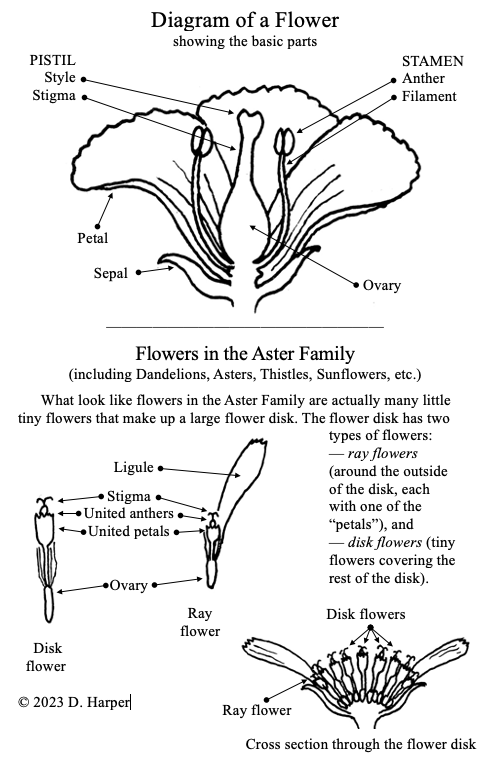
    Look closely at the flower I handed you. Now look at the diagram I gave you, and see if you can find the different parts of the flower.

    Let’s start with the petals and sepals. See those?

    Now let’s look at the tiny parts of the flower. Use a magnifying glass if you want. The pistil is in the middle, and it’s made up of the style and the stigma. The stamens are around the center, and they’re made up of anthers, which are held up by filaments. That structure down at the bottom is the ovary. If you want to, you can take off some of the petals so you can see the inside better (this is why I gave you these flowers, so you can pull them apart).

    The stamens produce pollen. The pistil takes the pollen that the stamens produce, and send it down to the ovary. The ovary is the part that turns into a seed.

    So how does the pollen get from the pistil to the stamen? Depending on the flower, the pollen can be transferred by an insect such as a bee; or a bird or a bat or another animal; or sometimes by wind or water.

    When an insect like a honey bee or a bumble bee comes to a flower, they are not looking for pollen. They are looking for nectar. Usually the flower stores the nectar deep inside the flower, at the base of the ovary. That way, the insect has to crawl all the way into the flower to get the nectar reward, which makes it more likely to get pollen on it. So the bee gets the nectar reward, and in return the bee helps the flower get pollinated. Look at your flower and imagine how a bee would spread the pollen around while getting its nectar reward.

    If you get a chance, try sitting outside and watching a flower to see what insects come visit it. (If you stand a couple of feet away from the flower, and don’t make any sudden moves, the bees won’t sting you; they’re too busy getting nectar.) There are dozens of different kinds of bees: from bumble bees, which are pretty big, to tiny little sweat bees that are bright green in color. When you look closely, each flower is like a miniature world.

    But what’s really fascinating is that bees need flowers so they can make honey from the nectar. And flowers need bees to move the pollen from stamen to pistil. This is yet another example of the interconnected web of all existence.

    If you want to keep looking at your flower you can take it with you. But please leave the magnifiers here. And now you return to sit with your families again.

    Diagram showing parts of a flower
  • Mother’s Peace Day

    Sermon copyright (c) 2023 Dan Harper. As delivered to First Parish in Cohasset. As usual, the sermon as delivered contained substantial improvisation.

    Readings

    The first reading was the “Mother’s Day Proclamation” by Julia Ward Howe:

    Arise, then, women of this day!

    Arise, all women who have hearts, whether your baptism be that of water or of tears! Say firmly: “We will not have great questions decided by irrelevant agencies, our husbands shall not come to us, reeking with carnage, for caresses and applause.

    “Our sons shall not be taken from us to unlearn all that we have been able to teach them of charity, mercy and patience. We women of one country will be too tender of those of another country to allow our sons to be trained to injure theirs.”

    From the bosom of the devastated earth a voice goes up with our own. It says, “Disarm, disarm! The sword is not the balance of justice.” Blood does not wipe out dishonor nor violence indicate possession.

    As men have often forsaken the plow and the anvil at the summons of war, let women now leave all that may be left of home for a great and earnest day of counsel. Let them meet first, as women, to bewail and commemorate the dead. Let them then solemnly take counsel with each other as to the means whereby the great human family can live in peace, each learning after his own time, the sacred impress, not of Caesar, but of God.

    In the name of womanhood and of humanity, I earnestly ask that a general congress of women without limit of nationality may be appointed and held at some place deemed most convenient and at the earliest period consistent with its objects, to promote the alliance of the different nationalities, the amicable settlement of international questions, the great and general interests of peace.

    The second reading was from “Gitanjali 35” by Rabindranath Tagore:

    Where the mind is without fear and the head is held high;
    Where knowledge is free;
    Where the world has not been broken up into fragments by narrow domestic walls;
    Where words come out from the depth of truth;
    Where tireless striving stretches its arms towards perfection;
    Where the clear stream of reason has not lost its way into the dreary desert sand of dead habit;
    Where the mind is led forward by thee into ever-widening thought and action
    Into that heaven of freedom… let my country awake.

    Sermon: “Mother’s Peace Day”

    It appears that the very first mention of Mother’s Day dates back to 1870. Julia Ward Howe, a Unitarian and author of the popular Civil War song “The Battle Hymn of the Republic,” had grown horrified at the actual results of war. She was horrified by how many young men were killed or disabled by war, but she was also horrified by what war did to the moral character of those who fought. A mother herself, she wrote in her proclamation for Mother’s Peace Day: “Our sons shall not be taken from us to unlearn all that we have been able to teach them of charity, mercy and patience.” Thus she issued her historic call for all mothers everywhere to come together in an international congress of women in order to promote world peace.

    After that initial proclamation of Mothers Peace Day in 1870, the idea of a day for mothers to take action together was forgotten until 1907. In that year, an Episcopalian laywoman named Anna Jarvis organized a worship service for mothers at her church in West Virginia. She did so in part to honor her own mother, Ann Reeves Jarvis, who had been a peace activist who had worked with Julia Ward Howe, and had supported Howe’s original idea for a Mother’s Peace Day. So our modern Mother’s Day began with a worship service in 1907, which had been inspired by Julia Ward Howe’s original vision of Mother’s Peace Day.

    Since 1907, Mother’s Day has continued to evolve. By the mid-twentieth century, Mother’s Day was not centered on a church service. It had become a holiday that upheld a view of women then permeating American society: a woman was supposed to get married young, have lots of children, and subsume her identity in motherhood. This mid-twentieth century myth of motherhood ignored all the women who chose not to marry, or who were unable to have children, or didn’t become mothers for whatever reason. Unfortunately, when Mother’s Day became a day to uphold that old mid-twentieth century myth of motherhood, the original purpose of the day was forgotten. No longer were mothers actively taking control of the destiny of the world. Instead of mothers coming together as peace activists, mothers were supposed to be passive recipients of cards and flowers from their children and husbands. If they were lucky, mothers got taken out to lunch; at least then there was one less meal they had to cook and clean up after.

    During the second-wave feminist movement of the 1970s, some feminists began to criticize Mother’s Day: why should women be reduced to being mothers? Why couldn’t we value women for all their contributions to society? These were needed criticisms, helping society to understand that women could be more than stereotypical mothers. At the same time, it turned out that many feminists happened to like Mother’s Day. We liked the thought that there might be a special connection between a mother and the children to whom she had given birth. We liked giving cards or flowers to our mothers. We liked the thought of taking our mothers out to lunch — although in my family, my mother, being a thrifty New England Yankee, was resistant to buying lunch in a restaurant.

    In the twenty-first century, Mother’s Day continued to evolve and change. We began to re-evaluate the American myth of motherhood. We began to expand our understanding of what it meant to be a mother. We had already heard from women who had adopted their children, who had pointed out that their connection with their children was just as special as that of biological mothers. At the start of the twenty-first century, increasing numbers of same sex couples began having children, and male couples began to point out that they provided the mothering that their children wanted and needed. In the past decade, increasing numbers of transgender and non-binary people began having children, and they too have pointed out that mothering is not limited to just one gender.

    And in the past half century, we have also learned to adopt the the perspective of children when we think about motherhood. For some children, their fathers provide more mothering than their mothers. Some children have cold or distant parents, and get their mothering from people who are not their parents. There are of course a great many children who do get mothering from their biological or adoptive mothers, but we began to understand that those children can get mothering not just from their mothers, but from other people in their lives — fathers and aunts and older siblings and teachers and so on.

    We have expanded our understanding of motherhood, and this has come about in part because we have expanded our understanding of gender. It used to be that our society took it for granted that biological sex, gender identity, and gender role were all the same thing. Indeed, some conservative Christians still believe that if your biological sex is female then you are female, and many states in the South are passing laws that uphold this conservative Christian notion of sex gender. Many of those conservative Christians also believe that all women should be ruled by biological males, and should stay at home to raise children; these conservative Christians want to go back to that mid-twentieth century stereotype that the only appropriate role for a biological female is to be a mother.

    However, the rest of our society has come to understand that biological sex, gender identity, and gender role can be quite separate. For example — and this is an example that gets the most press these days — our society is coming to understand that there are transgender people whose biological sex happens to be different from their gender identity. But our society is also coming to accept that people can take on a gender role that is different from their biological sex or their gender identity. We are coming to understand that man can be nurturing and can even take on the role of mothering; we are coming to understand that people who do not have children of their own can take on the role of nurturing and mothering.

    We are slowly expanding our understanding motherhood to include a wider range of actual experiences. Of course we still celebrate biological females who give birth to new human beings. But now we can also celebrate those biological females who do not fit comfortably into the gender role of nurturing female, and we can also celebrate the biological males who take on the role of a nurturing mother. We can celebrate people of any gender identity, of any biological sex, who take on the gender role of mothering.

    This helps us to expand Julia Ward Howe’s original idea of Mother’s Peace Day. Howe knew that anyone who had been a mother would not want to send their child off to war. Anyone who had been a mother would not want to see their child killed or maimed or traumatized by the horrors of war. That is why she ended the original Mother’s Peace Day Proclamation with these words: “I earnestly ask that a general congress of women without limit of nationality may be appointed and held at some place deemed most convenient and at the earliest period consistent with its objects, to promote the alliance of the different nationalities, the amicable settlement of international questions, the great and general interests of peace.” Howe’s idea is quite logical and straightforward: If she could just gather all the mothers of the world together in one great room, surely they could find a way to put an end to war. She was thinking about just those biological females who happened to have given birth, but why not include in that gathering all those who people who have filled some sort of mothering, nurturing role? The more people we can find who have filled a nurturing mothering role, the more people there are who will feel committed to ending war.

    This might include people who would never be called mothers. Take me, for example. I’m a biological male, my gender identity is male, I’ve never had children of my own. Yet I spent a couple of decades doing religious education, and in my own way I helped raise two or three generations of young people. And there are quite a few people like me, people who didn’t exactly do any mothering, but who wound up doing a lot of nurturing. When add together all the mothers with the non-mothers who did a lot of nurturing, that adds up to a great many people who have put a lot of effort into helping the next generation grow up. And we would all prefer it if the next generation were not killed or maimed or traumatized by war.

    I like to think that Julia Ward Howe would have welcomed no just women but nurturing people of all genders to her “general congress of women without limit of nationality.” I suspect Julia Ward Howe would have given the women and mothers the seats of honor in the front of the congress. But she would have welcomed anyone dedicated to keeping our children safe — people of all genders; teachers and social workers and doctors and anyone who nurtured others; aunts and uncles and cousins and older siblings and anyone who didn’t happen to have children of their own but helped raise and nurture children — anyone who has contributed to raising up the next generations. I think Julia Ward Howe would welcomed us all to her great congress.

    And to me, this remains the central meaning of Mother’s Day. Not that any of this should interfere with your traditional celebration of Mother’s Day. Do whatever it is that you usually do on Mother’s Day: call your mom, let your children take you out to lunch, take your spouse out to lunch, ignore the whole thing. I don’t mean any of this to interfere with your celebration of Mother’s Day, but perhaps the thought of Julia Ward howe and Mother’s Peace Day will add to your celebration. If we were all better at mothering, perhaps the world would be a better, more peaceful place. If our world leaders learned some mothering skills, if they allowed themselves to be more nurturing, perhaps we would have fewer wars. Maybe that’s too much to ask — it’s hard for me to imagine that Vladimir Putin knows what it is to nurture others. But what if he could change? What if he could become empathetic? What if he could forget his own egotistical ambitions and learn to how to selflessly nurture those people who are not as strong or powerful as he?

    What if all our world leaders learned how to be empathetic and nurturing? That is, what if all world leaders lived up to the late nineteenth century ideal of motherhood? What if Julia Ward Howe’s great congress of mothers had actually gathered, and had actually taken on real power? We can imagine that such a congress would have focused on how to nurture and raise the next generation. And if our governments were formed with the goal of nurturing and raising the next generation, perhaps we would finally put an end to war.

    Of course Julia Ward Howe’s great congress of mothers was not able to take control of world affairs in 1870. Given the rampant sexism of the time, it was too much to expect that a congress of mothers could in fact take over the world. Nor are the chances for a great congress of mothers much better in today’s world.

    That does not mean that we should lose all hope. We can start small. We can honor and support empathetic nurturing wherever we may find it. We can honor every person in our lives who nurtures others with empathy. There are people of all genders who nurture others with empathy. There are people of all ages who nurture others with empathy. Both parents and non-parents can be nurturing influences in the lives of others. We can honor all these people, and we can support them in their efforts to raise the next generation — to raise up a generation that in its turn will be more nurturing and empathetic than we are today. Perhaps one day, everyone will know the central skills of mothering — nurturing, empathy, and kindness.

    Until that time comes, may we continue to honor the mothers among us. Those of us who had empathetic nurturing mothers can honor their roles in our lives, and if our mothers are still alive we can send them a card or maybe even take them out to lunch. Those of us who have a spouse who is a mother can honor our spouse. All of us can remember and honor all those people in our lives who helped to nurture us.

    And so may I wish all the mothers among us a happy Mother’s Day. May you be honored for all you do, and all you have done. And in the spirit of the original Mother’s Peace Day, may your example of mothering be an inspiration to the rest of the world — so that together we may, in the words of Julia Ward Howe, “take counsel with each other as to the means whereby the great human family can live in peace.”