Tag: American War of Independence

  • A Revolutionary Religion

    Sermon copyright (c) 2023 Dan Harper. As delivered to First Parish in Cohasset. The sermon text may contain typographical errors. The sermon was actually delivered by Bev Burgess, worship associate, because I was out of town on family leave.

    Reading

    The reading this morning is an excerpt from a biography of Rev. William Emerson, the grandfather of Ralph Waldo Emerson, and minister of First Parish in Concord, Massachusetts, in 1775. This biography was written by Rev. Dana McLean Greeley, minister of the Concord church in 1975, and published in his book Know These Concordians: 24 Minutes Biographies (1975). Although Greeley was a pacifist, he was also a patriot, and fully appreciative of William Emerson’s military service in the Revolutionary War.

    In 1765 William Emerson became the minister in Concord. He seems to have been as conscientious a pastor as he was studious as a scholar; and the indication is that he called constantly on his people, and likewise entertained both people and visitors at the Manse. He was friendly and warm, even if held somewhat in awe by many of his parishioners.

    Eight years rolled by before the spirit of rebellion against the oppressiveness of King George III began to come to a head. The Concord minister had been among the patriots who were early spokesmen for the cause of freedom. With Jonathan Mayhew in Boston and Jonas Clarke in Lexington, he had used his pulpit to point out the injustice of the British rule, and to stimulate the imaginations and undergird the moral courage of his listeners. He had plenty of company in the town in support of his views, but he did not fail to exercise a role of leadership. So when the First Provincial Congress met in Concord, having moved there from Salem, it was not strange that as John Hancock of Boston was elected president, and Benjamin Lincoln of Hingham as secretary, so the Reverend William Emerson was elected chaplain. It is said that in the following Spring he watched the battle at the North Bridge from his house (on the 19th of April) and properly recorded it in his diary afterward, although there is also the suggestion that he may have been closer to his men, and encouraging them in the battle, and not just a spectator….

    Before we speak of his departure to Ticonderoga, we must mention his going to Cambridge after the battle [at Concord], his constant service with the army, his breakfast and frequent meetings with George Washington, his preaching to the soldiers, and his participation at Bunker Hill. He himself did not distinguish between General Washington and the humblest soldiers. All men seemed to count equally in his sight….

    On August 16, 1776, he bade a brave farewell himself to his family and his town, and knew not that he would never return…. He was at Ticonderoga, and then contracted a fatal disease, typhoid or dysentery, and died in Rutland, Vermont…. He had expected his own death, and his letters home were very tender…

    The ‘Old Manse’ which he built for his bride, Phebe, and his family, is a continuing monument to him, but so is a bit of the independence of the United States of America.

    Sermon: A Revolutionary Religion

    We are rapidly approaching the United States of America semiquincentennial, or two hundred and fiftieth birthday. (There are, by the way, several words used for a two hundred and fiftieth birthday, but “semiquincentennial” is what the National Park Service calls it.) Most of the United States will be celebrating the nation’s semiquincentennial in 2026, but those of us who live here in Massachusetts know that the real semiquincentennial anniversary commemorates April 19, 1775, what we call Patriots’ Day.

    April 19, 1775, marked the real beginning of the Revolutionary War. The momentous events of that day are sometimes called the Battle of Concord and Lexington, but to use that term ignores the fact that several other towns also saw armed conflict. In fact, the first colonist blood of the war was shed in the town of Lincoln, just after midnight, when one of His Majesty’s troops slashed Lincoln militiaman Josiah Nelson on the head with a sword. And some of the most heated fighting took place in Menotomy, which is now called Arlington. And dozens of towns sent militia men and Minute Men to the battle. But for the sake of convenience, I’ll call it the battle of Concord and Lexington. (1)

    As we approach America’s semiquincentennial, I would like us Unitarian Universalists to remember that our co-religionists were right in the thick of the Revolutionary War from the very beginning. Both Unitarians and Universalists were deeply involved in the American Revolution.

    The first major engagement on the morning of April 19, 1775, was in Lexington, where at sunrise several hundred Redcoats fired at a small interracial company of colonial militiamen, killing eight and wounding several more. This engagement took place on the town green, right next to the church. The congregation that met in that building is still in existence, and is now called First Parish in Lexington, and it later became a Unitarian Universalist church. The commander of the Lexington militia was a man named John Parker, who famously said, “Stand your ground. Don’t fire unless fired upon, but if they mean to have a war, let it begin here.” But John Parker should also be remembered because the small company he commanded included both Black and White militia men. (2)

    John Parker did not live long enough to hear the name “Unitarian” applied to his religion, though we usually consider him to have been a Unitarian on the basis of his church affiliation. But the succeeding generations of the Lexington Parkers were very definitely Unitarians. One of John Parker’s grandsons, Theodore Parker, was a Unitarian who inherited his grandfather’s revolutionary spirit, in more ways than one. Theodore grew up to become a Unitarian minister, a Transcendentalist, and an abolitionist. As an abolitionist, he sheltered people escaping from slavery in his own house, and later recalled that at times he had to keep a loaded pistol on the desk beside him as he wrote his sermons, in case the slave catchers came to his door. (3)

    To return to the events of April 19, 1775 — After marching through Lexington, His Majesty’s troops continued on to Concord, where their spies had informed them that the colonists were storing ammunition, cannon, and firearms. Realizing that they were greatly outnumbered, the colonial forces withdrew from Concord center. This was a strategic withdrawal, for they knew that the alarm was being spread throughout the countryside, and that soon militia companies and Minute Men from other towns would swell their numbers. At about ten o’clock in the morning, they marched down a hill and engaged a small unit of Redcoats guarding the North Bridge that lead back into Concord center. Right next to this bridge stood the house of Rev. William Emerson, the patriotic minister of the Concord church, about whom we heard in the reading this morning. William Emerson made sure his wife and family were safe in their house, then went on to join the colonial troops. (4)

    And here comes another Unitarian grandchild connection. One of William Emerson’s grandchildren was Ralph Waldo Emerson, who became a Unitarian minister, then left ministry to pursue a career as a public intellectual. Ralph Waldo Emerson wrote the famous “Concord Hymn” to commemorate the events of April 19, 1775:

    “By the rude bridge that arched the flood,
    Their flag to April’s breeze unfurled,
    Here once the embattled farmers stood
    And fired the shot heard ‘round the world.”

    Emerson fired his own shots heard round the world, with his electrifying essays on topics like self-reliance, and nature. He was not as physically combative as his contemporary Theodore Parker — he never kept a pistol on his desk, nor did he help fugitive slaves escape to Canada (though his wife might have) — but Emerson was intellectually combative. He made clear the crucial importance of each individual. When we talk about the radical concept of the inherent worth and dignity of every human personality, much of what we say comes straight from Emerson. And with his disciple Henry Thoreau, who also grew up a Unitarian, Emerson helped lay the foundations for the modern environmental movement, another revolutionary movement that carries on American ideals.

    The Emersons and the Parkers are just two examples of the connections between Unitarianism and the American Revolution. I could also mention Kings’ Chapel in Boston. King’s Chapel started out as part of the Church of England, but by 1775 they were a congregation of Patriots who felt compelled to sever their ties with anything British. And when they severed their ties to the Church of England, they found they also wanted to sever their ties to the doctrine of the Trinity. So in 1785 they became the first avowedly Unitarian congregation in the new United States of America.

    Now let me turn to the Universalist side of our heritage. I’ll begin with a brief mention of Benjamin Rush, one of those who signed the Declaration of Independence in 1776. While Rush never joined a Universalist church, he was a firm believer in the central message of Universalism, that all persons would be saved. Universalist historian Charles Howe writes, “Rush’s shift from Calvinism to universalism was profoundly influenced by the social changes of the Revolutionary era. He embraced republicanism as an essential part of” his religious outlook. (5) Thus, to embrace the political doctrine that all persons are created equal, lead Rush directly to the equivalent religious doctrine. We could only wish that today’s Christian nationalists would follow Benjamin Rush’s example.

    Another Universalists who was in the thick of the Revolution was Rev. John Murray, the first prominent Universalist minister in British North America. He converted to Universalism while a young man in England, then after the death of his wife came to the New World in 1770, where he began preaching the happy religion of Universalism. By 1774, his preaching had attracted the attention of a group of wealthy merchants in Gloucester, Massachusetts. They had become convinced Universalists and wanted to find a Universalist minister. Murray was as interested in them as they were in him, but the Revolutionary War intervened before he could go to Gloucester. In order to support the Patriots’ cause, John Murray entered military service as the chaplain to the Rhode Island Continental Army during the defense of Boston.

    By March, 1776, Murray was apparently part of the inner circle of the Continental Army. On March 10, James Bowdoin, a member of the Massachusetts Council, recorded that “Mr. [John] Murray, a clergyman, din’d with the General [George Washington] yesterday, and was present at the examination of a deserter, who upon oath says that 5 or 600 [British] troops embarked the night before without any order or regularity….” (6) There are two things of interest to us in this passage. First, John Murray was close enough to General Washington to dine with him. Second, John Murray was intimate enough with General George Washington that he was able to be present as they were finding out crucial military intelligence. Perhaps Murray’s military service included military intelligence work as well as chaplaincy.

    Nor was John Murray the only Universalist or Unitarian clergyman who helped with military intelligence. The Rev. Dr. Samuel West, minister of the Dartmouth church which later became First Unitarian of New Bedford, was also involved in military intelligence. After the Battle of Bunker Hill, West joined the American army as a chaplain. The details of his service as a chaplain have been lost, except for one incident. While in the army, he assisted General Washington by deciphering a letter written in code by Benjamin Church, an American officer who was suspected of being a spy. In the eighteenth century, it was not uncommon to encipher personal correspondence since there was no formal postal service, and letters were not secure; therefore, just because the letter was enciphered was not evidence that Church was a spy. Washington needed to have the cipher broken, and the brilliant Dr. West was one of only three men who were capable of doing so. West worked alone, the other two worked together, and then their deciphering was compared. Their versions agreed perfectly, and through the efforts of West and the two others, Church was revealed as a British spy. (7)

    So you can see that both Unitarians and Universalists were deeply involved in the Revolutionary War. In the United States today, the Christian nationalists claim that they are the only religious patriots. We Unitarian Universalists have a far better claim to being religious patriots, not just because of our historical connections (which the Christian nationalists lack), but because our religion upholds the Revolutionary ideals of democracy and equality of all persons (ideals which the Christian nationalists constantly subvert).

    I wish we Unitarian Universalists would reclaim our patriotic identity. But sometimes I feel that we Unitarian Universalists have lost sight of our Revolutionary connections. When we issued a new hymnal in 1993 — that gray hymnal which we still use — all the patriotic hymns got left out. I can understand leaving out “America the Beautiful,” because the whole rhyme scheme of the first verse depends on rhyming the word “brotherhood,” which goes against our Revolutionary ideals by excluding women. But I do think we could have left in “My Country ‘Tis of Thee,” if for no other reason than the last phrase of the first verse: “Let freedom ring.” Every time I hear that phrase, I can hear Rev. Dr. Martin Luther King, Jr., using that phrase in his “I Have a Dream” speech. Martin Luther King, Jr., upheld the Revolutionary ideals of our country by calling for freedom for all persons, regardless of race. Thus when I sing “My Country ’Tis of Thee,” I hear King’s call for ongoing justice in America.

    If we were to bring patriotic hymns back to our hymnal, we might also consider “The New Patriot,” which we sung as our first hymn. This hymn was included in the 1977 hymnal that was published by First Unitarian Church of Los Angeles, and it captures some of the essence of today’s Unitarian Universalist patriotism. We Unitarian Universalists value our own democratic country, but we also value world community. We owe allegiance to the United States, upholding the high ideal that all persons are created equal — but we also want to extend that high ideal to all persons everywhere.

    This should be the broader vision of Unitarian Universalism. We should continue to uphold our patriotic support of the United States; at the same time, we should continue to hold the United States accountable when our country falls short of living up to its highest ideals. We should continue to uphold our country’s sovereign rights; at the same time, we should continue to work towards world community. And both here at home and abroad, we should continue to promote not just our democratic ideals and our ideals of equality, but also things like our ideals of environmental protection.

    Another way to say all of this: We should continue to be patriots. We should continue to display the American flag inside our Meeting House, upstairs in the gallery. And we should continue to hold our country accountable to our high ideals of equality for all persons, for example by flying the rainbow flag from our Meeting House. And we should also be the “New Patriots” spoken of in the final hymn, patriots “whose nation is all humanity.”

    As we approach the semiquincentennial of the beginning of America, perhaps we will also want to find other ways to show our Unitarian Universalist patriotism. I don’t know what that would look like for us here in Cohasset, but I’ll tell you a little story of how another Unitarian Universalist congregation showed its patriotism.

    When I worked at First Parish in Lexington, the church of John Parker and Theodore Parker, they still celebrated communion once a year, even though the majority of the congregation were atheists who had no interest in traditional Christian communion. But they had a different approach to communion. On the Sunday nearest April 19, they retrieved a few pieces of ancient communion silver from the local history museum. Some people would show up that Sunday dressed in 18th century garb (mind you, they left their muskets at the door of the church building, just as the Lexington militia did when they went to Sunday services back in 1775). Celebrating communion on Patriots’ Day was both a historical re-enactment, and also a public affirmation of the ideals of equality and democracy that are central both to Unitarian Universalism and to the United States.

    I don’t think we should start holding Patriots’ Day communion services in our congregation. Cohasset is not Lexington. (8) But I do think we should remember that our ancient Meeting House was the scene of stirring events during the American Revolution. The old church records show that some sort of hiding place was made somewhere in this building to hide firearms and ammunition during the Revolution. (9) And then, in 1776 Rev. John Brown, then the minister of our congregation, gave a stirring reading of the Declaration of Independence from this very pulpit.

    As we approach the two hundred and fiftieth anniversary of the birth of the United Sates of America, we owe it to ourselves — we owe it to the town of Cohasset — we owe it to our country to commemorate these stirring events, and to renew our commitment to the highest ideals of democracy. I’m looking forward to opening our Meeting House more often to visitors, with people from our congregation serving as docents to talk about our Revolutionary history. I’m looking forward to commemorating John Brown’s stirring reading of the Declaration of Independence this July, on the Sunday closest to Independence Day. And perhaps you will think of other ways we can celebrate our history, celebrate our patriotism, celebrate the semiquincentennial of the United States. So together we can keep alive the highest ideals of democracy, freedom, and equality.

    Notes:

    (1) The information about the Battle of Concord and Lexington comes from standard reference books, esp. Frank Warren Coburn, The Battle of April 19, 1775, in Lexington, Concord, Lincoln, Arlington, Cambridge, Somerville, and Charlestown, Massachusetts (Lexington, Mass.: privately printed, 1912), and Robert A. Gross, The Minutemen and Their World (New York: Hill and Wang, 1976).

    (2) For an excellent detailed account of one Black militia man, see: Alice Hinkle, Prince Estabrook: Slave and Soldier (Pleasant Mountain Press, 2001). My copy is signed by the man who for many years acted the part of Prince Estabrook during the annual re-enactment of the Lexington engagement.

    (3) For the story of the loaded pistol, see Albert Réville , The life and writings of Theodore Parker (London: Simpkin, Marshall, & Co., 1865), pp. 112-114; and Francis E. Cooke, The Story of Theodore Parker (London: Sunday School Association, 1890), pp. 100-101.

    (4) In his book Know These Concordians: 24 Minute Biographies (Concord, Mass.: privately printed, 1975), Dana Greeley gives the oral tradition sources which state that William Emerson joined the soldiers; I find Greeley’s argument convincing. William Emerson’s diaries are published in Amelia Forces Emerson, ed., Diaries and Letters of William Emerson, 1743-1776 (Boston: privately printed, 1972).

    (5) Charles Howe, “Benjamin Rush,” Unitarian Universalist Dictionary of Historical Biography, https://uudb.org/articles/benjaminrush.html

    (6) Quoted in J. Bell, “I hear that General How said…”, Boston in 1775, March 6, 2023 entry,
    https://boston1775.blogspot.com/2023/03/i-hear-that-general-how-said.html

    (7) This story is told in my book Liberal Pilgrims: Varieties of Liberal Religious Experience in New Bedford, Massachusetts (New Bedford, Mass.: privately printed, 2008).

    (8) So there is no confusion, I should say that I, like Ralph Waldo Emerson, would politely refuse to officiate at communion services, for much the same reasons that Emerson gave in his famous sermon, “The Lord’s Supper,” available online at https://emersoncentral.com/texts/uncollected-prose/the-lords-supper/

    (9) Eric Kluz, a retired architect and long-time member of First Parish, told me that during a 1980s renovation of the east wall of the Meeting House, a late 18th century firearm was found hidden in the south east corner in the wall, at about the level of the pew back. The town records show that a “closet” was built in the Meeting House to hide arms and ammunition; perhaps this closet was made behind the pews in the southeast corner of the building. That firearm was donated to the Cohasset Historical Society.
  • Meaning in Our Meeting House

    Sermon copyright (c) 2022 Dan Harper. Delivered to First Parish in Cohasset. The sermon text may contain typographical errors. The sermon as preached included a significant amount of improvisation.

    Readings

    The first reading this morning is from an 1897 address given by Rev. William Cole, then minister of our congregation, about this history of this Meeting House:

    “What was the size and appearance of the meeting-house when finished, about 1755? Its dimensions were the same as those contained within the four walls of the present edifice. It has no tower, no porch. Three doors admitted you to its worship and exercises, one where the tower now stands, one opposite on the south side, and the third faced the pulpit.

    “Upon the roof at the north end was placed the belfry, without, at first, a bell—a modest belfry, something like the one on the ‘Old Ship’ in Hingham. The upper windows on either side of the pulpit were not in the original plan….

    “Within the church, steps as now led up into the gallery…. The gallery was divided in the front gallery by a partition. The south side was allotted to the women to use.

    “It is impossible to be sure about the arrangement of the different kinds of pews, though one would surmise that, when they spoke of pews, they meant the square box-pews, and by seats and seatlets [they meant] narrow pews. There appear to have been both kinds [of pews] in the church….

    “No carpet, no oil lamps, no cushions, and no stoves lent comfort to the people or beauty to the interior. No bell as yet called to worship or struck the hours of the day….”

    The second reading is a poem by Roscoe Trueblood, minister of this congregation who died in 1969. Had Roscoe Trueblood lived long enough, he would doubtless have been part of the feminist movement in Unitarian Universalism, and would have revised this poem with gender inclusive language.

    The Meeting House

    Here stands this house and we, for what it stands
    Are gathered in these calm beloved walls
    We called it church and now in turn it calls
    Us members, and it speaks some clear commands:
    We built the spire and raised it with our hands
    Now it points us to high dreams and enthralls
    Us with its beauty. And when grief appalls
    There is a spirit here which understands.

    So may this house be both effect and cause
    Both voice and echo, then voice again
    Antiphonal of man to God — to man:
    So may our values couched in truth and laws
    Find home and symbol safe from storm and flood,
    So may we surely call it, House of God.

    This poem was first published by First Parish in Cohasset, and is used with their permission.

    Choir anthem

    The choir performed “Chester,” a patriotic song by William Billings. This song could well have been sung in the Cohasset Meeting House during the Revolutionary War period. The text and scores are available on the Choral Public Domain Library website.

    Sermon: “Meaning in Our Meeting House”

    This year represents the 275th anniversary of the raising of this Meeting House. Many of you present here, or watching online, know far more about the history of this Meeting House than I do. But I’d like to talk with you about the meaning that can be found in this Meeting House, and how that meaning has changed over the years. I’ll start in 1750, when our Meeting House was built. From there I’ll fast forward to 1855, after a number of important changes had been made to this Meeting House. Then I’ll fast forward to 1980, when some of the most radical changes were happening here in our Meeting House. And finally, I’ll talk about some surprising changes that are happening right now, in 2022.

    Let’s begin by traveling back in time to 1750. In that year, our Meeting House embodied the social structures of the what was then called the Second Precinct of Hingham — we were not yet an independent town.

    In 1750, where you sat within the Meeting House, what you sat on, who you sat next to — all these things were dictated by your social status. If you were part of a well-to-do family, you sat with your family, and you most likely sat in the center of the Meeting House. Half the money needed to construct this Meeting House came from taxes, but the other half came from auctioning off the space in the Meeting House where you could have a pew. The old documents referred to this as owning “ground” in the Meeting House.

    If your family had a lot of money, you could afford to purchase ground in the center of the Meeting House. Then you could afford to build your family pew. You had to build the pew according to standards set by the proprietors of the Meeting House. But then, if your family was wealthy, the male head of your family would probably be one of the proprietors of the Meeting House, and so your family was one of the group that got to set the standards for pews.

    If your family had less money, you’d be able to afford ground in a less desirable part of the Meeting House — under the galleries, off to the sides, or maybe even in the front of the galleries. Quite a few of the less wealthy families could not afford to build a pew for themselves right away, so the old records talk about “seats” and “seatlets.” These would have been less expensive to build — quite literally, the cheap seats.

    And then there were the people who were not part of one of the land-owning families. This would have included itinerant laborers, enslaved persons, and free people of color, including both people of African descent and people of Native descent. It seems likely that the proprietors would not have allowed people in these categories to own ground within the Meeting House. But benches in the backs of the galleries were reserved for them.

    Our Meeting House also embodied the strict gender divisions of mid-18th century Massachusetts Bay Colony. In 1750, the Meeting House had three doors, and some of the histories suggest that women entered by the south door, men by the north door, and the minister came in the west door. Women who were not part of a land-owning family — that is, servants, enslaved women, perhaps indentured servants, and so on — had seats reserved for them in the south gallery. A partition carefully separated the women’s section from the rest of the gallery.

    In other words, your socio-economic status and your gender and your race determined where you sat inside the Meeting House. Yet there was another strict division that was present but not visible in the building of the Meeting House. This was the division between those who “owned the covenant,” that is, had formally joined the church, and those who were not church members. You could own a pew and be one of the proprietors of the physical Meeting House, and yet not be a member of the church proper. When you became a member of the church, you had a special spiritual status, and you had more direct access to the minister. Joining the church was a way for women and people of color to gain in status, to gain prestige that would otherwise be denied them.

    When I hear about these 18th century social divisions, our Meeting House begins to feel strange. While in many ways it still looks the same as it did back in 1750, the meaning we find in our Meeting House today differs substantially from the meaning they found.

    Now let’s jump forward in time to 1855. We’ll skip over the exciting events of the American Revolution, with the choir anthem this morning to remind us of those dramatic events — the closet in the Meeting House where ammunition was hidden, the reading of the Declaration of Indpenedence from the pulpit, and so on.

    By 1855, the Meeting House had been changed in a number of ways. The porch had been added to the front of the Meeting House in 1767; the tower and steeple in 1799. Stoves supplied heat to the Meeting House for the first time in 1822. Second Congregational Church had been organized in 1824, so town taxes no longer supported our congregation. The years from 1837 to 1855 saw the addition of the present pews, carpets on the floors, oil lamps, draperies blocking the windows behind the pulpit, and finally an organ in the west gallery. The north and south doors were long gone, and everyone came in together through the west door.

    These substantial changes in the appearance of the Meeting House were accompanied by substantial changes in the social structure of the congregation. The congregation was now separate from the town; we had become a so-called “voluntary association,” that is, participation in the congregation was a voluntary act. I think it is no accident that the old box pews were replaced by the present pews a dozen years after church and town were separated. The new pews, our present pews, embody a different way of thinking about who is part of the congregation. The old box pews, with their high walls, would have carefully separated families from one another. The new pews allow us to see and hear one another better, they show that we are all part of one congregation. Families still owned their own pew, and the wealthier people still got to sit in the best locations. But the new pews give more of a sense of being one people worshipping together.

    Interestingly, the congregation kept the old orientation of the pulpit. In the 19th century, some old meeting houses were converted into churches, by moving the pulpit from the long wall to the short wall of the building. That could easily have been done here when the new pews were installed. The pulpit could have been moved to the south wall, for example, with the main entrance through the tower, as in a conventional church. And in fact, the present stairs to the pulpit were probably added in 1838 — one architectural consultant thought that the door to the space under the pulpit on the south side is actually the door to one of the old pews.

    So the pulpit was indeed modified in the mid-19th century. But our congregation chose to leave the pulpit on the long wall, maintaining this building as a meeting house. The floor plan of a meeting house has the effect of keeping the preacher closer to the rest of the congregation. This seems to me to correspond with a growing sense of egalitarianism within our congregation. Cohasset, along with Hingham, became a hotbed of abolitionism, and in 1842 the congregation called as its new minister Joseph Osgood, an abolitionist. I like to think that the egalitarian impulses of abolitionism are the same egalitarian impulses that maintained this as a meeting house.

    By 1855, the interior of our Meeting House was much the same as we see it today. We’ve changed the carpet several times, there are not electric lights instead of oil lamps, and we get our heat from an oil-burning furnace instead of stoves. We also removed the heavy dark Victorian drapery that provided a backdrop to our pulpit, and in 1892 a new larger organ was built in the north gallery, replacing the old organ. Women gained the right to vote on parish affairs in the 1880s, and pew ownership ended about 1900, continuing the congregation’s trend of increasing egalitarianism. We changed the color of the walls more than once — in the 1960s, these walls were a pleasant blue color. But these are mostly minor changes, and if Joseph Osgood came back to preach here in the 1960s, I think he would have felt right at home. He would have felt comfortable in the building, and he would have felt comfortable with the social structures revealed in the appearance of our Meeting House.

    But in the 1970s, a series of radical changes swept through our Meeting House. These radical changes didn’t cause too many architectural changes, but these social changes drastically changed the way we used the Meeting House.

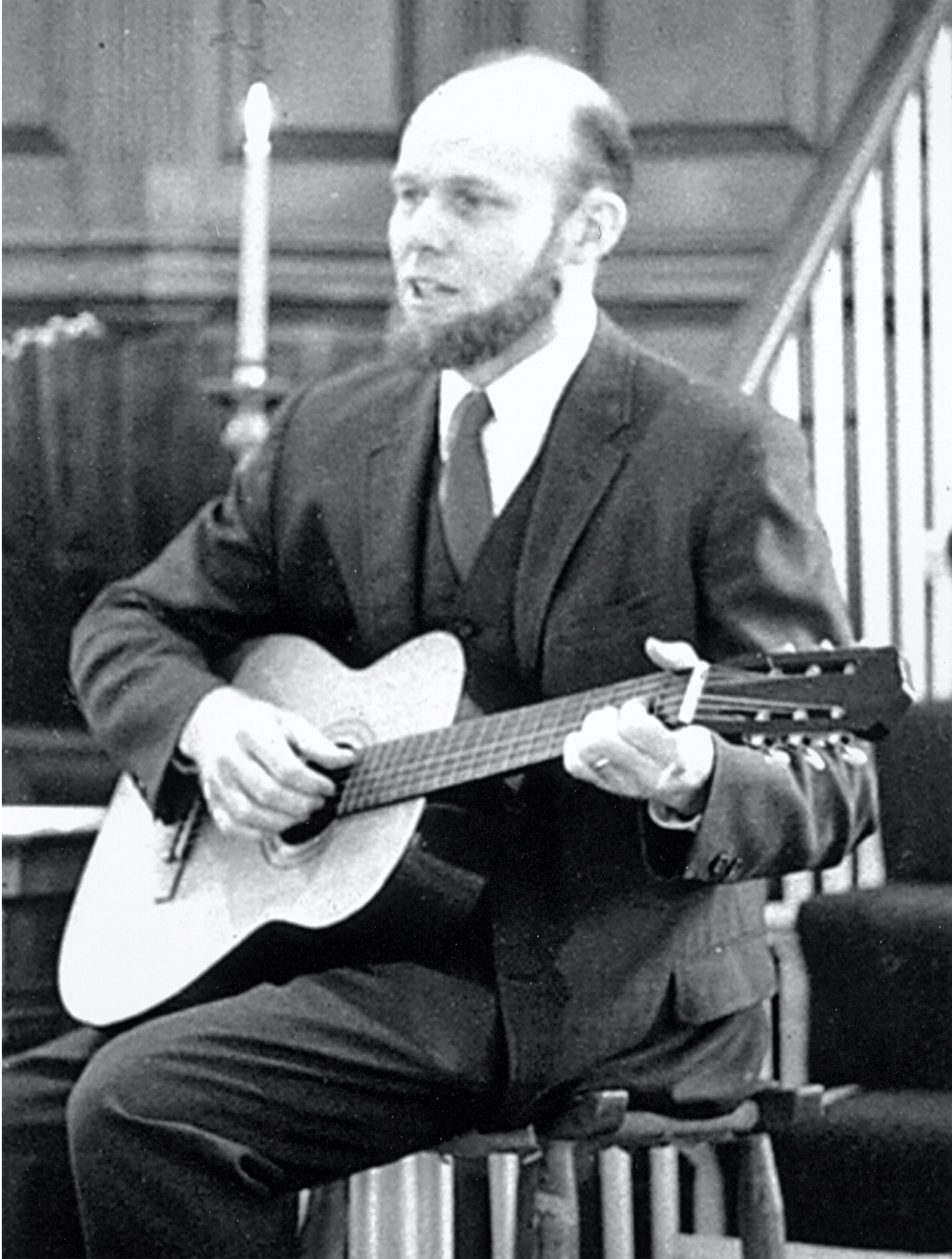
    Perhaps the most radical of these changes — I’d argue this was the most radical of all the changes to our Meeting House in its 275 year existence — was when the minister came out of the high pulpit and began preaching from the main floor. That minister was Edward Atkinson, who served this congregation from 1969 until his death in 1995. There’s a fabulous photograph of Ed Atkinson in our archives dating from the mid-1970s: he has a beard, he’s playing a guitar, and he’s sitting on a stool in front of the high pulpit. That one photograph encapsulates all kinds of stereotypes of the 1970s. [See a digitized copy of the photo below.]

    But we shouldn’t let the stereotypes obscure the truly radical act of a straight white cis-gender male minister stepping out of a symbolical position of great power, and coming down to the same level as the rest of the congregation. I’m inclined to understand this act as an embodiment of the feminist revolution that swept through Unitarian Universalism in the 1970s and 1980s. Male ministers, and men in general, began to understand the power they got just from being male. This helps explain why Ed Atkinson decided to step out of the high pulpit, out of the literal position of power.

    Second wave feminism brought other radical changes. We started lighting a flaming chalice in our worship services. This new religious ritual appears to have come from religious educators, ninety percent of whom were women. Lighting a chalice was an embodied ritual; it was something physical we did; it got us out of our heads and into our bodies. We adopted other new rituals that also got us out of our heads and into our whole selves including most notably lighting candles of joy and sorrow, and what we now call “Water Communion” that was originally called the “Water Ritual.”

    By the 1990s, we were no longer content to sit still for most of an hour and listen to the minister — the male minister — preach to us. We began to worship with more than just our heads; we began to worship with our hands and our bodies and our whole selves. This was a radical revolution in Unitarian Universalist worship. It is still continuing. We still spend a lot of time sitting and listening. But at least now we listen to as much music as the spoken word.

    Now let’s fast forward to the present day. Once again, we’re in the middle of a radical change in the way we use our Meeting House. That radical change is embodied in the livestreaming camera up in the gallery. You no longer have to be physically present in the Meeting House to participate in worship services. You can be in new Mexico, or in Wisconsin, or in Texas, or in Colorado, or Florida. Our Meeting House now exists online as well as in person.

    Our online presence is so new we don’t even know how it’s going to affect us. As one example of what I mean, I’ve been hearing from our members and friends at a distance that they would like to be able to participate in some way in the candles of joy and concern. Currently we mute the microphone during the candles of joy and concern, to preserve people’s privacy. But this seems to me to move us away from egalitarianism; we have unwittingly created a class of worshippers who cannot fully participate in our services. This at a time when our society is being polarized; this in a time when we need to embrace community and egalitarianism.

    And this leads me to the final point I’d like to make. It is we, the congregation, who create the meaning in this Meeting House. Yes, we are influenced by outside events — by abolitionism, by the second wave of feminism, by the online revolution. But we have a great deal of freedom in how we decide to respond to those outside events. We left behind the strict social divisions of 1750, while keeping the egalitarianism implicit in having our pulpit on the long wall. We embraced abolitionism in the mid-19th century. We embraced the feminist revolution in the 20th century.

    In the 275th year of this Meeting House, we find ourselves in another time of great change. What creative ways will we find to embrace online worshippers? The moral arc of our congregation has always bent towards greater inclusiveness, towards greater egalitarianism, towards greater justice. May we find ways to keep that moral arc bending in that direction.

    Man with beard sitting on a stool in front of the pulpit of First Parish in Cohasset. He is playing a guitar and wearing a three piece suit.
    Rev. Edward T. Atkinson circa 1974. Photo courtesy First Parish archives.
  • Samuel West, Eccentric Revolutionary

    This sermon was preached by Rev. Dan Harper at First Unitarian Church in New Bedford. As usual, the sermon below is a reading text. The actual sermon as preached contained ad libs, interjections, and other improvisation. Sermon copyright (c) 2008 Daniel Harper.

    Readings

    The first reading this morning is taken from a sermon preached on May 29, 1776, by Samuel West, who was the minister of this church from 1761 to 1803. The sermon from which this reading is taken gives a moral and religious justification for the North American colonies to rebel against Great Britain. It was preached by Samuel West to the House of Representatives and Council of the Massachusetts Bay Colony. West said:

    “Thus we see that both reason and revelation perfectly agree in pointing out the nature, end, and design of government, viz., that it is to promote the welfare and happiness of the community; and that subjects have a right to do everything that is good, praiseworthy, and consistent with the good of the community, and are only to be restrained when they do evil and are injurious either to individuals or the whole community; and that they ought to submit to every law that is beneficial to the community for conscience’ sake, although it may in some measure interfere with their private interest; for every good man will be ready to forego his private interest for the sake of being beneficial to the public. Reason and revelation, we see, do both teach us that our obedience to rulers is not unlimited, but that resistance is not only allowable, but an indispensable duty in the case of intolerable tyranny and oppression. From both reason and revelation we learn that, as the public safety is the supreme law of the state, — being the true standard and measure by which we are to judge whether any law or body of laws are just or not, — so legislators have aright to make, and require subjection to, any set of laws that have a tendency to promote the good of the community.”

    [The complete sermon is online here.]

    The second reading comes from a short biography of Dr. Samuel West, written by John Morison, who was co-minister of our church from 1838-1844. This short biography was later edited by Samuel Atkins Eliot in 1910 when he was president of the American Unitarian Association; Eliot, as it happened, was the grandson of Ephraim Peabody, who was co-minister of our church from 1838-1844; and Samuel Eliot preached from this very pulpit more than once. In any case, here is how John Morison described Samuel West’s theology:

    “Dr. West’s sympathies with humanity were too quick to make him a good Calvinist. His sermons were largely of the old Biblical and textual type, but theologically they were Unitarian in thought and temper. He asserted free will for man in opposition to the Calvinistic doctrine of preordination and election, and he believed in man’s ability of moral choice in opposition to the doctrine of total depravity. In his election sermon of 1776 he said, ‘A revelation pretending to be from God that contradicts any part of natural laws ought immediately to be rejected as an imposture, for the Deity cannot make a law contrary to the law of nature without acting contrary to himself.’ In his Forefathers’ Day sermon [of 1777] he said: ‘Love and unity are the essential marks of a true Christian. Were we possessed of true Christian candor, by a fair and impartial comparison we should find that many differences in explaining matters of faith are only mere verbal differences, and entirely vanish when we come to define our terms.’ It was natural that under such a minister, broad and tolerant in spirit, robust in thought, fervid in patriotism, incisive in logic, inclusive in fellowship, that [West’s church] should pass without break or discussion into the liberal ranks.”

    [Samuel Atkins Eliot, ed., Heralds of a Liberal Faith: Vol. 1, The Prophets (Boston: American Unitarian Association, 1914).]

    Sermon

    This is the three hundredth anniversary of the establishment of our church, and with that in mind, this fall I am going to continue a series of sermons begun last fall in which I talk about exceptional people from our church’s past. I suppose you could call this the “Three Hundredth Anniversary Sermon Series.” But in my own mind, I have come to call this series “Inspired and Inspiring Lives.” We Unitarian Universalists don’t have saints, but we do have people to whom we look when we need inspiration as we live out our own lives. We don’t have saints, but yet we do seek out moral exemplars, individuals who lived worthy lives, and whom we might emulate to good purpose. And it is good for us to talk about people from whom we can draw inspiration — being fully aware of their flaws and quirks of personality, but also being fully aware of what makes them good or even great human beings, and how we might emulate their goodness or greatness.

    Last fall, I gave you sermons on three inspiring and inspired lives: — I spoke about Maja Capek, minister of North Unitarian Church, who escaped Czechoslovakia ahead of the Nazis, and wholed a church of immigrants here in New Bedford ; and I spoke about John Murray Spear, the first Universalist minister in New Bedford, who fought for abolition of slavery and who built a racially integrated church here in this city in the 1830s and 1840s. And beginning this morning, I’m returning to this topic.

    This morning I would like to talk with you about a person from our past whom I have come to greatly admire: Rev. Dr. Samuel West, minister of this church from 1761 to 1803. In the readings this morning, I have tried to give you a sense of how Rev. Dr. Samuel West contributed to the American Revolution. In the first reading, we heard an excerpt from West’s Election Sermon of May 29, 1776, and how West helped the political leaders of his time to understand how to steer a carefully plotted course between submission to the tyrannies of the British government on the one hand, and anarchy on the other hand. In 1776, there were many great thinkers here in the British colonies who were trying to prove that, on the one hand, they must rebel against Britain, but that, on the other hand, rebelling against Britain did not mean doing away with all government altogether. And we all know that West was not the greatest of these thinkers, — he was not as great as Thomas Jefferson, or Thomas Paine, or John Adams. Yet his Election Day Sermon of 1776, which was widely distributed here in the Massachusetts Bay Colony, is noteworthy for its clarity; it is still readable today, and abridged versions of it are still widely available on the Internet.

    Indeed, I think you could argue that West could have made a much bigger contribution to the American Revolution, except for the fact that he lived down here on the south coast of Massachusetts. Remember that in those days, this region was dominated by the Quakers, who were pacifists, and who therefore were unlikely to declare themselves as passionate revolutionaries. If Samuel West had gotten a church in Boston, it seems likely to me that he would have been right in the thick of the planning of the American Revolution; but in those days, New Bedford was a long way from Boston, a long ride on horseback over rough roads.

    Selfishly, I am glad that West remained here in New Bedford. It is West more than any other minister, more than any other single person, who put his mark on this church; it is West who led this church away from its Calvinist beginnings into liberal religion; and there we have stayed ever since. That West served here has been the best possible thing for our church (in my selfish view); but I feel that West paid the price for our good fortune, for he was unable to participate in the Revolutionary cause as fully as he might have otherwise done.

    West paid another price for living down here in old Dartmouth, and later in the brand new city of New Bedford. West was a gifted scholar and, by all accounts, a brilliant man. John Morison, in his short biography of West, tells us that: “Among his own society [West] found little intellectual sympathy. [The people of his church] were a plain, industrious, uneducated people.” On top of that, West was very poorly paid. When he arrived at this church in 1761, he was promised a salary of sixty-six pounds, thirteen shillings, and sixpence per year; in terms of today’s dollars, that would be roughly $20,000, a low salary for someone who had a degree from Harvard College. It is true that West also received additional compensation in the form of two cows and a horse that were to be maintained by the congregation for his use. But what it also true is that West never received the whole of his salary:– by 1788, 27 years after he started, the congregation owed him a total of 769 pounds, twelve shillings, and eleven pence; this was nearly two hundred thousand dollars in today’s money. Or put it this way: over a 27 year period, the congregation paid him less than half of what wasn’t a very good salary to begin with. Nor was there much that the congregation could do about the situation: this whole region was sparsely populated and predominantly Quaker, so there just weren’t that many people from whom to get the money to pay Dr. West.

    Thus we can see that circumstances were against Samuel West being able to play any role in the great events of the American Revolution: — he was both poor, and he lived in a provincial backwater of Massachusetts. Yet West rose above these circumstances, and was an active participant in the Revolutionary cause.

    The most prominent of West’s revolutionary activities have been recorded for history. After the Battle of Bunker Hill, West joined the American army as a chaplain. While in the army, he assisted General George Washington by deciphering a treasonous letter written in code by an American officer to a British officer. He was at the Provincial Convention in Watertown, after that revolutionary body had to evacuate Boston, and her preached a sermon for them which was later reprinted. He preached the Election Day sermon in May, 1776, before the House of Representatives. In December, 1777, he delivered a patriotic message for the anniversary sermon at Plymouth, to commemorate the landing of the Pilgrims.

    In the winter and spring of 1779-1780, West was a member of the General Court which met together to prepare a constitution for what became known as the Commonwealth of Massachusetts; this document was finally ratified in June of 1780, and remains the oldest written constitution in effect today. In the winter of 1787-1788, West was part of the convention by means of which Massachusetts approved the United States constitution. There was real doubt as to whether Massachusetts would adopt the United States constitution, and it was Samuel West who played a key behind-the-scenes role. According to historian Francis Baylies, in a letter he wrote to John Clifford of New Bedford, this is what happened:

    “The fate of the Constitution in the convention was doubtful, when Governor Hancock, without whose aid it certainly could not be adopted, was seized with his constitutional disorder, the gout, and, withdrawing from the chair, took to his bed. The friends of the Constitution were convinced of the necessity of getting him out. Dr. West (who was Hancock’s classmate at Harvard) was selected as the person most likely to influence him. He repaired to his house, and after a long condolence on the subject of his bodily complaints he expressed his deep regrets that this affliction should have come upon him at a moment when his presence in the Convention seemed almost indispensable. He enlarged upon his vast influence, his many acts of patriotism, his coming forth in former days, at critical periods, to give new energy to the slumbering patriotism of his countrymen, and on the prodigious effect of his name. Heaven, he said, had given him another glorious opportunity, by saving his country, to win imperishable honor to himself. The whole people would follow his footsteps with blessings. The governor, who knew that Dr. West had always been his sincere and disinterested friend, listened to his suggestions, and made up his mind to appear again in the Convention. Wrapped in his flannels, he took the chair, addressed the Convention, proposed the conciliatory plan suggested by his friend, and the result is known. There is little doubt that Hancock turned the scale in this State in favor of the Constitution, and in my mind there is little doubt that Dr. West induced him to do it.”

    So you see, while Samuel West may have had to play a minor role in the American Revolution and the formation of the new United States of America, it was nevertheless a crucial role.

    Now this is all very interesting, but I am more interested in learning about West as a human being. What comes down to us about Dr. West, above all other aspects of his personality, is that he was somewhat eccentric. The historian Francis Baylies has recorded how absent-minded Dr. West was, saying:

    “During the session of the Convention Dr. West spent many of his evenings abroad. He generally returned with his pockets filled with fine handkerchiefs, silk stockings, silk gloves, small pieces of cambric, and many other articles which could, without attracting attention, be slipped into his pocket. His distress, on discovering them, was ludicrous; for, aware of his absence of mind, he supposed that he might have taken these articles unconsciously and without the consent of the owners, but his fellow-boarders generally contrived to convince him that they were designed as presents, — which was the truth.”

    Many other examples of Dr. West’s absent-mindedness have been recorded. He was known to arrive at the church on horseback, and stop at the horse-block so that his wife could get down from the pillion behind him, only to find that his wife wasn’t there; he had forgotten to wait for her, and had left her at home.

    On another occasion, Dr. West’s horse came running up to the house of another minister, one Dr. Sanger, in another town; the horse had on a saddle, but Dr. West was not on the horse. So Dr. Sanger and some boys living in his house went back to look for Dr. West, figuring that the horse must have thrown him. They found him sitting in the middle of the road, in deep thought, and asked him, “Is it you, Dr. West? How come you’re sitting in the middle of the road?” To which he is said to have replied, “Yes, I suppose it is I, and I suppose the beast has thrown me.” This particular anecdote was recorded by one Charles Lowell, who was one of the boys living with Dr. Sanger at the time.

    People who met him remembered Dr. West’s “eccentricity and roughness,” and his “oddity of manners.” It is easy to remember such personal quirks, but I want to know more about who Dr. West was as a human being. And the historical record does give us a more rounded view of who he was as a human being. The following anecdote was recorded by John Morison:

    “[Dr. West’s] metaphysical investigations must have colored all his thoughts. He usually preached without notes, and was always prepared. Once, when in Boston, during the latter part of his life, he was invited by Dr. Clarke, of the First Church, to preach for him. About an hour before the services were to commence, Father West requested his friend to give him a text. At this Dr. Clarke was alarmed, and asked if it were possible that he was going to preach without notes, and with no other preparation. ‘Come, come,’ said Father West, ‘it is my way, give me a text.’ Dr. Clarke selected Romans ix. 22: ‘What if God, willing to show his wrath, and to make his power known, endured with much long-suffering the vessels of wrath fitted to destruction.’ Dr. West looked over the Bible a few minutes, turning down leaves here and there, and then went into the church, where he preached a cogent, logical discourse, an hour and twenty minutes long, on that perplexing subject. The strong men of the congregation were intensely interested, and Dr. Clarke, on coming from the pulpit, exclaimed, ‘Why, Father West, it would have taken me three months to prepare such a discourse.’ ‘Ha, ha,’ was the reply, ‘and I have been studying it twenty years.’  ”

    And here is another, very brief, anecdote recorded by John Morison. Dr. West “would sometimes follow the young men who were studying theology with him to their bedchamber, and remain discoursing to them nearly the whole night.”

    These last two anecdotes imply that Dr. West must have been a man of uncommon intellect and ability. Perhaps he wished that he lived in a city where he would have had more intellectual stimulation; surely he must have wished that his church had paid him regularly and in full. Rather than bemoan the lack of intellectual stimulation, Dr. West had a rich life of the mind — rich enough that others thought he was absent-minded. And he found ways to remain in conversation with other intellects: — he traveled regularly to Boston, then the intellectual capital of New England if not of the United States, he trained theological students, presumably in his home.

    We can piece together more of Dr. West’s personality from the historical record. We know he married and raised a family, and when his first wife died, he married again. We know that he was a trusting man — he was perhaps too trusting of others, being sometimes unable to know when he was being deceived. We have already learned that he gave much time and energy to public service, at the state and indeed at the national level. And it is also clear that he helped his little church grow and thrive, for in 1795 he moved the church from its old location up in what is now Acushnet down to the corner of Purchase and William Streets in the new and bustling city of New Bedford, so that it could grow and thrive even more — he may not have gotten his full salary, but he was able to convince the church to pay for a new building!

    There is one last little tidbit that I find very interesting: the people of this church called Dr. West “Father West.” I am sure they meant this as a compliment, and as a testament to his character. I imagine the people of this church saw Dr. West as a kind of friendly father-figure: — a good man, an intelligent man, a leader who put his church’s welfare above his own.

    It seems to me that, of all the ministers who have served this church, Dr. Samuel West stands out as the most impressive human being of any of them. Perhaps some of our other ministers surpassed his intellectual capacities, but Dr. West’s intellect was only a small part of who he was. Perhaps he was eccentric and absent-minded; but that appears to have come part-and-parcel with his great intellect, and his general lack of intellectual companionship close to home, and his eccentricities never descended into bizarreness. Perhaps he had odd and even rough manners; but he more than made up for that by his essential goodness and his deep and abiding faith in human nature. Perhaps he never had much money throughout his life here; but he proved that one does not need to be wealthy to be a useful member of society.

    Dr. West combined a great intellect, an essential goodness and decency, and the energy and ability to serve the world around him in spite of adverse circumstances. He had a vision of how this might be a better world, and he worked towards that vision in spite of the obstacles in his way.

    Dr. Samuel West was one person whom we might consider emulating. Not that we should emulate his eccentricity; not that we should try to emulate his poverty. Nor should we try to slavishly emulate every detail of his life. We should consider emulating the core of his life: — He lived in times that called for energetic service to a greater cause, and he served; this we can emulate. He pushed himself to use his intellect beyond what those around him could appreciate; this we can emulate. he lived a good and decent life; this we can emulate. He offered leadership to his church, based on thoughtful consideration of what would best serve the greater good of humanity. He was also able to be agood follower — he was not one of the primary leaders in the American Revolution, but he trhrew his best energies behind the efforts of those leaders — and so we can say that he offered good “followership” as well as good leadership.

    It is in his religious views that we can especially emulate Dr. West. He transcended the narrow Calvinism in which he was brought up; he knew that human beings can and often will make sound moral choices, and so he refused to believe the utter depravity of humanity which many around him preached. And his religious convictions informed his political convictions : he knew that, on the whole, people do make good moral choices, and that, on the whole, individual people will transcend their narrow private interests for the greater good of human society; at the same time, he knew that our highest allegiance must be to our consciences, and from thence to that which is highest and best in humanity, which he called God.

    We Unitarian Universalists don’t have saints, but we do have moral exemplars, people to whom we look when we need inspiration as we live out our own lives. Dr. West is one of the great, if not the greatest, moral exemplars in our church’s long history; may we draw inspiration from his life.