Stories for liberal religious kids, drawn from a wide variety of religious and spiritual traditions.
- Stories labeled “Wisdom Tale” teach life lessons.
- Stories labeled “Spiritual Tale” have a spiritual purpose (which can seem alien to Westerners).
- Stories labeled “Tale of Deities” tell about the attributes and characters of gods/goddesses/divine beings.
- Stories labeled “Myth” explain or describe some natural phenomenon.
The stories on these pages were originally written for a variety of
purposes — worship services, classes, or just for fun. You should adapt
them to whatever situation you want to use them in.
Copyright: Please respect copyright. For just one example, if you use one of my copyright-protected stories in a webcast or recording, I ask that you give me credit for the story (e.g., “This story is copyright by Dan Harper”). You do not have to give me credit in educational settings or at home.
Cultural appropriateness: When I wrote these stories, I worked from the most culturally appropriate sources I could find, and I attempted to retain the distinctive flavor of the original religion/culture of each story. You will have to decide how you want to present other religious traditions where they conflict with modern Western sensibilities, whether you will cover over religious differences or not. Some examples of what I mean: Will you ignore that Buddhists affirm that Buddha had 500+ previous lives? Will you adhere to Western understandings of gender, or acknowledge diverse understandings of gender (e.g., the contemporary Native concept of “Two Spirit”)? You will have to judge for yourself, based on the needs of your class or local congregation.
Table of Contents
- North American Indigenous Tales
- Ohlone
- Navajo
- Tlingit
- Tigua Peublo
- Miwok
- South American Indigenous Tales
NORTH AMERICAN INDIGENOUS TALES
The Creation of the World: a story of the Ohlone people
Myth
This is one of the stories about the beginning of the world that were told by the Northern Ohlone Indians, who once lived around San Francisco Bay.
Once upon a time, there were no human beings, but there were two spirits, one good and one evil. The two spirits made war upon each other, and at last the good spirit overcame the evil spirit. At that time, the entire world was covered with water, except for two islands, one of which was Monte Diablo and the other of which was Mount Tamalpais.
There was a Coyote on Mount Tamalpais. He was the only living thing there. One day Coyote saw a feather floating on the water, and, as it reached the island, is suddenly turned into an Eagle. Spreading its broad wings, the Eagle flew up onto the mountain.
Coyote liked his new friend very much, and they lived together in great harmony. Sometimes they would from one island to the other island, Coyote swimming while Eagle flew overhead. This went on for some time.
Then, after talking with each other, they decided to make something new in the world. Together they made the first human beings.
Soon the first human beings had children, and the level of the water went down so that there was more land for the human beings.
Soon the children of the first human beings had children, and the level of the water went down some more.
Then the grandchildren of the first human beings had children, and so on, and the more human beings there were, the more the waters decreased, until at last where there was dry land in most of the places where we have dry land now. But what we call San Francisco Bay was still under water. It was not a bay, but a deep lake.
At that time, there was no opening in the mountains that ran along the coast. What we now call the Golden Gate was a chain of mountains, and you could walk from one side to the other side without getting your feet wet. The water that came down from the east had to go out through other rivers to the north and to the south.
Then a great earthquake struck, and chain of mountains was cut in two, forming what we now call the Golden Gate. Then the waters of the Great Ocean and the Bay could at last come together, and the land became as we now know it.
Source: adapted from “Tradition of the California Indians,” by H. B. D., in Hesperian Magazine, vol. 2-3, (ed. F. H. Day, San Francisco, vol. III, no. 1, September, 1859), p. 326. H. D. B. says this tale came “from the lips of one of our most venerable pioneers, and I give it as I heard it.” This tale is cited by Hubert Howe Bancroft in his Native Races, vol. 3, (History Company: San Francisco, 1886), p. 88; and by Alfred Louis Kroeber in his “Myths of South Central California,” American archaeology and ethnology: Shoshonean Dialects of California, vol. 4, no. 3 (Berkeley: University of California, 1907), pp. 188-189. I have made a few changes in the H. B. D. version based on Kroeber’s commentary.

Public domain image (from a US government publication).
The Diné: An origin myth of the Navajo
Myth, Spiritual Tale
These stories were told to Sandoval, Hastin Tlo’tsi hee, by his grandmother, Esdzan Hosh kige. Her ancestor was Esdzanata’, the medicine woman who had the Calendar Stone in her keeping. Here are the stories of the Four Worlds that had no sun, and of the Fifth, the world we live in, which some call the Changeable World. Sandoval told these stories to Aileen O’Bryan at Mesa Verde in 1928, and she wrote them down.
The First World
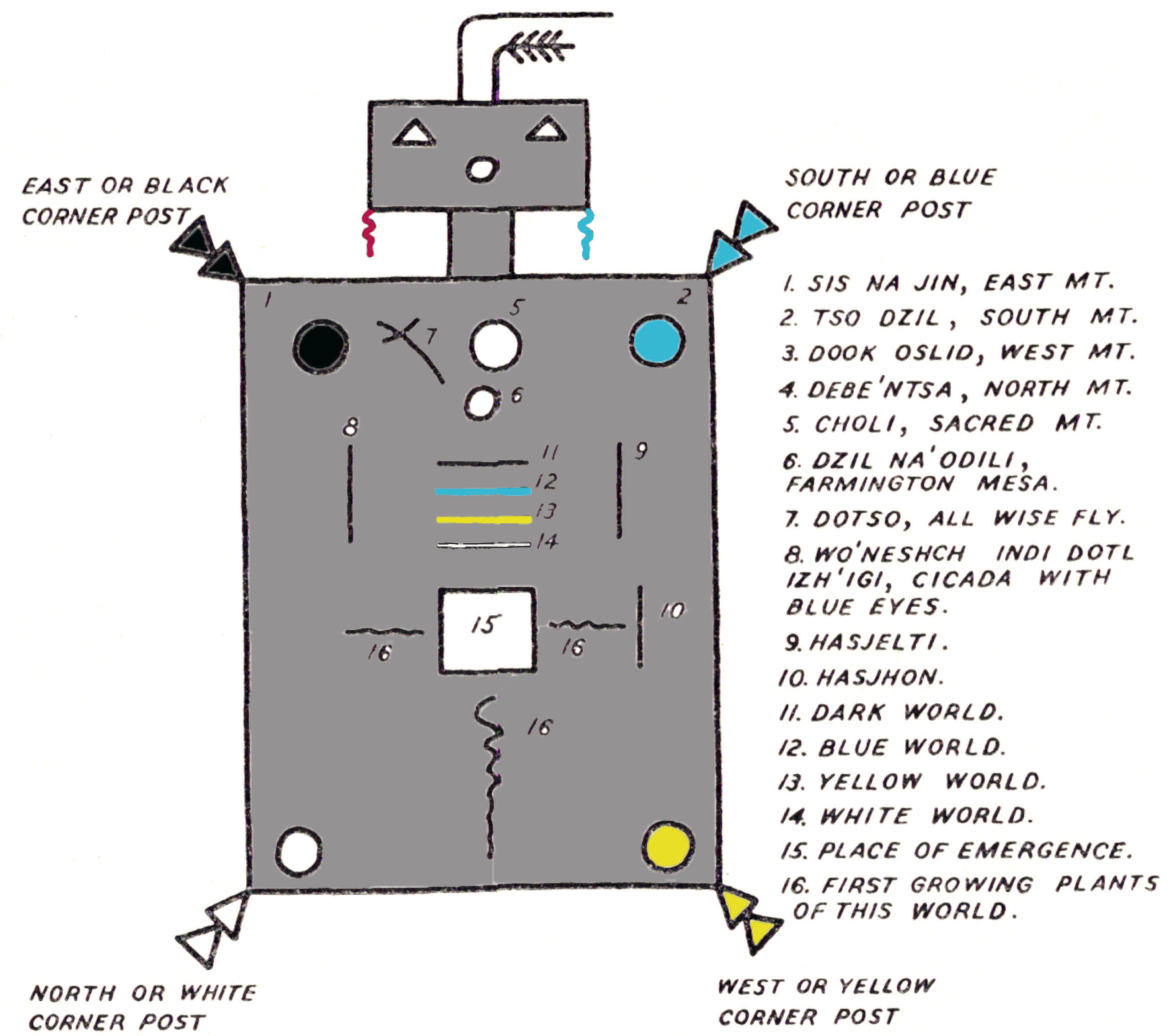
The First World, Ni’hodilqil (which was also called Red Earth, One Speech, Floating Land, and One Tree) was black as black wool. It had four corners, and over these appeared four clouds. These four clouds contained within themselves the elements of the First World. They were in color, black, white, blue, and yellow.
The Black Cloud represented the Female Being. For as a child sleeps when being nursed, so life slept in the darkness of the Female Being. The White Cloud represented the Male Being or Substance. He was the Dawn, the Light-Which-Awakens, of the First World.
In the East, at the place where the Black Cloud and the White Cloud met, First Man, Atse’hastqin, was formed; and with him was formed the white corn, perfect in shape, with kernels covering the whole ear. Dolionot i’ni is the name of this first perfect seed corn, and it is also the name of the place where the Black Cloud and the White Cloud met.
The First World was small in size, a floating island in mist or water. On it there grew one tree, a pine tree, which was later brought to the present world for firewood.
But human beings had not yet evolved to their present form. The creatures of the First World were the Mist People. They had no definite form, but evolved to change to humans, beasts, birds, and reptiles of this world. There was a male and a female being who were to become man and woman.
Now on the western side of the First World, in a place that later was to become the Land of Sunset, there appeared the Blue Cloud, and opposite it there appeared the Yellow Cloud. Where they came together First Woman was formed, and with her the yellow corn. This ear of corn was also perfect. With First Woman there came the white shell and the turquoise and the yucca.
First Man stood on the eastern side of the First World. He represented the Dawn and was the Life Giver. First Woman stood opposite in the West. She represented Darkness and the End of Life.
First Man burned a crystal for a fire. First Woman burned her turquoise for a fire. They saw each other’s lights in the dis-tance. When the Black Cloud and the White Cloud rose higher in the sky First Man set out to find the turquoise light. He went twice without success, and again a third time; then he broke a forked branch from his tree, and, looking through the fork, he marked the place where the light burned. And the fourth time he walked to it and found smoke coming from a home.
“Here is the home I could not find,” First Man said.
First Woman answered: “Oh, it is you. I saw you walking around and I wondered why you did not come.”
Again the same thing happened when the Blue Cloud and the Yellow Cloud rose higher in the sky. First Woman saw a light and she went out to find it. Three times she was unsuccessful, but the fourth time she saw the smoke and she found the home of First Man.
“I wondered what this thing could be,” she said.
“I saw you walking and I wondered why you did not come to me,” First Man answered.
First Woman saw that First Man had a crystal for a fire, and she saw that it was stronger than her turquoise fire. And as she was thinking, First Man spoke to her. “Why do you not come with your fire and we will live together.” The woman agreed to this. So instead of the man going to the woman, as is the custom now, the woman went to the man.
About this time there came another person, the Great-Coyote-Who-Was-Formed-in-the-Water, and he was in the form of a male being. He told First Woman and First Man that he had been hatched from an egg. He knew all that was under the water and all that was in the skies. First Man placed this person ahead of himself in all things.
The three began to plan what was to come to pass; and while they were thus occupied another being came to them. He also had the form of a man, but he wore a hairy coat, lined with white fur, that fell to his knees and was belted in at the waist. His name was Atse’hashke’, First Angry, or Coyote.
He said to the three: “You believe that you were the first persons. You are mistaken. I was living when you were formed.”
Then four beings came together. They were yellow in color and were called the tsts’na or wasp people. They knew the secret of shooting evil and could harm others. They were very powerful.
This made eight people.
Four more beings came. They were small in size and wore red shirts and had little black eyes. They were the naazo’zi or spider ants. They knew how to sting, and were a great people.
After these came a whole crowd of beings. They were dark colored with thick mouths and dark, protruding eyes. They were the wolazhi’ni, the black ants. They also knew the secret of shooting evil and were powerful; but they killed each other steadily.
By this time there were many people. Then came a multitude of little creatures. They were peaceful and harmless, but the odor from them was unpleasant. They were insects called That-Which-Emits-An-Odor.
And after the wasps and the different ant people there came the beetles, dragonflies, bat people, the Spider Man and Woman, and the Salt Man and Woman, and others that rightfully had no definite form but were among those people who peopled the First World. And this world, being small in size, be-came crowded, and the people quarreled and fought among themselves, and in all ways made living very unhappy.
The Second World
Because of the strife in the First World, First Man, First Woman, the Great-Coyote-Who-Was-Formed-in-the-Water, and the Coyote called First Angry, followed by all the others, climbed up from the First World, the World of Darkness and Dampness, to the Second World, Ni’hodotl’ish, or the Blue World.
When they came to the Second World, they found a number of people already living there: Bluebirds, Blue Hawks, Blue Jays, Blue Herons, and all the blue-feathered beings.
The powerful Swallow People lived there also, and these people made the Second World unpleasant for those who had come from the First World. There was fighting and killing.
The First Four found an opening in the World of Blue Haze; and they climbed through this and led the people up into the Third or Yellow World.
Arriving in the Third World
The Bluebird was the first to reach the Third or Yellow World. After him came the First Four and all the others.
A great river crossed this land from north to south. It was the Female River. There was another river crossing it from east to West, it was the Male River. This Male River flowed through the Female River and on; and the name of this place is tqo al-na’osdli, the Crossing of the Waters.
There were six mountains in the Third World. In the East was Sis na’ jin, the Standing Black Sash. Its ceremonial name is Yolgai’dzil, the Dawn or White Shell Mountain. In the South stood Tso’dzil, the Great Mountain, also called Mountain Tongue. Its ceremonial name is Yodolt i’zhi dzil, the Blue Bead or Turquoise Mountain. In the West stood Dook’oslid, and the meaning of this name is forgotten. Its ceremonial name is Dichi’li dzil, the Abalone Shell Mountain. In the North stood Debe’ntsa, Many Sheep Mountain. Its ceremonial name is Bash’zhini dzil, Obsidian Mountain. Then there was Dzil na’odili, the Upper Mountain. It was very sacred; and its name means also the Center Place, and the people moved around it. Its ceremonial name is Ntl’is dzil, Precious Stone or Banded Rock Mountain. There was still another mountain called Chol’i’i or Dzil na’odili choli, and it was also a sacred mountain. (1)
There was no sun in this land, only the two rivers and the six mountains. And these rivers and mountains were not in their present form, but rather the substance of mountains and rivers as were First Man, First Woman, and the others.
Now beyond Sis na’ jin, in the east, there lived the Turquoise Hermaphrodite, Ashton nutli, who was then neither a boy nor a girl. Later he was also known as the Turquoise Boy. And near this person grew the male reed. Beyond, still farther in the east, there lived a people called the Hadahuneya’nigi, the Mirage or Agate People. Still farther in the east there lived twelve beings called the Naaskiddi. And beyond the home of these beings there lived four others — the Holy Man, the Holy Woman, the Holy Boy, and the Holy Girl.
In the West there lived the White Shell Hermaphrodite, who was then neither boy nor girl; later they became White Shell Girl, and still later she entered the Moon and became Moon Bearer. And with her was the big female reed which grew at the water’s edge. It had no tassel. Beyond her in the West there lived another stone people called the Ha-dahunes’tqin, the Ground Heat People. Still farther on there lived another twelve beings, the Corn Maidens, all of whom were females. And again, in the Far West, there lived four Holy Ones.
Within this land there lived the Kisa’ni, the ancients of the Pueblo People. On the six mountains there lived the Cave Dwellers or Great Swallow People. The Great Swallow People lived in rough houses of mud and sticks. They entered them from holes in the roof. On the mountains lived also the light and dark squirrels, chipmunks, mice, rats, the turkey people, the deer and cat people, the spider people, and the lizards and snakes. The beaver people lived along the rivers, and the frogs and turtles and all the underwater people in the water. So far all the people were similar. They had no definite form, but they had different names because they were different inside.
Now the plan was to plant.
First Man called the people together. He brought forth the white corn which had been formed with him. First Woman brought the yellow corn. They laid the perfect ears side by side; then they asked one person from among the many to come and help them. The Turkey stepped forward. They asked him where he had come from, and he said that he had come from the Gray Mountain. The Gray Mountain is the home of the Gray Yei, Hasch ei’ba’i, whose other name is Water Sprinkler. The turkey is connected with water and rain.
The Turkey danced back and forth four times, then he shook his feather coat and there dropped from his clothing four kernels of corn, one gray, one blue, one black, and one red. Another person was asked to help in the plan of the planting. The Big Snake came forward. He likewise brought forth four seeds, the pumpkin, the watermelon, the cantaloupe, and the musk-melon. His plants all crawl on the ground.
They planted the seeds, and their harvest was great.
Note for this section: (1) Today these six mountains have English names: Sis na’ jin is Mount Baldy near Alamos, Colorado; Tso’dzil, Mount Taylor, New Mexico; Dook’oslid, San Francisco Mountain, Arizona; Debe’ntsa, San Juan Mountains, Colorado; Dzil na’odili, El Huerfano Peak, New Mexico; and Choli, El Huerfano Peak, New Mexico.
The Men and Women Live Apart
Now at that time there were four chiefs: Big Snake, Mountain Lion, Otter, and Bear. And it was the custom when the black cloud rose in the morning — as there was no sun, and no true division of night and day, time was counted by the black cloud rising and the white cloud rising — for First Man to come out of his dwelling and speak to the people. After First Man had spoken, the four chiefs told them what they should do that day. They also spoke of the past and of the future.
But after the harvest, the Turquoise Boy from the East had come and visited First Woman. When First Man had returned to his home, he found his wife with this boy. First Woman told her husband that Turquoise Boy was of her flesh and not of his flesh. She said that she had used her own fire, the turquoise, and had ground her own yellow corn into meal. This corn she had planted and cared for herself.
When First Man found his wife with Turquoise Boy, he would not come out to speak to the people. The black cloud rose higher, but First Man would not leave his dwelling; neither would he eat or drink. No one spoke to the people for four days. All during this time First Man remained silent, and would not touch food or water. Four times the white cloud rose, and still he would not come out.
Then the four chiefs went to First Man and demanded to know why he would not speak to the people. The chiefs asked this question three times, and a fourth, before First Man would answer them.
He told them to bring him an herb which was an emetic. He made a hot brew from the herb, and drank it, and it caused him to vomit, and in this way he purified himself. First Man then asked them to send Turquoise Boy to him.
When Turquoise Boy came, First Man asked him if the stone for grinding corn, and the brush, belonged to him. Both these things were usually used by women, but not by men. Turquoise Boy said that they were. First Man asked him if he could cook and prepare food like a woman, if he could weave, and brush the hair. And when Turquoise Boy had assured First Man that he could do all manner of woman’s work, First Man said: “Go and prepare food and bring it to me.” After he had eaten, First Man told the four chiefs what he had seen, and what his wife had said.
At this time the Great-Coyote-Who-Was-Formed-in-the-Water came to First Man and told him to cross the river. They made a big raft and crossed at the place where the Male River followed through the Female River. And all the male beings left the female beings on the river bank; and as they rowed across the river they looked back and saw that First Woman and the female beings were laughing.
In the beginning the women did not mind being alone. They cleared and planted a small field. On the other side of the river First Man and the chiefs hunted and planted their seeds. They had a good harvest. Turquoise Boy, the first man to become as a woman, ground the corn and cooked the food. The men had plenty and were happy.
Four seasons passed. The men continued to have plenty and were happy; but the women became lazy, and only weeds grew on their land. The women wanted fresh meat. Some of them tried to join the men and were drowned in the river.
First Woman made a plan. The women missed the men. One woman gave birth to a big stone. This stone-child was later the Great Stone that rolled over the earth killing men. Another woman brought forth the Big Birds of Tsa bida’hi; and others gave birth to the giants and monsters who later destroyed many people.
On the opposite side of the river, the men also missed the women, and they did not know what to do. Then the second chief spoke: he said that life was hard and that it was a pity to see women drowned when they tried to cross the river to join the men. He asked why they should not bring the women across the river and all live together again.
“Now we can see for ourselves what comes from our wrong doing,” he said. “We will know how to act in the future.” The three other chiefs of the animals agreed with him, so First Man told them to go and bring the women.
After the women had been brought over the river First Man spoke: “We must be purified,” he said. “Everyone must bathe. The men must dry themselves with white corn meal, and the women, with yellow.”
This they did, living apart for four days. After the fourth day First Woman came and threw her right arm around her husband. She spoke to the others and said that she could see her mistakes, but with her husband’s help she would henceforth lead a good life. Then all the male and female beings came and lived with each other again.
The Flood, and Going to the Fourth World
The people moved to different parts of the land. Some time passed; then First Woman became troubled by the monotony of life. She made a plan. She went to Atse’hashke, the Coyote called First Angry, and giving him the rainbow she said: “I have suffered greatly in the past. I have suffered from want of meat and corn and clothing. Many of my maidens have died. I have suffered many things. Take the rainbow and go to the place where the rivers cross. Bring me the two pretty children of Tqo holt sodi, the Water Buffalo, a boy and a girl.
The Coyote agreed to do this. He walked over the rain-bow. He entered the home of the Water Buffalo and stole the two children; and these he hid in his big skin coat with the white fur lining. And when he returned he refused to take off his coat, but pulled it around himself and looked very wise.
After this happened the people saw white light in the East and in the South and West and North. One of the deer people ran to the East, and returning, said that the white light was a great sheet of water. The sparrow hawk flew to the South, the great hawk to the West, and the kingfisher to the North. They returned and said that a flood was coming. The kingfisher said that the water was greater in the North, and that it was near.
The flood was coming and the Earth was sinking. And all this happened because the Coyote had stolen the two children of the Water Buffalo, and only First Woman and the Coyote knew the truth.
When First Man learned of the coming of the water he sent word to all the people, and he told them to come to the mountain called Sis na’jin. He told them to bring with them all of the seeds of the plants used for food. All living beings were to gather on the top of Sis na’jin. First Man traveled to the six sacred mountains, and, gathering earth from them, he put it in his medicine bag.
The water rose steadily.
When all the people were halfway up Sis na’ jin, First Man discovered that he had forgotten his medicine bag. Now this bag contained not only the earth from the six sacred mountains, but his magic, the medicine he used to call the rain down upon the earth and to make things grow. He could not live without his medicine bag, and be wished to jump into the rising water; but the others begged him not to do this. They went to the kingfisher and asked him to dive into the water and recover the bag. This the bird did. When First Man had his medicine bag again in his possession he breathed on it four times and thanked his people.
When they had all arrived it was found that the Turquoise Boy had brought with him the big Male Reed; and the White Shell Girl had brought with her the big Female Reed. Another person brought poison ivy. Another person, the spider, brought cotton, which was later used for cloth. First Man had with him his spruce tree which he planted on the top of Sis na’jin. He used his fox medicine to make it grow; but the spruce tree began to send out branches and to taper at the top, so First Man planted the big Male Reed. All the people blew on it, and it grew and grow until it reached the canopy of the sky. They tried to blow inside the reed, but it was solid. They asked the woodpecker to drill out the hard heart. Soon they were able to peek through the opening, but they had to blow and blow be-fore it was large enough to climb through. They climbed up in-side the big male reed, and after them the water continued to rise.
The Fourth World
When the people reached the Fourth World they saw that it was not a very large place.
The last person to crawl through the reed was the Turkey from Gray Mountain. His feather coat was flecked with foam, for after him came the water. And with the water came the female Water Buffalo who pushed her head through the opening in the reed. She had a great quantity of curly hair which floated on the water, and she had two horns, half black and half yellow. From the tips of the horns the lightning flashed.
First Man asked the Water Buffalo why she had come and why she had sent the flood. She said nothing. Then the Coyote drew the two babies from his coat and said that it was, perhaps, because of them.
The Turquoise Boy took a basket and filled it with turquoise. On top of the turquoise he placed the blue pollen, tha’di’thee do tlij, from the blue flowers, and the yellow pollen from the corn; and on top of these he placed the pollen from the water flags, tquel aqa’di din; and. again on top of these he placed the crystal, which is river pollen. This basket he gave to the Coyote who put it between the horns of the Water Buffalo.
The Coyote said that with this sacred offering he would give back the male child. He said that the male child would be known as the Black Cloud or Male Rain, and that he would bring the thunder and lightning. The female child he would keep. She would be known as the Blue, Yellow, and White Clouds or Female Rain. She would be the gentle rain that would moisten the earth and. help them to live. So he kept the female child, and he placed the male child on the sacred basket between the horns of the Water Buffalo. And the Water Buffalo disappeared, and the waters with her.
After the water sank there appeared another person. They did not know him, and they asked him where he had come from. He told them that he was the badger, nahashch’id, and that he had been formed where the Yellow Cloud had touched the Earth. Afterward this Yellow Cloud turned out to be a sun-beam.
The Diné: The Fifth World
First Man was not satisfied with the Fourth World. It was a small barren land; and the great water had soaked the earth and made the sowing of seeds impossible. He planted the big Fe-male Reed and it grew up to the vaulted roof of this Fourth World. First Man sent the newcomer, the badger, up inside the reed, but before he reached the upper world water began to drip, so he returned and said that he was frightened.
At this time there came another strange being. First Man asked him where he had been formed, and he told him that he had come from the Earth itself. This was the locust. He said that it was now his turn to do something, and he offered to climb up the reed.
The locust made a headband of a little reed, and on his forehead he crossed two arrows. These arrows were dressed with yellow tail feathers. With this sacred headdress and the help of all the Holy Beings the locust climbed up to the Fifth World. He dug his way through the reed as he digs in the earth now. He then pushed through mud until he came to water. When he emerged he saw a black water bird, the Grebe, swimming toward him. The Grebe had arrows crossed on the back of his head and big eyes.
The bird said: “What are you doing here? This is not your country.” And continuing, he told the locust that unless he could make magic he would not allow him to remain.
The black water bird drew an arrow from back of his head, and shoving it into his mouth drew it all the way through his stomach and intestines and out of hid anus.
“That is nothing,” said the locust. He took the arrows from his headband and pulled them both ways through his body, between his shell and his heart. The bird believed that the locust possessed great medicine, and he swam away to the East, taking the water with him.
Then came the blue water bird from the South, and the yellow water bird from the West, and the white water bird from the North, and everything happened as before. The locust per-formed the magic with his arrows; and when the last water bird had gone he found himself sitting on land.
The locust returned to the lower world and told the people that the beings above had strong medicine, and that he had had great difficulty getting the best of them.
Now two dark clouds and two white clouds rose, and this meant that two nights and two days had passed, for there was still no sun. First Man again sent the badger to the upper world, and he returned covered with mud, terrible mud. First Man gathered chips of turquoise which he offered to the five Chiefs of the Winds who lived in the uppermost world of all. They were pleased with the gift, and they sent down the winds and dried the Fifth World.
First Man and his people saw four dark clouds and four white clouds pass, and then they sent the badger up the reed. This time when the badger returned he said that he had come out on solid earth. So First Man and First Woman led the people to the Fifth World, which some call the Many Colored Earth and some the Changeable Earth. They emerged through a lake surrounded by four mountains, a place which is near Pagosa Springs, Colorado. The water bubbles in this lake when anyone goes near it.
Now after all the people had emerged from the lower worlds First Man and First Woman dressed the Mountain Lion with yellow, black, white, and grayish corn and placed him on one side. They dressed the Wolf with white tail feathers and placed him on the other side. They divided the people into two groups.
The first group was told to choose whichever chief they wished. They made their choice, and, although they thought they had chosen the Mountain Lion, they found that they had taken the Wolf for their chief. The Mountain Lion was the chief for the other side. And these people who had the Mountain Lion for their chief turned out to be the people of the Earth. They were to plant seeds and harvest corn. The followers of the Wolf chief became the animals and birds; they turned into all the creatures that fly and crawl and run and swim.
And after all the beings were divided, and each had his own form, they went their ways.
This is the story of the Four Dark Worlds and the Fifth, the World we live in. Some medicine men tell us that there are two worlds above us, the first is the World of the Spirits of Living Things, the second is the Place of Melting into One.
Source: Aileen O’Bryan, The Dîné: Origin Myths of the Navaho Indians, Bulletin 163 of the Bureau of American Ethnology of the Smithsonian Institution, (1956), pp. 1-13. This government publication is in the public domain. I have adapted and shortened the narrative slightly.
The Red-Cedar Sculpture of the Woman Who Had Died: a Tlingit story
Wisdom Tale
This is a story of the Tlingit people of Wrangell Island, Alaska.
A young man and a young woman on the Haida Gwaii, the Islands of the Haida People, married. The young man was a chief, and the couple were very happy together. But soon after they were married, the young woman fell ill. Her husband sent around everywhere for the very best shamans, to try to cure her of her illness. He heard about a very fine shaman from another village on the island, and sent a canoe there to bring that shaman. But that shaman could do nothing. The young chief heard about another fine shaman at another village on another island, and again sent a canoe; but neither could that shaman cure the young woman. The young man sent for several fine shamans, but none of them could help his wife, and after she had been sick for a very long time she died.
The young chief felt very badly after his wife had died. He went from village to village to find the best wood-carvers in order to have them carve a sculpture of his wife. But though he asked several fine carvers, no one could make a sculpture that looked like his wife.
All this time there was a wood-carver in his own village who could carve much better than all the others. This man met the young chief one day and said, “You are going from village to village to have wood carved like your wife’s face, and you can not find anyone to do it, can you? I have seen your wife a great deal walking along with you. I have never studied her face with the idea that you might want some one to carve it, but I am going to try if you will allow me.”
The young chief agreed to try. The wood-carver found a very fine piece of red-cedar and began working upon it. When he had finished, the wood-carver had dressed the sculpture just as he used to see the young woman dressed. Then he went to the young chief and said, “Now you can come along and look.”
The young chief came to the wood-carver’s workshop, and when he got inside, he saw his dead wife sitting there just as she used to look. This made him very happy, and he said he would like to take this sculpture home. “What do I owe you for making this?” he asked the wood-carver.
The wood-carver had felt sorry to see how the young chief was mourning for his wife, so he said, “Do as you please about it. It is because I felt badly for you that I made that. So don’t pay me too much for it.”
But the young chief paid the wood-carver very well, both in slaves and in goods.
The young chief dressed this sculpture in his wife’s clothes and her marten-skin robe. When he finished, he felt that his wife had come back to him. He treated the sculpture just like her. One day, while he sat very close to the sculpture, mourning for his dead wife, he felt the sculpture move. He thought that the movement was only his imagination. Yet he knew his wife had been as fond of him as he was of her, and so each day as he ate his meals he sat close to the sculpture, thinking perhaps some time it would in fact come to life.
After a while the whole village learned the young chief had this sculpture of his wife. One by one, they all came to see it. It was so life-like that many people could not believe that it was not the woman herself until they had examined it closely and saw it was only made of wood.
One day, after the chief had had it for a long, long time, he sat down next to the sculpture, and saw that the body was just like the body of a human being. Now he was sure the sculpture was alive, and he began to treat it just as if it were his wife. Yet though he was sure the sculpture was alive, it could not move or speak.
Then one day the sculpture gave forth a sound like cracking wood. The man was sure something was wrong; perhaps the sculpture was ill. He had some people come and move it away from the place where it had been sitting, and when they had moved the sculpture they found a small red-cedar tree growing there on top of the flooring. The man left the young red-cedar tree to grow there, until it grew to be very large. (For many years afterwards, when people on the Haida Gawaii went looking for red-cedars, if they found a good one they would say, “This looks like the baby of the chief’s wife.” And it is because of the young chief’s wife that red-cedars on these islands provide the very best wood for carving.)
But to return to the red-cedar sculpture of the young woman:– The sculpture continued to grow more and more like a human being day after day. People from villages far and near heard the story, and came in canoes to look at the sculpture, and at the young red-cedar tree growing there, at which they were very much astonished. The red-cedar sculpture of the woman moved around as much as a tree trunk might move in the wind, which is to say not much at all, and the sculpture was never able to talk. Yet the woman’s husband had dreams in which she spoke to him, and even if the sculpture could not talk, it was through these dreams the husband knew his wife was talking to him.
Source: Tlingit Myths and Texts, John R. Swanton, Bureau of American Ethnology Bulletin 39, [1909], pp. 181-182
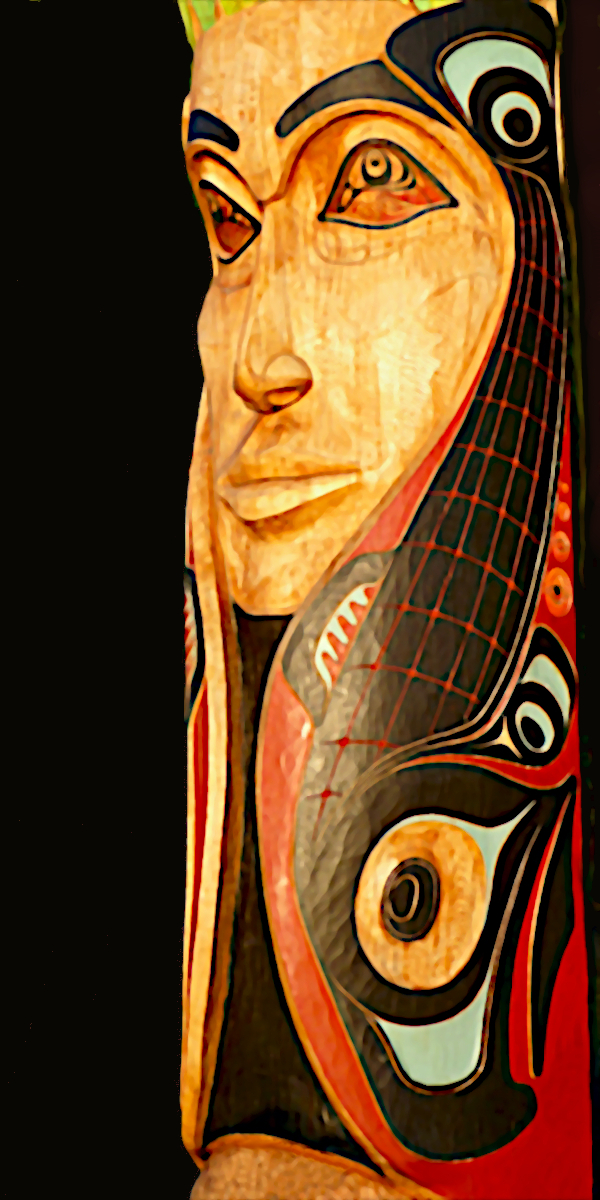
Above: A National Park Service photograph of the Centennial Pole, dedicated in 2011 at the Sitka National Historical Park, Sitka, Alaska, showing the woman carved at the bottom of the pole. “The bottom figure…is a fascinating female portrait by Donnie Varnell, a Haida carver from…Ketchikan (Alaska). Flanked by male and female salmon, she represents Mother Earth.” (Mike Dunham, “Sitka’s Centennial Pole a showpiece of modern totemry,” Anchorage Daily News, June 6, 2014.) Since this story is a Tlingit tale of the Haida Gwaii, the homeland of the Haida people, it seemed appropriate to use a Haida sculpture to illustrate the story.
The Accursed Lake: a story of the Tigua pueblo
Myth, Spiritual Tale
This is a story of the Tigua (or Tiwa) people of Ysleta del Sur Pueblo, in what is now far western Texas.
Long ago there was still a village east of the Eagle-Feather Mountains, where there lived a Hunter. One day, while out hunting, he followed the trail of an antelope until the trail ended in a large lake.
Just then, a fish thrust its head from the water and said, “Friend Hunter, you are on dangerous ground!” and off it went swimming.
Before the Hunter could recover from his surprise, a Lake-Man came up out of the water and said, “How is it that you are here, where no human ever came?”
The Hunter told his story, and the Lake-Man invited him to come in to his house. They entered the house by a trap-door in the roof, and climbed down a ladder. Inside, there were doors to the east, north, west, and south, as well as the door in the roof. Soon the Lake-Man learned that the Hunter had a wife and son at home.
“Why not come live with me?” the Lake-Man said. “I am no hunter, but I have plenty of other food. We could live very well here together.” And he showed the Hunter the four other huge rooms, all filled with corn and dried squash and the like.
“I will come with my wife and son in four days,” said the Hunter, “if the leader of my village will let me.”
So the Hunter went home, and his wife thought very well of the offer. The leader of his village did not want him to go, for he was the best hunter in all the pueblo, but at last gave permission.
So the Hunter and his wife and little boy came to the lake with all their property. The Lake-Man welcomed them, and they settled in. The Hunter went out hunting and brought back great quantities of game, and his wife took charge of the household, as was their custom.
Some time passed very pleasantly. But at last the Lake-Man, who had an evil heart, pushed the Hunter into the East Room, locked the door and left him there to starve. The room was full of the bones of people whom he had tricked in the same way.
The boy was now old enough to hunt small game, and he brought home many rabbits. But the evil-hearted Lake-Man wanted to get him out of the way, too. One morning when the boy was about to start hunting, he heard his mother groaning as if about to die.
“Your mother is in terrible pain,” said the evil Lake-Man, “and the only thing that will cure her is sacred ice from the Lake of the Sun in the east.”
The boy said he would go get the ice, and started off toward the sunrise.
He walked over the brown plains until at last he came to the house of Old-Woman-Mole. She was there all alone, for her husband had gone to hunt. They lived in an old broken-down hut, and she was huddled trying to keep warm by a dying fire. But when the boy knocked, she rose and welcomed him kindly and gave him all there was in the house to eat: a tiny bowl of soup with a patched-up snowbird in it. The boy was very hungry, and picking up the snowbird bit a big piece out of it.
“Oh, my child!” cried the old woman. “You have ruined me! My husband trapped that bird these many years ago, but could never get another, and that is all we have had to eat ever since. So we never bit it, but cooked it over and over and drank the broth. And now not even that is left.” And she wept bitterly.
“Nay, Grandmother, do not worry,” said the boy, for he saw many snowbirds alighting nearby. Using his long hair, he made sanres and soon caught many snowbirds. Then the Old-Woman-Mole was full of joy. After the boy told her his errand, she said:
“I shall help you. When you come into the house of the True People, they will offer you a seat, but you must not take it. They will try you with smoking the weer, but I will help you.”
With that, the boy started away to the east. At last, he came so near to Sun Lake that medicine men and guards of the True People saw him coming, and went in to tell the True People.
“Let him be brought in,” said the True People; and the guards brought the boy in through a magnificent building, until he stood in the presence of the True People in a vast room: white-colored gods of the East, blue gods of the North, yellow gods of the West, red gods of the South, and rainbow-colored gods of Up, Down, and Center. Beyond them were the sacred animals: the buffalo, the bear, the eagle, the badger, the mountain lion, the rattlesnake, and all the others that are powerful in medicine.
The True People offered the boy a white robe to sit on; but he declined respectfully, saying that he had been taught, when in the presence of his elders, to sit on nothing save what he brought, and he sat upon his blanket and moccasins. Then he told them that he had come for the sacred ice, to save his mother’s life.
The True People gave him a sacred weer, that is, a hollow reed filled with the magical plant pee-en-hleh, from the smoke of which the rain clouds come. The boy took in the unpleasant smoke, but the Old-Woman-Mole dug a hole up to his toes, and the smoke went down through his feet into the hole so that no smoke escaped into the room of the True People.
“Surely he is our child,” said the True People to one another, “but we must test him again.” So they put him into the room of the East with the bear and the mountain lion, but he came out again unhurt. They put him into the room of the North, with the eagle and the hawk; into the room of the West, with the snakes; into the room of the South, with the Apaches and other human enemies of his people. He came forth from each room unhurt.
“Surely he is our child,” said the True People to one another, “but we must test him again.” They had a great pile of logs built up, set the boy on the top of the pile and lighted it. But in the morning, the boy sat there unharmed, saying, “I am cold and would like more fire.”
So the guards brought him inside, and the True People said: “You have proved yourself worthy of us, and now you shall have what you seek.”
They gave him the sacred ice, and he hurried home, stopping only to thank the Old-Woman-Mole.
When the evil Lake-Man saw the boy, he was very angry, for he had never expected him to return with the sacred ice. He pretended he was glad to see the boy, but said he must go to the gods of the South to get sacred ice there.
The boy walked south across the brown plains until he came to a drying lake. There, dying in the mud, was a little fish. Picking it up, the boy put it in his gourd canteen of water. After awhile he came to a good lake, and the fish in his gourd said, “Friend Boy, let me swim while you eat your lunch, for I love the water.”
So he put the fish in the lake; and when he was ready to go on, the fish came to him, and he put it back in his gourd. At three lakes he let the fish swim while he ate; and each time the fish came back to him.
Beyond the third lake began a great forest which stretched clear across the world, and was so dense with thorns and brush that no human being could pass through. The tiny fish changed itself into a great Fish-Animal with hard, strong skin, and bidding the boy mount upon its back, it went plowing through the forest, breaking down big trees like stubble, and bringing him through to the other side without a scratch.
“Now, Friend Boy,” said the Fish-Animal, “you saved my life, and I will help you. When you come to the house of the True People of the South, they will try you as they did in the East. When you have proved yourself, the leader of the True People will bring you his three daughters, from whom to choose you a wife. The two eldest are very beautiful, and the youngest is not; but choose the youngest, for she is good and the beauty of the older sisters does not reach to their hearts.”
The boy thanked the fish and went on. At last he came to the house of the True People of the South. They tried him just as the True People of the East had done. Once again he passed the tests, and they gave him the sacred ice. Then the leader of the True People brought his three daughters, and said, “You are now old enough to have a wife, and I see that you are someone who cares for those around him. Therefore, choose one of my daughters to marry.”
The boy remembered the words of his fish friend, and said, “I choose your youngest daughter.”
The leader of the True People was pleased, and the boy and the youngest daughter were married. They started home, carrying the sacred ice and many presents. With the help of the Fish-Animal, they got through the forest, and walked on.
At last they came in sight of the big lake, and over it were great clouds, with the forked lightning leaping forth. They could see the evil Lake-Man sitting at the top of his ladder, watching to see if the boy would return, and as they watched the lightning of the True People struck him dead.
So the boy and the youngest daughter found the boy’s mother, and the three of them left the house of the evil Lake-Man. They left all the belongings of the evil Lake-Man behind, and when they got to the shore of the lake, the boy stood and prayed to the True People that the lake might be accurst forever. From that day its waters turned salt, and no living thing has drunk therefrom.
Source: Charles Fletcher Lummis, Pueblo Indian Folk-Stories (New York: D. Appleton-Century Co., 1910), pp. 109-116.
Coyote Creates Human Beings: A Story of the Miwok People
Myth, Wisdom Tale
After the coyote had finished all the work of creating the world and the animals, he called a council of animals to deliberate on the creation of human beings. The animals sat down in an open space in the forest, all in a circle, with the mountain lion at the head. On her right sat the grizzly bear, next the cinnamon bear, and so on around according to the rank, ending with the little mouse, which sat at the mountain lion’s left.
The mountain lion was the first to speak, and she declared, “I would like to see humans created with a mighty voice like myself, with which they could frighten all other animals. For the rest,” the mountain lion said, “I would like to have humans well covered with hair, with terrible fangs, and with strong claws, like mine.”
The grizzly bear said, “It is ridiculous to have such a voice as my neighbor, the mountain lion, for she was always roaring with it and scaring away the very prey she wished to capture.” The grizzly bear shook her head and went on: “Humans ought to have prodigious strength like mine, and they should be able to move about silently but very swiftly if necessary, and be able to grip their prey without making a noise, like me.”
The deer said, “Humans would look very foolish, in my way of thinking, unless they each had a magnificent pair of antlers on their heads to fight with. And I think it is very absurd to roar so loudly. I would pay less attention to the human’s voice than to their ears and his eyes. The humans should have both excellent hearing and sight, like mine.”
The bighorn sheep protested he never could see what sense there was in such antlers. “Big antlers, branching every way, only get caught in the thickets,” he said. “If humans had horns which were mostly rolled up, they would be like a stone on each side of their heads, giving it weight, and enabling the humans to butt a great deal harder, like me.”
When it came the coyote’s turn to speak, he said, “All these are the stupidest speeches I have ever heard. I could hardly keep awake while listening to such a pack of noodles and nincompoops. Every one of you wants to make the humans like yourselves. You might just as well take one of your own cubs and call it a human.
“As for myself,” Coyote said, “I know I am not the best animal that could be made, and I could make one better than himself or any other. Of course, humans would have to be like myself in having four legs, five fingers, and so on. It was well enough to have a voice like the mountain lion, only humans need not roar all the while with it. The grizzly bear also had some good points, one of which was the shape of her feet, which enable her easily to stand erect; and I am in favor, therefore, of making the human’s feet nearly like the grizzly’s.
“The grizzly was also happy in having no tail,” Coyote went on. “I have learned from my own experience that tails are only a harbor for fleas. The deer’s eyes and ears are pretty good, perhaps better even than mine.”
Coyote thought for a moment. “Then there is the fish, which is naked, and which I envy, because having a coat of hair was too hot most of the year. Therefore, I think humans should have no hair. Their claws ought to be as long as the eagle’s, so that they can hold things in them.
“And finally,” Coyote concluded, “even with the different gifts you all have,— voice, feet, hearing and sight, and so on — you all have to admit that no animal is as cunning and crafty as I am. So I will have to make humans like me in this respect — they will have to be cunning and crafty.”
After the coyote had finished speaking, the beaver said, “I have heard such twaddle and nonsense in all my life. No tail, indeed! I would make humans with a broad, flat tail, so they could haul mud and sand on it, and build their houses with it.”
The owl said, “All you animals seemed to have lost your senses; even you, Coyote! None of you want to give wings to the humans. I could not see of what use anything on earth could be without wings.”
The mole said, “It is silly to talk about wings, for with them humans would be certain to bump their heads against the sky. Besides that, if the humans had sharp eyes and wings both, they would get their eyes burnt out by flying too near the sun. But if they were like me, with small, weak eyes, they could burrow in the cool, soft earth, and be happy.”
Last of all, the little mouse squeaked out, “I would make humans with sharp eyes, of course, so they could find good things to eat. As for burrowing in the ground, that was absurd.”
So the animals disagreed among themselves, and the council of the animals broke up in a fight. The coyote fought with the beaver, and nipped a piece out of her cheek; the owl jumped on top of the coyote’s head, and dug in her talons. And all the other animals fought, one against the other.
When the fighting stopped, every animal set to work to make humans, each according to his or her own ideas. Taking a lump of earth, each animal commenced molding it to make a creature that looked like himself or herself. But the coyote began to make a creature like the one he had described in the council: a strong voice, feet that enabled it to stand on its hind legs, no tail, good eyes and ears, no fur, long claws that could grasp things and hold them, and as cunning and crafty as the coyote himself.
It was so late before the animals starting molding their creatures out of earth that nightfall came on before any one had finished their models, and they all lay down and fell asleep. But the cunning coyote stayed awake and worked hard on his model all night. When all the other animals were sound asleep, he went around and poured water on their models, dissolving the earth, and spoiling their work.
In the morning early he finished his model of humans, and gave life to the humans long before the others could make new models. And so it was that human beings were made by the coyote.
Source: The following story of the creation of human beings is a Miwok story heard at Little Gap, California, and reported in Tribes of California by Stephen Powers and John Wesley Powell (Washington, D.C.: U.S. Government Printing Office, 1877), p. 358; the version below is an adaptation of the version given by Powers and Powell. This story is included in the old Unitarian Universalist curriculum Beginnings by Sophia Fahs and Dorothy Spoerl (Boston: Beacon, 1958), pp. 103 ff., but the version in Beginnings states in the first sentence that “the Great Spirit” created the world, whereas the story reported by Powers and Powell specifically states that Coyote created the world. I have also retained some details that Fahs and Spoerl left out; and I have degenderized the language.
SOUTH AMERICAN INDIGENOUS TALES
Coming soon.