Stories for liberal religious kids, drawn from a wide variety of religious and spiritual traditions.
- Stories labeled “Wisdom Tale” teach life lessons.
- Stories labeled “Spiritual Tale” have a spiritual purpose (which can seem alien to Westerners).
- Stories labeled “Tale of Deities” tell about the attributes and characters of gods/goddesses/divine beings.
- Stories labeled “Myth” explain or describe some natural phenomenon.
The stories on these pages were originally written for a variety of
purposes — worship services, classes, or just for fun. You should adapt
them to whatever situation you want to use them in.
Copyright: Please respect copyright. For just one example, if you use one of my copyright-protected stories in a webcast or recording, I ask that you give me credit for the story (e.g., “This story is copyright by Dan Harper”). You do not have to give me credit in educational settings or at home.
Cultural appropriateness: When I wrote these stories, I worked from the most culturally appropriate sources I could find, and I attempted to retain the distinctive flavor of the original religion/culture of each story. You will have to decide how you want to present other religious traditions where they conflict with modern Western sensibilities, whether you will cover over religious differences or not. Some examples of what I mean: Will you ignore that Buddhists affirm that Buddha had 500+ previous lives? Will you adhere to Western understandings of gender, or acknowledge diverse understandings of gender? You will have to judge for yourself, based on the needs of your class or local congregation.
Table of Contents
- Myths of Ancient Greece
- Stories from Ancient Greece
- Ancient Greek Stories Retold by Modern Writers
- Ancient Rome
MYTHS OF ANCIENT GREECE
The Myth of Prometheus
The first of two stories is complete. The conclusion will be completed Real Soon Now.
1. The Punishment of Prometheus
Tales of Deities, Wisdom Tale
Once upon a time, the immortal god Prometheus stole fire from the other immortal gods and goddesses, and gave it to mortal human beings.
Zeus, who had just become the new ruler over all the other gods and goddesses, was very angry. To punish Prometheus, Zeus commanded him to be nailed to a cliff in Scythia, a distant place at the end of the world. Zeus told two of his henchmen, a demon named Might and another demon named Violence, to take Prometheus to Scythia. Prometheus had taken the fire from Hephaestus, who was the god who made things out of metal for the other gods and goddesses at his forge, so Hephaestus had to go along to make shackles of bronze to hold Prometheus tightly against the rocks.
After traveling many miles, at last they came at last to a high and lonely cliff. Hephaestus began working while Might and Violence watched to make sure Prometheus didn’t get away.
“I don’t have the heart to bind another god in this desolate place,” said Hephaestus to Prometheus, as he hammered bronze nails into the cliff face. “Yet I have to do it because it’s dangerous to ignore the commands of Zeus. Prometheus, I don’t want to do this to you. The sun will scorch you during the day, and the cold will freeze you at night. This is what has happened because you opposed the will of Zeus. This is what you get for giving fire to the human beings.” Hephaestus paused to wipe the sweat from his forehead. “Zeus is a new ruler, and new rulers are harsh.”
“Why are you delaying?” said the demon named Might. “Why do you pity this god who has betrayed all other gods and goddesses by giving such power to mortal beings?”
“I pity him because we are friends and relations,” Hephaestus started to say. But Might scared him — and Violence, who never said anything at all, scared him more. Hephaestus began working faster. He quickly bound Prometheus’s wrists and ankles with bronze shackles, and bound his body with a strong bronze chain that he nailed to the cliff. Soon Prometheus could not move at all.
“Let me see you hammer with your full force,” said Might. “The power of Zeus is great, and the anger of of Zeus is severe, so you better do a good job.”
“I’m doing what I have to do,” said Hephaestus. “There’s no need to tell me what to do.”
“Oh, I’ll tell you what to do,” said Might, mockingly. “Now get his legs secure.”
“Your words are as ugly as your looks,” muttered Hephaestus under his breath.
“You can soft-hearted if you want,” said Might, sounding dangerous, “but don’t cross me.”
Hephaestus gave one last blow with his hammer. “There, it’s done,” he said. “Now let’s go.” He left, and Violence followed him.
Might stayed behind for a moment. “That’s what you get for insulting the gods and goddesses by giving fire to beings who live for such a short time,” he said to Prometheus. “And are the mortals able to help you now? Your name means ‘Far-seeing,’ but it doesn’t look to me like you could see very far at all.” With that, he turned and left Prometheus alone, bound to the face of the desolate cliff.
When they all had gone, Prometheus groaned in misery. He did have the power of foresight, the ability to see ahead into the future. He had known that he would be chained on that cliff for what he had done, chained for many long years, wracked by pain, burned by the sun, frozen with the cold. He had stolen the fire anyway. Now here he was, groaning in pain, punished by Zeus for helping the human beings.
At last he stopped. “Why am I groaning?” he said to himself. “I foresaw this, and I must bear this punishment as well as I can. Yes, I gave the gift of fire to mortals. Yes, I took a small coal from the forge of Hephaestus, and hid it in a stalk of fennel so I could smuggle it down to the human beings. Giving that fire to mortals was the right thing to do. Fire has helped them learn new arts and sciences; fire has helped them become far more powerful. Zeus is afraid of human beings, afraid they will rival the gods and goddesses with their new knowledge. That is why I am bound here, riveted in bronze fetters beneath the wide sky. I did the right thing, and I’m not afraid to be punished for it.”
The immortal daughters of the god Oceanus flew to Scythia to talk with Prometheus and comfort him. Prometheus poured out his troubles to them, complaining about his fate, while they listened sympathetically. Then Oceanus himself, god of the ocean stream, came too, flying there on his winged horse.
Oceanus asked if there was anything he could do for Prometheus.
“What can you do except look at my suffering?” said Prometheus bitterly. “I was one of the friends of Zeus, and look at me now. I was one of the ones who helped him overthrow Cronus, helped him become the new ruler of the gods and goddesses. Yet here I am, punished cruelly by the one I helped to win power.”
“I see, Prometheus, and I’m sympathetic to you,” said Oceanus. “I want to give you some advice, because even though you are more clever than I, I am an older god than you. When there’s a new ruler of the gods and goddesses, you have to adapt to their rule. You’re going to have to adapt to the new rule of Zeus. Remember that if Zeus hears your bitter angry words, he can make things even worse for you. So take my advice and speak calmly. Our new ruler is a harsh god, and he doesn’t have to listen to anyone’s advice. Now if you will speak calmly, I will go and see if I can get Zeus to free you.”
“No, don’t go to Zeus,” said Prometheus. “Thank you for your loyalty, but you shouldn’t do that. You’ll just get in trouble, too. Go back home. Don’t let him become angry with you.”
Oceanus tried to argue with him, but Prometheus insisted that Oceanus should not go to Zeus. At last, Oceanus leapt back on his winged horse and flew away to his home.
The daughters of Oceanus burst into tears. Prometheus had dared to help human beings by stealing fire for them. Because of that — because he had dared to rebel against the will of Zeus — he was sentenced to be chained to this desolate rocky cliff forever. No one could help him.
Or could they?…To be continued….
Source: This version of the story of Prometheus comes from the play Prometheus Bound by the ancient Greek poet Aeschylus. I used two translations of Aeschylus’s play, by David Grene (University of Chicago Press, 1942); and by Herbert Weir Smyth (Loeb Classical Library, Harvard Universrity Press, 1926). I also referred to the exegesis offered by William R. Jones in his essay “Theism and Religious Humanism: The Chasm Narrows” (The Christian Century magazine, May 21, 1975).
How to pronounce the Greek names:
Prometheus [pro mee’ the us]
Zeus [zoos]
Hephaestus [heh fay’ stuss]
Oceanus [oh keh ah’ nuss]
Cronus [kro’ nus]
The Myth of Demeter and Persephone
A four-part myth of Demeter and Persephone from the Homeric Hymns.
1.How Persephone Disappeared, and What Demeter Did
Tales of Deities
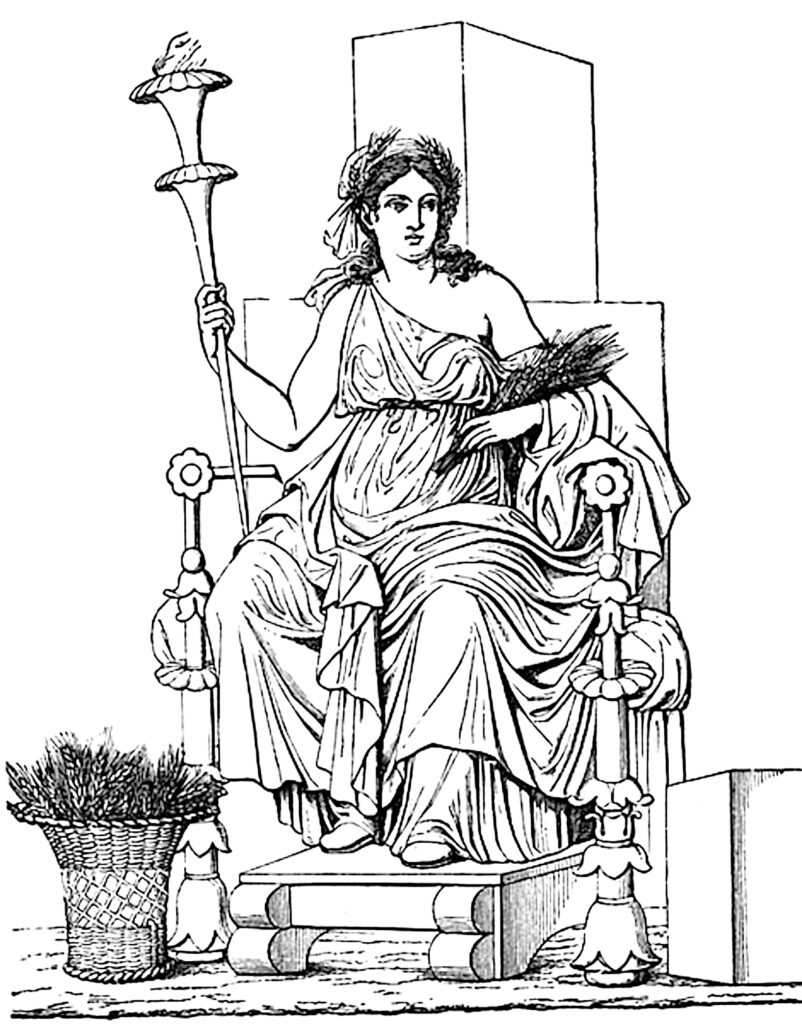
Rich-haired Demeter, goddess who strikes awe in the hearts of all humankind, the goddess of the wheat-fields, goddess of farming and agriculture — Demeter had a daughter named Persephone.
Once upon a time, trim-ankled Persephone was playing with the daughters of Oceanus. They roamed over a soft meadow on the plain of Nysa, gathering flowers. Many flowers grew there: roses, crocuses, beautiful violets, irises, hyacinths, and also the narcissus. The narcissus is a marvelous, radiant flower, admired by both the deathless gods and by mortal humans. From its root grow a hundred blooms, and it smells so sweet that all wide heaven above and the whole earth and the sea’s salt swell laughed for joy.
The narcissus grew there at the will of all-seeing Zeus, the god of loud thunder, the ruler of the other gods and goddesses. Zeus decided that Persephone was old enough to be married. He told Gaia, mother earth, to make the narcissus grow in the meadow to attract the attention of Persephone.
When Persephone saw the narcissus blooming, she was amazed by its beauty. She reached out with both hands to take the lovely flower. But to her surprise, the earth opened there in the middle of the meadow. Out of the yawning hole rode Hades, the Son of Cronos, the brother of Zeus, the god of the underworld — he who was called the Host of the Many because in the underworld were the spirits of everyone who had ever died.
Hades caught up the reluctant Persephone and carried her away. But before he could turn his horses to carry her back into the underworld, Persephone cried out shrilly, calling upon her father Zeus, Son of Cronos, who is the highest of all the gods and goddesses. She cried out, and the heights of the mountains and the depths of the sea rang with her immortal voice.
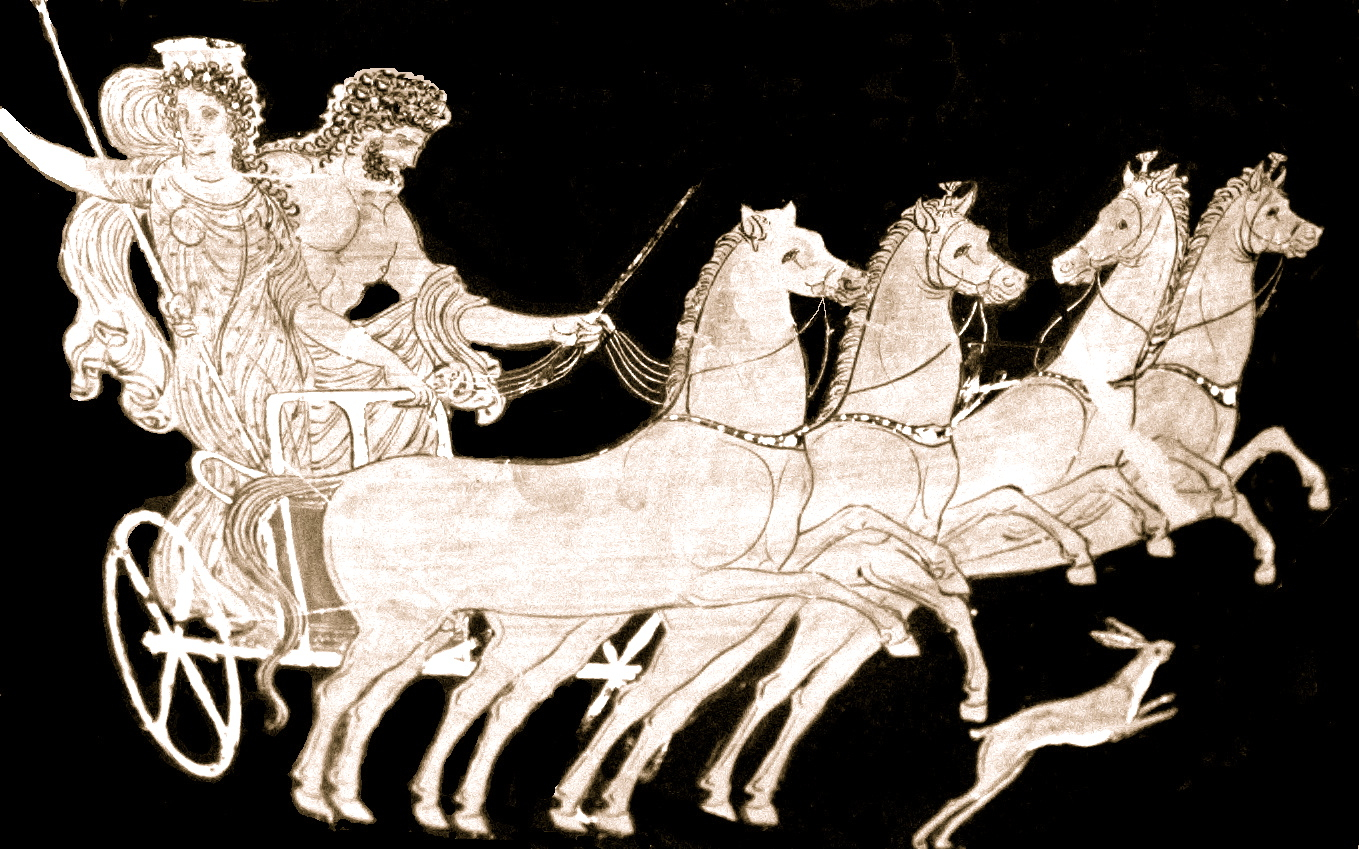
No one seemed to hear her cries — not one of the mortal human beings, not even the nearby olive trees, and almost none of the gods and goddesses. But two of the gods and goddesses did hear her. Sitting in her cave, tender-hearted Hecate, she of the bright hair, goddess of witches, heard Persephone cry out to Zeus. And from high above the earth from where he was guiding the sun across the sky, Helios, god of the sun, also heard Persephone cry out to Zeus.
At last Demeter heard Persephone’s cries. Bitter pain seized Demeter’s heart, and she tore the covering from her divine hair; her dark cloak she threw off her shoulders, and she sped towards where she had thought she had heard the cry; sped like a wild bird, over the firm land and yielding sea, seeking her child.
But she was too late. Persephone was beneath the earth. And when she asked where Persephone was, no one would tell her the truth, neither gods nor mortal human beings. For nine days, queenly Demeter wandered over the earth with flaming torches in her hands. Her grief was so great that she refused to eat the food of the gods, the ambrosia and the sweet draught of nectar. Then on the tenth day, Hecate, with a torch in her hands, came to give Demeter news.
“Queenly Demeter,” said Hecate, “O bringer of seasons and giver of good gifts, I do not know what god of heaven or what mortal man carried away Persephone and pierced your heart with sorrow. I heard her voice cry out, but I did not see who it was.”
Demeter sped swiftly with Hecate, holding flaming torches in her hands. Together, they came to Helios, who is watchman of both immortal gods and mortal humans, and stood in front of his horses.
“Helios,” said Demeter, “listen to me, goddess as I am, if ever by word or deed of mine I have cheered your heart and spirit. I heard the cry of my daughter, and though I could see nothing, the way she cried sounded as though someone had seized her violently. You look down from the bright upper air, and can see over all the earth and sea. Tell me truly, have you seen my dear child anywhere? Have you seen what god or mortal has violently seized her against her will, and against my will?”
“Queen Demeter,” Helios said, “I will tell you the truth, for I pity you in your grief. Zeus gave her to Hades, the god of the underworld, to be his wife. Hades seized her and took her in his chariot, loudly crying, down to his realm of mist and gloom.
“But cease your sadness and be not angry any longer,” Helios went on. “Hades, the Ruler of Many, is a fitting husband for your child. He holds great honor among the gods and goddesses, and he is appointed lord of all those among whom he dwells.”
Then Helios called to his horses, and drove his swift chariot around Demeter and Hecate, his horses moving like long-winged birds.
But after she heard what Helios had to say, Demeter’s her grief became more terrible and savage. She was so angry at Zeus, the dark-clouded Son of Cronos, that she stayed away from Mount Olympus where the other gods and goddesses gathered. She disguised herself, hiding her true form, and went to wander the towns and fields of humans. And none of the men or women who saw her knew that she was the goddess Demeter.
To be continued….
Source: Taken from the Homeric Hymn to Demeter. Adapted from a public domain translation of the “Homeric Hymn to Demeter” in Hesiod: The Homeric Hymns and Homerica, trans. Hugh G. Evelyn-White (Cambridge, Mass.: Harvard University Press, 1914), pp. 288-325. I also referred to a more recent translation, The Homeric Hymns: A Translation with Introduction and Notes by Diane J. Rayor (Berkeley: University of California Press, 2004), pp. 17-34.
2. Doso and Metaneira
Tales of Deities
Demeter’s wanderings led her to the house of wise Celeus, who then was lord of fragrant Eleusis. Sad and vexed, she sat down to rest on the wayside by the road, next to the Maiden Well. There the women of the place came to draw water. She found a shady place to sit, beneath an olive shrub. She looked like a woman who is too old to bear children, the kind of old woman who cared for the children of a king.
The four daughters of Celeus — Callidice, Cleisidice, Demo, and Callithoe — came to Maiden Well with their bronze pitchers, to draw water and carry it to their father’s house. They looked like goddesses in the flower of their girlhood. They saw Demeter sitting there in the shade of the olive shrub, but did not realize that she was a goddess. They thought she was an old woman.
“Old mother,” they said, “where do you come from, and what people do you come from? Why do you sit here so far from our city? In many of the shady rooms of the houses there, you would find women of your own age, and others younger, who would welcome you.”
Demeter, seeing that the girls were polite, answered them politely. “Hail, dear children,” Demeter said to them, “I will tell you my story; for it is not unseemly that I should answer your questions.
“My name is Doso. I have come from the island of Crete, sailing over the wide back of the sea. But I did not come willingly.
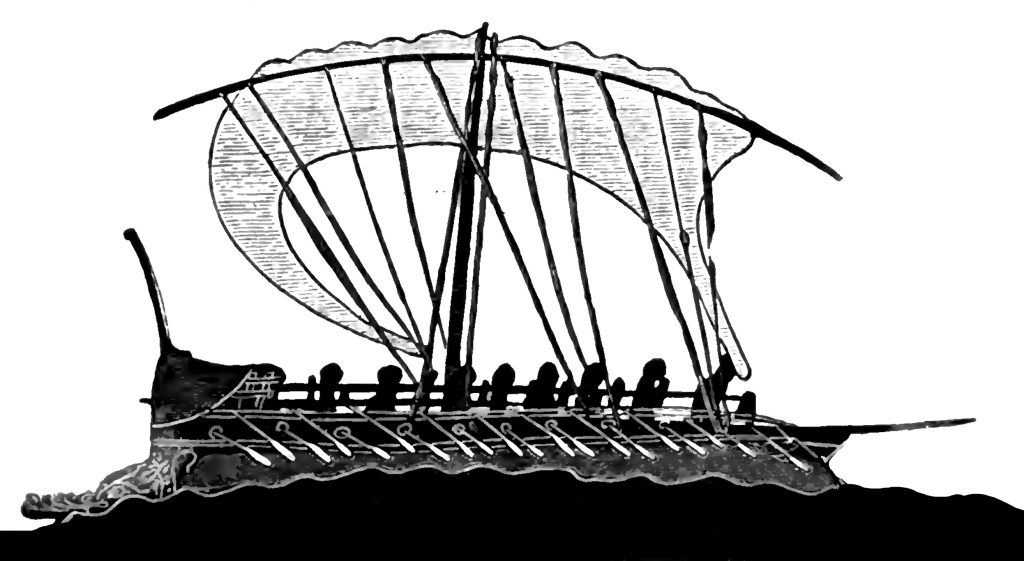
“Pirates took me from Crete by force. After they had stolen me away, they took me in their swift ship to the city of Thoricus. There the pirates, both the men and the women, went on shore and began to prepare a meal next to the ropes that tied the stern of the ship to the shore. But I did not want their food. I escaped the ship, and fled across the dark countryside, so that the pirates could not take me somewhere across the sea and sell me as a slave.
“Since my escape, I have wandered, and at last came here. I do not know what land this is, or what people are in it. But may the gods and goddesses who dwell on Mount Olympus give you your wishes, dear maidens. Take pity on me, dear children, and show me to a house where I may go to work cheerfully at such tasks belong to a woman of my age. I could take care of a newborn child, holding the child in my arms. Or I could keep house, or teach the other women their work.”
When she had finished, Callidice said: “Dear Doso! The gods and goddesses are stronger than us, and we must bear whatever they send us — even being stolen away by pirates. But why don’t you stay with us? We will go to our house and tell Metaneira, our mother, all about you, so she will have you come to our home. You see, our mother has an only son, late-born, who is being nursed in our well-built house, a child we have all welcomed with many prayers. If you could bring him up until he reached the full measure of youth, our mother would give you gifts that any woman would envy.”
Doso bowed her head in agreement. The four girls filled their bronze pitchers with water, and joyfully ran back to the house. They ran to their mother and told her Doso’s story. Metaneira told the girls to go back with all speed and invite the stranger to come. The girls ran back to Doso, running like young deer bounding across a meadow in springtime, their hair streaming around their shoulders.
Doso returned with them, walking behind them, still sad at heart, with her head veiled and her long dark cloak waving about her slender feet. The girls led her through the portico to where Metaneira sat next to a pillar, holding her baby son to her breast. When Doso crossed the threshold, Metaneira turned to look at her. For just a moment, Doso’s head reach the roof and she filled the doorway with a heavenly radiance. Awe and reverence and pale fear took hold of Metaneira. She rose up from her couch before her, and bade her be seated.
But Doso stayed silent with lovely eyes cast down until careful Iambe placed a low stool for her, and threw over it a silvery fleece. Only then did Doso sit down, for disguised as she was as an old woman, she should sit in a more humble place than Metaneira.
Doso held her veil in her hands before her face, and sat without speaking for a long time, still pining for her daughter Persephone. But after a time, gentle Iambe touched Doso with her funny sayings and jests. At last, Doso smiled and laughed, and her heart was cheered.
Metaneira filled a cup with sweet wine and offered it to Doso. But she refused it, for she said it was not lawful for her to drink red wine, and she asked them to mix meal and water with soft mint and give her to drink. Metaneira mixed the drink and gave it to the goddess as she bade. And the great queen Demeter, still in her guise as Doso, took the drink — and this simple act later became one of the most important rituals in the temple to Demeter that was built in Eleusis.
“Hail, lady!” said Metaneira. “I greet you as lady, for even though you come to us looking like a woman who is old and poor, I think you are nobly born. Yet you were stolen away by pirates. We mortals must bear whatever the gods send us, even sadness and grief. But now, since you are come here, you shall have what I can bestow. Will you nurse this child whom the gods gave me in my old age? I can promise you a great reward if you nurse him to manhood.”
“And to you, lady, all hail!” replied Doso. “Gladly will I take the boy, be his nurse. I shall protect him from evil witchcraft, and I know a strong charm to keep away the pain of teething.”
So Metaneira was glad to find a nurse to care for her child. But it was not long before she thought Doso was trying to kill her baby boy.
To be continued….
Source: Adapted from a public domain translation of the Homeric Hymn to Demeter in Hesiod: The Homeric Hymns and Homerica, trans. Hugh G. Evelyn-White (Cambridge, Mass.: Harvard University Press, 1914), pp. 288-325. With reference to a more recent translation, The Homeric Hymns: A Translation with Introduction and Notes by Diane J. Rayor (Berkeley: University of California Press, 2004), pp. 17-34.
3. Demeter and the Baby
Tales of Deities, Spiritual Tales
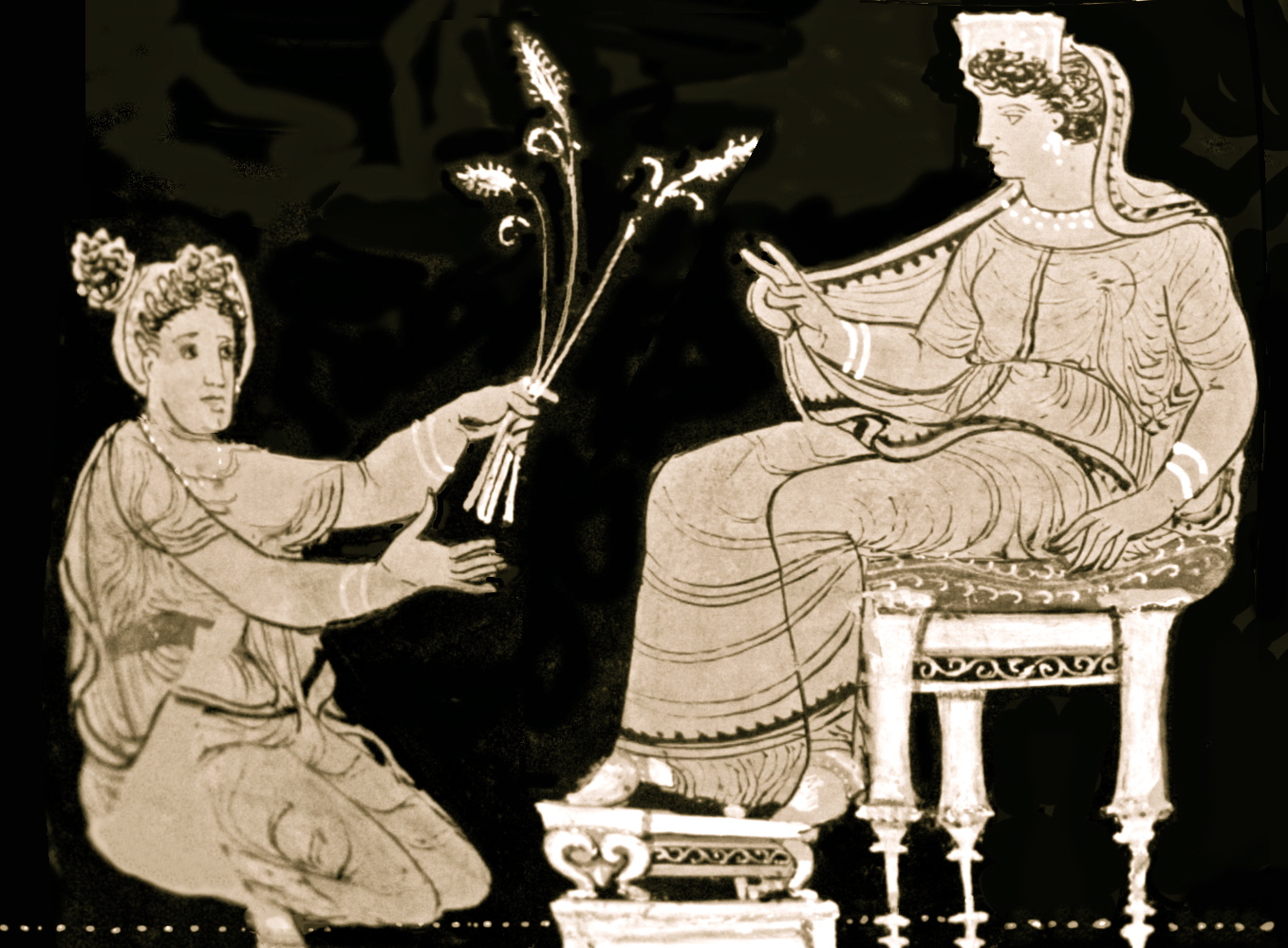
Doso immediately began her duties as a nurse, taking care of Demophoon, the infant son of Metaneira and Celeus. With Doso as his nurse, the child grew like some immortal being. This was because during the day, when no one was watching, Doso secretly anointed him with ambrosia, one of the foods of the gods. And as she held him at her breast, she breathed sweetly on him, and that too helped him to grow like an immortal.
At night, when Metaneria and Celeus were fast asleep, Doso did something that required even more secrecy. She went to the hearth, where the fire burned all night, and placed Demophoon in the fire. Because she was a goddess, the fire did not hurt the baby. Instead, the fire worked a great wonder in the child, and he grew beyond his age, and his face looked like the face of one of the gods.
Not only that, but if a goddess can hold a mortal child in the fire night after night, eventually that child can become immortal, too. Doso loved the little boy, and hoped to hide Demophoon in the fire night after night, until he became deathless and unaging, just like her.
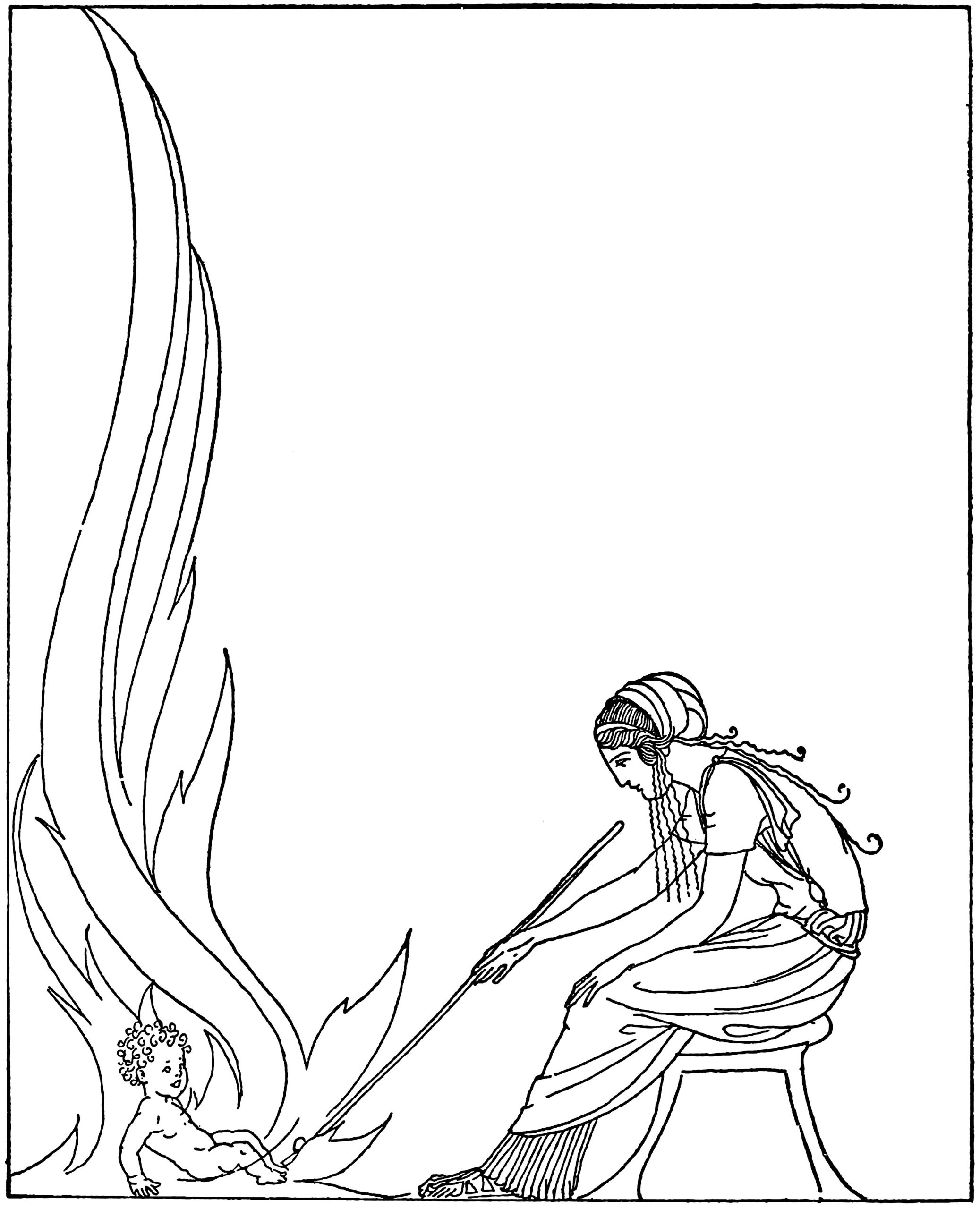
But Metaneira suspected that Doso was doing something to the boy in secret. So one night, she kept watch on Doso from the door of her bed chamber. When she saw Doso put Demophoon into the fire, she feared for her son’s life, and cried aloud in her fear.
“Demophoon, my son,” she cried, “why is this strange woman burying you deep in the fire?”
Doso heard her cry out, and grew terribly angry. With her divine hands, she snatched the child from the fire, and cast him from her to the ground.
“You mortals are witless!” she said to Metaneira. “You are utterly unable to understand whether good or evil comes upon you. For now in your heedlessness you have been foolish past healing. I swear by the relentless water of Styx, which is the most sacred oath of the gods and goddesses, that I would have made your dear son so that he would never age all his days. I would have made him so that he would never die. I would have bestowed on him everlasting honor. This is why I put him in the fire. Now, because of what you have done, he can never escape death and age.
“Yet even so I have made sure unfailing honor will always be his, for he lay upon my knees and slept in my arms. Lo! I am Demeter, who is the greatest help and cause of joy to the undying gods and mortal humans.”
As she spoke, the goddess changed her appearance, thrusting old age away from her. Beauty spread round about her and a lovely fragrance was wafted from her sweet-smelling robes. Rich golden hair spread down over her shoulders. A light shone from her, so that the house was filled with brightness as with lightning. Metaneira knew that a goddess stood before her.
“Now let all the people build me a great temple,” said the goddess. “Let there be an altar below it, and beneath the city and its sheer wall upon a rising hillock above Callichorus. And I, Demeter, myself will teach my rites, that hereafter you may reverently perform them and so win the favor of my heart.”
And with that, Demeter went out from that palace, never to return to that house.
Metaneira’s knees gave way, and she remained speechless for a long time. She did not even think to pick up her son from the ground.
But her daughters heard the baby boy’s pitiful wailing and sprang down from their well-spread beds. One of them took up the child in her arms, while another revived the fire, and a third rushed with soft feet to care for their mother. And they gathered about the struggling child and washed him, embracing him lovingly.
But Demophoon cried and would not be comforted. The nurses and handmaids who were holding him now were much less skillful than the goddess Demeter!
As soon as dawn began to show, Metaneira and her daughters told their father Celeus the whole story. They told him that the lovely-crowned goddess Demeter had charged them to build her a temple. So Celeus called the countless people to an assembly and bade them make a goodly temple for rich-haired Demeter and an altar upon the rising hillock. Before long, the temple was built, and it is said that Demeter herself was pleased with it.
As for the child, Demophoon grew like an immortal being.
And as for Demeter, she remained in her temple at Eleusis, still angry with Zeus.
Source: Adapted from a public domain translation of the Homeric Hymn to Demeter in Hesiod: The Homeric Hymns and Homerica, trans. Hugh G. Evelyn-White (Cambridge, Mass.: Harvard University Press, 1914), pp. 288-325. With reference to a more recent translation, The Homeric Hymns: A Translation with Introduction and Notes by Diane J. Rayor (Berkeley: University of California Press, 2004), pp. 17-34.
4. Persephone and Demeter Meet Again
Tales of Deities, Myth
Rich-haired Demeter still sat apart from all the blessed gods, wasting with yearning for her daughter Persephone. She caused a most dreadful and cruel year for humankind all over the earth.
The farmers and their oxen plowed the fields in vain. Farmers sowed seeds of the white barley, but the ground would not let the seed sprout. It seemed that Demeter would destroy the whole human race with cruel famine. And without humankind, the gods and goddesses who dwell on Mount Olympus would no longer receive the gifts and sacrifices that meant so much to them.
Zeus knew he must do something. First he called for golden-winged Iris, the goddess of the rainbow, to bring Demeter to Mount Olympus. Iris sped with swift feet to Eleusis, and found dark-cloaked Demeter in her temple.
“Demeter,” said Iris, “father Zeus, whose wisdom is everlasting, calls you to come join the tribes of the eternal gods. Come and do not ignore the command of Zeus, who rules over all the gods and goddesses.”
But Demeter’s heart was not moved, and she refused to go with Iris.
Then Zeus sent forth each of the gods and goddesses. They went to Demeter one after the other, offering many beautiful gifts, and godly rights and privileges.
But Demeter was still full of anger, and none of them could persuade her to go to Mount Olympus. Demeter said she would never set foot on fragrant Olympus, nor would she let food grow from the ground, until she saw her daughter again.
When all-seeing Zeus heard this, he called for Hermes, messenger of the gods, god of trickery and travelers and thieves. Zeus sent Hermes to the underworld, to convince Hades with soft words to allow Persephone come up from the misty gloom of the underworld, so that her mother Demeter might see her with her own eyes.
Hermes straightaway flew down to the underworld. He found Hades in his house, seated upon a couch, and his shy wife Persephone with him.
“Dark-haired Hades,” said Hermes, “you who are the ruler over the departed, Zeus bids me bring noble Persephone forth from the underworld up to the rest of the gods, so her mother may see her, and cease from her anger.
“Demeter has promised to destroy the tribes or mortal humans by letting no plants grow,” Hermes said. “But this will put an end both to humankind, and to the sacrifices and honors humans offer to us, the immortal gods.”
Hades smiled grimly and turned to obey the command of Zeus the king. “Go now, Persephone, to your dark-robed mother,” he said. “But feel kindly towards me. I could be a fitting husband for you among, I who am a brother to Zeus, the ruler of all the gods and goddesses.”
Persephone was filled with joy. She sprang up in gladness. But while she had been distracted, Hades had given her a sweet pomegranate seed to eat. For if she ate even one thing in the underworld, she would have to return there. He did not want her to remain forever with grave, dark-robed Demeter.
Hades harnessed his deathless horses to his golden chariot. Hermes took the reins, and Persephone got in the chariot. Swiftly the horses pulled them over the long road, driving past seas and rivers, grassy glens and mountain-peaks — nothing could slow the pace of those immortal horses. At last, Hermes brought them to the fragrant temple where rich-crowned Demeter was staying.
When Demeter saw them, she rushed forth — and Persephone, when she saw her mother’s sweet eyes, leaped down from the chariot and ran to her, fell upon her neck and embraced her. But while Demeter was still holding her dear child in her arms, she began to fear that somehow they had been tricked.
“My child, tell me,” said Demeter. “Did you taste any food while you were in the underworld? If you did not taste any food in the underworld, you shall come back from loathly Hades and live with me on Mount Olympus and be honored by all the deathless gods. But if you tasted any food in the underworld, you must go back there again every year.
“If you ate any food in the underworld, you may only stay with me for two thirds of the year,” Demeter went on. “Each year when the winter returns, you must return to Hades. And when the earth blooms with fragrant flowers in the springtime, then you may return from the realm of darkness and gloom back up to this world.”
“When luck-bringing Hermes came, swift messenger from my father Zeus and the other immortal gods and goddesses,” Persephone said, “When he bid me come back from Hades so you could see me with your eyes and so cease from your anger against the gods, I sprang up at once for joy. But Hades had secretly put in my mouth sweet food, a pomegranate seed, and forced me to taste it.”
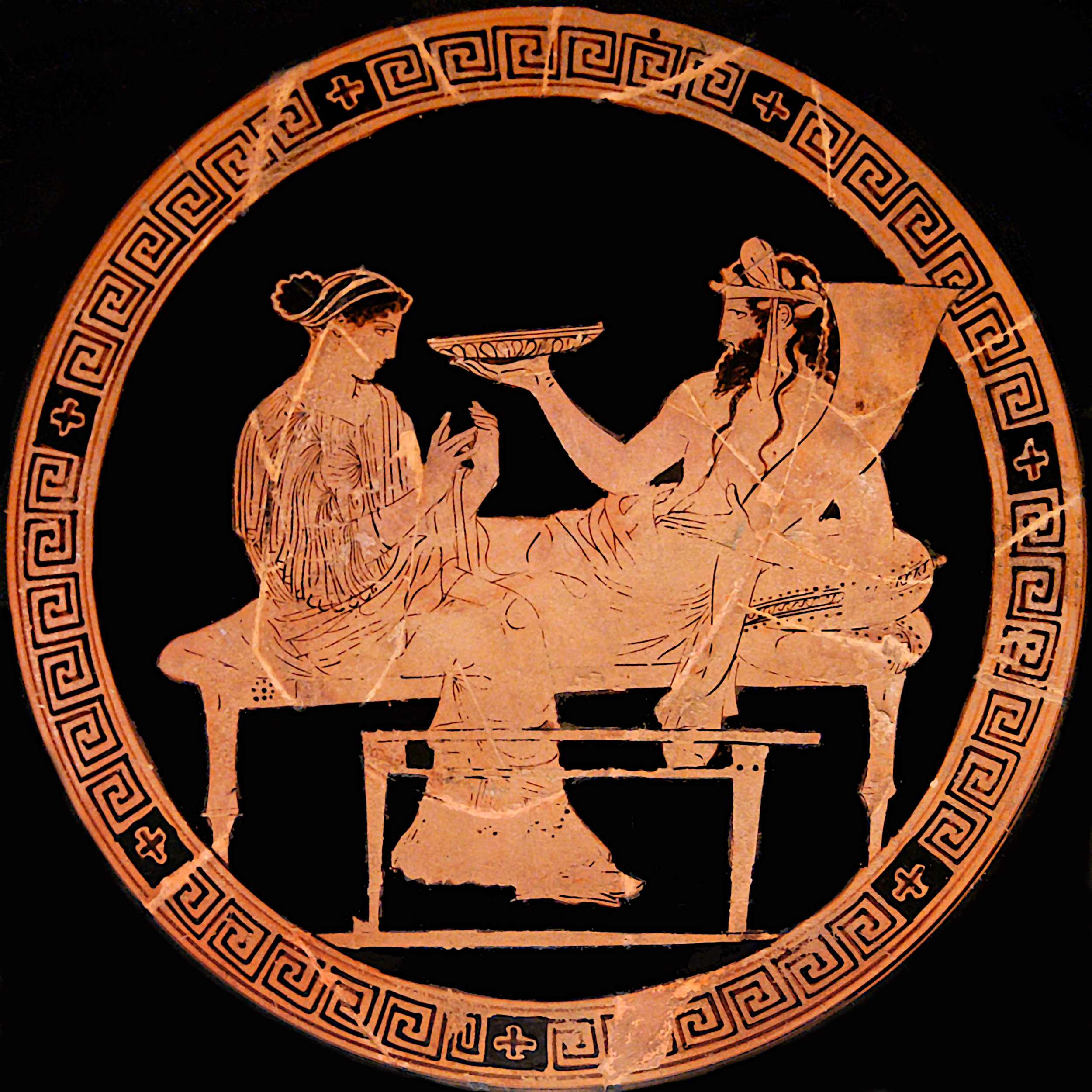
Then Demeter asked how Hades had found her, and Persephone told her about the narcissus flower in the meadow. And they embraced each other, their hearts at one. And Hecate came to them, and she too embraced the daughter of holy Demeter. From that time onwards, the lady Hecate was minister and companion to Persephone.
All-seeing Zeus called for the goddess Rhea, mother of Demeter, to be his messenger to Demeter. Rhea rushed swiftly down from the peaks of Olympus and came to the plain of Rharus — once rich, fertile farm-land, but now lying barren and leafless because Demeter had hidden the seeds.
“Come, my daughter,” said Rhea to Demeter. “Far-seeing Zeus, the loud-thunderer, calls you to join the families of the gods and goddesses. He has promised to give you what right you please among the deathless gods. He has agreed that for a third of each year, your daughter shall go down to dark and gloomy Hades. He has also said that for the rest of the year, she shall be with you and the other deathless gods and goddesses. So Zeus has declared it shall be. So he has bowed his head in token. But come, Demeter my child, obey, and leave your anger behind, and make the earth grow the fruit and food that gives mortal human beings life.”
So Demeter made fruit spring up from the rich lands, so that the whole wide earth was laden with leaves and flowers. Soon the earth was covered with waving corn, and out of the rich furrows of the fields grew grain and other crops.
Demeter also went to the human kings who were most just. She showed them how to conduct religious rites for her, and she taught them all her mysteries. Happy are those among mortals upon earth who have seen these mysteries. But those mortals who have not seen these religious rites, and who have not taken part in these mysteries, will not have good things after death, down in the darkness and gloom of the underworld.
When the bright goddess Demeter had taught those kings all they needed to know, she and Persephone went to Olympus to the gathering of the other gods and goddesses. There they lived, awful and reverend goddesses, next to Zeus who delights in thunder.
Source: Adapted from a public domain translation of the Homeric Hymn to Demeter in Hesiod: The Homeric Hymns and Homerica, trans. Hugh G. Evelyn-White (Cambridge, Mass.: Harvard University Press, 1914), pp. 288-325. With reference to a more recent translation, The Homeric Hymns: A Translation with Introduction and Notes by Diane J. Rayor (Berkeley: University of California Press, 2004), pp. 17-34.
Demeter and Triptolemus
Spiritual Tale, Myth. A composite story — see sources.
When Persephone returned to her mother from the underworld, and Demeter grew happy once more, she came back to Eleusis.
First Demeter showed Triptolemus and others how to conduct religious rites in her honor, and she taught them her mysteries. These mysteries filled mortal humans with awe when they were initiated into the cult of Demeter. And any one who was initiated into the Mysteries at Eleusis ever told about them, for deep awe of Demeter and the other gods and goddesses stopped them from speaking. Happy is the mortal among all humans on earth who has seen these mysteries; and those who are initiated into the religion may hope for better things when they finally die and go the underworld with Hades. As for those who were never initiated into the Mysteries of Eleusis — once they die, they could count on having nothing good down in the darkness and gloom of the underworld.(1)
Then Demeter had Triptolemus bring wheat to all humankind. She went to the stable where she kept her pair of dragons, also known as the Sacred Serpents. She harnessed them to her chariot, and drove from the stable back to Triptolemus. Demeter gave him seed to scatter all over the world, telling him to sow the seed partly in land that had never been farmed before, and partly in farm fields that had been lying fallow since the beginning of the famine.
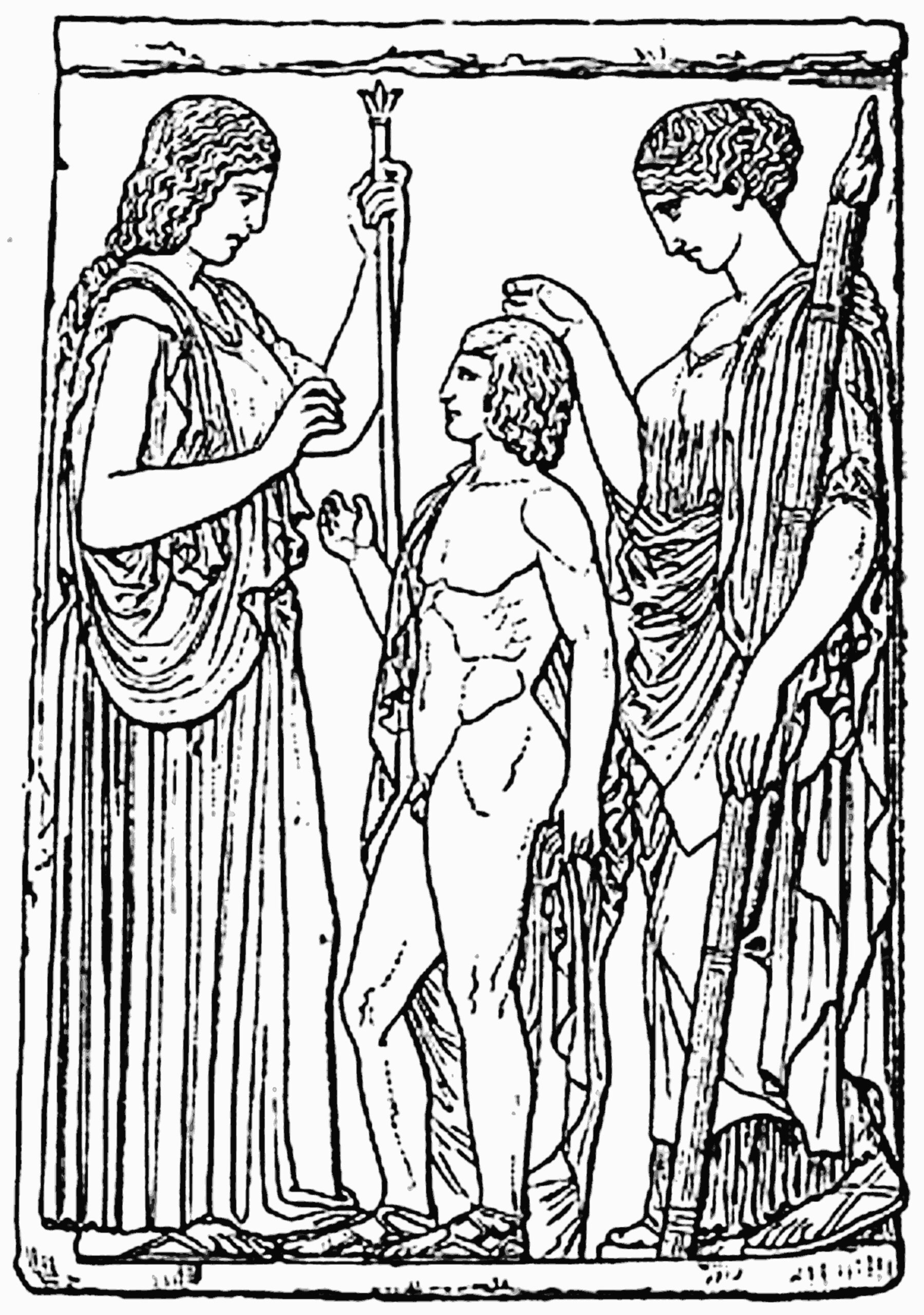
Triptolemus rode high in the sky, driving the chariot through all of Europe in into the realms of Asia. At last he came to the land of Scythia, where King Lynchus ruled. He landed the chariot, and entered the king’s palace.
“What is your name and where are you from?” said King Lynchus. “How did you get here, and what brings you to Scythia?”
“I am from Athens, that famous country,” said Triptolemus. “My name is Triptolemus. No boat brought me by sea, nor did I come on foot by land. I came via the sky, which lay wide to give me way. I bring the gifts of the goddess Demeter.” Triptolemus held out seeds of wheat to show to King Lynchus. “If you sow these wide over your farm lands, they will give you back bountiful harvests, gentle nourishment.”
When he heard this story, the uncivilized King Lynchus was jealous of Triptolemus. The King wanted to gain the glory of bringing the gift of wheat. He offered Triptolemus great quantities of food and drink, and soon his guest had eaten and drunk so much that he fell fast alseep.
When King Lynchus was certain that Triptolemus was fast asleep, he went to get a dagger. He attacked his guest with the dagger, intending to kill him on the spot. But as he tried to stab Triptolemus, Demeter transformed the king into a lynx.(2)
When he was done with his task, Triptolemus flew home again to Eleusis. And there he lived, gaining a reputation as a fair and just man. When at last he died, he became one of the judges in the underworld, along with three others who were just and wise in their lifetimes, Minos and Rhadymanthys and Aeacus.(3) In his lifetime, Triptolemus brought the life-giving gift of agriculture to humankind, which allowed them to become something more than animals. In his death, as a judge in the underworld, he provides sweeter hopes to the dead, regarding the end of life and all eternity.(4)
Sources: No one extant myth tells the whole story of Triptolemus, so this version of the Triptolemus story draws from three different ancient sources, and one modern interpretation:
1. Homeric Hymn to Demeter
2. Ovid, Metamorphoses
3. Plato, Apology 41a
4. “Triptolemos, Hemitheos and Judge at Eleusis and Beyond? Plato’s Apologia 41a” by Patrick Hunt, published on the Web site Archaeolog, accessed 10 March 2026 https://web.stanford.edu/group/archaeolog/cgi-bin/archaeolog/2005/12/24/triptolemos-hemitheos-and-judge-at-eleusis-and-beyond-platos-apologia-41a/
STORIES FROM ANCIENT GREECE
Hermes and the Woodman
Tales of Deities, Wisdom Tale
This is one of Aesop’s fables, which date from roughly 500 BCE. The Greek gods appear in some of Aesop’s fables, and in this fable the moral (here translated fairly literally from the ancient Greek version) directly concerns the gods.
A Woodman was chopping wood alongside a river, when his axe flew out of his hands and and was carried away by the swift current. The Woodman sat down on the riverbank and began to weep; for he earned his living with his axe, and what was he to do without it?
Hermes, the messenger of the gods, and himself the god of trade, merchants, roads, and many other things, saw the Woodman weeping, and took pity on him. The god’s winged sandals carried him to the riverbank, and he appeared before the Woodman. “Why are you crying, Woodman?” he said.
“I have dropped my axe in the river, and the swift current has carried it away,” said the Woodman.
Hermes went into the river, and emerged holding an axe made out of solid gold. “Is this your axe?” he asked. But the Woodman said it was not his. Hermes went into the river again, and this time brought up an axe made of solid silver. But again, the Woodman said it was not his.
Once more, Hermes went into the river, and this time brought up the Woodman’s axe. This time, the Woodman recognized his axe. Hermes rewarded the Woodman’s honesty by giving to him, not just his own axe, but the gold and silver axes, too.
When the Woodman told this story to his friends, one of them grew jealous. He decided to do the same thing as the Woodman. The jealous friend went to the riverbank, began chopping wood, and then let his axe fall into the river, where it was carried away by the swift current. He sat down and began weeping.
The god Hermes appeared and asked what had happened, and the man said that he had lost his axe in the river. Hermes went into the river and brought up an axe made of solid gold. Hermes asked if this was the axe he had lost. The man said happily, “Yes, this is it.” Hermes hated such shameless greed. The god kept both the golden axe, and also the axe the jealous man had dropped into the river.
This fable shows that the divine is in agreement with people who are just, and the divine is opposed to people who are unjust.
Sources: V. S. Vernon Jones, Aesop’s Fables: A New Translation (1912); Laura Gibbs, Aesop’s Fables: A New Translation, Oxford University Press (2002); and a machine translation of the ancient Greek text from the Chambry edition (no. 253).
ANCIENT GREEK STORIES RETOLD BY MODERN WRITERS
The Tale of Perseus
In two parts, both taken from Bullfinch’s Mythology (1867).
1. Perseus and Medusa
Tales of Deities, Wisdom Tale
This story is lightly adapted from Bullfinch’s Mythology — not the best source of ancient Greek myths, so use with caution.
Perseus was the son of the god Zeus and the human Danae. Perseus’ grandfather Acrisius, alarmed by an oracle which had told him that his daughter’s child would be the instrument of his death, locked Danae in an underground room made out of bronze. This did not stop Zeus, who turned himself into a golden rain shower, and so entered the underground chamber where Danae was kept.
Soon Danae was pregnant, and gave birth to Perseus. Acrisius, still worried about the oracle, caused the mother and child to be shut up in a chest and set adrift on the sea. The chest floated towards Seriphus, where it was found by a fisherman who conveyed the mother and infant to Polydectes, the king of the country, by whom they were treated with kindness.
When Perseus was grown up Polydectes, king of the island of Seriphos, sent him to attempt the conquest of Medusa, a terrible monster who had laid waste the country. She was once a beautiful maiden whose hair was her chief glory, but as she dared to vie in beauty with Athena, the goddess deprived her of her charms and changed her beautiful ringlets into hissing serpents. She became a cruel monster of so frightful an aspect that no living thing could behold her without being turned into stone. All around the cavern where she dwelt might be seen the stony figures of men and animals which had chanced to catch a glimpse of her and had been petrified with the sight. Perseus, favored by Athena and Hermes, the former of whom lent him her shield and the latter his winged shoes, approached Medusa while she slept, and taking care not to look directly at her, but guided by her image reflected in the bright shield which he bore, he cut off her head and gave it to Athena, who fixed it in the middle of her Aegis, or shield.
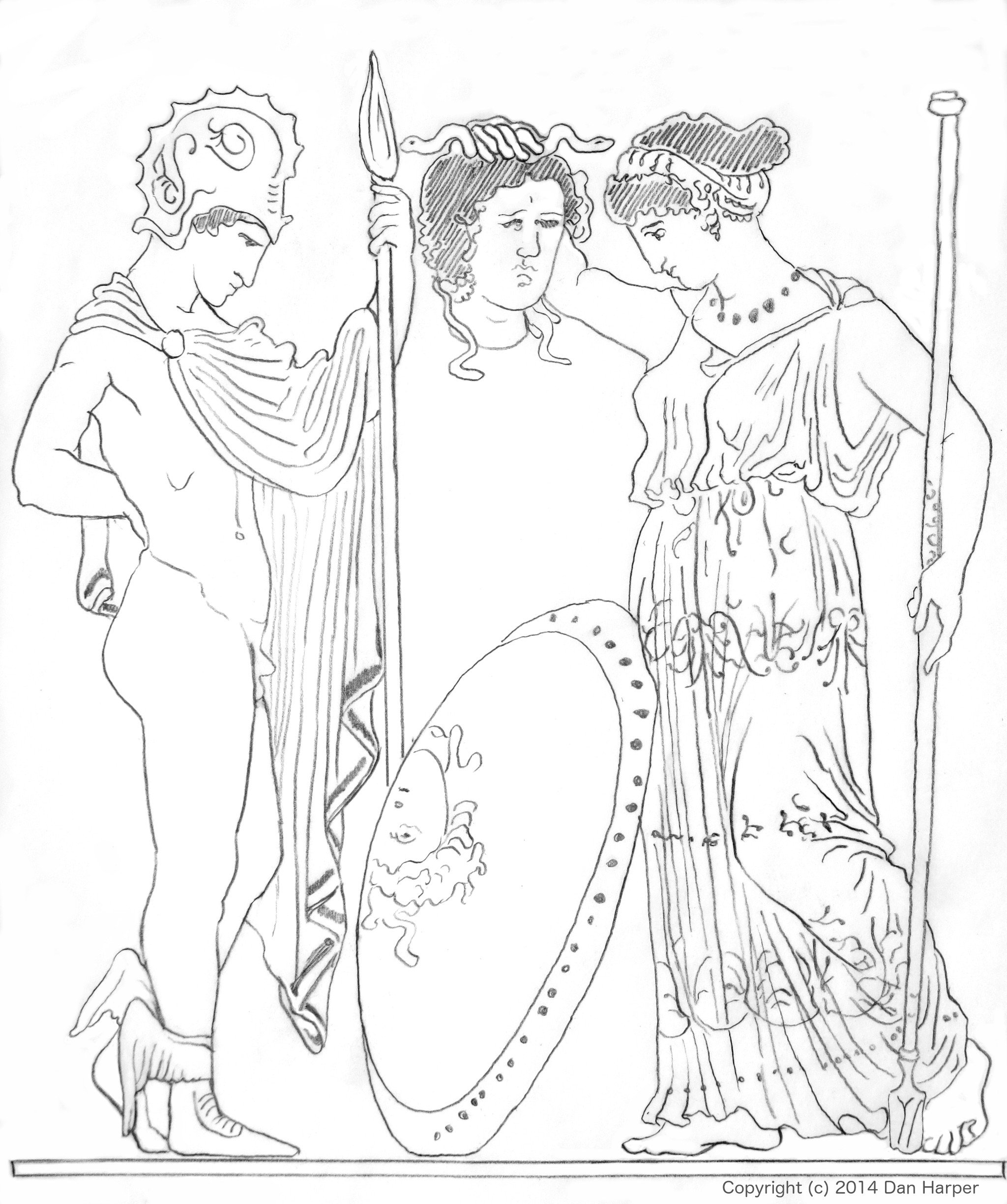
After the slaughter of Medusa, Perseus, bearing with him the head of the Gorgon, flew far and wide, over land and sea. (Presumably Athena let him use the head for a time, but the old myths do not tell us this.) As night came on, he reached the western limit of the earth, where the sun goes down. Here he would gladly have rested till morning. It was the realm of the Atlas, a huge Titan. He was rich in flocks and herds and had no neighbor or rival to dispute his state. But his chief pride was in his gardens, whose fruit was of gold, hanging from golden branches, half hid with golden leaves.
Perseus said to him, “I come as a guest. If you honor those who are descended from the gods and goddesses, I claim Zeus for my father. If you honor mighty deeds, I claim the conquest of the Gorgon. I seek rest and food.”
But Atlas remembered that an ancient prophecy had warned him that a son of Zeus should one day rob him of his golden apples. So he answered, “Begone! Neither your false claims of glory nor parentage shall protect you!” And he attempted to thrust him out.
Perseus, finding the giant too strong for him, said, “Since you value my friendship so little, deign to accept a present.” And turning his face away, he held up the Gorgon’s head. Atlas, with all his bulk, was changed into stone. His beard and hair became forests, his arms and shoulders cliffs, his head a summit, and his bones rocks. Each part increased in bulk till he became a mountain, and (such was the pleasure of the gods and goddesses) heaven with all its stars rests upon his shoulders.
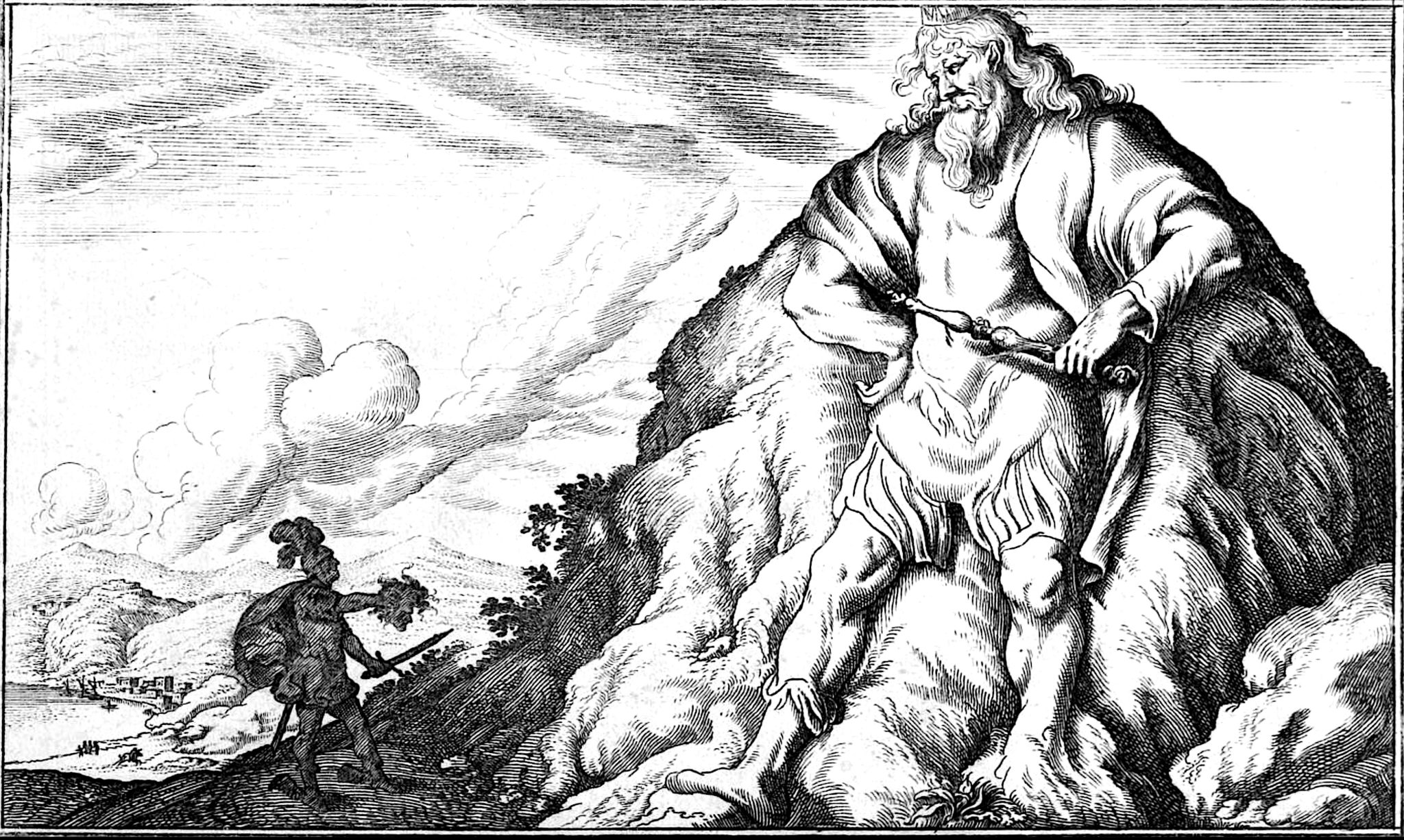
Perseus, continuing his flight, arrived at the country of the Ethiopians, of which Cepheus was king. Cassiopeia his queen, proud of her beauty, had dared to compare herself and her daughter to the Sea-Nymphs, which roused their indignation to such a degree that they sent a prodigious sea-monster to ravage the coast. To appease the deities, Cepheus was directed by the oracle to chain his daughter Andromeda near the edge of the sea, to be devoured by the monster.
As Perseus looked down from his aerial height he beheld the young woman chained to a rock, and waiting the approach of the serpent. She was so pale and motionless that if it had not been for her flowing tears and her hair that moved in the breeze, he would have taken her for a marble statue. He was so startled at the sight that he almost forgot to wave his wings.
As he hovered over her he said, “O young woman, undeserving of those chains, but rather of such as bind fond lovers together, tell me, I beseech you, your name, and the name of your country, and why you are thus bound.”
The woman was silent for a long while before she began to speak….
To Be Continued….
Source: Story adapted from Bulfinch’s mythology: The age of fable, The age of chivalry, Legends of Charlemagne, rev. ed., by Thomas Bulfinch (New York: T. Y. Crowell Co., 1913), chapter XV, “The Graeae and Gorgons — Perseus and Medusa — Atlas — Andromeda.” Public domain story.
Perseus — PER see us
Danae — DAH nay ee
Acrisius — ah KRIS ee us
Seriphus — se RI fuss
Polydectes — poll i DECK tess
Cepheus — SI fee us
Cassiopeia — kass ee o PEE ah
Andromeda — an DROM eh duh
2. Perseus and the Sea Monster
Tales of Deities, Wisdom Tale
This story is lightly adapted from Bullfinch’s Mythology — not the best source of ancient Greek myths, so use with caution.
This was the land of the Ethiopians, of which Cepheus was king. Cassiopeia his queen, proud of her beauty, had dared to compare herself and her daughter to the Sea-Nymphs, which roused their indignation to such a degree that they sent a prodigious sea-monster to ravage the coast. To appease the deities, Cepheus was directed by the oracle to chain his daughter Andromeda near the edge of the sea, to be devoured by the monster. This was the young woman over which Perseus hovered.
As he hovered over her he said, “O young woman, undeserving of those chains, but rather of such as bind fond lovers together, tell me, I beg you, your name, and the name of your country, and why you are thus bound.”
At first she was silent, and refused to speak to him. But when he repeated his questions, for fear she might be thought guilty of some fault which she dared not tell, she finally told Perseus her name and that of her country, and her mother’s pride in her own beauty, and in her daughter’s beauty.
Before she had done speaking, a sound was heard off upon the water, and the sea-monster appeared, with his head raised above the surface, cutting through the waves with his broad breast. The young woman’s eyes grew wider, she started in surprise, and pulled away from the monster to the extent her chains would allow. The father and mother who had now arrived at the scene, both of them feeling wretched, but the mother more justly so, stood by, not able to afford protection, but only to pour forth lamentations and to embrace the victim.
Then spoke Perseus: “There will be time enough for tears; this hour is all we have for rescue. My rank as the son of Zeus and my renown as the slayer of Medusa might make me acceptable as a suitor. But I will try to win her by saving her from the sea monster, if the gods will only be in favor of my success. If she be rescued by my valor, I demand that she be my reward.”
The parents consented (how could they hesitate?) and promised a royal dowry with her.
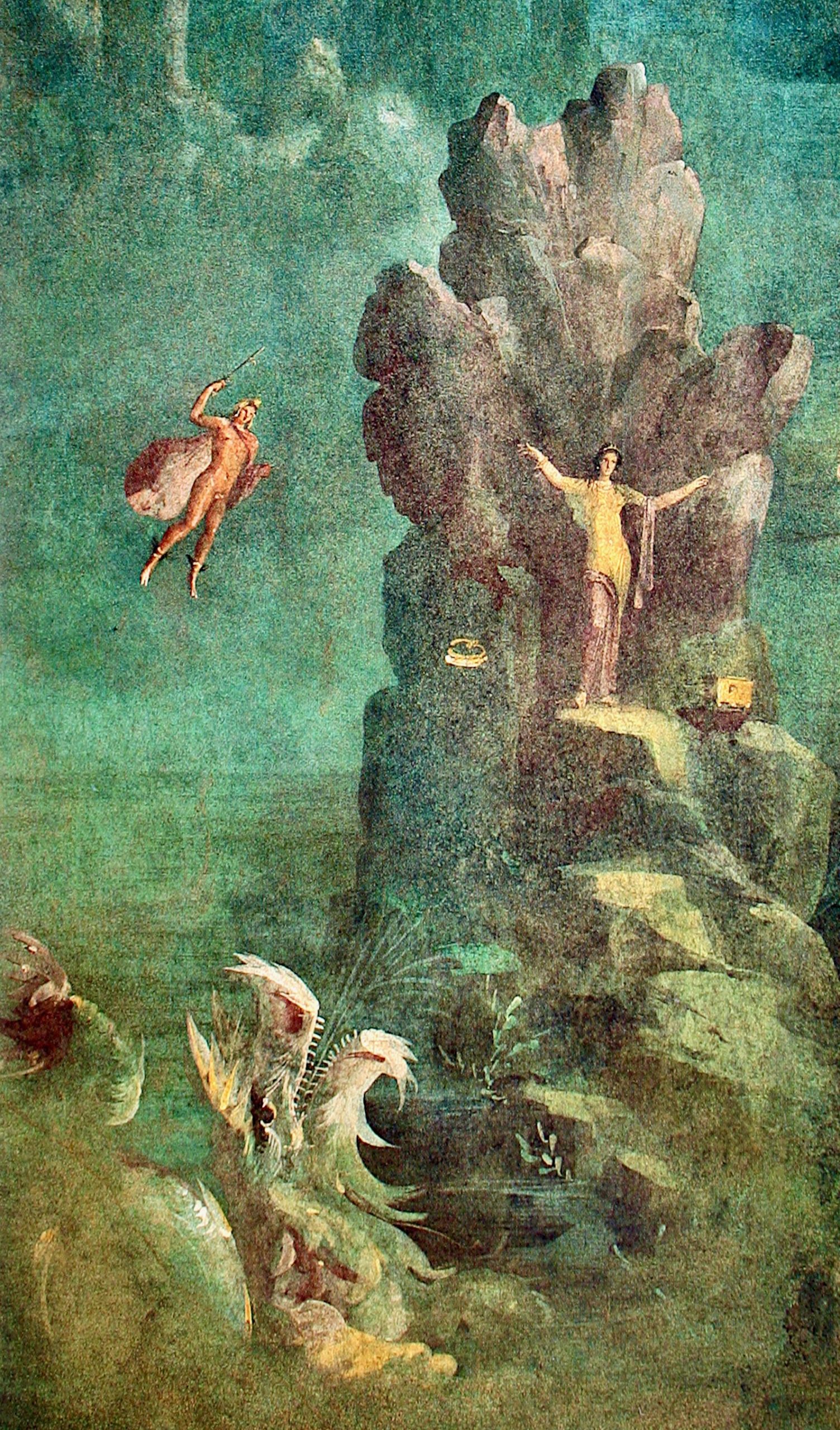
And now the monster was within the range of a stone thrown by a skilful slinger, when with a sudden bound the youth soared into the air. As an eagle, when from his lofty flight he sees a serpent basking in the sun, pounces upon it and seizes it by the neck to prevent it from turning its head round and using its fangs, so the youth darted down upon the back of the monster and plunged his sword into its shoulder. Irritated by the wound, the monster raised itself in the air, then plunged into the depths; then, like a wild boar surrounded, by a pack of barking dogs, turned swiftly from side to side, while the youth eluded its attacks by means of his wings.
Wherever he can find a passage for his sword between the scales he makes a wound, piercing now the side, now the flank, as it slopes towards the tail. The brute spouts from its nostrils water mixed with blood. The wings of the hero are wet with it, and he dares no longer trust to them. Alighting on a rock which rose above the waves, and holding on by a projecting fragment, as the monster floated near he gave it a death stroke. The people who had gathered on the shore shouted so that the hills re-echoed the sound. No one knows what the monster thought as it died; it had only done what the Sea Nymphs had asked of it, and had died as a result.
The parents, transported with joy, embraced their future son-in-law, calling him their deliverer and the savior of their house. Andromeda was released from her chains, and descended from the rock to look at Perseus, the man to whom she was now promised in marriage by her thoughtless parents.
Cassiopeia is called “the starred Ethiopean queen” because after her death she was placed among the stars, forming the constellation of that name. Though she attained this honor, yet the Sea-Nymphs, her old enemies, prevailed so far as to cause her to be placed in that part of the heaven near the pole, where every night she is half the time held with her head downward, to give her a lesson of humility.
The joyful parents, with Perseus and Andromeda, repaired to the palace, where a banquet was spread for them, and all was joy and festivity. But suddenly a noise was heard of warlike clamor, and Phineus, who was both the uncle of, and the promised husband of the young woman, burst in with a party of his adherents, demanding his right to marry Andromeda. It was in vain that Cepheus remonstrated — “You should have claimed her when she lay bound to the rock, the monster’s victim. The sentence of the gods dooming her to such a fate dissolved all engagements, as death itself would have done.”
Phineus made no reply, but hurled his javelin at Perseus, but it missed its mark and fell harmless. Perseus would have thrown his in turn, but the cowardly assailant ran and took shelter behind the altar. But his act was a signal for an onset by his band upon the guests of Cepheus. They defended themselves and a general conflict ensued, the old king retreating from the scene after fruitless expostulations, calling the gods to witness that he was guiltless of this outrage on the rights of hospitality.
Perseus and his friends maintained for some time the unequal contest; but the numbers of the assailants were too great for them, and destruction seemed inevitable, when a sudden thought struck Perseus: “I will make my enemy defend me.” Then with a loud voice he exclaimed, “If I have any friend here let him turn away his eyes!” and held aloft Medusa’s head.
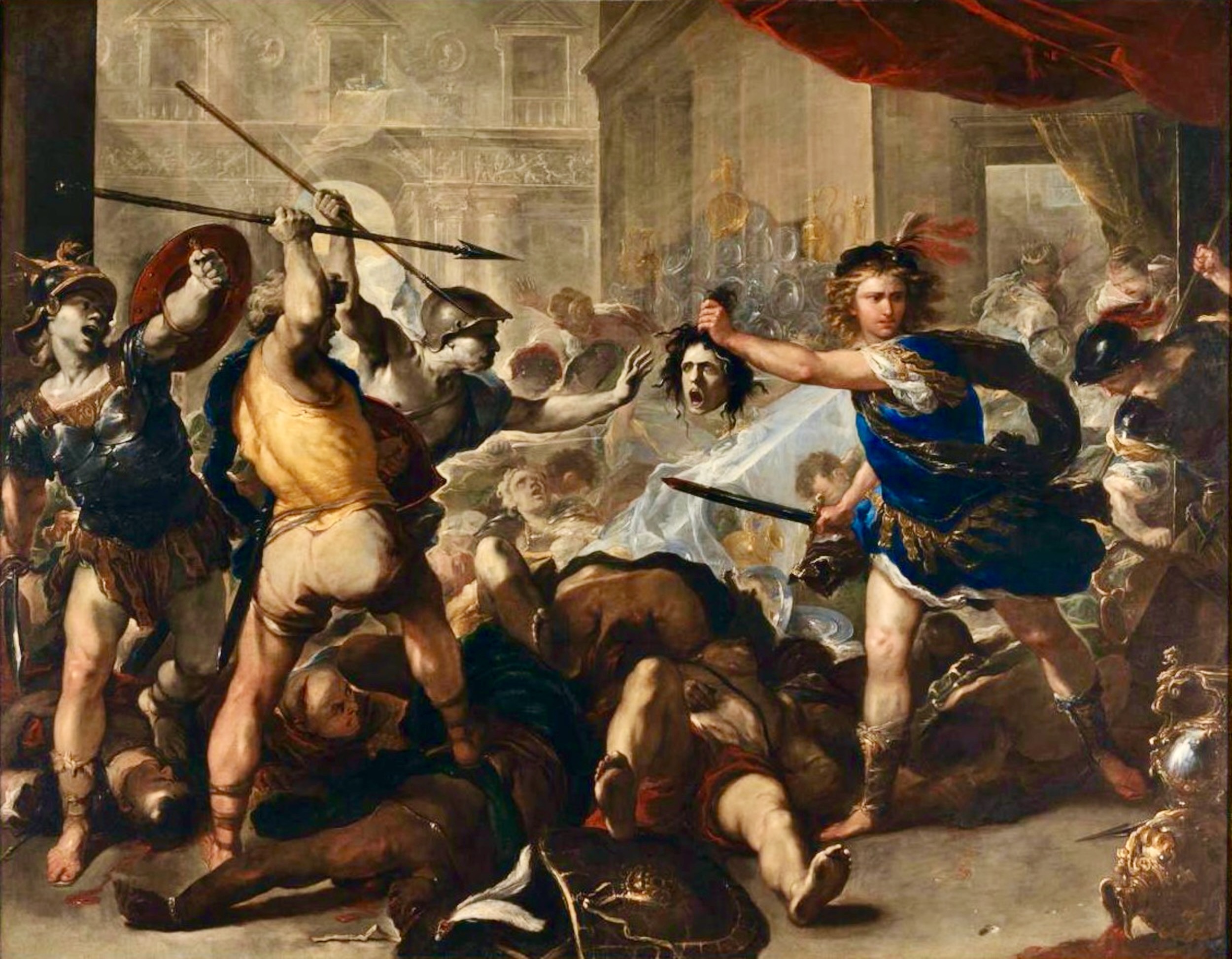
“Seek not to frighten us with your jugglery,” said Thescelus, and raised his javelin in act to throw, and became stone in the very attitude. Ampyx was about to plunge his sword into the body of a prostrate foe, but his arm stiffened and he could neither thrust forward nor withdraw it. Another, in the midst of a vociferous challenge, stopped, his mouth open, but no sound issuing. One of Perseus’s friends, Aconteus, caught sight of Medusa’s head, and stiffened like the rest. Astyages struck him with his sword, but instead of wounding, it recoiled with a ringing noise.
Phineus beheld this dreadful result of his unjust aggression, and felt confounded. He called aloud to his friends, but got no answer; he touched them and found them stone. Falling on his knees and stretching out his hands to Perseus, but turning his head away he begged for mercy.
“Take all,” said he, “give me but my life.”
“Base coward,” said Perseus, “thus much I will grant you; no weapon shall touch you; moreover, you shall be preserved in my house as a memorial of these events.”
So saying, he held the Medusa’s head to the side where Phineus was looking, and in the very form in which he knelt, with his hands outstretched and face averted, he became fixed immovably, a mass of stone.
Andromeda finally did marry Perseus, and left her parents to live with him in Tiryns, in the land of Argos. Perhaps she was glad enough to get away from such thoughtless parents. She and Perseus had nine children together: two daughters, Autochthe and Gorgophone; as well as seven sons: Perses, Alcaeus, Heleus, Mestor, Sthenelus, Electryon, and Cynurus. After she died, the gods and goddesses placed her in the heavens as the constellation Andromeda. The constellation shows her chained to the rock, and some see a constellation of a fish at her feet; no doubt she would prefer to be remembered in some other way, but like it or not she will always be remembered for the most dramatic moment in her life.
Source: Adapted from Bulfinch’s Mythology: The age of fable, The age of chivalry, Legends of Charlemagne, rev. ed., by Thomas Bulfinch (New York: T. Y. Crowell Co., 1913), chapter XV, “The Graeae and Gorgons — Perseus and Medusa — Atlas — Andromeda.” Public domain story.
STORIES FROM ANCIENT ROME
Coming soon.