Stories for liberal religious kids, drawn from a wide variety of religious and spiritual traditions.
- Stories labeled “Wisdom Tale” teach life lessons.
- Stories labeled “Spiritual Tale” have a spiritual purpose (which can seem alien to Westerners).
- Stories labeled “Tale of Deities” tell about the attributes and characters of gods/goddesses/divine beings.
- Stories labeled “Myth” explain or describe some natural phenomenon.
The stories on these pages were originally written for a variety of
purposes — worship services, classes, or just for fun. You should adapt
them to whatever situation you want to use them in.
Copyright: Please respect copyright. For just one example, if you use one of my copyright-protected stories in a webcast or recording, I ask that you give me credit for the story (e.g., “This story is copyright by Dan Harper”). You do not have to give me credit in educational settings or at home.
Cultural appropriateness: When I wrote these stories, I worked from the most culturally appropriate sources I could find, and I attempted to retain the distinctive flavor of the original religion/culture of each story. You will have to decide how you want to present other religious traditions where they conflict with modern Western sensibilities, whether you will cover over religious differences or not. Some examples of what I mean: Will you ignore that Buddhists affirm that Buddha had 500+ previous lives? Will you adhere to Western understandings of gender, or acknowledge diverse understandings of gender? You will have to judge for yourself, based on the needs of your class or local congregation.
Table of Contents
- Jataka Tales from the Buddhist tradition
- Other Buddhist stories
- Sikh stories
- Jain stories
- Hindu stories
- Tales from the Panchatantra
JATAKA TALES FROM THE BUDDHIST TRADITION
While the Jataka Tales have appeared in many children’s books, those who retell them rarely include the framing story. The framing story typically tells an incident from the community that gathered around Gautama Buddha. Then the Buddha tells a tale from one of his previous lives, which is always designed to teach his followers an ethical lesson. After the Buddha has told the tale from one of his previous lives, his followers try to guess which of the characters in the story was the Buddha.
Where there is a framing story, I’ve included it here. These framing stories help children (and adults) understand something of Buddhist values and beliefs, and also something of the early Buddhist community.
Most of the material below is adapted The Jataka, or Stories of the Buddha’s Former Births, ed. E. B. Cowell (Oxford, 1895-1911).
The Frightened Rabbit
Wisdom Tale, Tale of Deities
One day in the town of Savatthi, some of Buddha’s followers went out to beg for their food, as was their custom. (These followers of Buddha were known as bhikkus.)
Each day when the bhikkus went out to beg, they went to a different part of the town. On this particular morning, their path led them past some holy men. These holy men lay naked on beds of thorn-plants, in the hope that this would help them become more holy.
The bhikkus looked at these holy men, and kept walking. Then their path led them past more holy men. These men had built a large bonfire, and even though the day was hot and the sun was bright, they sat as close as they could to the broiling fire, in the hope that this would help them become more holy.
The bhikkus walked by these men, too, and continued on their way, stopping at each house and begging for food. When at last each of their begging bowls was filled with food, they returned to where they lived with Buddha and all the other bhikkus.
As they sat and ate, the bhikkus talked about the holy men that they had seen. They talked and they talked, and finally they decided to ask Buddha about these holy men.
“Buddha,” said one bhikku, “when we were out getting our food this morning, we walked past some holy men who were lying naked on cruel, sharp thorns.” She paused for a moment. “Will doing this make them any more holy?”
“And Buddha,” said another bhikku, “when we were out getting our food this morning, we walked past some holy men who were sitting next to a blazing fire, out under the blazing hot sun.” He paused for a moment. “Will do this make them any more holy?”
“No,” said Buddha. “Lying on thorns will not make you more holy. Baking yourself under the sun and next to a hot fire will not make you more holy. Such things are just like the horrible noise that was heard by the timid rabbit.”
The bhikkus looked at each other. One of them said, “Buddha, we have never heard about the timid rabbit and the noise he heard.”
“Well,” said Buddha, “it is a story that took place long, long ago, in the far distant past.” And then he told this story:
***
Once upon a time, there was a little rabbit who lived in a forest by the Western Ocean. This little rabbit went to live in a beautiful grove of trees. He made his home at the foot of a Bengal quince tree, the kind of tree under which the god Shiva was said to have lived. Next to the Bengal quince tree was a palm tree where the little rabbit liked to sit and nibble grass.
One fine day, the little rabbit sat under the palm tree nibbling grass and thinking about what would happen to him if the world got destroyed by Lord Shiva. At just that moment, a large, hard Bengal quince fell off the tree and hit the ground directly behind the little rabbit.
“The earth is being destroyed!” cried the little rabbit, and he immediately started running as fast as he could away from the sound.
Another rabbit saw him running with terror in his eyes, and said, “What’s going on?”
“The earth is being destroyed!” cried the little rabbit, and kept running.
The second rabbit ran after him, shouting, “The earth is being destroyed!” Soon, all the rabbits in the neighborhood were running with them.
When the other animals saw all the rabbits running, they asked, “What’s going on?”
The rabbits cried out, “The earth is being destroyed! Run for your lives!”
The other animals began to run, too: the wild pigs, the deer, the buffaloes, the rhinoceroses, the tigers, and even the elephants all began to run, shouting, “The earth is being destroyed!”
Now, in another part of the forest there lived a good and kind lion. She saw all the animals running, and heard them shouting, “The earth is being destroyed! Run for your lives!” The lion was wise enough to see that the earth was not being destroyed, and she could also see that the animals were so frightened that they would run right into the Western Ocean and drown. She ran as fast as she could and got in front of all the animals, and stopped them by roaring three times.
When the animals heard the good and kind lion roaring, they call came to a stop.
The lion said, “Why are you all running?”
“The earth is being destroyed,” said all the animals together.
The lion said, “How do you know the earth is being destroyed?”
One of the animals said, “The elephants must have seen it.”
But the elephants hadn’t seen anything. “We think the tigers saw it,” they said.
But the tigers hadn’t seen anything. “We think the rhinoceroses know what happened,” they said.
But the rhinoceroses didn’t know anything. “We think it was the buffaloes who gave the alarm,” they said.
But the buffaloes hadn’t given the alarm. Nor did the deer know anything. The wild pigs said they started running when they saw the rabbits running. One by one, each of the rabbits said that they hadn’t seen anything, until at last the little rabbit said, “I was the one who saw the earth starting to break into pieces.”
The lion said, “Where were you when you saw this?”
“I was at home in the little grove of trees,” said the little rabbit, “next to my house at the foot of the Bengal quince tree. I was sitting under my favorite little palm tree nibbling grass, when I heard the earth start to break behind me. So I ran away.”
The lion knew then that the Bengal quinces were starting to ripen, and she knew that one of the fruits had fallen from the tree and hit the ground behind the little rabbit. But she said to all the animals, “Stay here for a while. I will take the little rabbit with me to this place, and we will see what is happening back there.”
The kind lion had the little rabbit jump up onto her broad back, and ran off to where the little rabbit thought he had heard the earth breaking up. When they got to the Bengal quince tree, the little rabbit pointed in terror and said, “There! There it is! That’s where the earth is breaking up!” And the little rabbit closed his eyes in fear.
But the lion said kindly, “Little rabbit, open your eyes and you will see that the earth is not breaking up. I can see just where you were crouching under the little palm tree nibbling on some grass, and right behind that a large fruit from the Bengal quince tree is lying on the ground. You heard was the sound of that piece of fruit hitting the ground behind you. It must have made a loud sound, and now wonder you got scared, but there really is nothing to fear.”
The good lion went back and told the other animals what she had found. The animals all sighed in relief, and everything returned to normal.
***
“So it is,” said the Buddha, “that you should not listen to rumors, and you should not listen to the fears of other people. You should try to find out the truth for yourselves.”
A bhikku said, “The lion was truly wise and compassionate. If it had not been for her, all the animals would have drowned.”
Another one of the bhikkus said, “Buddha, were you the lion in that story?”
“Yes,” said the Buddha. “I was the lion who stopped the animals from harming themselves for no reason at all.”
After that, the bhikkus no longer needed to ask questions about people who lay on thorns or sat next to a bonfire on a blazing hot day.
Source: Duddubha Jataka, Jataka tale no. 322, from the Cowell translation (1911). It’s interesting to note that the fruit tree that the little rabbit lives under is the same kind of fruit tree that Shiva, the Hindu god of destruction, is said to have lived under, and perhaps there is some implicit criticism of Hinduism in this story.
The Quails and the Net
Wisdom Tale, Tale of Deities
Gautama Buddha was a great holy man who lived long, long ago in India. He was so wise that people came from far and wide to learn from him. Many of these people stayed with him, and became his bhikkus, or his followers.
Once upon a time, Buddha noticed that several of his bhikkus were spending a great deal of time arguing among themselves. As a result, these bhikkus began to disturb the other people who had come to learn from Buddha. Not only that, but Buddha felt that because of their arguing, they were not making any progress toward becoming truly enlightened beings.
That evening, Buddha sat all his followers down together, and he told them this story:
***
“Once upon a time, long, long ago, there lived a large flock of quails in a forest. Now in near this very same forest there lived a hunter who made his living from capturing quails and selling them to people who wanted to eat them. Every day this hunter would slip quietly into the forest and sit hidden behind a big bush. Then he would imitate the call of a quail. He did it so perfectly that the quail thought the hunter was one of them.
“Upon hearing the hunter’s call, the quail would come out of the safe places where they had been gathering food. Once the quail came out into the open, the hunter would leap out from his hiding place and throw a big net over as many quails as he could reach. He would bundle up the net and take all the quail away to the marketplace to be sold to people who wanted to eat them for dinner.
“As you might expect, this state of affairs did not please the quail at all. In fact, they were scared silly because this hunter was capturing so many of them.
“The quail decided to hold a meeting to discuss the problem. One wise quail brought up a good point. She said:
“‘You know, that net the hunter throws over us isn’t very heavy. If we all agreed to work together, we could escape. As soon as he throws the net over us, if we all fly up together at the same time, we can lift the net up with us and get away.’
“The other quails thought this was a good plan. They all agreed to work together to escape the next time the hunter threw the net over them.
“The very next day, the hunter came back to the forest. He imitated the call of a quail so perfectly that all the quail were fooled again. Then he threw the net over as many quail as he could reach, expecting to bundle them up as always.
“But this time the quail who were caught under the net knew what to do. Instantly, before the hunter could bundle them up, they all flew up in the air together. They lifted the net up with them, and settled down together into a nearby rose bush. The net got tangled up in the thorns of the rose bush, and the quail scurried away to safety.
“The hunter was left to pick his net out of the sharp thorns. After hours of work, he finally untangled his net, and walked home, tired and discouraged.
“The next day, the hunter came back to try his luck again. He gave his imitation of the quail’s call. All the quail came running. When they felt the net settle over them, they instantly began to fly to a nearby patch of brambles. They settled down into the brambles leaving the net caught on the sharp thorns. Once again, the hunter was left to untangle his net from the sharp thorns.
“This went on for some days. The hunter was growing more and more discouraged. Finally, one day the hunter came back into the forest, gave his perfect imitation of the quail’s call, and threw his net over the quail when they came out into the open.
“But this time, when it came time for all the quail to fly up together, one quail happened to step on the foot of another quail.
“‘Hey,’ said the second quail, ‘who kicked me?’
“‘Nobody kicked you,’ said a third, ‘It’s just your imagination.’
“Yet a fourth quail said, ‘Oh, he’s just complaining because he’s lazy; he never lifts his share of the net.’
“Still another quail said, ‘And who are you to talk? Yesterday I noticed that you did very little of the flying, leaving all the hard work to the rest of us.’
“As the quail fought and bickered among themselves, the hunter bundled them up in his net and carried them off to market. They were all fat, plump quails, and the hunter got a very good price for them.”
***
The followers of Buddha all believed that they had lived many lives in the past, sometimes as animals and sometimes as humans. The Buddha told them that the story of the quails was really a story of them in one of their past lives.
“When you were on this earth as quails,” said the Buddha, “you argued among yourselves, and were caught by the hunter, and were eaten for dinner that very night. You are no longer quails. Is it not time for you to stop arguing among yourselves?”
The bhikkus who had been arguing so much grew embarrassed and ashamed, and from that day on, so it is told, they no longer engaged in silly arguments.
Source: Jataka tale no. 33, Cowell translation. A well-known Jataka tale, but in the West the story is rarely told with the framing story.
The Little Tree-Spirit
Wisdom Tale, Tale of Deities
One day, some of Buddha’s followers, or bhikkus, were sitting in the Hall of Truth. They were talking about three other bhikkus, Kokalika and his friends Sariputta and Moggallana. The three friends didn’t seem to know how to get along with each other. Just that day, Kokalika had asked his two friends to travel with him back to his own country, and they had refused — rather rudely, too.
Buddha came and and heard the bhikkus talking about the three Kokalika, Sariputta, and Moggallna. One bhikku said, “That Kokalika can’t live without his two friends, but he can’t live with them, either.”
“That reminds me of a story,” said Buddha, joining the conversation….
***
Once upon a time, two tree-spirits lived in a forest. One of the tree-spirits lived in a small, modest tree; the other tree-spirit lived in a huge old tree that towered over the other trees.
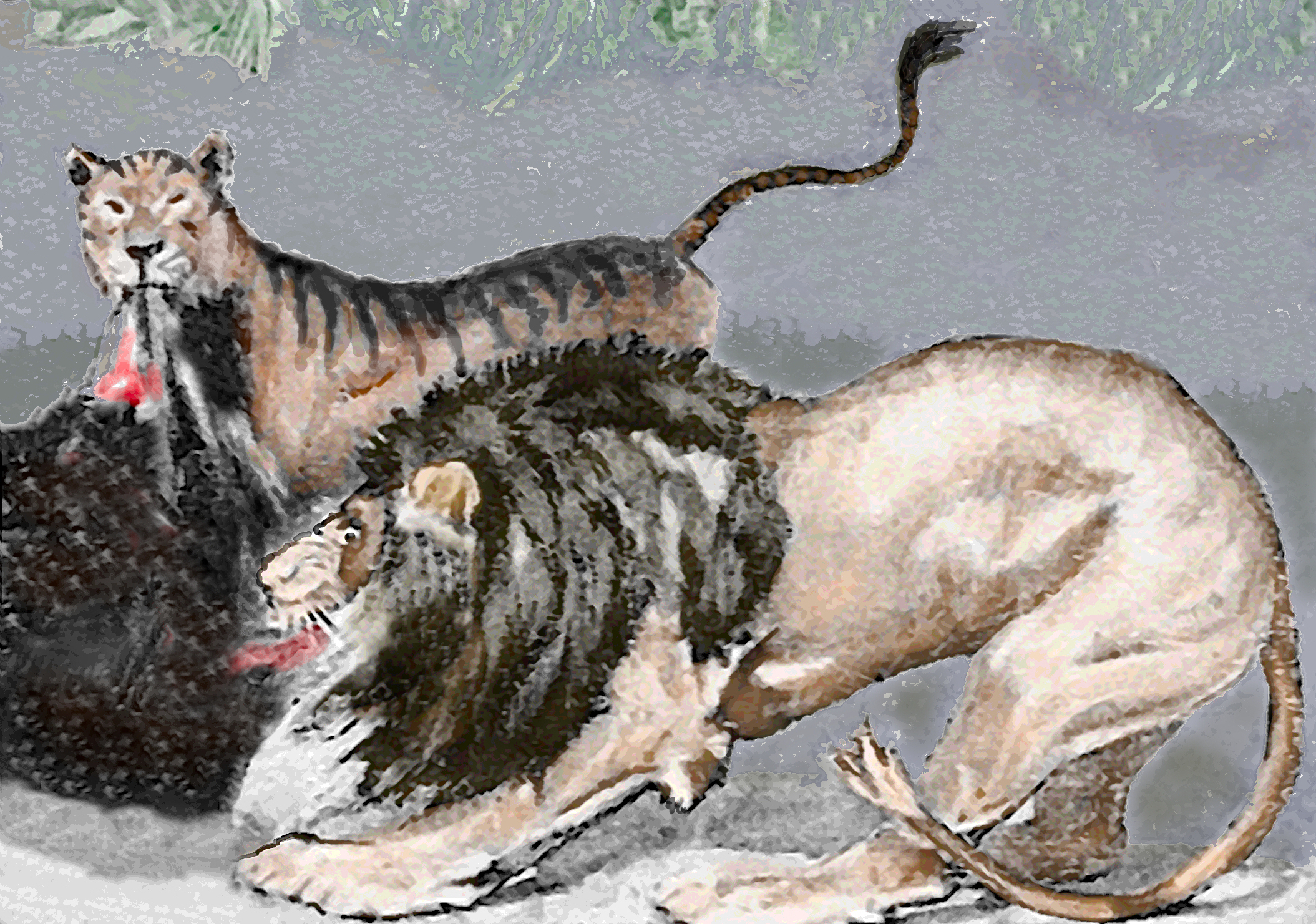
Now in that same forest there lived a ferocious tiger and a fearsome lion. This lion and this tiger used to kill and eat every large animal they could get. Because of this, no human beings dared set foot in the forest, nor were there very many other animals left. Worse yet, the lion and the tiger were very messy eaters, leaving chunks of meat on the forest floor to rot. The whole forest was filled with the smell of their rotting food.
The smaller tree-spirit had no common sense, and got the idea that the lion and the tiger had to leave the forest. He said to his neighbor, the great tree-spirit, “I have decided to drive the ferocious tiger and the fearsome lion out of our forest!”
“My friend,” said the great tree-spirit, “don’t you see that it is because of these two creatures that our beloved forest is protected? If the tiger and the lion leave the forest, human beings will come and cut all the trees down.” And the great tree-spirit recited part of an old poem:
When you feel a friend
Might bring an end
To your peace of mind,
Watch what you say,
Remain kind.
One day, that friend might prove
Worth the love
That you should offer anyway
To all living beings
In every way.
But the little tree-spirit didn’t listen to the great tree spirit, and the very next day assumed the shape of a large and terrible monster, and drove the ferocious tiger and the fearsome lion out of the forest.
Within two weeks, the human beings who lived close by began to realize that the tiger and the lion had left for good. They moved into the forest, and cut down half the trees.
The little tree spirit was frightened, and cried out to the great tree spirit, “Oh, you were right, I should never have driven the tiger and the lion out of our forest, for now the human beings are cutting us down. Oh, great tree spirit, what can we do?”
“Go find the tiger and the lion,” said the great tree-spirit. “Apologize for your harsh treatment of them, and invite them to return to the forest. That is our only hope.”
The little tree spirit ran off and found the tiger and the lion living nearby. He greeted them, and said, “Lion and Tiger, I’m sorry I chased you out of your old home by assuming the shape of a large and terrible monster. Please come back to live in the woods once again, for once you left the human beings started to cut down the trees, and soon your old home will be gone for good.”
But the tiger and the lion just growled at the little tree spirit, and rudely said that they would never return. Within a few days, the human beings had cut down the rest of the trees, and the forest was gone.
***
When Buddha finished telling the story, he said, “As you might have guessed, the little tree-spirit in the story was Kokalika, the lion was Sariputta, and the tiger was Moggallana.” And the bhikkus knew that Buddha himself was the great tree-spirit in the story.
Source: Vyaggha-Jataka, Jataka tale no. 272, from the Cowell translation (1911). This little-known tale is unusual in that Buddha is incarnated as a tree. An essay on Jataka tales in the book Buddhism and Ecology, part of the Harvard University series on ecology and religions of the world, mentioned this story as having implications for a Buddhist ecological theology.
The Two Friends
Wisdom Tale, Tale of Deities
Once there were two friends, one of whom was a follower of Buddha, and the other of whom was an old person who lived nearby. The follower of Buddha used to go every day to the house of the elder, where they would eat together. Then the follower of Buddha returned to the community of people that lived with Buddha.
Some of Buddha’s other followers were talking about these two friends, and Buddha overheard them. “Ah yes,” said the Buddha. “Those two were great friends in a past life.” (For all of Buddha’s followers believed that they had had many past lives.) And then the Buddha told this story of the past:
***
Once upon a time a Dog used to go into the stable where the king’s Elephant lived. At first the Dog went there to get the food that was left after the Elephant had finished eating.
Day after day the Dog went to the stable, waiting around for bits to eat. But by and by the Elephant and the Dog came to be great friends. Then the Elephant began to share his food with the Dog, and they ate together. When the Elephant slept, his friend the Dog slept beside him. When the Elephant felt like playing, he would catch the Dog in his trunk and swing him to and fro.
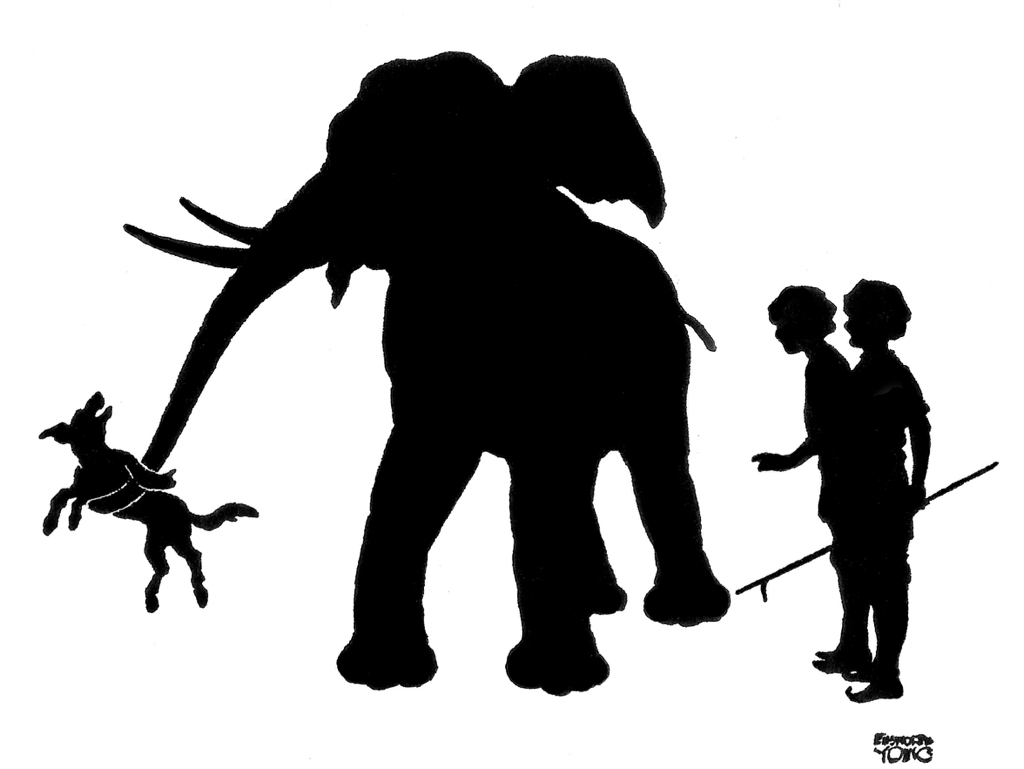
Neither the Dog nor the Elephant was quite happy unless the other was nearby.
One day a farmer saw the Dog and said to the Elephant-keeper: “I will buy that Dog. He looks good-tempered, and I see that he is smart. How much do you want for the Dog?”
The Elephant-keeper did not care for the Dog, and he did want some money just then. So he asked a fair price, and the farmer paid it and took the Dog away to the country.
The king’s Elephant missed the Dog and did not care to eat when his friend was not there to share the food. When the time came for the Elephant to bathe, he would not bathe. The next day again the Elephant would not eat, and he would not bathe. The third day, when the Elephant would neither eat nor bathe, the king was told about it.
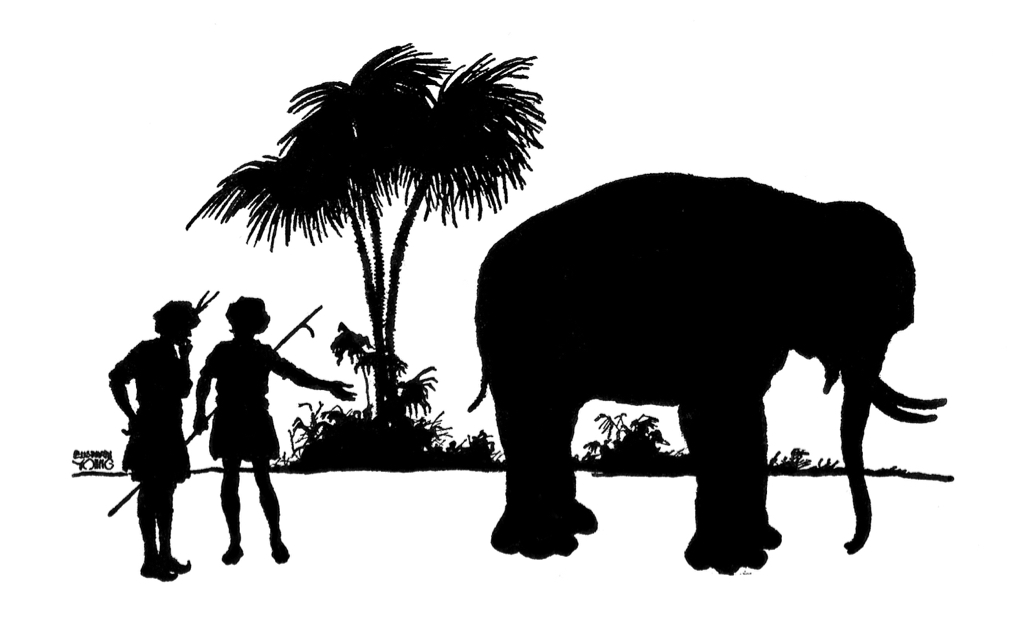
The king sent for his wisest advisor, saying, “Go to the stable and find out why the Elephant is acting in this way.”
The wise advisor went to the stable and looked the Elephant all over. Then he said to the Elephant-keeper: “There seems to be nothing the matter with this Elephant’s body, but why does he look so sad? Has he lost a playmate?”
“Yes,” said the keeper, “there was a Dog who ate and slept and played with the Elephant. The Dog went away three days ago.”
“Do you know where the Dog is now?” asked the wise advisor.
“No, I do not,” said the keeper.
Then the wise advisor went back to the king and said, “The Elephant is not sick, but he is lonely without his friend, the Dog.”
“Where is the Dog?” asked the king.
“A farmer took him away, so the Elephant-keeper says,” said the wise advisor. “No one knows where the farmer lives.”
“Very well,” said the king. “I will send word all over the country, asking the man who bought this Dog to turn him loose. I will give him back as much as he paid for the Dog.”
When the farmer who had bought the Dog heard this, he turned him loose. The Dog ran back as fast as ever he could go to the Elephant’s stable. The Elephant was so glad to see the Dog that he picked him up with his trunk and put him on his head.
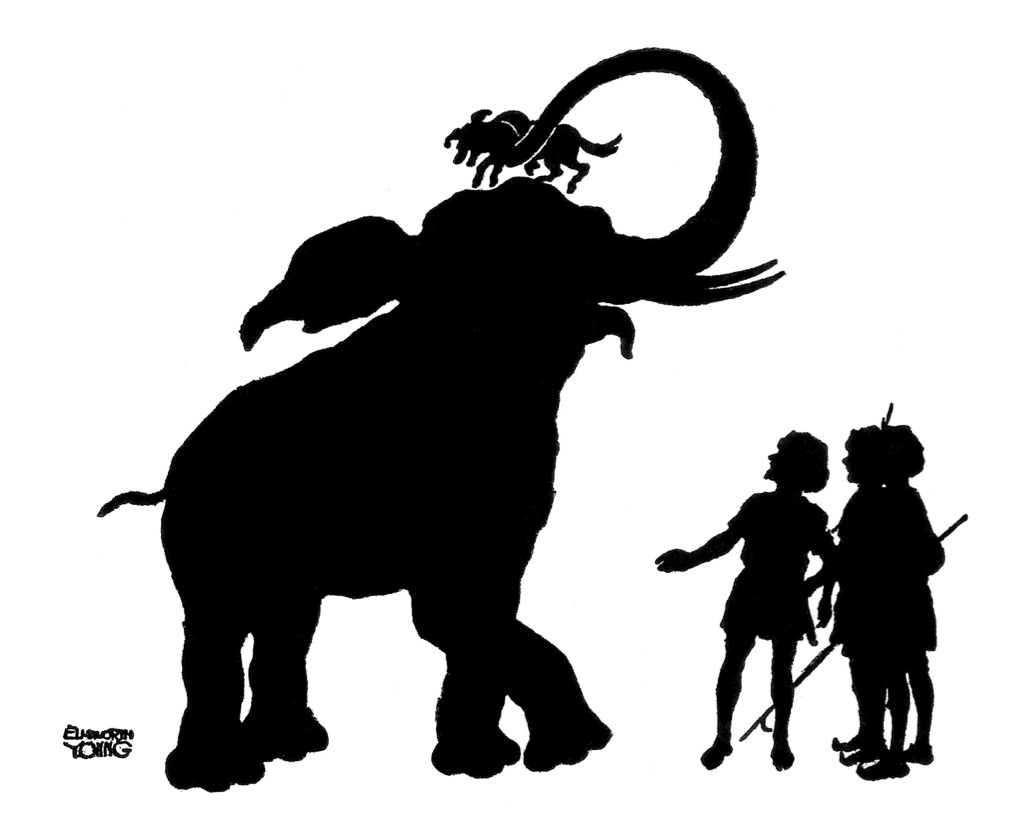
Then he put him down again. When the Elephant-keeper brought food, the Elephant watched the Dog as he ate, and then took his own food.
All the rest of their lives the Elephant and the Dog lived together.
Buddha’s followers knew that when he told one of these stories, he was also telling about one of his past lives. And the Buddha said, “My follower was the dog of those days, the aged Elder was the elephant, and I myself the wise advisor.”
Source: Main story adapted from “The Elephant and the Dog,” from More Jataka Tales by Ellen C. Babbitt (New York: Appleton-Century, 1922). Illustrations by Ellsworth Young from this same book. Framing story adapted from Abhinha-Jataka, Jataka tale no. 27, in the Cowell translation (1911).
The Miracle Birth of Buddha
Tale of Deities
The people of the city of Kapilavatthu were celebrating a spring festival, and the queen of the city, Queen Maya, celebrated with them. One day, she arose early, gave money to many beggars, ate a delicious meal, and then went back to the palace to sleep.
As she slept, she dreamed that the four Guardian Angels of the world lifted her up and took her to the highest mountains in the Himalayas. They set her down under a huge Sala tree. Four more angels came forth, clothed Queen Maya in heavenly garments, and led her to a silver mountain. Inside the silver mountain was a house of gold, and there the queen lay down to rest. It was not long before a great and gentle white elephant came into the silver mountain, carrying a white lotus flower in his trunk. The elephant trumpeted, walked around the bed where the queen lay, and gave her the lotus flower.
When the queen awakened the next morning, she told her dream to her husband, King Suddhodana. The king called sixty-four wise brahmins. After serving them food in gold and silver bowls, the king told them the dream and asked them what it meant. The brahmins told the king, “Do not worry, great king. This dream means that Queen Maya will soon give birth to a baby boy. If this child chooses life at home he will become the greatest king the world has seen; but if instead he chooses to forsake home life and become a hermit, then he will become a great religious teacher.”
When it came time for Queen Maya to give birth, she told King Suddhodana that she wanted to go to the city where her parents were the king and queen. King Suddhodana called a thousand officers to carry the queen and escort her on the journey. Along the way was a beautiful place called Lumbini Park, and at that time of year the trees were covered with blossoms, and flocks of singing birds flew among the flowers. The queen asked to stop to enjoy the beauty. She got down from the palanquin, and as she reached up to grasp a blossom of a Sala tree, she knew it was time for her to have her baby. The officers set up a curtain around her for privacy. As she stood there holding the branch of the Sala tree, the queen gave birth.
Immediately, the four great Brahmas appeared with a fine golden net, and they carefully laid the new baby into this net. Presenting the child to Queen Maya, they said, “Be joyful, O Queen, for a great son is born unto you.” The four Brahmas prepared a soft antelope skin, and placed the child on it. The baby stood up and looked towards the east. Voices were heard saying, “O Great One, there is no other like you!” The baby gazed in all directions, and then took seven steps towards the north, while the Great Brahma held a white umbrella over him. And when her baby was born thirty two miraculous things happened as signs that this baby was unique.
Queen Maya brought the baby home. The king rejoiced to see his new son, and they named their baby Siddhartha Gotama. Now a hermit who lived nearby, a man with great spiritual wisdom, heard about this new baby. He came down to the palace and said to King Suddhodana, “O King, I have heard that a child is born to you, and I would like to see him.” They brought the child out, and upon seeing him the hermit knew the baby would grow up to be a great man, and he stood and paid homage to the baby. Then the hermit smiled, and proclaimed that the baby would become the Buddha when he was 35 years old.
And that is exactly what happened. Although King Suddhodana tried to convince his son to become a king, when Siddhartha Gotama was old enough to decide what to do with his life, he left the palace and went out into the world. He got his food by begging, and he went to learn from the greatest spiritual teachers. At last, he sat down beneath a tree to meditate, and he achieved enlightenment, and became the Buddha, the Enlightened One, the one who awakened to the Truth of the ages. Buddha spent the rest of his life teaching others how they, too, could calm themselves and awaken to the truth. And even today, thousands of years after he lived, there are still millions of people who follow the Buddha’s teachings.
Source: The Story of Gotama Buddha: Jataka-nidana, trans. N. A. Jayawickrama (Oxford: Pali Text Society, 2002 corrected edition), pp. 66-72.

King Usinara and the Huge Hound
Wisdom Tale, Tale of Deities
One day, the followers of Buddha were sitting in the Hall of Truth talking with one another.
“Isn’t it amazing,” one of them said, “that the Buddha gave up a beautiful home, and now lives only for the good of the world?”
“Yes,” said another, “isn’t it amazing that he has attained supreme wisdom, yet rather than making himself rich, he goes about teaching goodness?”
Buddha came into the Hall and heard them talking. “Yes, it is true,” said the Buddha. “Even in my previous lives, even then when I had not attained supreme wisdom, I still always tried to live for the good of the world. Let me tell you the story of one of my previous lives.” This is the story the Buddha told:
***
Once upon a time, there reigned a king named Usinara. In the land of this king, the people had given up doing good, given up all religion, and instead they followed the paths of evil-doing. Sakka, the ruler of all the gods, looked upon this, and saw that people were suffering because they did evil.
“What shall I do, now?” he said to himself. “Ah, I have it! I will scare and terrify humankind. And when I see they are terrified, I will comfort them, I will tell them the universal Law of life, I will restore the religion which has decayed!”
So Sakka made the god Matali into the shape of a huge black hound, with four tusks each as big as a plantain, with a hideous shape and a fat belly. Sakka fastened this horrible dog with a chain, and turned himself into a hunter. Together they walked to King Usinara’s city.
“The world is doomed to destruction!” the hunter cried out, so loudly that he terrified everyone within earshot. He repeated this cry as he walked up to the very gates of the city.
The people of the city saw the huge dog and heard the hunter’s cries, and hurried into the city to tell the king what had happened. The king ordered the city gates to be closed. But the hunter and the huge dog leaped over the wall.
When they saw that the hunter and the dog had gotten inside the city, everyone ran away to find a place to hide. Those who could not get to their houses in time ran to the king’s palace to find safety.
The hunter and the dog came to the palace. The dog raised itself up, put its paws on the window of the room where the king was hiding, and barked. Its bark was a huge roaring noise that seemed to go from the depths of the earth to the highest heaven. Upon hearing this bark, the people were terrified and horrified, and no one could say a word.
At last the king plucked up his courage, and went to the window. He called out to the hunter: “Ho, huntsman! why did your hound roar?”
“The hound is hungry,” said the hunter.
“Well,” said the king, “I will order some food to be given to it.”
The king told his servants to give all the food in the palace to the dog. The huge dog gulped all the food down in one mouthful, then roared again.
Again the king called out the window: “Huntsman! Why does your dog still roar?”
“My hound is still hungry,” said the hunter.
Then the king had all the food for all his elephants and all his horses and all his other animals brought and given to the huge dog. Once again, the dog swallowed it in one gulp. So the king had all the food in the entire city brought. The huge dog swallowed all that in one gulp, and then roared again.
The king then said to himself, “This is no hound. I will ask him wherefore he is come.” Terrified with fear, he said to the hunter: “Why does this huge hound, with sharp white fangs as big as plantains, come here with you?”
“The dog comes to eat my enemies,” said the hunter.
“And who are your enemies?” said the king.
“All those people who are smart and educated, but who use their skill only to acquire money. All those who do not take care of their parents, once their parents get old. All those who betray their friends or spouses or siblings. All those who pretend to follow religious principles, but who actually do whatever they want. All those who are criminals, and kill and rob. All those who have hearts filled with evil, and who are evil and deceitful.
“These,” said the hunter, “all these are my enemies, O king!”
And the hunter made as though he would let the hound leap forth and devour all those who did the deeds of enemies. But as all the multitude was terror-struck, he held in the hound by the leash.
The Sakka shed his disguise of a hunter. By his power he rose and poised himself in the air, and said: “O great king, I am Sakka ruler of the gods! Seeing that the world was about to be destroyed by evil, I came hither. Religion had become corrupt and humans were suffering because they were doing evil. From henceforth I will know how to deal with the wicked, but you had better remain vigilant, lest I have to return.”
So King Usinara and all the people saw how they must stop doing evil, and return to the ways of virtue. They must stop doing evil, or the huge dog would remain hungry, and would keep roaring!
And when they saw that humankind had turned away from evil, and once again was following the paths of good — then Sakka and Matali returned to their own place.
***
When the Master had finished telling this story, he went on to say: “So you see, in my former lives I lived for the good of the world.”
Buddha and his followers all believed that they had had many previous lives, and had been reincarnated many times. And his followers knew that one of the characters in the story had been Buddha. But which one?
At last Buddha told them: “At that time, my follower and friend, Ananda, was Matali,” said the Buddha. “And I was Sakka.”
Source: Maha-Kanha Jataka, Jataka tale no. 469, in the Cowell translation [1911]. This story has been widely retold (by, e.g., Paul Carus, Sophia Fahs, etc.), but usually in a way that removes the specifically Buddhist elements from it.
The Tale of the Dhak Tree
Wisdom Tale, Tale of Deities
One day, four of Buddha’s followers came up to him and asked how they might learn to meditate and rise above earthly things. Buddha explained to the four bhikkus how they might do so, and each of the four went off to learn a different kind of meditation. The first bhikku learned the Six Spheres of Touch. The second bhikku learned the Five Elements of Being. The third bhikku learned the Four Principal Elements. The fourth bhikku learned the Eighteen Constituents of Being. And each one of these four bhikkus learned how to meditate so well that they each achieved Enlightenment and became a holy person.
Now one day all four of these bhikkus came back to tell the Buddha what they had done, and each of them claimed that their way was the best form of mediation. At last one of them said, “Buddha, each of us has achieved Enlightenment, but we each used a different type of meditation. How could this be?”
And Buddha said, “It is like the four brothers who saw the dhak tree.”
***
Once upon a time Bramadatta, the King of Benares, had four sons.
One day, the four sons sent for a charioteer and said to him, “We want to see a dhak tree [butea frondosa]. Show us one!”
“Very well, I will,” the charioteer replied. “Let me begin by showing the eldest son.”
The charioteer took the eldest to the forest in the chariot. It was springtime, and eldest son saw the dhak tree at the time when the buds had not yet begun to swell, and the tree looked dead.
But the charioteer told them he could not return right away. After two or three weeks had gone by, the charioteer brought the second son to see the dhak tree, but now it was entirely covered with reddish-orange flowers.
Again, the charioteer told them he could not return to the tree right away. After two or three weeks had gone by, the charioteer brought the third son to see the dhak tree, but now the flowers were gone and the tree was covered with leaves.
Again, the charioteer told them he could not return to the tree right away. The fourth son waited and waited until at last he could wait no more. The charioteer brought him to see the dhak tree when it was covered with long brown seed-pods.
When at last all the brothers had seen the dhak tree, they sat down together, and someone asked, “So what is the dhak tree like?”
The first brother answered, “It is like a bunch of dead twigs!”
And the second brother said, “No, it is reddish-orange like a big piece of meat!”
And the third brother said, “No, it has leaves like a banyan tree!”
And the fourth brother said, “No, it looks just like the acacia tree with its long seed pods!”
None of them liked the answers the other gave. So they ran to find their father.
“Father,” they asked, “tell us, what is the dhak tree like?”
“You have all seen the tree,” the king said. “You tell me what it’s like.”
And the four brothers gave the king four different answers.
“You have all seen the tree,” said the king. “But when the charioteer showed you the tree, you didn’t ask him what the tree looked like at other times of the year. This is where your mistake lies.”
And the king recited a poem:
Each one of you has gone to view the tree,
And yet you are in great perplexity.
But you forgot to ask the charioteer
What forms the dhak tree takes throughout the year.
***
Buddha then spoke to the four bhikkus. “These four brothers did not ask themselves what the tree looked like in different times of the year, and so they fell into doubt. So the four of you have fallen into doubt about what is true and right.” Then the Buddha gave another stanza for the king’s poem:
If you know truth, but with deficiency,
You’ll be unsure, like those four and their tree.
Source: Kimsukopama-Jataka, Jatka tale no. 248, in the Cowell translation (1911).
OTHER BUDDHIST STORIES
Prince Gotama and the Four Sights
Wisdom Tale, Tale of Deities
Once upon a time, a prince named Gotama lived in a royal palace in the land of Kapilavastu, which was on the border between the countries we now call India and Nepal. Gotama’s family was very wealthy. As he grew up, the prince had everything money could buy. He had servants to take care of every need. He had the finest food. He had all the toys he could wish for.
The story is told that while Gotama was still young, a sage came to visit his parents, the King and the Queen. This sage was very wise. He looked at the young boy and said, “This child will grow up to be either a great king, or a great spiritual leader.”
Now his father wanted Gotama to become king after the father died. Therefore, the King decided that the young prince must never see anything that might raise spiritual questions in him. The King instructed everyone in the palace that Prince Gotama must never be allowed to go outside the palace grounds by himself, lest he fall into conversation with a wandering spiritual person. The King also ruled that Prince Toama must not see anyone who was ill, or disabled in any way, nor anyone who was old. The King also ruled that if someone died, the prince should hear nothing of it. Thus the King hoped to keep the prince from asking any spiritual questions.
To keep Gotama happy, the King and Queen gave him everything he could want, so that he would want to stay inside the palace grounds. And when he was old enough, they found the kindest and most beautiful young woman in all the kingdom to marry the Prince. Both the prince and his new wife were vary happy, and they became even more happy when they had their first child together. The King and Queen hoped that the prince had forgotten his wish to leave the palace on his own.
One day, when he was twenty nine years old, Gotama went out of the palace to go hunting, accompanied by his servant Channa. As they were riding along on their two horses, they came upon a man lying beside a rock, groaning in pain.
“What is wrong with this man?” asked Gotama.
“He is ill,” said Channa.
“But why is he in such pain?” said Gotama.
“It is the way of life,” said Chana. “It is just what happens when people are ill.” And they rode on.
When he was back at the palace, he tried to ask the wise men there about illness, but they would not answer his questions.
Gotama and Channa went out hunting again. As they rode along, they passed a woman whose hair was white and whose skin was wrinkled, and who used a cane to walk.
“What is wrong with this woman?” asked Gotama.
“She is old,” said Channa.
“But what do you mean by ‘old’?” said Gotama.
“It is the way of life,” said Channa. “It happens to anyone who lives a long time.”
Back at the palace, Gotama tried to ask the wise men there about being old, but they would not answer his questions.
Gotama and Channa went out hunting again. As they rode along, they came across man lying as if asleep. But Gotama could not wake him.
“What is wrong with this man?” asked Gotama.
“He is dead,” said Channa. “This is the way of life, people must one day die.”
Gotama and Channa went out hunting a fourth time and saw a wandering holy person. Gotama asked Channa who he was.
“He is a wandering holy person,” said Channa. “He wanders around the world begging for his food, and seeking spiritual enlightenment.”
This was something Prince Gotama had never heard of before. That night, Gotama could not sleep. He remembered both the suffering he had seen, and the holy man seeking enlightenment. Gotama realized that he himself would one day face illness, old age, and death.
“I must leave the palace where I’m always protected,” he thought to himself. “I must find answers to my questions.”
He got up, and told Channa to saddle his horse. The he looked in at the bedroom where his wife and their child lay sleeping. If he left the palace, he worried that his his wife and son would not be safe. He didn’t want to make them go with him.
He stood looking at them, wondering what to do. Should he stay? Or should he go?
As it happens, we know what Prince Gotama did. He left his wife and child behind, went out into the wide world, and after many hardships he became the Buddha, the Enlightened One, one of the greatest spiritual leaders the world has ever known. Knowing that, what would you do? Would you stay and become a great king, or leave and become a great spiritual leader? Would you give up the chance of being enlightened to stay with your family?
Source: Heavily adapted from Myths of the Hindus and Buddhists, Ananda K Coomaraswamy and Sister Nivedita (Margaret E. Noble) of Ramakrishna-Vivekananada (London: George G. Harrap & Co., 1914).
Visakha’s Sorrow
Wisdom Tale
Once upon a time, the Buddha was staying in the city of Savatthi, in the Eastern Grove. He was staying as a guest in the mansion owned by Visakha. Now Visakha had a granddaughter whom she loved very much; this granddaughter was her darling and her delight. While Buddha was staying in her mansion, Visakha’s granddaughter died after a long illness. When Visakha heard that her granddaughter had at long last died, it was very early in the morning. Visakha was overwhelmed with grief when she heard the news. Even though it was very early in the morning, she went to see the Buddha.
She approached the Buddha, greeted him politely, and went to sit down at his side. The Buddha looked at her, and could see she had been crying. He said quietly, “Well, Visakha, what is it that brings you here at a very early hour, with your hands and hair all wet from tears?”
“Forgive me, Buddha, but my granddaughter has just died,” she said. “My granddaughter was my darling and my delight, and that is why I come to you at this early hour with my hands and hair all wet with my tears.”
The Buddha looked kindly at Visakha. “Would you like to have many grandchildren who were as darling and as delightful as your granddaughter?” he said.
“Oh, yes, I would like to have as many darling grandchildren as there are people in Savatthi.”
“But Visakha,” said the Buddha, “how many people die in the city of Savatthi each day?”
“Ten or a dozen people die each day in our city,” she said. “I know my granddaughter is no different from any other human being, and I know she is no different from any of the dozen people who must die each day in our city.”
“So what do you think, Visakha,” said the Buddha sympathetically. “In all the households where someone has died, do you think that in that same household there will also be people whose hands and hair are all wet with tears?”
“Yes,” she said, “wherever someone has died, that will be so.”
“Visakha, if you hold something dear to your heart, then you will have a sorrow,” said the Buddha. “If you hold a hundred people dear, you will have a hundred sorrows. If you hold fifty people dear, you will have fifty sorrows. If you hold twenty people dear, you will have twenty sorrows. If you hold one person dear, you will have one sorrow. But those people who hold nothing dear will have no sorrow; those people will be free from grief, they will be free from passion, and they will be free from despair. Do you wish to be free from grief?”
Visakha nodded.
The Buddha went on. “In this world, whatever grief or sorrow or sadness there may be, exist because we hold on to something too tightly. The only people who are truly happy, the only people who are free from grief, are those who do not try to hold anything too tightly. If you wish to be free from grief and free from passion, you must hold nothing dear that is on this earth.”
Source: The Udana, viii. 8. I used the following translations: Eugene Watson Burlingame, Buddhist Parables, pp. 107-108; and The Udana: or the Solemn Utterances of the Buddha, trans. from the Pali by Dawsonne Melanchthon Strong (Luzac/India Company: London, 1902), pp. 126-127.
Buddha Teaches Meditation
Wisdom Tale
After he had reached Enlightenment, Buddha taught many other men and women how to meditate. He lived with four hundred of his followers, or bhikkus, in the middle of Eastern Park, which was a beautiful open space, dotted with trees, located in the city of Savatthi.
Every day, Buddha and all his followers (who were called bhikkus) got up and sat together to meditate. The more experienced bhikkus, the people who had lived with Buddha the longest, helped teach the newer bhikkus how to meditate. After the meditation time was over, all the bhikkus would take a bowl and head into town to beg for food. They would all come back to the retreat center before noontime. Before they ate, some of the older, more experienced bhikkus would give a lecture to any townspeople who came by. Then everyone would eat.
After lunch, Buddha and all the bhikkus would go find a cool shady grove of trees. They would all sit together in the shade of the trees, and Buddha would give a talk, telling them how to be better people. Sometimes, when the moon was full, they would all stay up late and Buddha would give another talk in the moonlight.
One day, hundreds more of Buddha’s followers traveled to the retreat center in Eastern Park in the town of Savatthi. Soon there were over a thousand bhikkus, over a thousand followers of Buddha, all gathered together. It was the time of the full moon, and that evening, all the bhikkus gathered together outside to hear Buddha tell them how to meditate. Of course, all the bhikkus were already learning how to meditate, and practicing meditation every day. But for the first time, Buddha described his whole system of meditation from start to finish.
Here’s what Buddha said:
“When it’s time for you to meditate, go out and sit at the foot of a tree; or if you can’t find a good tree, just find a nice quiet place where you won’t be disturbed.
“Then sit down on the ground. Sit in the lotus position, that is, sit with your left foot on your right thigh, and your right foot on your left thigh. Be sure you hold your body straight.
“As you sit, pay attention to your breathing. When you breathe in, know that you are breathing in. When you breathe out, know that you are breathing out.”
Buddha kept talking in his calm, peaceful voice, describing what to do when you meditate. He said:
“Breathe in and out, and be aware of your whole body.
“Breathe in and out, and let your breathing make your whole body calm and at peace.
“Breathe in and out, and let yourself be joyful.
“Breathe in and out, and be aware that your mind is full of thoughts.
“Breathe in and out, and let your mind become calm and peaceful.
“Breathe in and out, and let your mind become happy and peaceful.
“Breathe in and out, and concentrate so you can free your mind.”
Buddha kept talking in his calm, peaceful voice for over an hour. Everyone sat in stillness in the moonlight and listened. Everyone, all Buddha’s followers, felt calm and peaceful. This is how Buddha taught his followers how to meditate.
There are many people in the world today who still follow Buddha’s teachings; they are called Buddhists. We are not Buddhists, we are Unitarian Universalists; but we Unitarian Universalists have learned a lot about meditation from Buddha. Many Unitarian Universalists meditate every day, so they can feel peaceful and happy.
Source: based on Thich Nhat Hanh’s translation and exegesis of Anapanasati Sutta, as set forth in his book The Full Awareness of Breathing; with reference to other modern translations of the suttra.
The Shattered Tea Cup
Wisdom Tale
Once upon a time in the land of Japan, there lived a man named Sheng-yen who was both a Zen master and a professor at a university. One day, in order to explain to his students how they might become enlightened, he told how his own teacher had reached enlightenment.
Once upon a time, there lived a Zen Master. The Zen Master was small and quiet, with gray hair and many lines on his face. He often smiled. He lived in a monastery that stood near the banks of a rushing river. There, he watched over all the monks who lived at the monastery, teaching them about Zen Buddhism and helping them reach enlightenment.
The monks chopped wood for the fireplace. They hauled buckets of water from the well to use in the kitchen. They listened to the teaching of the Zen Master, sitting in the great hall while the Zen Master gave Dharma Talks. But the most important thing that the monks did was to meditate. Every day, they sat on the floor of the great hall of the monastery, meditating in silence. No one said a word all day long.
It was hard for the young monks to sit in silence for such long periods of time, but the Zen Master could sit for days on end, meditating in silence. One of the younger monks asked him, “How can you sit for so long in silence?”
The Zen Master replied, “Stop thinking so much. Just sit.”
At that time, the man who later became my teacher came to learn at this monastery. This young monk did what he was supposed to do: he learned the sutras by heart, he learned to sit in silence for hours while he meditated, he learned everything he was supposed to know. But try as he might, he could not reach enlightenment.
One day, the Zen master invited the young monk to come talk to him. While the Zen Master prepared tea, the young monk said, “Zen Master, I have not been able to reach enlightenment.”
“Do you think I can help you?” said the Zen Master.
“I don’t know,” said the monk.
The Zen Master began to pour the hot tea. He slipped, and some scalding water flowed onto the young monk’s hands. The young monkstarted in surprise, the delicate cup flew out of his hands, and shattered on the floor beside him.
Upon hearing the cup shatter, the young monk reached enlightenment.
“And that,” said Sheng-yen, “is how my own teacher reached enlightenment. Just as the cup shattered, so must your mind shatter if you want to reach enlightenment.”
Source: A dharma talk by Master Sheng-yen (b. 1931), who tells the story of how one of his Zen masters, Xu Yun, achieved enlightenment: Xu Yun was holding a cup into which someone else was pouring tea. By mistake, the other person spilled some tea onto Xu Yun’s hand, he dropped the cup, and upon hearing it shatter he reached enlightenment. Master Sheng-yen says that just as the cup shatters, the mind must shatter to become “no-mind.”
SIKH STORIES
Guru Nanak and the Old Woman Who Lost Her Son
Wisdom Tale
Guru Nanak, the founder of the Sikh religion, lived in a land where there were many Hindus and many Muslims. But Nanak preached “There is no Hindu, there is no Muslim”– because the truth is not limited to any one religion.
Once upon a time, on one of his missionary trips or udasi, Guru Nanakcamped beside the Tigris River.
He had been teaching all day, and in the evening an old woman, a Muslim, came to visit him. Weeping, she bowed down at his feet. Nanak asked her to sit next to him and tell him her problems.
“I have been waiting for you for twelve years,” said the old woman. “It was twelve years ago that my son got onto a ferry boat at this very spot to travel to the other side of the Tigris. He was twenty years old, and he was going across the river to visit his sister. The ferry was well out into the river when it suddenly capsized. I watched in horror, trying to see if my son would be safe. Some of those aboard were able to swim to shore, but many were lost. My son was one of those who did not make it back to land.
“I waited all night by the side of the river to be sure,” said the woman, “and at last went home to sleep. I saw you in my dreams, a holy man who held up his hand so that a light shone upon me and filled me with warmth. I knew that you would come and bring back my son to me.”
“Where has your son been for the last twelve years?” Nanak said.
“He has been with Allah,” said the woman.
“Is he content and happy to be with Allah?” said Nanak.
“Oh, yes,” said the woman, “of course he has found perfect happiness with Allah.”
“Then surely you would not be selfish enough to ask your son to leave that perfect happiness to come back to this world,” said Nanak. “For as you know, in this world happiness is rare, while misery is a constant.”
The old woman was silent.
“And have you really been without your son all these twelve years?” said Nanak. “Has he not lived on in your memory? Can you not remember the way he played as a child, the trouble he got into, all the time you spent with him? He was so much a part of you while he was alive that he can never completely go away from you. You have lost his body, yes; but his soul and spirit will remain with you always.”
So it was that Nanak brought her son back to the old woman; though he had really never left her. She touched his feet and went on her way, her soul at peace at long last.
Source: The source for this story is The First Sikh Spiritual Master: Timeless Wisdom from the Life and Teachings of Guru Nanak, by Harish Dhillon (Mumbai: Indus Source Books, 2005; Woodstock, Vermont: Skylight Paths Publishing, 2006), pp. 166-167. Although the bulk of the book is a popular historical biography of Nanak, Dhillon also retells several stories from the Nanak janamsakhis, stories which his grandmother told him when he was a child. Dhillon states this story is probably not historically accurat, pp. 155-156.
The Raja’s Son
Wisdom Tale
There once was a raja, a Hindu king, who married a woman who was a Sikh. When she became the rani, or queen, this woman stayed in touch with the Sikhs who lived in the kingdom, and who had their dharamsala, or place of worship, just below the palace where the raja and rani lived. The Sikhs were well known for their beautiful hymns and their beautiful singing, and the raja came to enjoy listening to the hymns that were sung during kirtan, that is, during the Sikh worship service.
One day, the rani said to the raja, “Do you not wish that we had a child?”
“Oh yes,” said the raja. “I would love for us to have a child. I wish we could have a little boy.” For in the raja’s kingdom, it had always been men who had ruled the kingdom, and the raja hoped for a song that would rule his kingdom after him.
The rani said, “Let us go down to the dharamsala, and ask the sangat for a child.” The sangat was the gathered community of Sikhs, and it was thought that Guru Nanak, the founder of the Skih religion, was present in the sangat, even though he had died long ago.
The raja agreed to do this. A large congregation of Sikhs had gathered for Ekadasi, a Hindu lunar celebration. Even though Sikhs did not celebrate Hindu holidays, the Guru Arjan had said:
On Ekadasi, see God by your side,
Control your desires, and listen to God’s praise,
Let heart be content, and be kind to all beings.
The raja and rani presented their wish for a son as a hymn was being sung. Speaking to the congregation, the raja and rani said: “You come together for Guru Nanak, and so whatever wish is asked of you will be granted. We ask that the Guru would give us a son.”
Those who were in the sangat said, “Trust in the Guru, he will grant you a son.”
Not long thereafter, the raja’s wife told the raja that she was pregnant. “Guru Nanak was right,” they said to each other, “and soon we will have a son.” When the baby was born, the baby’s body looked like a girl’s body, but the raja and his wife were confident that Guru Nanak had correctly foreseen that their child would be a son.
The raja and his wife gave the baby a name that was usually given to a boy, and then waited to see what would happen. And when their baby grew enough to begin to walk and talk and run around, it became clear that the child knew he was a boy. So what Guru Nanak had said did indeed come true: the raja and his wife had a son.
The boy grew quickly, and became a fine young man. Although he had a young woman’s body, nobody in the raja’s palace thought much about it, and the young man did everything that all the other young men did. Then one day, his father called him to the throne room.
“My son,” said the raja, “it is time you married. I would like you to marry –” and he named the daughter of a neighboring raja.
The young man thought he liked this daughter of the neighboring raja, and he also thought that she liked him, so he did not disagree with his father’s idea. But he asked, “Why is it that you want me to get married now, father?”
“I have received a marriage proposal from the young woman’s father,” said the raja. “And besides, I would like to see you married, and I would like you to have children, so that my grandchildren will continue to rule this kingdom.”
The young man looked thoughtful. “Of course I would like to have children,” he said, “but as you know, even though I’m a man, remember that I do have a woman’s body….”
His father waved this away. “Do not worry,” said the raja. “I trust in the Guru. He said that your mother and I would have a child, and we did. He said that your mother and I would have a boy, and we did.”
So the marriage proposal was accepted. The raja instructed his Hindu pandit to carry out the ceremonies to prepare for the marriage. But there were those who whispered, “The young man has a woman’s body. If he marries a woman, how can the two of them have children? The old raja will bring disgrace on us all.” But the old raja didn’t listen to these whispers; he trusted in Guru Nanak, and he knew that his son was indeed a man.
Before long the day of the wedding arrived. The young man got on his horse and, accompanied by a large party of well-wishers, rode to the neighboring raja where the wedding would take place. Suddenly a golden deer appeared in front of the party, and the raja’s son boldly spurred his horse and gave chase to this magnificent animal.
The golden deer ran from the raja’s son, leading him away from the others, until at last the deer jumped into a garden. The raja’s son followed, but when was inside the garden he found, not the golden deer that he had expected, but the Exalted One, Guru Nanak himself.
The raja’s son bowed down before the Exalted One. The Guru said to him, “My child, the Guru will fulfill your wish.”
The rest of the party had been following the raja’s son, and just then they arrived in the garden. Upon seeing Guru Nanak, the raja walked around him, then prostrated himself and laid at the feet of the Guru. “I am truly blessed, to see you, Baba Nanak!” said the raja. “You granted my wish to have a son. No human mouth can praise you enough, for you are beyond all praise!”
“Go in peace,” said Guru Nanak. “I will be with you wherever you go. Wherever you sing my hymns or offer praise to me, there you shall find me.”
The raja and all those in the wedding party became Sikhs from this moment. They continued on their journey, all chanting, “Guru, Guru!” The raja’s son was duly married to the daughter of the neighboring raja, and all was well.
Source: Adapted from: The B40 Janam-Sakhi: An English translation with introduction and commentary of the India Office Gurmukhi Manuscript Panj. B40, a janam-sakhi of Guru Nanak compiled in A.D. 1733, by Daya Ram Abrol ed. W. H. McLeod (Amritsar: Guru Nanak Dev Univeristy, n.d. [1979]). The quote from Guru Arjan combines translations from Bhai Manmohan Singh, Dr. Sant Singh Khalsa, and the online Sikh Encyclopedia.
JAIN STORIES
Sayyambhava finds the truth
Wisdom Tale, Tale of Deities
Prabhava was one of the great teachers of the Jain religion. He wandered all over the earth teaching people to live a simple life, and to not be distracted by the pleasures of the senses, and to harm no living beings. Prbhava taught that if you could live like that, you could get rid of all your karma and achieve omniscience, so that you could see and know everything.
After Prabhava had been teaching for some time, he began to wonder who could take his place once he died. He thought about all his students and followers, but none of them (so he thought) would be able to take over for him. Then he used his upayoga power, that is, his mental sight, a power which allowed him to see everything in the whole world. He looked and looked until at last he saw someone who could take his place, a man named Sayyambhava.
This Sayyambhava was a priest of the Vedic religion, and when Prabhava saw him, Sayyambhava was in the city of Rajagriha, about to kill a goat as a sacrifice. Even though Sayyambhava was a priest in a religion that killed other living beings, because of his power of omniscience, Prabhava knew that he would make a good successor. “The beautiful lotus flower grows in the mud,” Prabhava said to himself, “so if you want a lotus flower you have to look in the mud.”
Prabhava went to Rajagriha to meet Sayyambhava. He sent two Jain monks ahead of him, and told them to go to the place where Sayyambhava was about to sacrifice the goat. “When you get there,” Prabhava told the two monks, “beg for food.” (Jain monks made their living by begging food from others.) “If the Vedic priests give you nothing, turn and walk away, and as you walk away, say in a loud voice, ‘Ah, it is too bad you do not know the Truth.’”
The monks got to the place where the sacrifice was about to take place, asked for alms, and when the Vedic priests refused to give them anything, they turned and walked away, saying in loud voices, “Ah, it is too bad you do not know the Truth.”
When Sayyambhava heard this strange remark, his mind became unsettled. Did these two monks know something that he didn’t know? Was his religion not the Truth? Instead of sacrificing the goat, he turned to his spiritual master, his guru, and asked, “Are the Vedas true — or not? Is our religion the path to the Truth — or not?”
His guru shrugged his shoulders.
Growing angry, Sayyambhava continued in a loud voice, “Those were holy monks, who obviously tell no lies. You’re not a true teacher, you’ve been lying to me all this time!” He took the dagger which he had been going to use to kill the goat. “Tell me the truth! If you don’t, I’ll cut off your head.”
Seeing that his life was in danger, the guru said, “I have not been telling you the truth. It is pointless to memorize the Vedas.” (The Vedas were the holy scriptures of the Vedic religion.) “Not only that,” the guru said, “but a statue of one of the Jain deities — a Jina, one of the highest Jain deities — is buried at the foot of the post where we tie to goats we are about to sacrifice.”
The guru pulled the sacrificial post out of the ground, and Sayyambhava looked down into the hole, where he saw a statue of a Jain deity. The guru went on, “There, that is a statue of the true religion. The only reason we do sacrifices is because we get to keep the meat afterwards. It’s an easy way to make a living. But what good is a religion that kills innocent animals? It is no good at all.
“Yes, I have been lying to you all these years,” said the guru to Sayyambhava. “Lying just so I could fill my stomach with easy food. But you are too good for that. Leave me, so that you can follow the true religion. If you do, I know that you will become all-seeing, and all-knowing.”
But Sayyambhava said, “You are still my teacher because in the end you told me the real truth.” Then Sayyambhava bid his guru a fond farewell, and went in search of the two Jain monks….
[To be continued]
Sources: This story is from Canto 5:1-37 of The Lives of the Jain Elders, by Hemachandra (1098-1172). I used the following translations: Sthaviravali Charita, or Parisishtaparvan, Being an Appendix of the Trishashtisalaka Purisha Charita by Hemachandra, ed. Herman Jacobi (Calcutta: Baptist Mission Press, 1891), pp. 39-41; and Hemacandra, The Lives of the Jain Elders, trans. R. C. C. Fynes (Oxford University Press, 1998), pp. 117-119.
HINDU STORIES
The Hymn of Purusha
Tales of Deities
This is just one of many Hindu stories about how everything began.
Before the beginning of all things, a giant named Purusha existed. Purusha had thousands of heads, and thousands of eyes, and thousands of feet. He was huge and embraced the earth on all sides; and at the same time he filled a space only ten fingers wide, the size of the space which holds a human soul.
The giant Purusha is everything, all that had once been, and all that which shall be in the future. He is the god of immortality, and he now lives through sacrificial food which humans offer up to him. All beings and creatures make up one quarter of him; the rest of him is immortal life in a world beyond this world. Before the beginning, the three quarters of Purusha which was immortal life rose up high, and the remaining one quarter of him remained here.
Purusha gave birth to his female counterpart, who was named Virat. When she was born, she took the form of an egg. And then Virat in turn gave birth, and she bore her male counterpart, Purusha. As soon as Virat had given birth to Purusa, he spread to the east and to the west over the earth. Together, Purusha and Virat produced the universe.
Then the Deities prepared Purusha as a sacrifice. They did not sacrifice him as humans might sacrifice an animal; it was a spsiritual sacrifice, an imaginary sacrifice. The clarified butter or ghee which they used in preparing the sacrifice was springtime. The wood which they gathered for the fire to burn the sacrifice was autumn. And the sacrifice himself, the giant Purusha, was summertime. All the Deities, and all the celestial beings, and all the sages sacrificed with him.
The ghee from the sacrifice was gathered up. Purusha, who was born in the beginning, was sprinkled on the grass. He formed the creatures of the air, and he formed the beasts of the forest and the beasts of the village. From that sacrifice were born horses, and cattle, and goats, and sheep.
And from the sacrifice were born the hymns of the Rig Veda, and the melodies of the Sama Veda. From the sacrifice came the ritual, and from it came the meters of poetry.
When Purusha was divided up after the sacrifice, his mouth became the Brahmins or the priests; his arms became the warriors and soldiers; his legs became the traders and farmers; and his feet became the workers and the slaves.
When Purusha was divided up, the Moon was born from his mind and his spirit; the Sun was born from his eye; from his mouth were born both Indra, the god of storms and warfare, and Agni, the god of fire; from his breath was born Vayu, the god of wind and of blowing breath and of life.
When Purusha was divided up, his navel became the middle sky, his head became the heavens, his feet became the earth. And so it was that all the worlds were made, and all that is began.
Sources: I drew on two translations of this hymn: Ralph T. H. Griffith, The Hymns of the Rig Veda: Translated with a Popular Commentary (1889; reprinted New Delhi: Munshiram Manoharlal, 1987), vol. 2, pp. 558-561; and Edward J. thomas, Vedic Hymns, Wisdom of the East series (London: 1923), reprinted in A Sourcebook in Indian Philosophy, ed. Sarvepalli Radhakrishnan and Charles A. Moore (Princeton, N.J.: Princeton University, 1957), pp. 19-20. This hymn has been the subject of long and sophisticated philosophical and religious reflection. In my retelling of it, I relied heavily on Griffith’s notes, and the notes provided in Radhakrishnan and Moore, to try to provide a simple yet reasonably accurate interpretation.
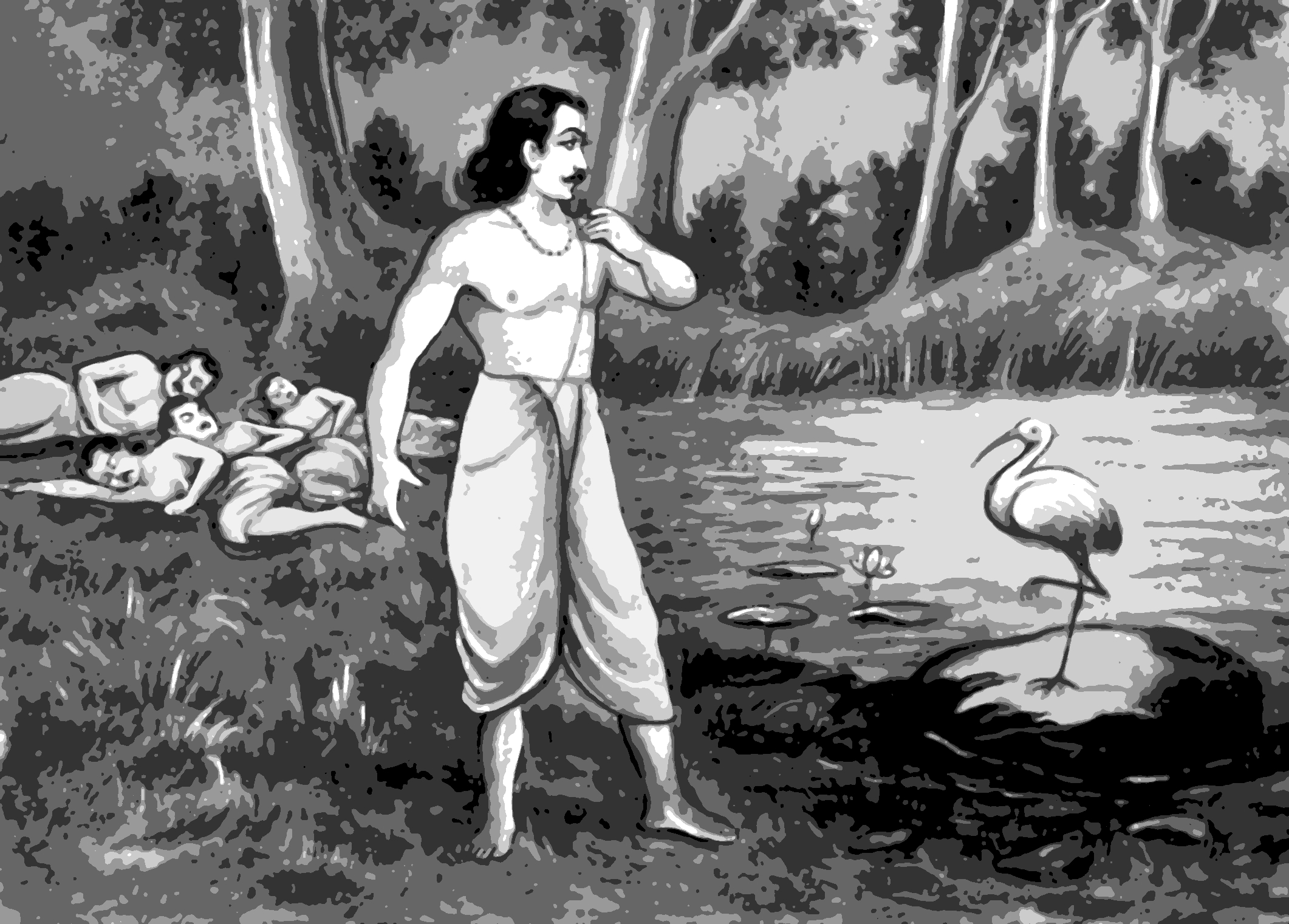
The Pool of Enchantment, or the Riddle Contest
Wisdom Tale; a story from the Mahabharata
One day, King Yudhisthira and his four brothers found that the wooden blocks they needed to light a sacred fire had been stolen by a deer. which had stolen the wooden blocks which a Brahmin needed so he could light the sacred fire. The king and his brothers went deep into the forest to find the deer. They searched for a long time. They grew thirsty, but could not find any water. At last, completely tired out, they sat down under a tall tree.
“If we do not find water soon, we shall die,” said Yudhisthira. Turning to his brother Nakula, he said, “Brother, climb the tree to see if there is any water nearby.”
In a few moments Nakula had climbed the tree, and he called down, “I see trees which only grow near running water. there I hear the sound of cranes, birds which love the water.”
“Take the arrows out of your quiver,” said Yudhisthira. “Go fill your quiver with water, and bring it back to quench our thirst.”
Nakula set out, and quickly found a small stream which widened into a pool of clear water. A crane stood on the far side of the pool. Nakula knelt down at the edge of the water to drink, but just then a stern Voice said:
“Do not drink, O Prince, until you have answered my questions.”
Nakula was thirsty, so he ignored the Voice. He drank eagerly from the cool water, and in a few moments lay dead at the edge of the pool.
Nakula’s four brothers patiently waited for him to return. At last Yudhisthira said, “Sahadeva, go find your brother. Then fill your quiver with water, and bring it back to quench our thirst.”
Sahadeva walked off through the forest. Soon he found Nakula lying dead at the edge of the pool. Before looking to see what had killed his brother, he knelt down at edge of the water to drink. Just then, a stern Voice said:
“Do not drink, O Prince, until you have answered my questions.”
But Sahadeva had already drunk from the water, and lay dead at the edge of the pool.
Once again the remaining brothers waited patiently. At last Yudhisthira said to his brother Arjuna, the mighty archer, “Go find our brothers. Then fill your quiver with water, and bring it back to quench our thirst.”
Arjuna slung his bow over his shoulder, and with his sword at his side walked to the pool. When he saw his brothers lying dead among the reeds, he fitted an arrow to his bow while his keen eyes pierced the darkness of the forest searching for the enemy who had killed them. Seeing neither human nor wild beast, he knelt down at the edge of the pool to drink. Just then, a stern Voice said:
“Do not drink, O Prince, until you have answered my questions.”
Prince Arjuna looked about him. “Come out,” he cried, “and fight with me.” He shot arrows in all directions, but the Voice only laughed and repeated its command.
But Arjuna knelt and drank, and soon lay dead at the edge of the pool.
Yudhisthira waited patiently, but when Arjuna did not return he said to Bhima, “Go find our brothers. Then fill your quiver with water, and bring it back to quench my thirst.”
Bhima silently rose, walked to the pool, and found his brothers lying dead. “What evil demon has killed my brothers,” he thought to himself, looking around. But he was so thirsty he knelt to drink. Just then, a stern Voice said:
“Do not drink, O Prince, until you have answered my questions.”
Bhima di not hear the Voice, and soon he lay dead beside his brothers.
Yudhisthira waited for a time. At last he went himself to find water.
When he came to the pool, he stood for a moment looking at it. He saw clear water shining in the sunlight, lotus flowers floating in the water, and a crane stalking along the far edge of the pool. There were his four brothers lying dead at the edge of the water.
Even though he was terribly weak and thirsty, he stopped and spoke aloud the name of each of his brothers, and told of the great deeds each had done. He spoke aloud his sorrow for the death of each one.
Then he thought to himself, “This must be the work of some evil spirit. Their bodies show no wounds, nor is there any sign of human footprints. The water is clear and fresh, and I can see no signs that they have been poisoned. But I am so thirsty, I will kneel down to drink.”
As King Yudhisthira knelt down, the Voice took the shape of a crane, a Baka, a gray bird with long legs and a red head. The Baka spoke to him in a stern voice, saying:
“Do not drink, O King, until you have answered my questions.”
“Who are you?” said Yudhisthira. “What do you want?”
“I am not a bird, but a Yaksha!” said the crane. Yudhisthira saw the vague outlines of a huge being above crane, towering above the lofty trees, glowing like an evening cloud.
“It seems I must obey, and answer your questions before I drink,” said the king. “Ask me what you will, and I will use what wisdom I have to answer you.”
So the Yaksha who disguised as a crane began asking question after question:
The Yaksha said: “Who makes the Sun rise? Who moves the Sun around the sky? Who makes the Sun set? What is the true nature of the Sun?”
The King replied: “The god Brahma makes the sun rise. The gods and goddesses move the Sun around the sky. The Dharma sets the Sun. Truth is the true nature of the Sun.”
The Yaksha asked: “What is heavier than the earth? What is higher than the heavens? What is faster than the wind? What is there more of than there are blades of grass?”
The King replied: “The love of parents is both heavier than earth and higher than the heavens. A person’s thoughts are faster than the wind. There are more sorrows than there are blades of grass.”
The Yaksha asked: “What is it, that when you cast is aside, makes you lovable? What is it, that when you cast it aside, makes you happy? What is it, that when you cast it aside, makes you wealthy?”
The King replied: “When you cast aside pride, you become lovable. When you cast aside greed, you become happy. When you cast aside desire, you become wealthy.”
The Yaksha asked: “What is the most difficult enemy to conquer? What disease lasts as long as life itself? What sort of person is most noble? What sort of person is most wicked?”
The King replied: “Anger is the most difficult enemy to conquer. Greed is the disease that can last as long as life. The person who desires the well-being of all creatures is most noble. The person who has no mercy is most wicked.”
Yudhisthira was able to answer all the questions wisely and well. At last the Yaksha stopped asking questions, and revealed who he was. He was Yama-Dharma, the god of death, and Yudhisthira’s father.
Yama-Dharma said, “It was I who took on the shape of a deer and stole the wooden blocks, so you would have to come look for me. Now you may drink. And you may also choose which of your four brothers shall be returned to life.”
“Bring Nakula back to life,” said Yudhisthira.
“Why not the other three?” said Yama-Dharma.
“My brother Nakula’s mother is Madri,” said the King. “Kunthi is the mother of rest of us. If you bring Nakula back to life, then both Madri and Kunthi will still have a son — Madri will have Nakula, and Kunthi will have me. Therefore, let Nakula live.”
“Truly you are called ‘The Just,” said Yama-Dharma as he began to fade away. “Noblest of kings and wisest of all persons, for your wisdom and your love and your sense of justice, I shall return all of your brothers to life.”
Source: Adapted from The Indian Story Book: Containing Tales from the Ramayana, the Mahabharate, and Other Early Sources, by Richard Wilson (London: Macmillan & Co., 1914); with references to English translations of the Mahabharata.
TALES FROM THE PANCHATANTRA
The Blue Jackal
Wisdom Tale
Once upon a time there lived a jackal named Fierce-Howl. This jackal lived in a cave not far from a city. Now this jackal felt throat pinched with hunger, and one night he went hunting in the city. But the dogs that lived there snapped at him with sharp teeth, and terrified him with their braking. He ran this way and that in order to escape, and blundered through the door of a house where there lived a man who made his living dying cloth. A huge vat of indigo dye was just inside the door, and in his haste the jackal tripped and fell into it.
By the time the jackal had managed to crawl out of the vat, all the dogs had gone. So he slunk back into the forest. Once he was in the forest, some of the other animals who lived there stared at with astonishment at this strange blue-colored beast. They cried out, “What is this creature whose coat is richly colored with the remarkable color?”
Then they fled in terror, and quickly spread the news through the forest: “Some strange beast has come into our forest! No one knows from whence he came, or what he might be like.” And the animals began to say to each other, “We must flee from the forest!” for they knew the old animal proverb: “Where you do not know who someone is, it is wise not to trust them.”
Fierce-Howl saw how frightened they all were, and had an idea. He called out to the animals, “Why do you flee in terror from me? The god Indra saw that the animals of the forest have no king, and he has appointed me as your king. My name is Fierce-Howl. You may rest in safety in my strong paws.”
When they heard this speech, the lions, tigers, leopards, monkeys, rabbits, gazelles, jackals, and all the other animals bowed humbly to Fierce-Howl, saying, “Your Majesty, please tell us what our duties are.”
Fierce-Howl made appointed the lion to be prime minister, the tiger to be lord of the king’s bedchamber, the leopard to be the keeper of the king’s food and drink, the elephant to be the royal doorkeeper, and the monkey he appointed the bearer of the royal parasol, to keep the hot sun off the king’s head. But fearing the other jackals might recognize who he really was, he cuffed them and drove them away.
And so the jackal lived in royal state. The lions and tigers killed food animals for their king, and laid them before him. And King Fierce-Howl divided the food, and distributed it among his subjects according to their need and their service to the king, just as all kings do.
One day when King Fierce-Howl was sitting in his royal court, he heard a pack of jackals begin to howl. This brought back old memories of the days before he became king. A tear came to his eyes, and without thinking he stood up and began to howl back. The lions and tigers, upon hearing this, realized that their king was nothing but a jackal. The jackal saw that he had made a horrible mistake, and stood there ashamed and downcast.
Lions and tigers do not care for jackals, since jackals may try to steal their food. The lions and tigers looked at each other and said, “We have been deceived by a jackal. He deserves to die.” And that was the end of the jackal.
Source: Arthur W. Ryder, The Panchatantra of Vishnu Sharma: English Translation (Univ. of Chicago, 1925), pp. 122-124 (available on Archive.org).
Numskull and the Rabbit
Wisdom Tale
In the forest lived an arrogant lion whose name was Numskull. He only needed one animal a day for his food, but he enjoyed killing for the fun of it. So he would kill any animal he saw, whether or not he was hungry, just because he enjoyed it.
At last, all the other animals of the forest — deer, boars, buffaloes, wild oxen, rabbits, and more — decided to go together to the lion, and try and stop this slaughter. When they approached Numskull, they got down on their knees and bowed to him. Speaking humbly, they said, “O King of all the animals, we beg you to end this endless slaughter. For as our sacred book tells us:
“When a fool does evil in this life
For the sake of bliss,
They shall have a thousand future lives
Pass in wretchedness.
“We beg you to think of what will happen to you in your next reincarnation,” the animals went on, “if you continue to slaughter us willy-nilly. We humbly ask you to stay home, and we will send one animal each day to serve as your meal. This way, you will never be hungry, and for our part we will not have to worry about our families. Thus you can perform the duties of a king without risking punishment in your future lives. For as the proverb says:
“When a king tastes power like a potion,
Sipping bit by bit,
He will not overload his life,
He’ll fully relish it.”
Numskull listened to the animals, and replied, “You have convinced me. But be warned! If you do not send me an animal to eat every single day, I swear I will come and kill every single one of you.”
Relieved, the animals promised to live by this agreement. From then on, the animals could roam about the forest without fear. But each day, they had to sent one animal to serve as Numskull’s midday meal. Each day, it was the turn of a different kind of animal, whether deer or gazelle or boar, to send forth one of their species to be killed.
Rabbit-day came around, and the rabbits chose one of their number to send to the lion. As they sent her off to die, this little rabbit thought to herself, “Somehow, it must be possible to kill this horrible lion. For it is said:
“In all things wisdom surely can prevail,
In nothing can determination fail,
There is nothing flattery cannot subdue,
Nothing enterprise cannot win through.”
And having repeated this little poem, the rabbit thought to herself, “Perhaps I can even kill a lion.”
She went along slowly, thinking of how she might defeat the lion. When at last she came to the home of the lion, she was several hours late. The lion had become very hungry because her lateness, and he was thinking to himself, “I cannot stand waiting so long! First thing in the morning, I shall go out and start slaughtering all the animals.”
Just then, the little rabbit came up and bowed low. The sight of this small rabbit, barely a single bite, enraged the lion. “You worthless animal!” he roared. “Not only are you late, but you are too small to make a full meal. I shall kill you first, and then I shall kill all the other animals besides.”
The little rabbit bowed low again, and humbly said, “O great lion, the fault is not mine, nor does it belong to the other animals. If you will listen, you will hear the real cause.”
The lion snapped, “Tell me quickly, before I eat you up.”
“O great lion,” said the rabbit, “today it was the rabbits’ turn to supply an animal for your meal. When the other animals saw how small we rabbits are, they sent six of us together so you would have enough to eat.
“Yet as we walked to your home, another lion leaped out of a huge hole in the ground, saying, ‘Where do you think you are going? You had better pray to your favorite god before I eat you up!’ I spoke for the other five rabbits, and said, ‘We go to the great lion Numskull, to become his dinner, according to our agreement with him.’ To which this great lion said, ‘This whole forest belongs to me! So the animals can only make an agreement with me. That makes this Numskull a small-time thief. Go call him and bring him here at once. Whichever of us is stronger shall be king of the forest, and shall eat all you six rabbits, and then whatever other animals he pleases.’
“So,” concluded the little rabbit, “this is why I am late. As for the rest of it, your majesty shall be the judge.”
Upon hearing this story, Numskull grew angry. “Show me where this thief of a lion is, and be quick about it. He shall feel my anger.”
“Yes, your majesty,” said the rabbit. “Yet you should know this other lion lives in a fortress with stone walls, where it is difficult to attack him.”
“Little rabbit, show me this thief,” said Numskull. “I will kill him even though he hides within a fortress.”
“Very well,” said the little rabbit. She led Numskull to a place where there was a well. “You see, your majesty, as soon as he saw you, that thief of a lion crawled into his fortress-hole. Come, I will show you to him.”
“Hurry,” said Numskull, “for I grow more and more angry.”
The rabbit had Numskull look down into the well. The lion saw his own reflection in the water deep down in the well. He gave a great roar. Out from the well came an echo, sounding twice as loud. Upon seeing another lion and hearing it roar, Numskull hurled himself down the well to fight his rival, and so drowned to death.
The little rabbit brought this good news to the other animals. They showered compliments on her, and they all lived in the forest happily and peacefully ever after. From this comes a proverb:
Wisdom by itself is power, but not where
Power and folly together make a pair.
The rabbit played upon the lion’s pride,
Outsmarting him, and so the lion died.
Source: Arthur W. Ryder, The Panchatantra of Vishnu Sharma: English Translation (Univ. of Chicago, 1925), p. 81-88.