Stories for liberal religious kids, drawn from a wide variety of religious and spiritual traditions.
- Stories labeled “Wisdom Tale” teach life lessons.
- Stories labeled “Spiritual Tale” have a spiritual purpose (which can seem alien to Westerners).
- Stories labeled “Tale of Deities” tell about the attributes and characters of gods/goddesses/divine beings.
- Stories labeled “Myth” explain or describe some natural phenomenon.
The stories on these pages were originally written for a variety of
purposes — worship services, classes, or just for fun. You should adapt
them to whatever situation you want to use them in.
Copyright: Please respect copyright. For just one example, if you use one of my copyright-protected stories in a webcast or recording, I ask that you give me credit for the story (e.g., “This story is copyright by Dan Harper”). You do not have to give me credit in educational settings or at home.
Cultural appropriateness: When I wrote these stories, I worked from the most culturally appropriate sources I could find, and I attempted to retain the distinctive flavor of the original religion/culture of each story. You will have to decide how you want to present other religious traditions where they conflict with modern Western sensibilities, whether you will cover over religious differences or not. Some examples of what I mean: Will you ignore that Yoruba religions have a strong faith in divination? Will you adhere to Western understandings of gender, or acknowledge diverse understandings of gender? You will have to judge for yourself, based on the needs of your class or local congregation.
Table of Contents
STORIES FROM AFRICA
The Moon and the Hare and the Origin of Death: a tale of the San people
Myth
When the San people of southern Africa first saw the new moon, they would look towards it, and put their hands over their eyes, and say this:
“Star, O Star, yonder in the sky!
Take my face there. You shall give me my face there.
When you have died, Moon, you return, alive again;
We no longer saw you, and then you came again.
Take my face that I may resemble you.
You always return, alive again, after we lose sight of you.
It was the hare that told you that you should do this.
It used to be that you told us that we also should return,
Alive again, after we had died.”
Having said this prayer, once a man of the San people named Dia!kwain followed the prayer by telling this story:
***
In the beginning, the hares looked much like a human beings. And when they died, they did not die forever, for after a time they would return to living once again.
There was a young male hare whose mother died. She would not return to life, for she was altogether dead. Seeing this, the hare cried out for his mother.
The Moon heard the hare. “You should leave off crying,” he said to the hare. “Your mother is not altogether dead. She will return to living once again, just as I do. When I am dead, I return, and once I return I am living once again.”
“I am not willing to be silent,” said the hare. “You are wrong. I know that my mother will not become alive again. She is altogether dead.”
The Moon became angry that this young hare should speak this way, and not agree with what the Moon said. So the Moon hit the hare in the mouth, splitting the hare’s lip. “The hare’s mouth shall always be like this,” said the Moon. And the Moon gave the hare the form that all hares have today, with a lip that is in two parts, and longs legs for running.
“The hare shall always bear this scar on his face,” said the Moon. “And the dogs shall always chase him, and he shall have to spring away, doubling back and forth as he tries to run away. If the dogs catch him, they will bit him and tear him to pieces, and he will altogether die, and never return to living once again.”
“And they who are human beings,” said the Moon, “when they die, they too shall altogether die, and never return to living once again. For the hare was not willing to agree with me when I told him that he should not cry for his mother. The hare was not willing to agree with me when I told him that his mother was not altogether dead, but would return to living once again.
“I told the hare,” the Moon went on, “that all people should be like me, and do that which I do. When I am dead, I return, and once I return I am living once again. But the hare contradicted me, when I told him that.”
And the Moon spoke further, saying: “Ye who are people, when ye die ye shall altogether vanish away. Before I said that when ye died, ye should again arise, ye should not altogether die — just the way that when I die, I again return living. I had intended that ye who are people, ye should resemble me and do the things I do. I had thought that I would give you joy. But the hare, when I tried to tell him about this — when I tried to tell him that his mother had not really died, but that she only slept — the hare was the one who said that his mother did not sleep, that she had altogether died. This is what I became angry about, for I thought the hare would say, ‘Yes, my mother is just asleep’.”
Because of the hare, the Moon cursed him, and cursed all people, all of us. And this is the story that tells why when we died, we die altogether, never to return.
***
Dia!kwain, the teller of this tale, went on to add:
This is the story of the hare that San mothers told to their children: the hare had once been like a human being, but when he talked the way he did to the Moon, the Moon cursed him, and turned him altogether into a hare. And the San mothers told their children that to this day, hares have a bit of human flesh left in them. For this reason, the San mothers would say to their children, when they killed and ate a hare, there was one small piece of meat, called the ||katten-ttu, which they should not eat.
Source and Notes:
This story comes from “The Origin Of Death; Preceded By A Prayer Addressed To The Young Moon,” Wilhelm Heinrich Immanuel Bleek, Lucy C. Lloyd, Specimens of Bushman Folklore (London: George Allen & Co., 1911). I stuck to this original text, a translation of the original |Xam language, as much as possible, but rearranged the story and removed some redundancies to conform to narrative norms of written English.
The story was dictated to Bleek and Lloyd in 1875 by Dia!kwain: “Dia!kwain gives fifteen pieces, which are in the Katkop dialect, which Dr. Bleek found to vary slightly from that spoken by ||kabbo and |a!kungta. He came from the Katkop Mountains, north of Calvinia (about 200 miles to the west of the homes of |a!kungta and ||kabbo). He was at Mowbray from before Christmas, 1873, to March 18th, 1874, returning on June 13th, 1874, and remaining until March 7th, 1875” (from the Preface).
The original language this story was told in was the |Xam language, which is now extinct. The people who spoke this language are part of a larger ethnic group commonly referred to as “Bushmen”; in academic circles, the term “San” is used. Both names may have pejorative connotations for the people to whom they refer; I have chosen to use the academic term.
Notes on pronunciation:
The symbol || represents a lateral click. The speaker covers the whole of the palate with the tongue and produces the click as far back as possible; “A similar sound is often made use of in urging forward a horse.” The symbol ! represents a cerebral click. “This is sounded by curling up the tip of the tongue against the roof of the palette, and withdrawing it suddenly and forcibly.” — Based on descriptions in Bleek and Lloyd, Specimens of Bushman Folklore.
Ifa
Myth. This is not a well-developed tale, but it does give one explanation of the origins of palm nut divination used by the Babalawo.
In the olden days Ifa was a great doctor. Once while he was pursuing his profession, he asked Olorun, “What shall I do that I may become rich in the world?”
Now Olorun was the god above all gods and goddesses, but nevertheless Olorun replied to Ifa. Olorun said, “You have tried by your own skill to become rich, and have never asked me for help before. Yet you knew all the time that I was your Creator. If you had asked me at first, of course I would have made you rich. But even now, when you finally asked me, I will grant your request.”
From that day, Ifa slowly became rich. At last all the people called him Orumila, which means, “rich of Olorun.”
In addition to making him rich, Olorun gave him an extraordinary kind of palm tree. The nuts of this palm tree became Ifa’s messengers. When at last Ifa died, the people — knowing how rich he had been — thought that if they worshipped him they might also become rich. So the people made Ifa into a god. Now when they want to make a request of Ifa, they use the nuts of his palm tree to make their requests. These palm nuts, which were his messengers while he was on earth, carry the request to Ifa, and then he grants the request.
So it is that the Babalawo who are the priests can tell the future using palm nuts, the messengers of Ifa.
Source: John Parkinson, “Yoruba Folk-Lore,” African Affairs, vol. VIII, no. XXX, January 1909, p. 184. doi.org/10.1093/oxfordjournals.afraf.a098993 — For a different version of this story, see The Yoruba Blog.
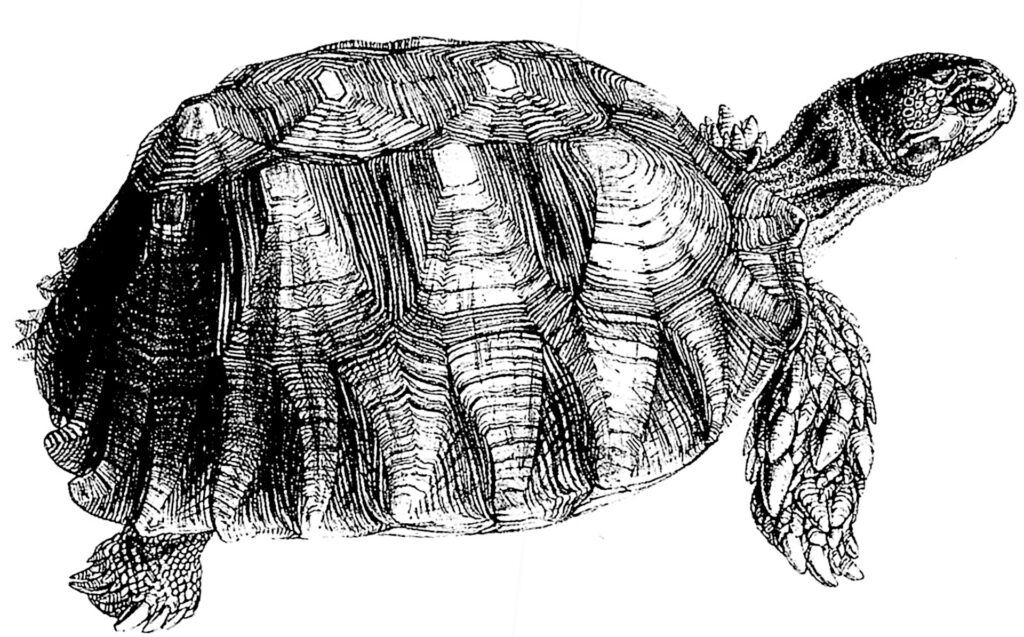
Tortoise and a man named Tela: a Yoruba tale
Wisdom Tale
Once there was a shortage of food throughout the land. Àjàpá the Tortoise, who was a very sensible animal, was friendly with a man named Tela. Tortoise was sick with hunger, because he didn’t know where he could get food. But Tela knew where he could get food. Now and again Tela went to this place, and got food and ate it there.
At last Tortoise said to Tela, “You look well-fed, but I get nothing to eat. You are my friend, yet you never show me where you get food.”
“I thought of taking you,” said Tela, “but I know you to be very clever. I fear that you will go to my place without my permission. Because of that, I have not told you.”
Tortoise kept asking, though, and at last Tela promised to take him to the place. When they got to the place, Tortoise saw it was just a rock. But Tela sang:
“This rock must open because I, Prince Tela, the owner of the house have come!”
Then the rock opened and Tela and Tortoise went inside. They found plenty of food, and they ate until they were full. After they had finished, they left the place, each going to his own home.
The next day Tela was away from home. So Tortoise went all around the countryside, inviting all the people to come to Tela’s place to get food. When everyone arrived at the place, Tortoise sang:
“This rock must open because I, Prince Tela, the owner of the house have come!”
The rock did not know that it was not Tela who sang, but Tortoise. So the rock opened, all the animals went inside, and they finished all the food in the store.
When they had finished eating, Tortoise said, “I will be the last to go.” But just as Tortoise was leaving, the rock closed and trapped him, half in and half out.
Just then, Tela felt hungry. When he got to the rock, he saw the head of Tortoise sticking. Tela said, “How is it that I find you here? When I brought you here the day before yesterday you promised you would not come, but now you have come, and from all the footprints in the dirt it looks like you brought friends with you.”
But Tortoise was in pain, and said only, “Get me out and don’t talk.” Tela, being hungry, commenced to sing:
“This rock must open because I, Prince Tela, the owner of the house have come!”
Just as before, the rock opened. Now Tela was very hungry, and because of the food he thought lay before him, did not stop to talk with Tortoise. But when Tela went in, he saw that all was eaten, and nothing was left.
Tela was so angry that he caught Tortoise up and was about to crush him. “Have patience and I will tell you all,” said Tortoise, and he told the entire story. And Tortoise added, “I have to admit that there is something that always makes me tell things I ought not to tell.”
“I have no time for this sort of thing,” said angry, hungry Tela. He dropped Tortoise on the rock and smashed his shell all to pieces.
Then the big ants and other insects gathered round, and tried to put Tortoise together again. They did the best they could, but they could not mend his back properly. So it is that the joints where the insects mended the Tortoise show on his back to this day.
Source: John Parkinson, “Yoruba Folk-Lore,” African Affairs, vol. VIII, no. XXX, January 1909, pp. 180-181 doi.org/10.1093/oxfordjournals.afraf.a098993 — For a different version of this story, see The Yoruba Blog.
Tortoise and Elephant: a Yoruba tale
Wisdom Tale
This alo (tale) is about Tortoise and Elephant.
Tortoise one day told the other animals that he would ride Elephant, the way humans ride horses. But all the other animals said: “No, you can’t ride Elephant.”
Tortoise said, “Well, I will make a bet with you that I will ride Elephant into town.”
All the other animals agreed to the bet.
Tortoise went into the forest and met Elephant. He said, “Elephant, all the animals say you are too fat and too big to go into town.”
Hearing this, Elephant grew angry. He said, “The animals are fools. I do not go into town because I would rather stay in the forest. Besides, I do not know which path leads to town.”
“Oh, if that’s all,” said Tortoise, “you can come with me. I will show you the path that leads to town, and you can put all the other animals to shame.”
So Elephant followed along, and when they were near to town, Tortoise said: “Oh, Elephant, I am tired. Will you kindly allow me to get on your back?”
“Of course,” said Elephant. He knelt down, and Tortoise climbed up on his back. Then they continued along the path to town.
Then Tortoise said, “Elephant, you need to put on a good show when you get to town. So when I scratch your back, run. When I knock my head against your back, run faster. Then you will impress all the other animals.”
Elephant agreed that this sounded like a good idea.
When they came near the town, Tortoise scratched Elephant’s back. Elephant began to run. Next, Tortoise knocked Elephant’s back with his head. Elephant ran even faster.
The animals, when they saw this, were frightened. They went into their houses, but they looked out of their windows. And Tortoise called out to them: “Did I not say I would ride to town the way humans ride horses?”
“What do you mean that you ride me like humans ride horses?” said Elephant, growing angry.
“I am only praising you,” said Tortoise.
But Elephant saw the other animals laughing, and grew more angry. “I will throw you down on the hard stones here, and break you to pieces,” he cried.
“Yes, yes, that is right,” said Tortoise. “Throw me down here. That will be all right. Then I shall not be hurt. If you really wanted to kill me, you would carry me to a swamp. If you threw me in a swamp, I would die at once, for the mud and water would drown me.”
So Elephant ran to the swamp, and threw Tortoise into the mud. Then Elephant stretched out his foot to kick Tortoise, but Tortoise dived in the muddy water, and came up in another place.
The other animals were there, looking on, and Tortoise called out to them, “Did I not say I would ride Elephant the way humans ride horses?”
When Elephant found that he could not catch Tortoise, he ran back to the forest. There he said to the other elephants, “Do you know what Tortoise has done to me?” And he told the other elephants the story.
But the other elephants only said, “You were a fool to carry Tortoise to town.”
Since then Elephant has not come to town any more.
Source: Alfred Burdon Ellis, The Yoruba-speaking peoples of the Slave Coast of West Africa : their religion, manners, customs, laws, language, etc : with an appendix containing a comparison of the Tshi, Gã, Ęwe, and Yoruba languages (London: Chapmand and Hall, 1894), pp. 265-267.
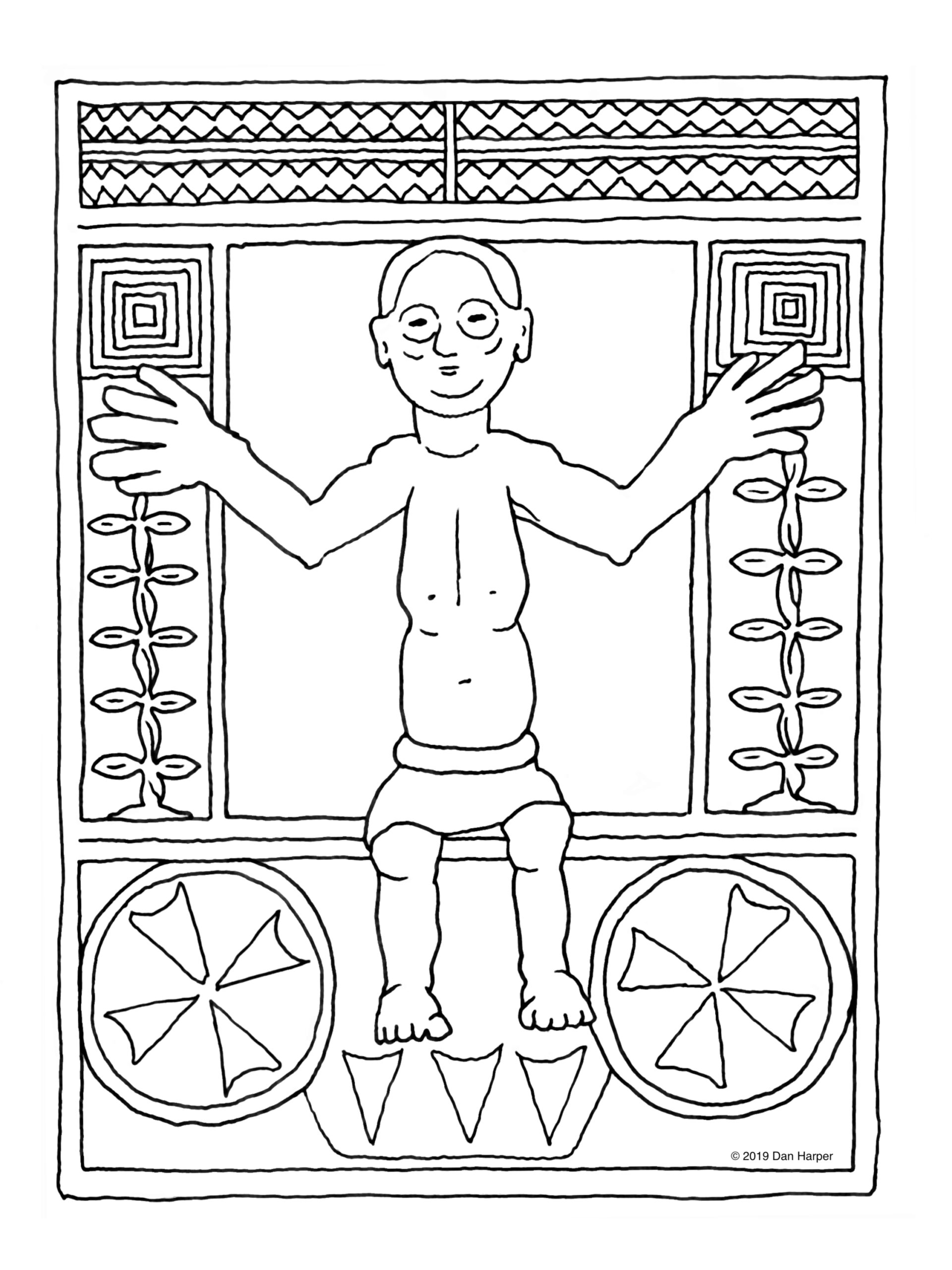
Spider and Nzambi Mpungu’s Heavenly Fire
Tales of Deities
First you must understand who Nzambi Mpungu is. He is the father of all things, and lives a happy life above the sky, where he has a many wives and beautiful children. He spends very little time thinking about us people here on earth, and since he is a good being there is no use in offering him worship or sacrifices. True, there are lesser gods and goddesses who can hurt us people here on earth, and to them we might offer worship and sacrefice, but Nzambi Mpungu will not mind, for he is not in the least jealous.
Now you may question whether Nzambi Mpungu actually exists. But there is a man still living, near the town of Loango, who says that one day, when it was thundering and lightning and raining very heavily, and when all the people in his village, being afraid, had hidden themselves in their houses, he alone was walking about. Suddenly, and at the moment of an extraordinarily vivid flash of lightning, after a very loud peal of thunder, he was seized and carried through space until he reached the roof of heaven, when it opened and allowed him to pass through to where Nzambi Mpungu lives.
There the man met Nzambi Mpungu, who cooked some food for him. Then Nzambi Mpungu showed the man his great plantations and rivers full of fish. Then Nzambu Mpungu left the man, telling him to help himself whenever he felt hungry. The man stayed there two or three weeks, and never had he had so much good food to eat. At last Nzambi Mpungu came to again, and asked the man whether he would like to remain there always, or whether he would like to return to the earth. The man said that he missed his friends, and would like to return to them, and Nzambi Mpungu sent him back to his family. So you see, Nzambi Mpungu does indeed live above the sky.
Nzambi, on the other hand, is Mother Earth. Some say she is Nzambi Mpungu’s first child. She is the great princess, a mighty ruler who governs all on earth. She has the spirit of rain, lightning, and thunder for her own use. She is a stern judge, and a fearsome ruler.
Now we can begin the story of how Spider almost married Nzambi’s daughter.
For Nzambi had a most delightful daughter whom anyone would have wanted to marry. But Nzambi swore that no earthly being should marry her daughter, unless they could bring her the heavenly fire from Nzambi Mpungu, who kept it somewhere in the heavens above the blue roof of sky.
The people all wondered who could ever bring the heavenly fire down to earth.
Then Spider said, “I will bring the heavenly fire to earth, but I will need help.”
“We will gladly help you,” said all the people, “if you will reward us for our help.”
So Spider climbed up to the blue roof of heaven, and dropped down again to the earth, leaving a strong silken thread firmly hanging from the roof to the earth below. Then he called to Tortoise, Woodpecker, Rat, and Sandfly, and bade them climb up the thread to the blue roof of sky.
When they got there, Woodpecker pecked a hole through the roof, and through this hole they all entered into the realm of Nzambi Mpungu, who, as it happens, was very badly dressed. Nzambi Mpungu received them courteously, and asked them what they wanted up there.
“O Nzambi Mpungu of the heavens above, great father of all the world,” they said, “we have come to fetch some of your terrible fire, to bring it down to Nzambi who rules upon earth.”
“Wait here then,” said Nzambi Mpungu, “while I go to my people and tell them of the message you bring.” But Sandfly followed Nzambi Mpungu without being seen, and heard all that was said.
While Sandfly was gone, the others talked among themselves, wondering if it were possible that someone who went around so badly dressed could be so powerful.
At last Nzambi Mpungu returned to them. “My friend,” he said to Spider, “how can I know that you have really come from the ruler of the earth, and that you are not impostors?”
“Nay,” said Spider and all the others, “put us to some test so we may prove our sincerity to you.”
“I will,” said Nzambi Mpungu. “Go down to this Earth of yours, and bring me a bundle of bamboos, so I can make myself a shed.”
Tortoise climbed all the way down to Earth, leaving the others where they were, and soon returned with the bamboo.
Nzambi Mpungu then said to Rat, “Get beneath this bundle of bamboo, and I will set fire to it. If you escape I shall surely know that Nzambi sent you.”
Rat did as he was told, and hid under the bundle of bamboo. Nzambi Mpurigu set fire to the bamboo, and lo! when they were entirely consumed, Rat came from amidst the ashes completely unharmed.
“Ah!” said Nzambi Mpungu. “You are indeed sent from Nzambi on Earth. I will go and consult my people again.”
Spider, Rat, Woodpecker, and Tortoise sent Sandfly after him, bidding him to keep well out of sight, to hear all that was said, and if possible to find out where the lightning was kept. Sandfly soon returned and told them all that he had heard and seen.
When Nzambi Mpungu came back a little later, he said, “Yes, I will give you the heavenly fire you ask for. But only if you can tell me where it is kept.”
Spider said, “Give me then, O Nzambi Mpungu, one of the five cases that you keep in the hen-house.”
“Truly, you have answered me correctly, O Spider!” said Nzambi Mpungu. “Take this case, and give it to your Nzambi.”
Tortoise carried the heavy case containing the heavenly fire down to the earth. When they got to Nzambi’s house, Spider presented the fire from heaven to her. True to her word, Nzambi agreed to let Spider marry her delightful daughter.
But Woodpecker grumbled, saying, “Surely your daughter is mine, for I was the one who pecked the hole through the roof, without which the others never could have entered the kingdom of the Nzambi Mpungu.”
“No, she is mine,” said Rat. “For I risked my life among the burning bamboo.”
“Nay, O Nzambi, she is mine,” said Sandfly. “For without my help the others would never have found out where the fire was kept.”
And Tortoise complained that he was the one who had to return to Earth to fetch the bamboo, and then had to carry the heavy case down to Earth, so of course the daughter should be married to him.
After listening to them all, Nzambi said: “Nay, Spider was the one who planned how to bring me the heavenly fire, and he has indeed brought it. By rights, my daughter should be married to him. But I know you others will make her life miserable if I allow her to marry Spider. Since she cannot marry all of you, I will not allow her to marry any of you. But I will give you her value” — for the people Nzambi ruled customarily gave presents when one of their children married.
Nzambi then paid fifty bolts of cloth each to Tortoise, Rat, Woodpecker, Sandfly, and Spider.
As for the daughter, she never married, and stayed with Nzambi for the rest of her days.
Source: Adapted from Richard Edward Dennett, Notes on the Folklore of the Fjort (French Congo), London: Folk-lore Society, 1898, pp. 74-76 and 131-135.
STORIES FROM THE AFRICAN DIASPORA
The Golden Chain: a tale of the African diaspora
Myth, Tales of Deities
The Yoruba peoples have lived in West Africa for more than fifteen hundred years. They were perhaps the most advanced civilization in Africa for much of their history; both their art and technology were superior to their neighbors.
During the years when West African peoples were captured and sold into slavery, there were many Yoruba people who were sold into slavery in North and South America and in the Caribbean islands. The Yoruba people brought their religious traditions to the Americas, and continued to worship their own gods and goddesses.
The Yoruba religions adapted some parts of Christianity, which was the religion of their masters, into their own religion. They may have done this to help keep their own religion secret from their masters.
Over time, the Yoruba religion came to be known by different names in different places. It is called Santeria in the Caribbean, Vodoun in Haiti, Candomble in Brazil, and Oyotunji in the United States. But all these different traditions give devotion to the orishas. An orisha is a heavenly being, like a god or goddess. Each orisha is identified with a Roman Catholic saint.
Olorun is the highest god, but human beings do not have direct contact with Olorun. Instead, human beings find ways of contacting the orishas, who in turn can contact Olorun. When a person needs help, she or he will visit a diviner who will offer advice on what to do. Often, the diviner will read the palm nuts, a traditional way of connecting with the orishas. Human beings also “make ebo” — offer sacrifices — at the shrine of one of the orishas, seeking the support and help of that ebo.
The following story is one of many creation stories told by the followers of the orishas.
***
Long ago, well before there were any people, all life existed in the sky. Olorun lived in the sky, and with Olorun were many orishas. There were both male and female orishas, but Olorun transcended male and female and was the all-powerful supreme being. Olorun and the orishas lived around a young baobab tree. Around the baobab tree the orishas found everything they needed for their lives, and in fact they wore beautiful clothes and gold jewelry. Olorun told them that all the vast sky was theirs to explore. All the orishas save one, however, were content to stay near the baobab tree.
Obatala was the curious orisha who wasn’t content to live blissfully by the baobab tree. Like all orishas, he had certain powers, and he wanted to put them to use. As he pondered what to do, he looked far down through the mists below the sky. As he looked and looked, he began to realize that there was a vast empty ocean below the mist. Obatala went to Olorun and asked Olorun to let him make something solid in the waters below. That way there could be beings that Obatala and the orishas could help with their powers.
Touched by Obatala’s desire to do something constructive, Olorun agreed to send Obatala to the watery world below. Obatala then asked Orunmila, the orisha who knows the future, what he should do to prepare for his mission. Orunmila brought out a sacred tray and sprinkled the powder of baobab roots on it. He tossed sixteen palm kernels onto the tray and studied the marks and tracks they made on the powder. He did this eight times, each time carefully observing the patterns. Finally he told Obatala to prepare a chain of gold, and to gather sand, palm nuts, and maize. He also told Obatala to get the sacred egg carrying the personalities of all the orishas.
Obatala went to his fellow orishas to ask for their gold, and they all gave him all the gold they had. He took this to the goldsmith, who melted all the jewelry to make the links of the golden chain. When Obatala realized that the goldsmith had made all the gold into links, he had the goldsmith melt a few of them back down to make a hook for the end of the chain.
Meanwhile, as Orunmila had told him, Obatala gathered all the sand in the sky and put it in an empty snail shell, and in with it he added a little baobab powder. He put that in his pack, along with palm nuts, maize, and other seeds that he found around the baobab tree. He wrapped the egg in his shirt, close to his chest so that it would be warm during his journey.
Obatala hooked the chain into the sky, and he began to climb down the chain. For seven days he went down and down, until finally he reached the end of the chain. He hung at its end, not sure what to do, and he looked and listened for any clue. Finally he heard Orunmila, the seer, calling to him to use the sand. He took the shell from his pack and poured out the sand into the water below. The sand hit the water, and to his surprise it spread and solidified to make a vast land. Still unsure what to do, Obatala hung from the end of the chain until his heart pounded so much that the egg cracked. From it flew Sankofa, the bird bearing the sprits of all the orishas. Like a storm, they blew the sand to make dunes and hills and lowlands, giving it character just as the orishas themselves have character.
Finally Obatala let go of the chain and dropped to this new land, which he called “Ife”, the place that divides the waters. Soon he began to explore this land, and as he did so he scattered the seeds from his pack, and as he walked the seeds began to grow behind him, so that the land turned green in his wake.
After walking a long time, Obatala grew thirsty and stopped at a small pond. As he bent over the water, he saw his reflection and was pleased. He took some clay from the edge of the pond and began to mold it into the shape he had seen in the reflection. He finished that one and began another, and before long he had made many of these bodies from the dark earth at the pond’s side. By then he was even thirstier than before, and he took juice from the newly-grown palm trees and it fermented into palm wine. He drank this, and drank some more, and soon he was intoxicated. He returned to his work of making more forms from the edge of the pond, but now he wasn’t careful and made some without eyes or some with misshapen limbs. He thought they all were beautiful, although later he realized that he had erred in drinking the wine and vowed to not do so again.
Before long, Olorun dispatched Chameleon down the golden chain to check on Obatala’s progress. Chameleon reported Obatala’s disappointment at making figures that had form but no life. Gathering gasses from the space beyond the sky, Olorun sparked the gasses into an explosion that he shaped into a fireball. He sent that fireball to Ife, where it dried the lands that were still wet and began to bake the clay figures that Obatala had made. The fireball even set the earth to spinning, as it still does today. Olorun then blew his breath across Ife, and Obatala’s figures slowly came to life as the first people of Ife.
Source: This creation story comes from the Yoruba people of Nigeria, Togo and Benin. In the religion of the Yoruba, the supreme being is Olorun, and assisting Olorun are a number of heavenly entities called orishas. This story was written down by David A. Anderson/ Sankofa, who learned it from his father, who learned it from his mother, and so on back through the Yoruba people and through time. See: The Origin of Life on Earth: An African Creation Myth. by David A. Anderson/Sankofa (Mt. Airy, Maryland: Sights Productions, 1991), 31 p. [Folio PZ8.1.A543 Or 1991].