Stories for liberal religious kids, drawn from a wide variety of religious and spiritual traditions.
- Stories labeled “Wisdom Tale” teach life lessons.
- Stories labeled “Spiritual Tale” have a spiritual purpose (which can seem alien to Westerners).
- Stories labeled “Tale of Deities” tell about the attributes and characters of gods/goddesses/divine beings.
- Stories labeled “Myth” explain or describe some natural phenomenon.
The stories on these pages were originally written for a variety of
purposes — worship services, classes, or just for fun. You should adapt
them to whatever situation you want to use them in.
Copyright: Please respect copyright. For just one example, if you use one of my copyright-protected stories in a webcast or recording, I ask that you give me credit for the story (e.g., “This story is copyright by Dan Harper”). You do not have to give me credit in educational settings or at home.
Cultural appropriateness: When I wrote these stories, I worked from the most culturally appropriate sources I could find, and I attempted to retain the distinctive flavor of the original religion/culture of each story. You will have to decide how you want to present other religious traditions where they conflict with modern Western sensibilities, whether you will cover over religious differences or not. Some examples of what I mean: Will you acknowledge that most Christians believe Jesus is divine? Will you adhere to twenty-first century politically liberal understandings of gender, or acknowledge diverse understandings of gender? You will have to judge for yourself, based on the needs of your class or local congregation.
Table of Contents
STORIES FROM THE HEBREW BIBLE
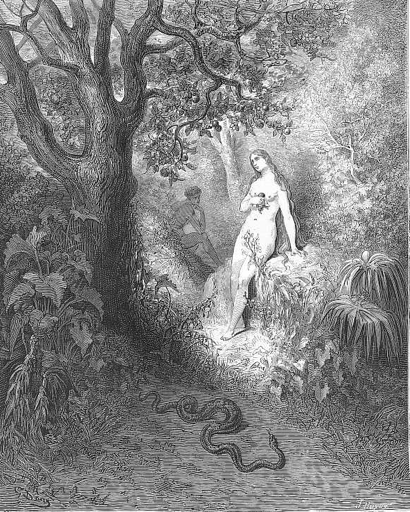
The Garden of Eden
Tales of Deities, Wisdom Tale
These are the beginnings of the heavens and the earth, when they were created.
In the day that Yahweh made the earth and the heavens, when no plant of the field was yet in the earth and no herb of the field had yet sprung up — for Yahweh had not caused it to rain upon the earth, and there was no one to till the ground; but a stream would rise from the earth, and water the whole face of the ground — then Yahweh formed a man (in Hebrew, “formed a man” is said adam), from the dust of the ground (which in Hebrew is said adamah). Yahweh breathed into the man’s nostrils the breath of life, and the man became a living being.
And Yahweh planted a garden in Eden, in the east; and there he put the man whom he had formed. Out of the ground Yahweh made to grow every tree that is pleasant to the sight and good for food, the tree of life also in the midst of the garden, and the tree of the knowledge of good and evil.
A river flows out of Eden to water the garden, and from there it divides and becomes four branches. The name of the first is Pishon; it is the one that flows around the whole land of Havilah, where there is gold; and the gold of that land is good; and there are precious stones there. The name of the second river is Gihon; it is the one that flows around the whole land of Cush. The name of the third river is Tigris, which flows east of Assyria. And the fourth river is the Euphrates.
Yahweh took the man and put him in the garden of Eden to till it and keep it (the name “Eden” means “pleasure and delight”). And Yahweh commanded the man, “You may freely eat of every tree of the garden; but of the tree of the knowledge of good and evil you shall not eat, for in the day that you eat of it you shall die.”
Then Yahweh said, “It is not good that the man should be alone; I will make him a helper as his partner.” So out of the ground Yahweh formed every animal of the field and every bird of the air, and brought them to the man to see what he would call them; and whatever the man called every living creature, that was its name. The man gave names to all cattle, and to the birds of the air, and to every animal of the field; but for the man there was not a helper to be his partner.
So Yahweh caused a deep sleep to fall upon the man, and he slept. Then Yahweh took one of the man’s ribs out, and closed up its place with flesh. Yahweh made the rib that had been taken from the man into a female human being, a woman, and brought her to the man.
The man said, “This at last is bone of my bones and flesh of my flesh; this one shall be called Woman (which in Hebrew is said ishshah), for out of a man (which is Hebrew is said ish) this one was taken.”
Therefore a man leaves his father and his mother and clings to his wife, and they become one flesh. And the man and his wife were both naked, and were not ashamed.
Now the serpent was more crafty than any other wild animal that Yahweh had made. He said to the woman, “Did Yahweh say, ‘You shall not eat from any tree in the garden’?”
The woman said to the serpent, “We may eat of the fruit of the trees in the garden; but Yahweh said, ‘You shall not eat of the fruit of the tree that is in the middle of the garden, nor shall you touch it, or you shall die.’”
But the serpent said to the woman, “You will not die; for Yahweh knows that when you eat of it your eyes will be opened, and you will be like Yahweh, knowing good and evil.”
So when the woman saw that the tree was good for food, and that it was a delight to the eyes, and that the tree was to be desired to make one wise, she took of its fruit and ate; and she also gave some to her husband, who was with her, and he ate. Then the eyes of both were opened, and they knew that they were naked; and they sewed fig leaves together and made loincloths for themselves.
They heard the sound of Yahweh walking in the garden at the time of the evening breeze, and the man and his wife hid themselves from the presence of Yahweh among the trees of the garden.
But Yahweh called to the man, and said to him, “Where are you?”
The man said, “I heard the sound of you in the garden, and I was afraid, because I was naked; and I hid myself.”
Yahweh said, “Who told you that you were naked? Have you eaten from the tree of which I commanded you not to eat?”
The man said, “The woman whom you gave to be with me, she gave me fruit from the tree, and I ate.”
Then Yahweh said to the woman, “What is this that you have done?”
The woman said, “The serpent tricked me, and I ate.”
Yahweh said to the serpent, “Because you have done this, cursed are you among all animals and among all wild creatures; upon your belly you shall go, and dust you shall eat all the days of your life. I will put enmity between you and the woman, and between your offspring and hers; he will strike your head, and you will strike his heel.”
To the woman, Yahweh said, “I will greatly increase your pangs in childbearing; in pain you shall bring forth children, yet your desire shall be for your husband, and he shall rule over you.”
And to the man, Yahweh said, “Because you have listened to the voice of your wife, and have eaten of the tree about which I commanded you, ‘You shall not eat of it,’ cursed is the ground because of you; in toil you shall eat of it all the days of your life; thorns and thistles it shall bring forth for you; and you shall eat the plants of the field. By the sweat of your face you shall eat bread until you return to the ground, for out of it you were taken; you are dust, and to dust you shall return.”
The man named his wife Eve, because she was the mother of all living (in Hebrew, “Eve” resembles the word for living). And Yahweh made garments of skins for the man and for his wife, and clothed them.
Then Yahweh said, “See, the man has become like one of us, knowing good and evil; and now, he might reach out his hand and take also from the tree of life, and eat, and live forever.”
Therefore Yahweh sent the man forth from the garden of Eden, to till the ground from which he was taken. He drove out the man; and at the east of the garden of Eden he placed the cherubim, who were angelic guardians of fearsome appearance, wielding swords that flamed and turned to guard the way to the tree of life.
Source: Hebrew Bible, Genesis 2.4-3.24. With reference to the feminist interpretation of Rev. Ellen Spero.
David and Goliath
Wisdom Tale
Once upon a time there was a shepherd named David. His three older brothers went off to fight in the army of Israel, under the command of King Saul. But David stayed behind with their father, Jesse, in the town of Bethlehem.
One day after his brothers had been gone for forty days, David’s father said to him, “Go take this bread and cheese and corn to the camp where your brothers and the rest of the army are, and give all this to the captain of their company.”
When David got to the place where the army of Israel was, they were just getting ready to go to battle with the army of the Philistines.
A champion came out of the camp of the Philistine army, a man named Goliath. He was over nine feet tall. He had a helmet of brass on his head, and he was armed with a coat of mail, and he wore brass armor on his legs, and brass armor on his back. He carried a long spear, with an iron tip that weighed six hundred shekels.
He stood in the valley between the two armies, and called out to army of Israel. “Why are ye come to set your battle in array?” he shouted. “Am not I a Philistine, and ye servants of Saul? Choose a man from among you, and let him come down to me. If he be able to fight with me, and to kill me, then we will be your servants. But if I prevail against him, and kill him, then you shall all be our servants, and serve us.”
When Saul and the army of Israel heard Goliath’s challenge, they were greatly afraid.
David came up to the army of Israel right after Goliath has issued his challenge. All the men in the army were talking about it. “Have you seen this man who has come up from the army of the Philistines?” they said. “King Saul has promised that if any man dares to take Goliath’s challenge, and also manages to kill Goliath, the king will give that man great riches, and give him the princess in marriage.”
Eliab, David’s eldest brother, saw David just then. “What are you doing here?” said his brother angrily. “I know your pride, and the naughtiness of your heart. You just came down so that you could watch the battle.”
David told Eliab that their father had sent him. “And now that I’m here,” he said, “I will go and fight this Goliath.”
Saul heard that David said he would fight Goliath. So Saul sent for David. But when he saw how young David was, he said, “You are not able to fight Goliath.”
“I have watched my father’s sheep,” said David, “and when a lion and a bear came and took a lamb from the flock, I went after them. I took the lion by his beard and killed him; and I killed the bear; and I can kill this Goliath too.”
Saul gave David a helmet made of brass, and a sword to buckle around his waist. But David took off the helmet and the sword. He took his shepherd’s staff, and he took five smooth stones from the brook, and he took his sling.
When Goliath, the Philistine, saw David, the shepherd, he laughed. “Come to me,” said Goliath, “and I will give leave you dead for the vultures to feed upon.”
“You come with a sword and a shield,” said David. “But I come in the name of Adonai, the god of Israel. Adonai will deliver you into my hand, and I will leave you dead for the vultures to feed upon.”
Goliath arose and started walking forward to meet David. David put his hand in his bag and took one of the five smooth stones. He ran ahead to meet Goliath, put the stone in his sling, and using his sling hit Goliath right in the forehead, and Goliath fell down dead.
When David returned, he was taken to Saul, and Saul adopted him as one of his own sons. And David became best friends with Saul’s own son, Jonathan.
Source: Hebrew Bible, 1 Samuel 18.
Saul and David
Wisdom Tale
Once upon a time there lived a good and holy man named Samuel. Samuel lived in the land of Israel, and he knew that Israel needed a good and strong leader. Samuel decided that Saul, son of Kish, would be the best person to rule over Israel, and so he anointed Saul king, and then served Saul as a holy man and an advisor.
Saul was a handsome man. There was not a man among all the people of Israel who was as handsome as he, and he was so tall that he stood head and shoulders over everyone else.
Saul was a likeable man. When he was a boy, he was easy-going and treated his parents with respect. When he became a man, he remained easy-going and friendly.
But even though he was handsome and likeable, every once in a while Saul would fall into a dark mood; more than just a bad mood, when Saul fell into one of these dark moods, the light went out of hid eyes. When he was in one of his dark moods, he didn’t want to talk with anyone, he just wanted to stay by himself in his throne room. When he was in one of his dark moods, sometimes he would do things that were dangerous or foolish.
One day Samuel sent Saul off to do battle with the evil tribe of the Amakelites. Samuel warned Saul that if he won the battle, he must slaughter all the Amakelites’ cattle. For their cattle was diseased, and if Saul brought the diseased cattle back to Israel, all the cattle of Israel would grow sick and soon die.
Saul fought the battle, and he won. But alas, after the battle he fell into one of his dark moods. He forgot what Samuel had told him, and he brought all the diseased cattle back to Israel.
Samuel met him, and cried out, “What is all this lowing of cattle that I hear?”
Suddenly Saul remembered what Samuel had him — but it was too late. Saul worried that Samuel could no longer trust him, and his mood grew even darker.
Samuel saw that Saul kept falling into these dark moods. He feared that Saul’s moods were growing worse and worse, and might some day overcome Saul entirely. So he decided to find a successor for Saul.
Samuel found David, the son of Jesse. David was a shepherd, he was short and cheerful, with red hair and bright eyes. Samuel anointed David in secret, and told David that soon he be the next king of Israel.
Saul knew none of this. But soon he fell into one of his dark moods again. His servants said, “One of your dark moods has come again! Command us to go and find someone to come an play beautiful music for you. The music will ease your pain and lighten your mood.”
One of the servants said, “I know a young man named David, the son of Jesse. He plays beautifully on the harp. He is also a warrior, and he doesn’t gossip.”
“Fetch him here,” said Saul.
So David came to live with King Saul, and his music helped to soothe the king when one of his dark moods came upon him.
But Saul’s dark moods got worse and worse, and they came more and more frequently. Sometimes Saul wouldn’t recognize David, and several times he tried to kill him. Finally, it got so bad that David had to leave the king, and go live in the wilderness….
Source: Hebrew Bible, 1 Samuel 10-16, 31; 2 Samuel 1-3. The notion that Saul’s dark moods might have been a form of mental illness comes from lectures given by Carole Fontaine, professor of Hebrew Bible, at Andover Newton Theological School in 1997.
Abigail and David
Wisdom Tale
Once upon a time, long before he became a king, when David was still running away from King Saul, afraid that Saul would kill him, he and his six hundred followers travelled to the wilderness of Paran.
In Carmel, which was near the wilderness of Paran, there lived a rich man named Nabal, who owned three thousand sheep and a thousand goats. Nabal was married to a woman named Abigail, who was clever and beautiful. Nabal himself, however, was rude and ill-natured; his name meant “The Fool.”
In the wilderness, David heard that Nabal was shearing his sheep. He decided to send ten young men to Nabal. David said to them, “Go to Carmel, find Nabal, and give him my greetings. Say to him, ‘Peace be upon your peace be upon your household, peace to all you have.’ Tell him that we have been living here among his shepherds, and we have not attacked them, nor have we stolen anything from them;— we have only the best intentions towards him and all those who work for him. You will arrive at his household on a feast day, and ask him if he would please give whatever food and drink he might have on hand to me and all of us.” David knew that anyone who lived in that land would feel compelled by the laws of hospitality to give at least some food to a band of men living in the wilderness.
David’s ten young men went to see Nabal the Fool, and they politely passed on David’s greetings, and his request for hospitality. But Nabal spoke to them harshly.
“Who is this David?” he said. “There are many servants who try to run away from their masters. Why should I take bread and meat and water away from the people who have been shearing my sheep, and give it to people who come from I know not where?”
When the ten young men came back to David and told him what had happened, he told four hundred of his men to strap on their swords.
“I protected his shepherds and everything else Nabal had in the wilderness, but for this good I did, he returned to me only evil,” said David. “Now we will go and kill every male in his household.”
They followed David towards Nabals’ house, while the remaining two hundred men stayed to guard the animals and the camp.
Meanwhile, one of the young men who worked for Nabal went to tell Abigail, Nabal’s wife, what had happened. The young man said that David had sent messengers to bring greetings to Nabal, but Nabal had only hurled insults at them. But, the young man said, when they had been out in the fields with Nabal’s sheep, David’s men had been good to them, and had even helped to protect them. And now David had decided to attack the household of Nabal, because Nabal was so bad-natured that no one can talk to him.
Abigail thought quickly. She ran and got two hundred loaves of bread, five sheep that had been butchered, one hundred clusters of raisins, two hundred cakes of figs, some grain, and some wine. She got her young men to load everything onto donkeys, and, without telling Nabal where she was going, she went along the mountain along the way she knew David would be taking.
When Abigail saw David, she got down from her donkey and hurried towards him. She fell to her knees, and bowed down before him.
“The guilt is mine alone,” she said. “My lord, please don’t take the words of ill-natured Nabal seriously. He is what his name says he is, a fool. I should have seen the young men you sent to our household, and then none of this would have happened.
“Now that I am here, there is no need to take vengeance, there is no need to shed blood. Please take all this food I have brought to you from Nabal’s household, and give it to your men.”
David listened to Abigail, and then said, “Blessed be your good sense, and blessed be you. If you hadn’t come to meet me, by the end of this morning my men and I would have killed every male in your household, and I would have incurred bloodguilt. Only Adonai, the God of the Israelites, is allowed to take vengeance. You have saved me from trying to take vengeance into my own hands.”
David and his men took everything Abigail brought to them. “See, I have done what you asked,” David said to her. “Go in peace.”
So Abigail went back to Nabal’s house. He was holding a feast, and he was very drunk, and acting very merry. Abigail waited until the next morning to tell him what had happened: that he had mortally insulted a band of six hundred warriors, warriors who had protected his shepherds, six hundred men to whom he at least owed ordinary hospitality. She told him how she had brought food to David and his men, and had intercepted them.
Nabal realized what a fool he had been, and his heart died within him. He became like a stone, and ten days later he died.
When David heard that Nabal had died, he sent messengers to Abigail, and asked her to marry him. And she agreed that she would marry him, and went off to live with David.
***
There is much more to the story of David, more than we have time for here….
At long last Saul was killed in battle, along with his son Jonathan. David cried when he heard that Saul had died, and that his best friend Jonathan had died, too. When Saul was killed, Samuel had died, too, and no one remembered that David was supposed to be the next king after Saul.
But eventually David did become king of Israel, and sat, as he was meant to do, in the throne once occupied by his old friend Saul. He was not only a warrior and a musician, he is said to have written many great poems, some of which were collected in a book known as the Psalms. And although he made mistakes, David ruled so wisely that we still tell stories about him today.
Source: Hebrew Bible, 1 Samuel 25.2-42.
How Moses Gained Freedom from the Pharaoh
Tales of Deities
The God of Israel came down to speak to Moses, and told Moses to go to the Pharaoh king of Egypt, and say to Pharaoh, “Let my people go, let them go free.” Moses didn’t want to do this, but God said he had to, and he did.
Moses said to Pharaoh, “Let my people go!” But Pharaoh was a hard-hearted man, and wouldn’t let the Israelites, the Jews, go free. So with God’s help, Moses took his staff while Pharaoh was watching, lifted it up, and struck the water of the Nile River. Immediately all the water in the river turned to blood, and that made all the fish in the river die. It did not smell good. And because the Egyptians got their water from the Nile, they had a hard time getting enough water to drink, or to wash with.
Well, you think that would have been enough to convince Pharaoh not to fool around with Moses — and to not fool around with the God of the Israelites. But the Pharaoh was a hard-hearted man. Moses came to Pharaoh, and said, “Now will you let my people go?” But Pharaoh said no.
This time Moses stretched out his staff over the river, the ponds and lakes and all the water, and with God’s help he let loose a plague of frogs. There were frogs everywhere! There were frogs in Pharaoh’s palace, frogs in everyone’s houses, frogs in people’s beds, so many frogs that the bakers put them into bread by mistake. Yuck! Bread with frogs in it. It tasted horrible.
Well, you think Pharaoh would have learned his lesson, but the Pharaoh was a hard-hearted man. Moses said, “Let my people go!” and Pharaoh just said, no.
This time Moses stretched out his staff and struck the dust of the earth, and with God’s help released a horde of gnats. Do you know what gnats are? They are little insects that bite you just like mosquitoes and when they bite you it’s just like a mosquito bite which swells up and itches, but gnats are so small you can’t see them. There were gnats everywhere, a plague of gnats, biting everyone all the time. It was most unpleasant.
Well, you think Pharaoh would have learned his lesson, but that Pharaoh was a hard-hearted man. Moses said, “Let my people go!” and Pharaoh just said, no.
So with God’s help, Moses sent a swarm of flies to plague the land. (If you’re keeping count, that’s the fourth plague Moses let loose on Egypt.) Flies everywhere! — on your food, in your eyes, everywhere.
But when Moses said, “Let my people go,” Pharaoh just said, no. So with God’s help Moses made all the cows and chickens and other livestock get sick. No milk to drink! No eggs to eat! (That’s number five.) Everyone got very hungry.
But when Moses said, “Let my people go,” Pharaoh just said, no. So with God’s help Moses made everyone in Egypt get pimples and boils that hurt like the dickens and looked nasty. (That’s number six.)
But when Moses said, “Let my people go,” Pharaoh just said, no. So with God’s help Moses let loose thunder and hail, big hailstones that damaged all the crops. (That’s number seven.)
But when Moses said, “Let my people go,” Pharaoh just said, no. So with God’s help Moses brought locusts into the country of Egypt. The locusts covered every inch of the land, and if there was anything left in the fields that the hail had not damaged, the locusts ate it up. (That’s number eight.) Now there was basically no food left to eat in all of Egypt.
But when Moses said, “Let my people go,” Pharaoh just said, no. So with God’s help Moses brought a dense darkness over the entire land of Egypt, except for little bits of light that were in the houses of the Israelites. (That’s number nine.)
But when Moses said, “Let my people go,” Pharaoh just said, no. This time, God said, “Moses, go tell Pharaoh that I, God, will make every first-born child die throughout the land of Egypt.” But God also told Moses that all the Jews should make a mark over their doors with the blood of a lamb, and that way God would know that God should pass over those houses, and not make the firstborn child die. That’s why it’s called Passover — God passed over the houses of the Israelites. (And that was the tenth, and the very worst, of the ten plagues.)
This time, when Moses went to Pharaoh and said, “Let my people go,” Pharaoh said, “Go! Go! You bring nothing but disaster to me and my kingdom.” But of course, it was all Pharaoh’s fault, because he should have set the Israelites free from slavery long before.
Source: Hebrew Bible, Exodus 7-11.
Moses and the Golden Calf
Tales of Deities
Moses and all the Israelites escaped from mean old Pharaoh, and Moses led them into the desert. They had to cross the desert, hot and dry, in order to get to the Promised Land, the place where they could live in peace and freedom.
They walked and they walked, day after day, for three whole months, until at last they reached Mount Sinai. They decided to camp there for a while, so they set up their tents.
Moses climbed up Mount Sinai, up to the very top, and while he was up there, the god sometimes known as Yahweh spoke to him. This god said to Moses, “All of you Israelites are going to be my special, chosen people. I will take care of you, and all you have to do is promise to obey me over all the other gods and goddesses.”
Moses agreed, and went back down Mount Sinai to tell the Israelites. All the Israelites had to do was to obey the god Yahweh, and Yahweh would take care of them. It’s always good to have a god looking out for you, so the Israelites agreed to obey this god.
Moses went back up Mount Sinai to report to the Yahweh. “They all promised to obey you,” Moses reported.
“Well, just to make sure,” said the god who was now the god of the ancient Israelites, “I’m going to appear at the top of this mountain as a dense dark cloud, filled with thunder and lightning. You come back up the mountain, I’ll talk with you, and then all the Israelites will know that I talk to you directly. That way they will trust you and listen to you.”
So Moses went back down Mount Sinai, and sure enough, the god of the Israelites appeared at the top of the mountain as a dense cloud. Moses went back up the mountain to talk with the god of the Israelites. All the other Israelites watched from the foot of the mountain.
Moses climbed up and up, and at last entered the dense cloud at the top of the mountain. The god of the Israelites started telling him about all the rules and laws the Israelites would have to obey. First of all, the god of the Israelites made ten laws against stealing, against murdering people, against lying. There was also a law saying the Israelites weren’t allowed to worship any other god or goddess. These first ten laws are sometimes called the “Ten Commandments.” Most of these laws still make sense, even today. And Moses went back down the mountain bringing those first ten laws to the Israelites.
Next day, Moses climbed back up the mountain for more laws. Yahweh gave him lots of laws. Some of these other laws sound strange to us today, like the law that said if one ox hurts another ox, the owner of the first ox has to sell it and divide the money with the owner of the second ox, and the owner of the second ox has to butcher it and divide the meat with the owner of the first ox. Yahweh had lots and lots of laws and rules for Moses to bring to the Israelites. Moses had to climb up and down that mountain quite a few times.
Then came a time when Moses stayed on top of the mountain for a really long time. The rest of the Israelites finally deicded Yahweh had abandoned them, and Moses wasn’t coming back. The Israelites decided to make a new god. They took gold and made it into the shape of a calf — a golden calf. They thought their new calf looked pretty cool, and they invented new worship services for their new religion, and had a big party to celebrate.
Just as the party was really getting going, Moses came back down the mountain with more laws.
“What’s going on here?” Moses said. “Don’t you remember that you promised not to worship any other gods? And here you all are, having a party, and worshipping some new god. You guys broke your promise!”
The Israelites looked a little shamefaced at first, but then some of them pointed out that Moses had been gone for a long time. For all they knew, Moses’s god had given up on the Israelites and gone somewhere else with Moses.
“Who’s on my side?” said Moses angrily. “If you still like Yahweh better than the golden calf, come with me!” A few people joined him. Moses made sure they all had swords, and then told them to go and kill anyone who was still worshipping that golden calf.
And they did.
Source: Hebrew Bible, Exodus 32.
STORIES FROM THE TALMUD
The Backwards Alphabet
Wisdom Tale
One day, a man came to Rabbi Shamai to ask about becoming a Jew. Rabbi Shamai told him that if he wanted to become a Jew, he would have to learn the Torah, or the Jewish law.
The man asked, “Well then, how many types of Torah do you have?”
“We have two types of law, or Torah,” replied Rabbi Shamai. “We have the written Torah, and we have the oral Torah, the law as passed down by oral tradition.”
“I believe in the written Torah,” said the man. “But I don’t trust laws that are passed on by word of mouth. If laws aren’t written down, they are worthless. I will still become a Jew, on one condition: that you only teach me the written laws, but not the oral laws, not the spoken laws.”
Upon hearing this, Rabbi Shamai said that the man could never become a Jew, that he was disrespectful, and then Rabbi Shamai told the man to leave.
But the man still wanted to know about becoming a Jew, so he went to Rabbi Hillel.
Rabbi Hillel told him that if he wanted to become a Jew, he would have to learn Jewish laws — for example, he would have to learn the laws about eating kosher foods, and so on.
The man asked, “Well then, how many types of Torah do you have?”
“We have two types of law, or Torah,” replied Rabbi Shamai. “We have the written Torah, and we have the oral Torah, the law as passed down by oral tradition.”
“I believe in the written Torah,” said the man. “But I don’t trust laws that are passed on by word of mouth. If laws aren’t written down, they are worthless. I will still become a Jew, on one condition: that you only teach me the written laws, but not the oral laws.”
“Then I will accept you as a student,” said Rabbi Hillel. “First, you must learn how to read Hebrew, so I will teach you the 22 letters of the Hebrew alphabet. Repeat after me: aleph, bet, gimel, dalet, he, vav, zayin, khet, tet, yod, khaf, lamed, mem, nun, samekh, ayin, pe, tsadi, kuf, resh, shin, tav.”
The man repeated the entire Hebrew alphabet after Rabbi Hillel — “Aleph, bet, gimel, dalet,….” — until he had all the letters memorized.
The next day, the man came back to learn the written law from Rabbi Hillel. Rabbi Hillel said, “Let’s make sure you remember the 22 letters of the Hebrew alphabet. Repeat after me: tav, shin, resh, kuf, tsadi, pe, ayin, samekh, nun, mem, lamed, khaf, yod, tet, khet, zayin, vav, he, dalet, gimel, bet, aleph.”
The man looked confused. “But that’s not the way you taught them to me yesterday,” he said.
“Yes, that’s true,” said Rabbi Hillel, “and as you can see, you must learn to rely upon me and my teaching. In just the same way, you must learn to rely upon the spoken law.”
Source: Babylonian Talmud, Tractate Sabbath 31a.
Standing on One Foot
Wisdom Tale
A man came to talk with Rabbi Shamai, one of the most famous of all the rabbis, nearly as famous as Rabbi Hillel.
“I would like to convert to Judaism and become a Jew,” said the man. “But I don’t have much time. I know I have to learn the entire book you call the Torah, but you must teach it to me while I stand on one foot.”
The Torah is the most important Jewish book there is, and this crazy man wanted to learn it while standing on one foot? Why, people spent years learning the Torah; it was not something you can learn in five minutes! Rabbi Shamai grew angry with this man, and he pushed the man away using a builder’s yardstick he happened to be holding in his hand.
The man hurried away, and found Rabbi Hillel. “I would like to convert to Judaism and become a Jew,” said the man. “But I don’t have much time. I know I have to learn the entire book you call the Torah, but you must teach it to me while I stand on one foot.”
“Certainly,” said Rabbi Hillel. “Stand on one foot.”
The man balanced on one foot.
“Repeat after me,” said Rabbi Hillel. “What is hateful to you, don’t do that to someone else.”
The man repeated after Rabbi Hillel, “What is hateful to me, I won’t do that to someone else.”
“That is the whole law,” said Rabbi Hillel. “All the rest of the Torah, all the rest of the oral teaching, is there to help explain this simple law. Now, go and learn it so it is a part of you.”
Source: Babylonian Talmud, Tractate Sabbath 31a.
The Rabbi and the Basket of Grapes
Wisdom Tale
The Rabbis taught that if you are going to judge a case between two people, you must not accept any kind of money or gift from either person, you must not accept anything that might look like a bribe. You must show everyone that you will remain completely neutral, and completely honest.
Obviously, a judge should not accept money from either person in a lawsuit. But the rabbis taught that a judge must be so honest that he or she does not accept anything, no gifts, no favors, not even a kind word.
To show what they meant, they told this story:
Once upon a time, Rabbi Ishmael rented part of his land to a tenant-farmer. The tenant-farmer paid part of the rent by bringing fruits and vegetables to Rabbi Ishmael every Friday, the day before the Sabbath day.
But one week, the tenant-farmer brought some fruit to Rabbi Ishmael on a Thursday — a big basket full of luscious, ripe grapes. Rabbi Ishmael loved grapes, but before he took the basket he said, “Thank you for bringing the grapes, but why do you bring me grapes on a Thursday, instead of your regular day, Friday?”
“It’s like this, Rabbi,” said the tenant-farmer. “I have a lawsuit, and I would like you to be the judge for this lawsuit. And as long as I was coming up here to talk to you about being the judge, I thought I’d bring your regular weekly delivery of fruit. So I brought you your basket of grapes.”
“No, no,” said Rabbi Ishmael, “I cannot be your judge. Take the grapes back to your house, and I will go find two other rabbis to act as judge for you.”
Confused, the tenant-farmer took the basket of grapes back to his house, even though they were really Rabbi Ishmael’s grapes.
Rabbi Ishmael went out to find two other rabbis to act as judge in the lawsuit, and brought them to meet the tenant-farmer. The two other rabbis began to ask the tenant-farmer about the lawsuit, and the tenant-farmer answered as best he could.
Rabbi Ishmael stood to one side, watching and listening, and he thought to himself, “Why doesn’t the tenant-farmer give better answers?” At one point, Rabbi Ishmael was on the point of breaking in and telling the tenant-farmer what to say, but he caught himself in time.
“Look at what has happened to me,” said Rabbi Ishmael to himself. “Here I am, secretly hoping that the tenant-farmer will win his case, and I didn’t even accept a bribe. I didn’t even accept the grapes that were really mine, but came a day early. What would I have done if I had accepted a real gift, a real bribe!”
Source: Babylonian Talmud, Kethuboth 105b
The Fox and the Fish
Wisdom Tale, Spiritual Tale
Once upon a time, the wicked Roman government issued a decree: no more would the Jews be allowed to study the Torah and the law.
But Rabbi Akiva seemed to ignore the decree. He gathered people together quite openly, and taught them the Torah and the law. Pappas, the son of Judah, took him aside and said, “Rabbi Akiva, do know what could happen to you? Aren’t you afraid the Romans will punish you?”
“Let me tell you a story,” said Rabbi Akiva, and he told this story:
***
Once upon a time, there were many small fish who lived in a stream. One day, fox walked alongside the stream, and noticed that all the fish were darting to and fro, as if they were afraid of something.
“O fish, o fish,” said the fox, “why are you swimming around so? What is it that you are trying to escape?”
“We are trying to escape the nets that the humans have put in the stream to catch us,” said the fish.
“Oh, ho,” said the fox. “Then perhaps you should come up here and walk on dry land alongside me, just as your ancestors used to walk beside my ancestors years and years ago. That way you can escape from the nets of the humans.”
“What, go up on dry land!” said the fish indignantly. “You have a reputation for being smart, but that is a stupid thing to say. We may be afraid of what’s going on here in the water where we feel comfortable, but it would be much worse for us up in the thin air where we would surely die.” And so the fish stayed in the water, and did not try to walk beside the fox on dry land.
***
Rabbi Avika said, “Now you can see that we are just like the fish in the stream.”
Pappas asked the rabbi to explain.
“It’s like this,” said Rabbi Avika. “If we neglect the Torah, if we neglect what is central to our religion, we would be like fish out of water, and we would die. It is written in the Torah, ‘For that is your life and the length of your days.’ Perhaps we will suffer if we do study the Torah, but we know we will surely die if we don’t.”
Not long after that, the wicked Romans arrested Rabbi Akiva for teaching and studying the Torah. He was roughly thrown into the Roman prison, and there to his surprise he found Pappas.
“Pappas, what are you doing here?” asked Rabbi Akiva.
“O rabbi,” said Pappas, “you were right. I have been thrown into prison for nothing important. At least you have been thrown in prison for something worth dying for.”
And when Rabbi Akiva was killed by the Romans, he died in peace with the words of the Torah on his lips.
Source: Babylonian Talmud, Tractate Berakoth 61b
STORIES FROM THE CHRISTIAN SCRIPTURES
The Empty Jar
Spiritual Tale
Jesus and his followers were traveling from village to village in Judea so that Jesus could teach his message of love to whomever would hear it. They had spent the day in a village where some people wanted to hear what Jesus had to say, and many others didn’t seem to care. That evening, they stayed on the outskirts of the village, and as they were eating dinner, Jesus said, “Let me tell you what it will be like when the kingdom of heaven is finally established….”
Once upon a time [said Jesus], there was a woman, just an ordinary woman who happened to live in a very small village that had no marketplace of its own. At the harvest season, the crops having been gathered in, the woman decided to walk to a larger village, two or three miles away, where there was a market.
She started off early in the morning. She brought along some things her family had grown to sell in the market, and she brought along a large pottery jar with two big handles. Since she was an ordinary villager, or course she did not have fancy bronze jars, nor did she even have well-made pottery jars with pretty decorations. The potter who lived in her village was not very good at what he did, so her jars were without decoration, and not very well made.
She arrived at the marketplace, and sold everything she had brought. Then she purchased a large amount of meal, or coarsely-ground flour. She filled her jar with the meal, tied the handle with a strap of cloth, and slung the jar over her back.
The path home was steep and rough, and by now the day was hot. She walked along, putting one foot in front of the other, and she did not notice anything besides the heat and the rough path.
But one of the handles to the jar broke off, and the jar slowly tipped to one side. Bit by bit, the coarsely-ground flour spilled out on the path behind her. Bit by bit, the jar tipped even further. Before she reached home, all the flour in that jar had spilled out.
At last the woman reached home. She put the jar down, and discovered that it was empty. That is what the Kingdom of Heaven will be like.
Source: Adapted from the Gospel of Thomas, chapter 97.
How To Feed Five Thousand People
Spiritual Tale, Wisdom Tale
Once upon a time, Jesus and his disciples (that is, his closest followers) were trying to take a day off. Jesus had become very popular, and people just wouldn’t leave him alone. Jesus and the disciples wanted a little time away from the crowds that followed them everywhere, so they rented a boat and went to a lonely place, far from any village.
But people figured out where they were going, and by the time Jesus and his friends landed the boat, there were five thousand people waiting there for them. So Jesus started to teach them, and he talked to them for hours.
It started getting late, and the disciples of Jesus pulled him aside and said, “We need to send these people to one of the nearby villages to get some food.”
“No,” said Jesus. “The villages around here are too small to feed five thousand people. You will have to get them something to eat.”
“What do you mean?” his disciples said. “We don’t have enough money to go buy enough bread for all these people, and even if we did, how would we bring it all back here?”
“No, no,” said Jesus. “I don’t want you to go buy bread. Look, how many loaves of bread have we got right here?”
The disciples looked at the food they had brought with them. “We got five loaves of bread, and a couple of fried fish. That’s it.”
“That’ll be enough,” said Jesus.
His disciples looked at him as if he were crazy. There was no way that would be enough food for five thousand people!
But Jesus had spent the whole day teaching people about the Kingdom of God, teaching them that everyone is dependent on someone else. And while he was sitting up in front of the crowd teaching, he looked out and saw that many of the five thousand people had brought their own food with them. He watched them as they surreptitiously nibbled away at their own food, ignoring the fact that many of the people around them had no food at all.
Jesus told everyone to sit down on the grass. All five thousand people sat down. Jesus brought out the five loaves of bread. Being a good Jew, he blessed the bread using the traditional Jewish blessing: “Blessed are you, O Holy One, Creator of the universe, who brings forth bread from the earth.” Then, so everyone could see, Jesus broke the bread, and cut up the fish, and divided it up, so the disciples could hand it around.
Everyone saw that even though Jesus and his disciples had barely enough food for themselves, they were going to share it with everyone. From where he sat, Jesus could see the truth dawning in people’s eyes. All day long, Jesus had been teaching them that the Kingdom of Heaven existed here and now, if only people would recognize it. Now Jesus was giving them a chance to show they understood, and to act as if the Kingdom of Heaven truly existed.
The disciples began to pass around the bread and the fried fish, shaking their heads because they knew there wasn’t going to be enough food for everyone. Yet, miracle of miracles, there was plenty of food to go around. People who had food put some of their food into the baskets so it could be shared. People who hadn’t brought food with them took some food from the baskets. By the time the followers of Jesus had passed the baskets to all five thousand people, everyone had gotten enough to eat, and there was so much food left over that it filled twelve baskets.
And that’s the story of how Jesus fed five thousand people with just a few loaves of bread and a couple of fried fish. Many people believe that Jesus performed a magical miracle when he blessed the bread and fish, and that somehow God turned a dozen loaves of bread and two fish into thousands of loaves of bread and thousands of fried fish.
It’s easier to believe that God performed the miracle, than to believe that humans could perform the same miracle. Because if humans performed the miracle, that means we could do the same thing today: to share with those who need it, and to live as if the Kingdom of Heaven existed here and now.
Source: Christian scriptures, Mark 6.32-44. Theological interpretation inspired by Bernard Loomer, Unfoldings (Berkeley, Calif.: 1985), pp. 3 ff.; and Latin American liberation theology.
Two Miracle Birth Stories of Jesus of Nazareth
Tales of Deities
Although the story of the miracle birth of Jesus is usually told as one story, actually we have two different stories about his birth, stories that are quite different from each other. The first story tells about the miraculous star and the visit of the Magi; the second tells of angels, shepherds, and the stable.
1. The Star and the Magi
The birth of Jesus happened in this way:
When Mary was engaged to Joseph, but before they lived together, she was found to be pregnant with a child. Then Joseph, being a just man, and not wanting to make a public example of her, was minded to put her away from him quietly.
But while he thought about it, an angel of Adonai, the God of the Israelites, appeared to him in a dream, and said, “Joseph, you son of David, do not fear to take Mary as your wife; for her child is from the Holy Spirit. She will bring forth a son, and you shall call him ‘Jesus,’ for he will save his people from their sins.”
All this happened to fulfill that which God said through the ancient prophet: “A virgin shall be with child, and she shall bring forth a son, and they shall call him ‘Emmanuel’,” which means, “God is with us.”
When Joseph awakened, he did as the angel of God had bid him do: he took Mary as his wife, but did not sleep with her until she had given birth to her firstborn son. And they named the baby “Jesus.”
Traditionally, the next part of the story happens on the holiday of Epiphany, which is on January 6, twelve days after Christmas. But most people include it with the Christmas story, so we will tell it here:
When Jesus was born in Bethlehem of Judea, in the days of Herod the king, Magi came to Jerusalem from the east. They said, “Where is he that is born King of the Jews? for we have seen his star in the east, and have come to pay him homage.”
When King Herod heard this, he was frightened, and all Jerusalem was frightened with him. He called together all the chief priests and scribes of the people, and he demanded of them where this Messiah was to be born.
They said to him, “In Bethlehem, in the land of Judea, for the prophet said: ‘And thou Bethlehem, in the land of Judah, art not the least among the princes of Judah: for out of thee shall come a Governor, that shall rule my people Israel.’”
Herod secretly called the wise men, and asked them what time the star had appeared. Then he sent them to Bethlehem, saying, “Go and search for the young child, and when you have found him, bring me word again, that I too might go and pay him homage.”
When they heard the king, the wise men departed. And the star, which they saw in the east, went before them, till it came and stood over where the young child was. When they saw the star, they rejoiced. They went into the house, and saw the young child with Mary, his mother. They knelt down, and paid him homage. When they had opened their treasure chests, they gave him gifts: gold, and frankincense, and myrrh.
God came to them in a dream, and warned them that they should not return to Herod. So they departed to their own country by another road.
Source: Christian scriptures, Matthew 1.18-2.12, using the beautiful original language of the King James Version translation whenever possible; checked against the more accurate New Revised Standard Version translation.
2. What Angels Told to Shepherds
A decree went out from the Emperor, Caesar Augustus, that all the world should be registered and taxed. This happened while Cyrenius was the governor of Syria.
Everyone went to be registered and taxed, each one into his own city. Joseph also went up from the city of Nazareth in Galilee, into the city of David called Bethlehem in Judea; he went there because he was of the family of David. He went to be registered with Mary, to whom he was betrothed to be married; and Mary was great with child.
And so it was, that, when they were in Bethlehem, it came time for Mary to deliver her child. She gave birth to her firstborn son, and she wrapped him in swaddling clothes, and she laid him in a manger; they had to stay in a stable because there was no room for them in the inn.
In that same country there were shepherds in the fields, keeping watch over their flock at night. An angel of Adonai, the God of the Israelites came upon them, and the glory of Adonai shone around them, and they were very afraid.
The angel said to them, “Fear not: for see, I bring you good tidings of great joy for all people; for to you is born this day in the city of David a savior, who is the Messiah. This shall be a sign to you: you shall find the babe wrapped in swaddling clothes, and lying in a manger.”
And suddenly there was with the angel a multitude of the heavenly host, praising God, and saying, “Glory to God in the highest, and on earth peace, and good will toward all people.”
When the angels had gone away from them into heaven, the shepherds said to one another, “Let us now go into Bethlehem, and see this thing which has happened, which God has made known to us.”
They went with haste, and they found Mary and Joseph, and the baby lying in the manger. When they had seen this, they told everyone what had been told to them about this child; and everyone who heard it wondered at the things which the shepherds told them.
Mary treasured what they told her, and pondered them in her heart. The shepherds returned to their fields, glorifying and praising God for all the things they had heard and seen, as it had been told to them.
Source: Christian scriptures, Luke 2.1-52, using the beautiful original language of the King James Version translation whenever possible; checked against the more accurate New Revised Standard Version translation.
The Story of Palm Sunday
Spiritual Tale
Perhaps you have heard of Palm Sunday, but aren’t quite sure what Palm Sunday is. This is the story of Palm Sunday as I learned it when I was a Unitarian Universalist child. This story took place two thousand years ago, and today different people tell many different versions of this story. But this is the story as I heard it.
***
Once upon a time, there was a Jewish teacher named Jesus. Jesus lived in a land called Judea, and he went from town to town teaching about religion. Jesus wasn’t an official Jewish religious leader, as the Pharisees were. Many people listened to his teachings anyway, probably because he treated everyone with respect, even people who were poor or homeless or sick. People also liked to listen to Jesus because what he said made so much sense. He said religion was simple:— love your God with all your heart and all your mind, and treat other people the way you would like to be treated.
Jesus taught in the countryside, not in the great city of Jerusalem. But at last he and his followers (who were called the disciples) decided they would go to Jerusalem for Passover. Just as it is now, Jerusalem was the most important city for Jews, and celebrating Passover in Jerusalem was especially meaningful for anyone who was Jewish.
They left the town they were in, a town called Jericho, and began to walk to Jerusalem. There were no cars or planes or trains in those days (even if there had been they would have been too poor to take them), so Jesus and his disciples had to walk all the way to Jerusalem. But Jesus was tired. He had been teaching and healing sick people and he was just plain worn out. He was so tired that when they all got close to Jerusalem, Jesus asked his disciples to see if they could find an animal for him to ride. The disciples managed to find someone who loaned them a foal for Jesus to ride.
There were crowds and crowds of people on the way in to Jerusalem for Passover. Quite a few of the people had seen Jesus before, and had heard his teachings about religion. Some of these people thought Jesus was the greatest religious teacher and leader around. They began to point at Jesus, and call out to him.
All these people were pouring in to Jerusalem for Passover, one of the most sacred days of the year for Jews. Someone began to sing a hymn that seemed to fit what they were doing, and other people joined in. They sang:
Enter into the gates with thanksgiving
And into the courts with praise.
Serve God with gladness,
Come before God’s presence with singing.
Blessed are those who come in the name of Adonai, our god!
People were in a happy, festive mood. They gathered flowers, and picked leaves from palm trees, and carried them along. Someone started singing again:
Hosanna! Hosanna!
Enter into God’s gates with thanksgiving,
And into God’s courts with praise.
Blessed are those who come in the name of Adonai, our God!
All these people singing and walking into Jerusalem together! Someone who thought Jesus was a great religious teacher and leader gave him flowers, and suddenly lots of people were giving him flowers, and lots more people were waving palm leaves over him.
I think at this point Jesus became uncomfortable. He didn’t mind that people liked him. He didn’t mind that they thought that he was a good religious teacher. But the singing, and people giving him flowers and waving palm leaves over him,— those were the kinds of things that people did for new kings of Jerusalem, back in the olden times, hundreds of years before Jesus lived. In Jesus’ time, the Romans were the rulers of Jerusalem. It was dangerous for these people to treat Jesus like one of the kings of old. Could some of the people hope that Jesus would stand up to the Romans, or even rebel against them? Jesus knew that it was dangerous for them to even think about such things. Would the Romans believe that someone was planning a rebellion? As Jesus rode into Jerusalem with all the people waving palm leaves over him, he began to think about how the Romans might react.
***
Now you know why Palm Sunday is called Palm Sunday: it celebrates the day that Jesus entered Jerusalem while the crowds waved palm leaves over him.
Source: Christian scriptures, Mark 14-16, with reference to Matthew and Luke.
Jesus in Jerusalem
Spiritual Tale, Tales of Deities
On the first day after he arrived in Jerusalem, Jesus did little more than look around in the great Temple of Jerusalem; the Temple that was the holiest place for Jesus and for all other Jews. Jesus couldn’t help but see that around the edges of the Temple there were people selling everything from goats to pigeons, and other people who would change money for you, for a fee. Besides that, Jesus saw all kinds of people coming and going, taking shortcuts by going through the Temple, carrying all kinds of gear and equipment and baskets. But on that first day, he and his followers just watched all this, and then left.
The next day, Jesus returned to the Temple. He walked in, chased out the people selling things, and upset the tables of the moneychangers. Needless to say, he created quite a commotion! and a crowd gathered around to see what this stranger, this traveling rabbi, was up to. Once the dust had settled, Jesus turned to the gathered crowd, and quoted from the Hebrew scriptures, the book of Isaiah where God says, “My Temple shall be known as a place of prayer for all nations.” Jesus said it was time that the Temple went back to being a place of prayer. How could you pray when there were people buying and selling things right next to you? How could you pray with all those pigeons cooing?
His followers and many other people thought Jesus did the right thing in chasing the pigeon-dealers, the moneylenders, and the other salespeople out of the Temple. But the way he did it managed to annoy the powerful people who ran the Temple. It made them look bad. They didn’t like that.
In the next few days, Jesus taught and preached all through Jerusalem. He quoted from the Hebrew scriptures, the book of Leviticus where it says, “You are to love your neighbor as yourself.” He encouraged people to be genuinely religious, to help the weak and the poor. Jesus also got into heated discussions with some of Jerusalem’s religious leaders, and he was so good at arguing that once again, he made those powerful people look bad. Once again, they didn’t like that.
Meanwhile, other things were brewing in Jerusalem. The Romans governed Jerusalem, and they became concerned about Jesus. They realized that when Jesus rode into the city, he was welcomed by a crowd of people who treated him as if he were one of the long-lost kings of Israel. That made the Romans worry. Was Jesus planning some kind of secret religious rebellion? How many followers did he have? What was he really up to, anyway?
Jesus continued his teaching and preaching from Sunday until Thursday evening, when Passover began. Since Jesus and his disciples were all good observant Jews, after sundown on Thursday they celebrated a Passover Seder together. They had the wine, the matzoh, the bitter herbs, all the standard things you have at a Seder.
After the Seder, even though it was after dark Jesus and his followers went to a garden to sit for a while. All his followers fell asleep, but Jesus himself was restless and depressed and stayed awake. He had a strong sense that the Romans or the powerful religious leaders were going to try to arrest him for stirring up trouble, for agitating the people of Jerusalem. He didn’t regret anything he had said or done, for after all what he had said was the truth; but he was restless. He didn’t know how or when he might be arrested, but he was pretty sure it would happen sometime soon.
As it happened, Jesus was arrested just a few hours after the Seder while he sat in the garden, while his followers were still sleeping. Jesus was put on trial that same night, and he was executed the next day. The Romans put him to death using a common but very unpleasant type of execution known as crucifixion. He died on Friday, when the sun was about to go down.
Because the Jewish sabbath started right at sundown, and Jewish law of the time did not allow you to bury anyone on the Sabbath day, Jesus’ friends couldn’t bury him right away. There were no funeral homes back in those days, so Jesus’ friends put his body in a tomb, a sort of cave cut into the side of a hill, where the body would be safe until after the Sabbath was over.
First thing Sunday morning, some of Jesus’ friends went to the tomb to get the body ready for burial. But to their great surprise, the body was gone, and there was a man there in white robes who talked to them about Jesus!
This whole story happened two thousand years ago, so we’ll never know quite what happened. But what might have happened is that some of Jesus’ other friends had already come along buried the body. Jesus’s followers must have been disorganized and confused that morning, and though they all were upset Jesus was dead, they also worried that one or more of them might be arrested, too, and even put to death. The burial must have taken place in secret, and probably not all the followers got told when and where the burial was.
So by the time some of Jesus’ followers had gotten to the tomb, others had already buried his body. Some of Jesus’ followers began saying that Jesus had risen from the dead, and after that several people even claimed to have spoken with him. All of his friends were so sad, and missed him so much, that they wanted to believe that he was alive again.
But you could say that Jesus did live on through his teaching. What he taught about the power of love has changed the world. He taught that we should love all people as we love ourselves; and if you can really live your life that way, you’ll find that your world will be changed, too.
Source: Christian scriptures, Mark 16, with reference to Matthew and Luke.
The Good Samaritan
Wisdom Tale
One day, Jesus was talking to a lawyer about the Jewish laws of God. Jesus asked the lawyer, “How do you understand what is written in our religious laws?”
“That’s easy,” replied the lawyer. “We are supposed to love our God with all our hearts and minds; and we are supposed to love our neighbors as ourselves.”
“Do you really believe this?” said Jesus.
“Yes,” said the lawyer. “But I have a question. I’m supposed to love my neighbor as much as I love myself. But who is my neighbor?”
To answer this question, Jesus told this story:
One day, a man from Jerusalem was going from Jerusalem down to the city of Jericho. On the road, the man was ambushed by robbers. The robbers beat him up, took all his money, and even took most of his clothing. The robbers left the poor man, bruised and unable to move, lying by the side of the road.
Now by coincidence, just a little later a priest from the great Temple at Jerusalem was going down the same road. The priest saw the man lying there, but instead of stopping to help him, the priest looked the other way and hurried on by.
A little later, a Levite came down the same road. Levites were the official helpers of the priests of the great Temple at Jerusalem, and only a little less important. Like the priest, the Levite took one look at the poor man lying by the side of the road, looked the other way, and hurried on by.
A little later, a man from Samaria came walking along the road. Now people from Jerusalem and people from Samaria did not like each other, and when the poor bruised man from Jerusalem saw a this Samaritan walking along, he was sure the Samaritan would just walk on by like the priest and the Levite.
But this Samaritan was moved to pity at the sight of the poor man lying by the side of the road. The Samaritan went up to him, bandaged his wounds, and poured healing oil on his wounds.
Then the Samaritan hoisted the poor man onto his donkey, brought the poor man to an inn, and looked after him. The next day, the Samaritan went to the innkeeper with some silver coins and said, “Look after that poor man until he gets better. On my way back, I’ll make sure to pay you back if there’s any extra expense.”
Once he had told the story, Jesus then asked the lawyer, “Which of the three was a good neighbor to the man who had been attacked by the robbers?”
The lawyer answered, “It was the one who had mercy on him.”
And Jesus, “That is how you, too, should act.”
Source: Luke 10:25-37