Stories for liberal religious kids, drawn from a wide variety of religious and spiritual traditions.
- Stories labeled “Wisdom Tale” teach life lessons.
- Stories labeled “Spiritual Tale” have a spiritual purpose (which can seem alien to Westerners).
- Stories labeled “Tale of Deities” tell about the attributes and characters of gods/goddesses/divine beings.
- Stories labeled “Myth” explain or describe some natural phenomenon.
The stories on these pages were originally written for a variety of
purposes — worship services, classes, or just for fun. You should adapt
them to whatever situation you want to use them in.
Copyright: Please respect copyright. For just one example, if you use one of my copyright-protected stories in a webcast or recording, I ask that you give me credit for the story (e.g., “This story is copyright by Dan Harper”). You do not have to give me credit in educational settings or at home.
Cultural appropriateness: When I wrote these stories, I worked from the most culturally appropriate sources I could find, and I attempted to retain the distinctive flavor of the original religion/culture of each story. You will have to decide how you want to present other religious traditions where they conflict with modern Western sensibilities, whether you will cover over religious differences or not. Some examples of what I mean: Will you ignore that Daoists affirm it is possible for adepts to achieve immortality? Will you adhere to Western understandings of gender, or acknowledge diverse understandings of gender? You will have to judge for yourself, based on the needs of your class or local congregation.
Table of Contents
DAOIST STORIES

The Bird Called P’eng
Spiritual Tale, Wisdom Tale
Many years ago in ancient China, the Emperor T’ang was speaking with a wise man named Ch’i.
Ch’i was telling the Emperor about the wonders of far off and distant places. Ch’i said:
“If you go far, far to the north, beyond the middle kingdom of China, beyond the lands where our laughing black-haired people live, you will come to the lands where the snow lies on the ground for nine months a year, and where the people speak a barbaric language and eat strange foods.
“And if you travel even farther to the north, you will come to a land where the snow and ice never melts, not even in the summer. In that land, night never comes in the summer time, but in the winter, the sun never appears and the night lasts fro months at a time.
“And if you go still farther to the north, beyond the barren land of ice and snow, you will come to a vast, dark sea. This sea is called the Lake of Heaven. Many marvelous things live in the Lake of Heaven. They say there is a fish called K’un. The fish K’un is thousands of miles wide, and who knows how many miles long.”
“A fish that is thousands of miles long?” said the Emperor. “How amazing!”
“It is even more amazing than it seems at first,” said Ch’i. “For this giant fish can change shape and become a bird called P’eng. This bird is enormous. When it spreads its wings, it is as if clouds cover the sky. Its back is like a huge mountain. When it flaps its wings, typhoons spread out across the vast face of the Lake of Heaven for thousands of miles. The wind from P’eng’s wings lasts for six months. P’eng rises up off the surface of the water, sweeping up into the blue sky. The giant bird wonders, ‘Is blue the real color of the sky, or is the sky blue because it goes on forever?’ And when P’eng looks down, all it sees is blue sky below, with the wind piled beneath him.”
A little gray dove and a little insect, a cicada, sat on the tree and listened to Ch’i tell the Emperor about the bird P’eng. They looked at each other and laughed quietly. The cicada said quietly to the dove, “If we’re lucky, sometimes we can fly up to the top of that tall tree over there. But lots of times, we don’t even make it that high up.”
“Yes,” said the little dove. “If we can’t even make it to the top of the tree, how on earth can that bird P’eng fly that high up in the sky? No one can fly that high.”
Ch’i continued to describe the giant bird P’eng to the Emperor. “Flapping its wings, the bird wheels in flight,” said Ch’i, “and it turns south, flying across the thousands of miles of the vastness of the Lake of Heaven, across the oceans of the Middle Kingdom, heading many thousands of miles towards the great Darkness of the South.”
A quail sat quietly in a bush beside the Emperor and Ch’i. “The bird P’eng can fly all those thousands of miles from the Lake of Heaven in the north across the Middle Kingdom, and into the vast ocean in the south?” said the quail to himself. “Well, I burst up out of the bushes into flight, fly a dozen yards, and settle back down into the bushes again. That’s the best kind of flying. Who cares if some big bird flies ninety thousand miles?”
The Emperor listened to Ch’i, and said, “Do up and down ever have an end? Do the four directions ever come to an end?”
“Up and down never come to an end,” said Ch’i. “The four directions never come to an end.
“That is the difference between a small understanding and a great understanding,” continued Ch’i. “If you have a small understanding, you might think the top of that tree is as high up as you can go. If you have a small understanding, you might think that flying to that bush over there is as far as you can go in that direction. But even beyond the point where up and down and the four directions are without end, there is no end.”
But the quail did not hear, for she had flown a dozen yards away in the bushes. The cicada did not hear because it was trying to fly to the top of a tree. And the little dove did not hear because he, too, was flying to the top of the nearby elm tree.
Source: From the Chuang-tzu [Zhuangzi], chapter 1, translations by Lin Yutang, Burton Watson, and James Legge. The closing paragraph is my adaptation of a line that may not have been part of the original text.
Frog in a Well
Spiritual Tale, Wisdom Tale
Once upon a time, Kung-sun Lung was talking to Prince Mou of Wei.
Kung-sun Lung said, “When I was just a boy, I learned all the teachings of the great kings of old, and I learned how to be good, kind, and righteous. I studied the wisdom of ancient philosophers; I learned all the arguments about being and the attributes of being; I learned what was true and correct, and what was false and incorrect. I thought I understood every subject under the sun.
“But when I heard the teachings of Chuang-tzu,” said Kung-sun Lung, “I get all confused. Maybe I’m not as good at arguing as he is. Or maybe I don’t know as much as he does. But now that I have heard the teachings of Chuang-tzu, I feel like I don’t even dare open my mouth. What is wrong?”
Prince Mou leaned forward on his stool. He drew a long breath, looked up to heaven, and smiled. “Have you ever heard the story of the frog of the broken-down well?” he said.
Kung-sun Lung shook his head.
“Well, then,” said Prince Mou, “Let me tell you the story.”
***
Once upon a time, there was a frog that lived in a broken-down well. Ordinarily, this frog would not want to live in a well, because once he got into the well, he wouldn’t be able to get out again. But the broken-down sides of the well allowed the frog to climb in and out of the well as if he were climbing a ladder, or a broken-down staircase.
One day, the frog climbed out of the well, and as he walked around, he happened to fall into a conversation with the Turtle of the Eastern Sea. She asked the frog how he enjoyed living where he did.
The little frog said he enjoyed it very much. “I hop onto the edge of my broken-down well,” said the frog, “and from there I climb down into the water, using the broken-down sides of the well as a grand staircase to the water. When I get close to the water, I dive into it. I draw my legs together, and keep my chin up, and swim around the well. I dive down to the bottom of the well, down and down until my feet are lost in the mud. I come back up for air, and I look around at everyone else who lives in the well — the little crabs, the insects, the tadpoles — and I see that there is no one who match me. I am in complete command of the water of my whole little valley. It is the greatest pleasure to enjoy myself in my broken-down well. You should come with me and try it yourself.”
With that, the little frog led the way to his broken-down well. The Turtle of the Eastern Sea tried to follow him. But her front right foot got stuck in the well, before she had even manage to move her front left foot forward. At this, she drew back, saying that it would be better if she didn’t try to get into the well.
Instead, the Turtle of the Eastern Sea tried to tell the little frog he she enjoyed living where she did.
“The Eastern Sea where I live,” said the turtle, “is thousands of miles across, so far I can’t even measure it. It is more than a mile deep, so deep that I cannot find the bottom. If your valley got flooded, and hundreds more valleys like yours also got flooded, and if they all drained into the Eastern Sea, it is so huge that the level of the sea would not rise. If there were to be a drought, so that no rain fell for seven out of eight years, it is so huge that the level of the sea would not fall. The waters of the Eastern Sea do not rise or fall for any cause, great or small. And this is the greatest pleasure of living in the Eastern Sea.”
When the little frog from the broken-down well heard the turtle describe how big the Eastern Sea was, he was amazed and frightened. His mouth opened, and he was lost in surprise.
***
When Prince Mou finished telling this story, he said to Kung Sung-lung, “Do you understand how this story answers your question? Someone who isn’t yet able to understand the true difference between truth and falsehood can’t possibly understand Chuang-tzu. It would be like asking a mosquito to carry a mountain on its back.
“Chuang-tzu is like like the Turtle of the Eastern Sea, able to reach the deepest depths of the earth, and able to rise to the highest heights of sky. With freedom he launches out in any direction, and starting from what is confusing, he always comes back to what is understandable. Yet you think you are going to understand what he’s talking about by making lots of arguments! It is if you are trying to look at the whole sky through a small tube. You are like a frog in a broken-down well.”
Upon hearing this, Kung-sun Lung’s mouth fell open in surprise. He felt like his tongue was stuck to the roof of his mouth. He slunk away, and when he was out of sight of Prince Mou, he ran away home.
Source: “Frog in a Well”: from the Chaung-tzu [Zhuangzi], 17.10, adapted from the James Legge translation.
The Useless Tree
Spiritual Tale, Wisdom Tale
A certain carpenter named Zhih was traveling to the Province of Ch’i. On reaching Shady Circle, he saw a sacred tree in the Temple of the Earth God. It was so large that its shade could cover a herd of several thousand cattle. It was a hundred yards thick at the trunk, and its trunk went up eighty feet in the air before the first branch came out.
The carpenter’s apprentice looked longingly at the tree. What a huge tree! What an enormous amount of timber could be cut out of it! Why, there would be enough timber in that one tree to make a dozen good-sized boats, or three entire houses.
Crowds stood around the tree, gazing at it in awe, but the carpenter didn’t even bother to turn his head, and kept walking. The apprentice, however, stopped to take a good look, and then had to run to catch up with his master.
“Master, ever since I have handled an adze in your service,” said the apprentice, “I have never seen such a splendid piece of timber. How was it that you did not care to stop and look at it?”
“That tree?” said the Master, “It’s not worth talking about. It’s good for nothing. If you cut down that tree and made the wood it into a boat, it would sink. If you took the wood to build a house, the house would break apart and rot. See how crooked its branches are! and see how loose and twisted is its grain! This is wood that has no use at all. Not only that, if you try to taste one of its leaves, it is so bitter that it would have taken the skin off your lips, and the odor of its fruit is enough to make you sick for an hour. It is completely useless, and because it is so useless, the tree has attained a huge size and become very old.”
The carpenter told his apprentice to dismiss the tree from his thoughts, and they continued on their way. They arrived home late at night, and both of them went straight to bed.
***
While the carpenter was asleep, the spirit of the tree came and spoke to him.
“What did you mean when you spoke to your apprentice about me?” said the spirit of the tree. “Of course I am not like the fine-grained wood that you carpenters like best. You carpenters especially like the wood from fruit trees and nut trees — cherry, pear-wood, and walnut.
“But think what happens! As soon as the fruits or nuts of these trees have ripened, you humans treat the trees badly, stripping them of their fruits or nuts. You break their branches, twist and break their twigs. And then you humans cut down the trees in their prime so you can turn them into boards and make them into furniture.
“Those trees destroy themselves by bearing fruits and nuts, and producing beautiful wood,” said the spirit of the tree. “I, on the other hand, do not care if I am beautiful. I only care about being useless.
“Years ago, before I learned how to be useless, I was in constant danger of being cut down. Think! If I had been useful, your great-grandfather, who was also a carpenter, would have cut me down. But because I learned how to be useless, I have grown to a great size and attained a great age.
“Do not criticize me, and I shan’t criticize you,” the spirit of the tree said. “After all, a good-for-nothing fellow like yourself, who will die much sooner than I will — do you have any right to talk about a good-for-nothing tree?”
***
The next morning, the carpenter told his dream to his apprentice.
The apprentice asked, “But if the goal of the tree is to be useless, how did it become sacred tree living in the Temple to the Earth God?”
“Hush!” said the master carpenter. “You don’t know what you’re talking about. And I should never have criticized the tree. The tree is a different kind of being than you and I, and we must judge it by different standards. That’s why it took refuge in the Temple — to escape the abuse of people who didn’t appreciate it.
“A spiritual person should follow the tree’s example, and learn how to be useless.”
Source: from Chuang-tzu [Zhuangzi] 1.16, based on translations by Lin Yutang, Burton Watson, and James Legge.
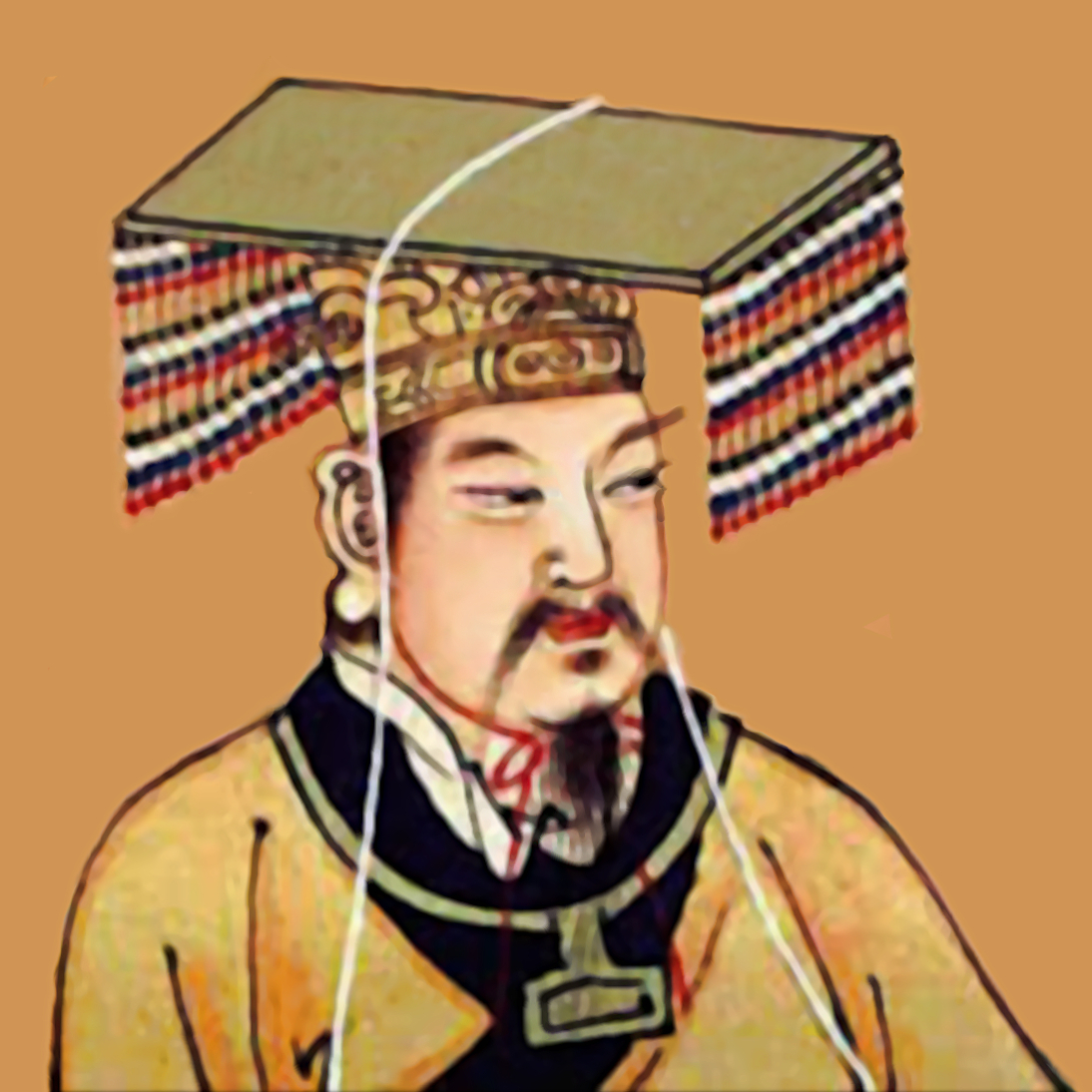
The Yellow Emperor
Spiritual Tale
Thousands of years ago, Huangdi, the Yellow Emperor, reigned in the land of Qi. This is one of the many stories told about this emperor:
For the first fifteen years of his reign, Huangdi took great pleasure in his position. He rejoiced that all the people in the Empire looked up to him as their emperor. He took care of his body. He ate well, and took the time to enjoy beautiful sights and sounds. Yet inside he was sad and disturbed, while his face looked haggard and ill.
Huangdi decided to change. He saw that the Empire faced great trouble and disorder. For the next fifteen years of his reign, he worked night and day to rule the people with wisdom and intelligence. Yet inside he was sad and disturbed, while his face looked haggard and ill.
Huangdi sighed heavily. “I was miserable in the first fifteen years of my reign, when I devoted all my attention to myself and my own needs, and paid no attention to the Empire. I was miserable in the second fifteen years of my reign when I devoted all of my time and energy to solving the problems of the Empire and paid no attention to myself. I see now that all my efforts have not succeeded in establishing good government, nor in making myself happy.”
He left the palace and dismissed all his servants. He went to live in a small building beside of the palace. He sat by himself for three months purifying his mind.
One day while napping, he dreamt that he traveled to the kingdom of Huaxu. This utopia could not be reached by ship, or by any vehicle, or even traveling by foot. It could only be reached through spiritual travel.
The people who lived in this kingdom did not feel joy in living, nor did they fear dying, so they never died before their time. They were not attached to themselves, so they felt neither love nor hatred. Profit and loss did not exist in their country. Thunder did not deafen them, physical beauty did not affect them, steep mountains and deep valleys could not slow them down. And Huangdi saw there was no ruler in this mystical kingdom: everything simply went on of its own accord.
Huangdi awoke from the dream. He called for his three advisors and told them what he had seen. “I thought it was impossible to rule others fairly and wisely. Then I fell into a deep sleep and dreamed this dream. Now I know the Perfect Way cannot be found through the senses. But I cannot tell you about the Perfect Way, because you cannot use your senses to learn it.”
That was all the Yellow Emperor said. The rest of his life, he ruled Qi the way the mystical kingdom was ruled: let everything simply go on of its own accord. Everything in the country of Qi was calm and orderly. When Huangdi died, the people mourned his death two hundred years.
Notes: Huangdi = 黄帝 — Huaxu = 華胥國
Sources: Daoist teachings translated from the Book of Lieh-Tzü [Liehzi], Book II “The Yellow Emperor,” trans. Lionel Giles, 1912. Supporting source: Alchemists, Mediums, and Magicians: Stories of Taoist Mystics, trans. and ed. Thomas Cleary, p. 8 n. 29. N.B.: This could be a troubling story for some religious liberals. The notion that the best leaders are those who do no work will be anathema to religious liberals who have come out of Protestantism, and who, while they might have become post-Christian in theology, have not abandoned the Protestant work ethic. Yet a documentary approach to telling religious stories should not soften the essential foreignness of other religions, when such foreignness is present.
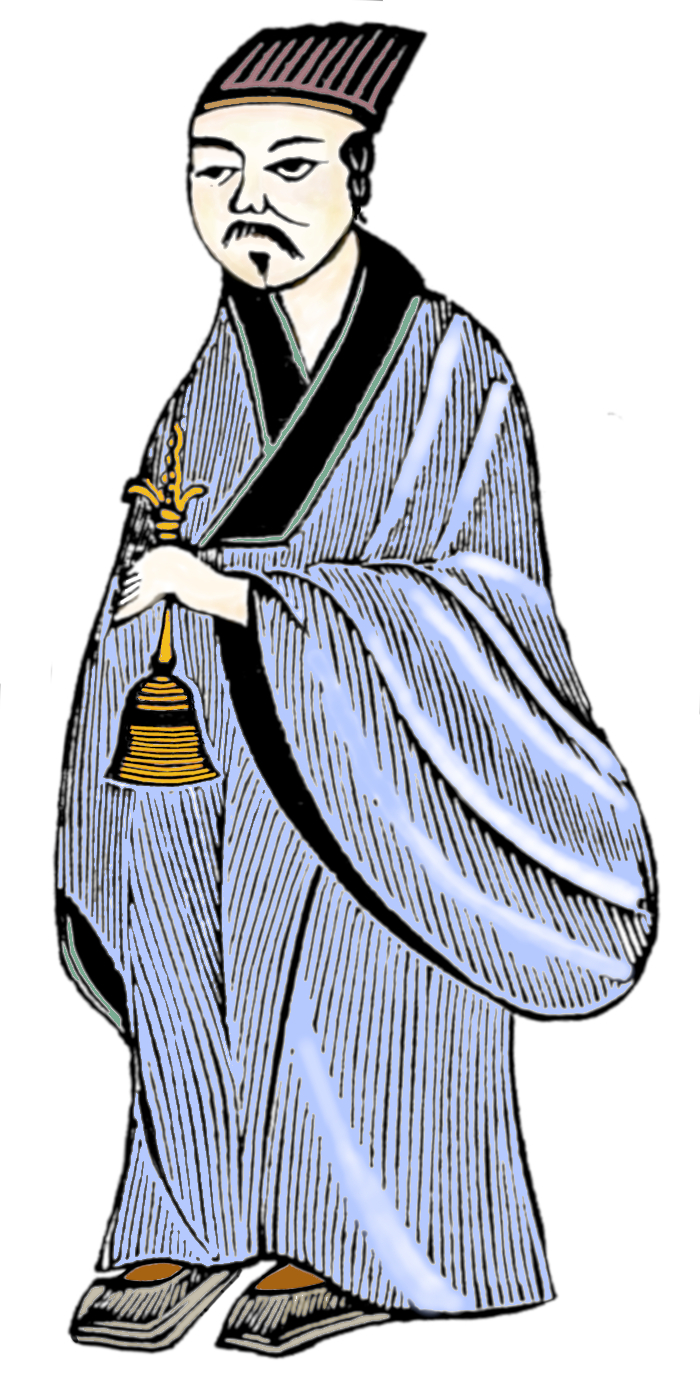
Planting a Pear Tree
Spiritual Tale, Wisdom Tale
One day in the marketplace, a farmer was selling pears he had grown. These pears were unusually sweet, so the farmer asked a high price for them. A Daoist priest stopped at the barrow in which the farmer had displayed these lovely pears.
“May I have one of your pears?” he said.
The farmer said, “Move aside, so paying customers can buy my pears.” The farmer knew the priest expected a pear for free. When the priest did not move, the farmer began to curse and swear at him.
The priest said, “You have several hundred pears on your barrow. I ask for a single pear. Why get angry?”
Some people nearby told the farmer to give the priest a pear that was bruised, which he couldn’t sell anyway. But the farmer was stubborn, and refused. The constable of the town came over to see what was going on. Seeing that things were getting out of hand, he bought a pear and gave it to the Daoist priest.
The priest bowed to the constable, and thanked him. Then the priest turned to the townspeople and said, “We Daoist priests give up all money and possessions. When we see selfish behavior, it’s hard for us to understand it. I have some pears with a very fine flavor, and unselfishly I would like to share them with you.”
Someone in the crowd called out, “If you have pears of your own, why did you want one of the farmer’s pears?”
“Because,” said the priest, “I needed a seed to grow my pears from.” He ate up the pear that the constable had given him. He took a seed, unstrapped a pick from his back, and made a hole in the ground. He dropped the seed in the hole and covered it with earth. Then he said, “Could someone bring me a little hot water, please, with which to water the seed?”
Someone ran into a neighboring shop and brought some steaming water. The priest poured the water over the seed. Everyone watched closely, for though it seemed like a joke, Daoist priests were supposed to have knowledge of mystical arts.
Suddenly green sprouts began shooting out of the ground. They grew until they became a pear tree. The tree sprouted green leaves, and put forth white flowers. Bees buzzed among the flowers, the petals dropped, and soon tiny green fruits grew and ripened into fine, large, sweet-smelling pears on every branch.
The priest picked the pears and gave one to everyone in the crowd. Then the priest turned and hacked at the tree with his pick until he cut it down. Picking up the tree and throwing it over his shoulder, leaves and all, he walked quietly away.
The farmer had been standing in the crowd the whole time, forgetting all about his own business. When the priest walked away, he turned back to his barrow and discovered that every one of his pears was gone. He then knew that the pears that old fellow had been giving away were really his own pears. And when the farmer looked more closely at his barrow, he saw that one of its handles had been newly cut off.
Boiling with anger, the countryman set off after the Daoist priest. But as he turned the corner where the priest had disappeared, there was the lost wheel-barrow handle lying next to a wall. It was, in fact, the very pear tree that the priest had cut down.
But there was no trace of the priest. The townspeople watched the farmer’s anger as they finished eating their sweet, juicy pears.
Source: Pu Songling, trans. Herbert A. Giles, Strange Stories from a Chinese Studio (London: Thomas De La Rue & Co., 1880). This may be interpreted as a tale about the dangers of greed and anger.
CONFUCIAN STORIES
Miracles at the Birth of Kongzi [Confucius]
Spiritual Tale
Once upon a time, in a place called Tsou, there lived a man named Shuliang He. He had been a soldier, now retired, and he was so tall that people said he was ten feet tall. He lived in China some two thousand five hundred years ago, at about the time when Gautama Buddha lived in India.
Shuliang He was an older man, perhaps 70 years old. He had had nine daughters with his first wife. But Shuliang He also hoped to have a son. So he went to the head of the noble house of Yen, and asked for one of their daughters in marriage. The youngest daughter, Yan Zhengzai, said that she would be willing to marry this older man.
The two were married, and not long thereafter Yan Zhengzai traveled to Mount Ni in Shangdong Province, one of the mountains that Emperor Shun had dedicated to the worship of its guardian spirit. Knowing that her husband would like to have a son in addition to his nine daughters, she offered up a prayer to give birth to a son. That night, she dreamed that a spirit came to her and said, “You shall have a son, who will be a great sage and prophet, and you must bring him forth in the hollow mulberry tree.” Not long after this dream, she became pregnant. (1)
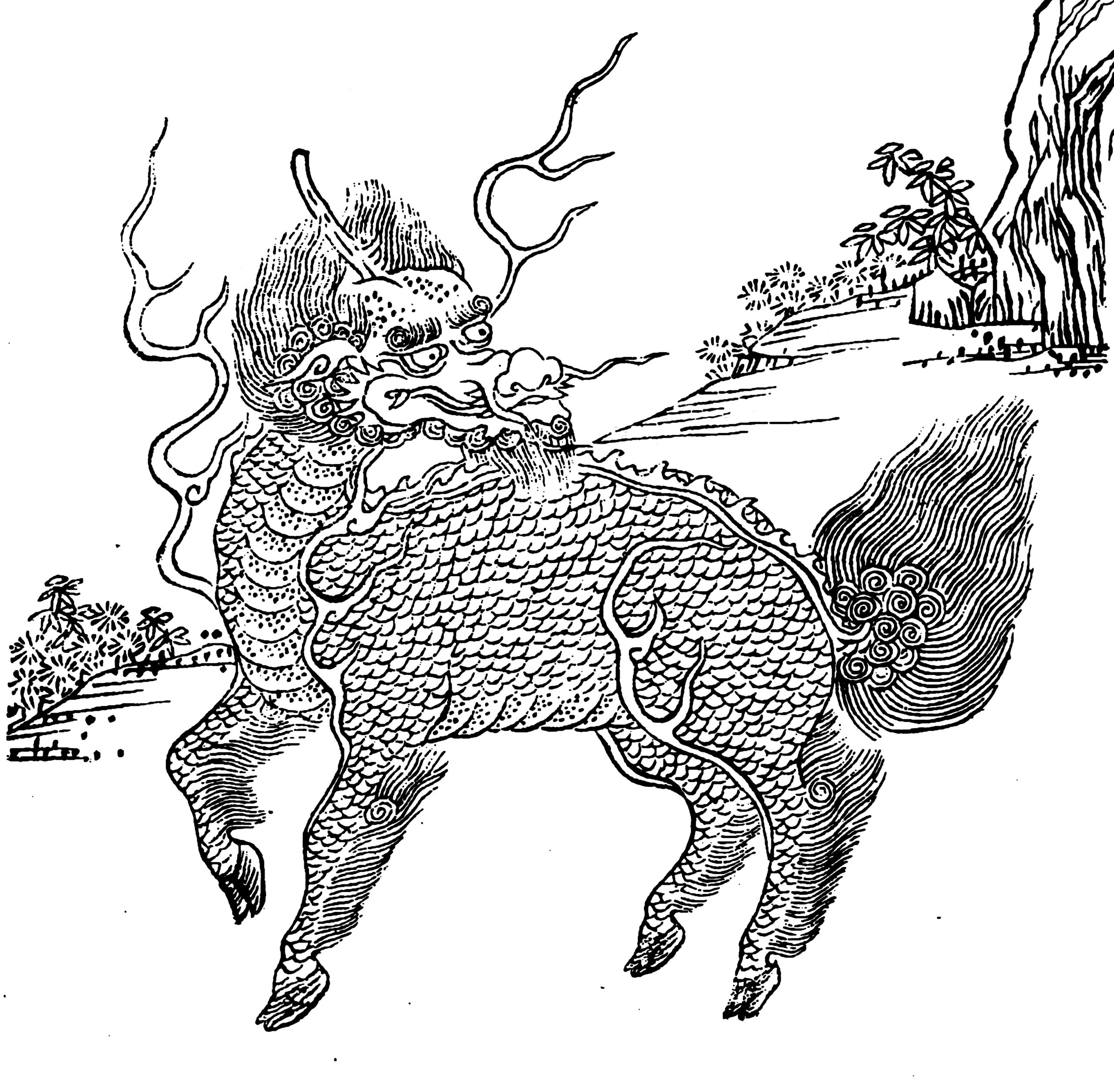
Some people say that while Yan Zhengzai was pregnant, she fell into a dreamy state, and five old men came up to here, leading behind them a unicorn (this was a Chinese unicorn, or qilin, was the size of a small cow, had one horn, and was covered in scales). The unicorn carried in its mouth a tablet made of green jade. On the tablet was carved a prophecy: “The son of the essence of water shall soon succeed to the withering Zhou, and be a throneless king”; which meant that her baby would grow up to become wise and valued leader, even though he would never hold political power. She tied a silk scarf around the qilin’s horn, upon which the animal disappeared. (2)
Soon it came time for Yan Zhengzai to give birth. She told her husband that she must give birth in the “hollow mulberry tree,” wherever that was, and her husband said that there was a dry cave in a hill nearby that went by that name. So even though she was near to giving birth, they travelled to the dry cave that was named “The Hollow Mulberry.” (3)
On the night the child was born, two dragons appeared in the sky to keep watch; one to the right of the hill where the cave was, the other to the left of the hill. Then two spirits appeared in the air above the hill, two women who poured out fragrant drafts, as if to bathe Yan Zhengzai in beautiful aromas as she was giving birth. (4)
And within the cave, Yan Zhengzai heard music, and a voice saying to her: “Heaven is moved at the birth of your son, and sends down harmonious sounds.” A spring of water bubbled up within the dry cave, so that Yan Zhengzai could bathe her new baby; and to confirm the prophecy that the new baby was the “son of the essence of water.” (5)
Five venerable men came from afar to pay their respects to the new baby. (6) Some people said they were the five old men of the sky, the five immortals who never die, and they had come down from the five planets to celebrate the birth of this great child. His parents named him King Qiu.
This little baby grew up to be a great human being, a prophet and sage who became known as Kongzi, the Master or Teacher Kong. (In the Western world, he is best known by the name Confucius.)
Kongzi said that by the age of fifteen, he knew that he wanted to spend the rest of his life learning how to master one’s own self, and learning how we can live harmoniously with brothers and sisters, with our parents and children, with all those with whom we come into contact. He learned these things, and he began to teach others how to live wisely and well. Today, some two thousand five hundred years after he was born, millions of people around the world continues to find wisdom in his teachings.
Sources:
(1) Confucius, the Great Teacher: A Study, by George Gardiner Alexander. pp. 33 ff. The Chinese Classics: Life and Teachings of Confucius, vol. 2, trans. James Legge, p. 58. Confucius: His Life and Thought, by Shigeki Kaizuka (Dover reprint, 1956/2002), pp. 42-44.
(2) Sages and Filial Sons: Mythology and Archaeology in Ancient China, by Julia Ching and R. W. L. Guisso (Chinese University Press, 1991), p. 143. Legge, p. 58 n.
(3) Legge, p. 58 n.
(4) Ibid.
(5) The Dragon, Image, and Demon: The Three Religions of China: Confucianism, Buddhism, and Taoism, by Hampden C. DuBose (New York: A.C. Armstrong, 1887), pp. 91-92.
(6) Ibid.
OTHER EAST ASIAN TALES
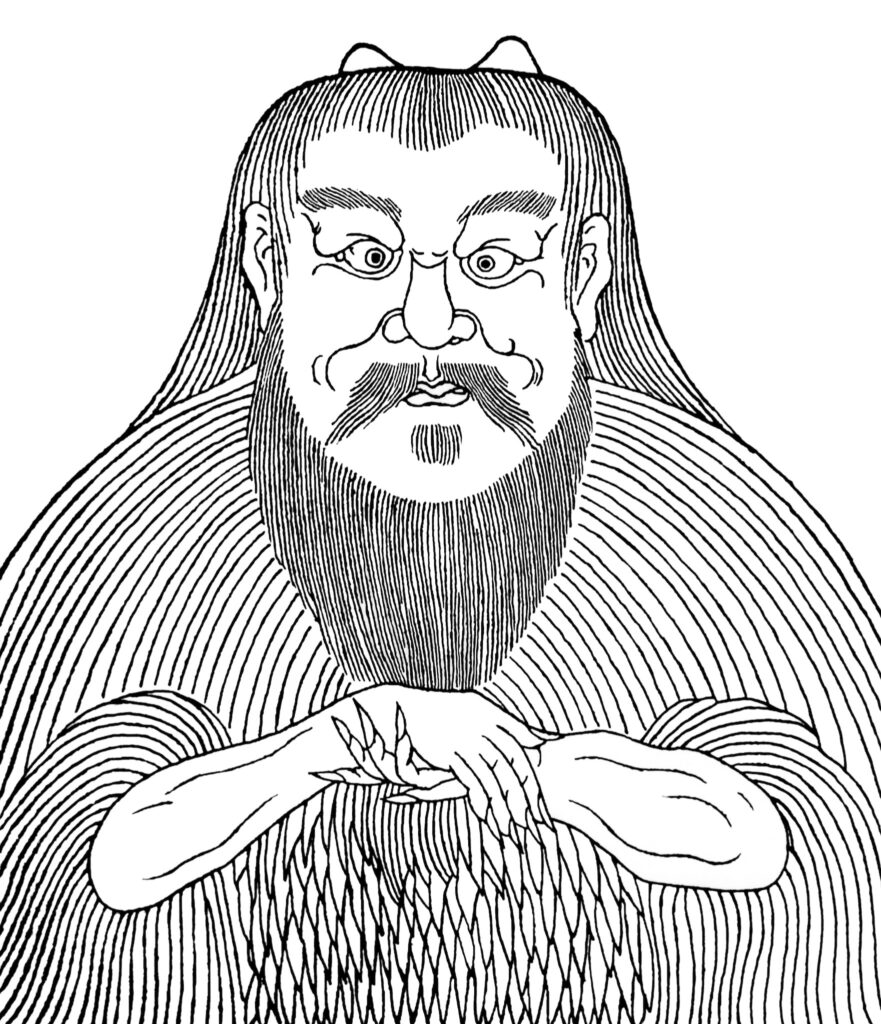
Pangu and the beginning of the universe
Tales of Deities
At the beginning, there was little difference between heaven and earth. All was chaos, and heaven and earth had no distinct forms, like the inside of a chicken’s egg. Within this chaos, the god Pangu was born inside the egg.
Pangu grew and grew inside the egg. After 18,000 years, the egg somehow opened up. Some say that Pangu stretched himself inside the egg, and shattered the egg’s shell into pieces.
Once the egg had shattered open, the lightest part of it, the part that was like the white of a chicken’s egg, rose upwards, and became the heavens. The heavier part of the egg, like the yolk of a chicken’s egg, sank downwards and became the earth. Pangu took a hammer and an adze, and cut the connections between earth and the heavens. Then to keep earth and the heavens from merging together once again, Pangu stood between them, serving as the pillar that kept them apart.
Pangu lived within earth and the heavens, standing between them. And one day he began to transform. He became more sacred than the earth, and he became more divine than the heavens. The heavens began to rise, going up one zhang, or about ten feet, each day. The earth began to grow thicker, thickening by one zhang each day. And as the heavens rose, so too Pangu grew; he grew one zhang taller each day. And this continued for 18,000 years: each day, the earth grew thicker, and the heavens rose higher, and Pangu grew taller.
At the end of 18,000 years, the heavens had grown very high, the earth had grown very thick, and Pangu had grown into a giant. He was now 90,000 li (or 87,000 miles) tall, the distance between earth and the heavens. Finally, all had become stable. The heavens had stopped rising. The earth had stopped growing thicker.
Not everyone agrees what Pangu looked like. Some say he had a dragons’ head and the body of a serpent. But most say he looked like human beings, except that he was a giant, and he had a horn on his head.
After uncounted years, Pangu felt that he was dying. As he was dying, his body began to transform itself.
His left eye became the sun, his right eye became the moon, and his hair and beard became the sky and the stars. His breath became the winds and clouds, and his voice became the thunder. His arms and legs became the four extremes or borderlines of the earth, and his head and torso became the Five Mountains. His blood became the rivers, his teeth and bones became the rocks and minerals, and his flesh became the fields and the soil. His skin became plants, and his sweat became the rain and the dew.
So it was that when he died, the body of Pangu became the whole universe and everything in it.
Source: The first part of the story is from the Sanwu Liji; and the second part of the story is from the Wuyun Linianji. Translation and retelling from Handbook of Chinese Mythology, Lihui Yang and Deming An (Oxford University, 2005), pp. 64-66, 170-176; with reference to Classical Chinese Myths, Jan Walls and Yvonne Walls (Hong Kong: Joint Publishing, 1984); and Chinese Myths and Legends, Lianshan Chen (Cambridge University Press, 2011), pp. 6-7. See also Asian Mythologies, ed. Yves Bonnefoy (University of Chicago, 1993), pp. 234 ff.
The Land of the Great
Wisdom Tale
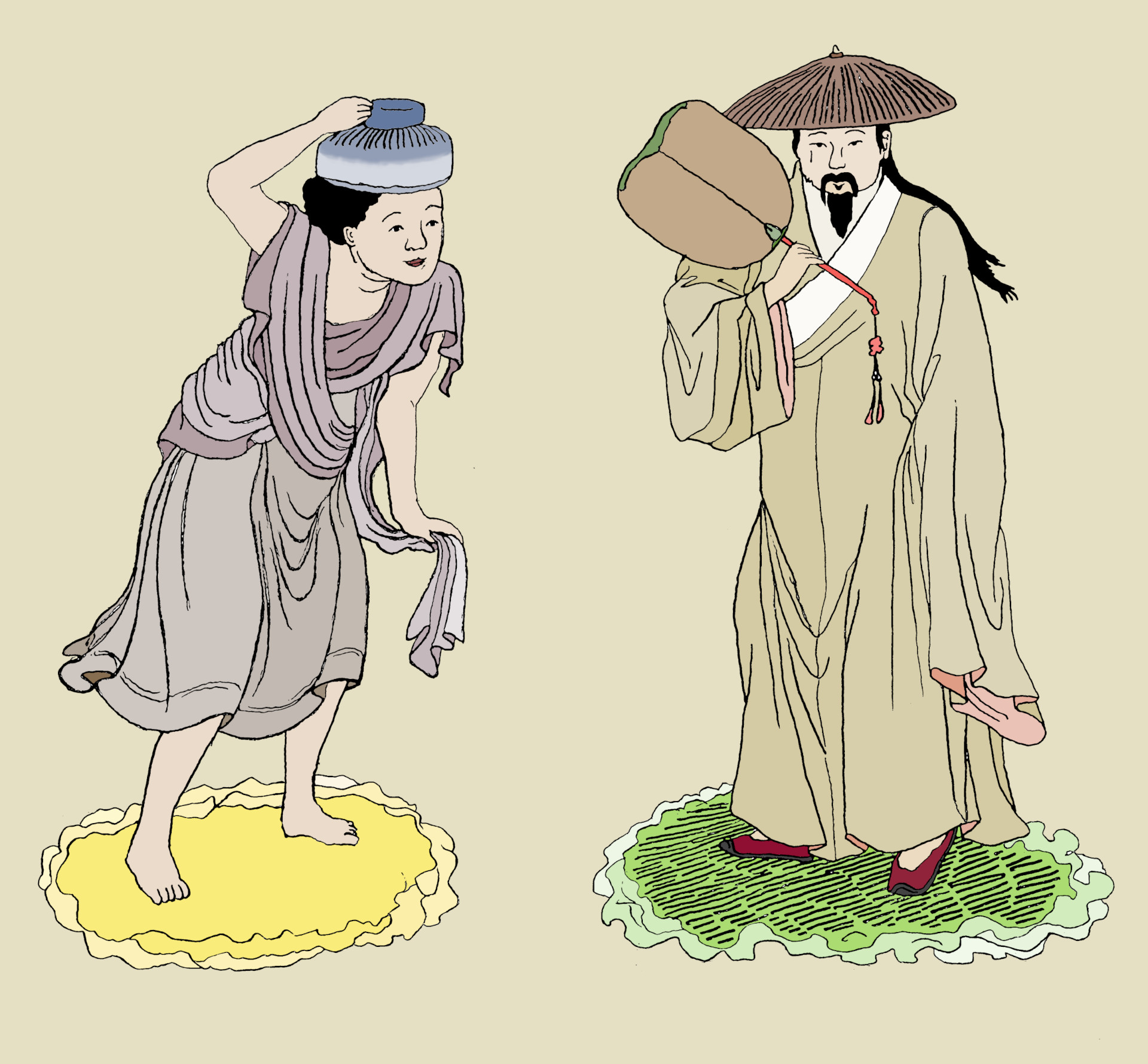
In the year 684, the scholar Tang Ao and his friend Lin Zhi-yang grew disgusted with the behavior of Empress Wu, ruler of their home land of China. These two friends thought the empress was both foolish and aggressive, and they also felt that under her reign anything might be bought or sold, including a person’s honor. They decided to travel the world to see if other nations were ruled better. Accompanied by Duo Jiu-gong, who knew much and had traveled far, they boarded a ship and sailed away.
Tang heard about the Land of the Great, where no one walked but instead everyone had their own personal cloud to carry them where they wanted to go. After a long voyage, they reached land, and began to walk over steep hills to the Land of the Great.
At last they reached a small temple hidden in among bamboos. Out of the temple came a priest who looked perfectly ordinary except for two things. First, he was riding on a rainbow-colored cloud. Second, he had long hair, a glass of wine, a plate of meat, and his wife sat inside the temple — while in their country would shave his head and have neither meat nor wine nor a wife. It is hard to say which surprised them more — a man floating on a cloud, or a long-haired, meat-eating, wine-drinking, married priest!
The priest smiled at them, saying, “You have reached the temple of the goddess of mercy. I am the priest of the goddess.”
Lin asked, “Respected sir, how can it be that you are a priest but do not shave your head?”
The priest replied, “Here in our country, when we heard that China had accepted the Law of the Buddha, we too decided to accept the Law of the Buddha. But we decided to allow priests to grow their hair, get married, eat meat, and drink wine.”
Tang said, “Could you please explain the reason why the people of your country all have clouds underneath their feet? Is this something that you are born with?”
“Yes, we are born with these clouds,” said the priest. “The clouds come in various colors, and colors change depending on the character of each person. The best clouds have stripes like a rainbow. The second-best clouds are yellow in color. The worst clouds have no color at all, and look as though there is nothingness under the person’s feet.”
Tang asked the way to the city so they could see more of these clouds, and the old man pointed to the correct road.
Soon they were in the great city. Throngs of people moved through the streets, each with a small cloud under their feet. They saw clouds of many different colors: red, yellow, orange, green, and so on. At last they saw a homeless man, who obviously hadn’t taken a bath in weeks, whose cloud was the color of a brilliant rainbow.
Tang said, “Why, the priest said a rainbow cloud was best of all. Yet here we see a homeless person with one!”
Duo, their guide, said, “When I was in this country before, I learned that good and virtuous people have clouds of the best colors, no matter what other people may think. A homeless person may have a good cloud, as long as they are a good person. The only way to change the color of your cloud to a better color is to become a better person. This means there are poor people who ride on rainbow clouds, and rich people people who ride on clouds that lack all color, the worst clouds of all.
“Of course,” Duo continued, “everyone avoids the people with the worst clouds. But the people of this country get the greatest pleasure from seeing acts of kindness, and everyone is always trying to become a better person.”
Tang said, “Is this why it’s called the Land of the Great?”
“Yes,” said Duo, “It’s called the Land of the Great because everyone is trying to become a kinder, better person.”
Suddenly they noticed that the people around them were pushing back to the sides of the street, leaving the center of the street to a person of great wealth and power. Assistants surrounded him, carrying important documents and beating gongs. But you could not see the rich man’s cloud, because it was carefully covered by a red silk cloth.
Tang said, “Why is this man’s cloud covered by red silk?”
Duo said, “Like too many other people with money and power, he has a cloud of a bad color, the color of charcoal and ashes. This means he is not completely bad, but it does mean his hands are not so clean as they ought to be.”
“In other words,” said Lin, “he is not exactly wicked, but he most certainly is not a good person.”
“Yes,” said Duo. “He tries to cover up his bad-colored cloud with red silk. But nothing can change the color of his cloud until his heart becomes good. He covers his cloud so no one is quite sure just how bad he really is.”
Lin said, “It would be very useful if we had these clouds in our own nation. If every wicked person rode about upon a marker of their wickedness, why, that would make good people’s lives easier.”
Duo said, “But you can tell from a person’s looks what the color of their heart is. Someone with a bright, shining look in their eyes surely must have a rainbow-colored heart.”
“That may be so,” answered Lin, “but I have been fooled by a person’s looks. I would rather we could see the color of the cloud they ride about on.”
Source: Visits to Strange Nations [Ching Hua Yüan], an anonymous Chinese work of the 17th century, from Gems of Chinese Literature, 2nd ed., trans. Herbert A Giles (Shanghai: Kelly and Walsh, 1923). The above version is shortened from earlier versions; names have been converted to Pinyin Romanization.
Peach Blossom Spring
Wisdom Tale. “Peach Blossom Spring,” or “Peach Blossom Fountain,” is a well-known Chinese story by Tao Yuanming, whose literary name was Tao the Hermit.
Sixteen hundred years ago, when the north of China had been conquered by the Mongol invaders from central Asia, and refugees from that war filled the south, there lived a fisherman in the village of Wu Ling.
In those days, the powerful emperors of the Xin dynasty ruled over China. The Xin emperors were powerful. Some people thought the emperors had done what they could to win the war against the barbarian army. Other people thought they were arrogant and greedy, and believed that China lost the war with the barbarians because the Xin emperors and their followers cared more about taking care of themselves than taking care of ordinary people. Now, to return to the fisherman of Wu Ling:
One day, the fisherman took his boat out on the river, and headed upstream. Far upstream, he came to a branch in the river, and forgot to pay attention as to whether he took the right-hand branch, or the left-hand branch.
As he sailed upstream, he realized he had never been along this stretch of the river. The river grew slowly narroweras he went. Rounding a bend, he suddenly came into a grove of peach-trees in full bloom. No other tree grew here, only peach-trees, as far upstream as he could see. He floated for a moment in the river, astonished by the beauty of dozens of trees in full bloom. The air was filled with the perfume from their flowers. After admiring the scene for some time, he again sailed upstream, wishing to see how far this grove of peach-trees continued.
By the time he sailed out of the peach trees, the river had narrowed and become a stream, and not long after he emerged from the trees, this stream ended at the foot of a hill. Here there was a cave, from which came a faint light. Curious, the fisherman tied his boat to a willow tree, and crawled into the cave to see if he could find from whence came this light.
He quickly made his way through the cave, coming out into a wide plain. he could see rich farm fields, fine houses, lovely pools of water, dotted with luxuriant mulberry trees and bamboo. He heard dogs barking merrily in the distance, and a rooster crowed nearby. He noticed smooth, well-kept road cross-crossing the land, with people coming and going on various errands. The clothing the people on the roads and working in the fields looked foreign and strange to him. And all the people he saw, young and old, looked happy and contented.
A man walking on a nearby road caught sight of the fisherman standing and staring at this new land. This man was greatly astonished to see the fisherman, and asked where he was from; for the fisherman’s clothes looked at strange to this man and the man’s clothes looked to the fisherman. Upon learning that the fisherman had come from China, the man invited him to his house, and together with his wife cooked a chicken for him to eat. The man’s neighbors all heard about this visitor, and they came to see him.
One of their elders told the fisherman their story. “Our ancestors came to this land in the Qin dynasty, more than two centuries ago” she said. “Here we were safe from the troubles of the world. But we no longer receive news from the rest of the human race. What has been happening in the world?”
The fisherman told them how the Qin dynasty fell, how the Han dynasty succeeded them, how the Han dynasty was overthrown by the Xin dynasty, and how the barbarians had invaded the northern half of the country. As the fisherman told them of these events, they grieved at the misfortunes of human affairs.
Each of the neighbors in turn invited the fisherman to stay at their house. At last, though, the fisherman said that he should return home. His new friends tried to convince him to stay, but no, he must go home. When they saw he was determined to go, one of their elders said to him, “We see you must go, but it would be best if you do not talk to anyone about what you have seen here.”
And so he bade them all farewell, and returned back through the cave to his boat. During the return trip, he was careful to remember the route, thinking he would like to return one day.
Upon reaching his home again, he went to the governor of the district to tell what he had seen. The governor, greatly interested in this beautiful land, sent a group of people with him to try to retrace the fisherman’s route. Try as they might, however, they did not find the correct branch of the river. Hearing of their failure, a great adventurer thought that he could succeed where they had failed; but he too failed to find this wonderful land, and he died of shame soon afterwards. From that time forth, no else tried to find the land beyond Peach-blossom Spring.
What is the moral of this story? Some say the moral is adults can never return to the joys of childhood, although I don’t agree. Others say the moral is that people used to live in a perfect world but not any more (like the old Bible story of Adam and Eve), although I don’t agree. I think the moral of this story is that we could create a perfect world, like the land beyond Peach-blossom Spring, if we wanted to; but we forget where we’re going and lose our way. What do you think the moral of the story is?
Source: Herbert Giles, Gems of Chinese Literature, pp. 107-108.
Chang-kung’s Secret
Wisdom Tale
The Emperor Kangxi was the fourth emperor of the Qing dynasty in China. Before he became the emperor, the land of China had been torn by wars. During the wars, the people had to leave their farms to fight, and farms were destroyed in battles. But after Kangxi became the emperor, there was peace throughout the land. The people could tend to their farms, and so there was plenty of food for everyone. So it was that Kangxi ruled over a land of peace and plenty.
When he was old, Emperor Kangxi began to think about what would happen to China after he died. What principles, what rules could he give to the next emperor so that China would continue to be a land of peace and plenty? He wanted to write down the principles for peaceful rule. And he remembered something that had happened many years before.
One year, not long after peace had been established throughout the land, Emperor Kangxi went on an Inspection Tour, a journey across all of China so that he could see that all was peaceful, and that the people had enough to eat.
He was accompanied by hundreds of people. Riders on horseback went out ahead on the road to let the people know that the Emperor was coming. Next came the many horses carrying the baggage, tended by more riders on horseback. Then came skilled warriors, with their bows and arrows slung over their shoulders, also riding horses. They were followed by more warriors walking just ahead of the emperor. The emperor himself rode in an open carriage drawn by magnificent white horses; a golden parasol protected the emperor from the sun. Behind him marched more warriors carrying long lances that pointed high in the air.
The emperor went from city to city, riding through villages and towns. Everywhere they went, he and his advisors asked questions to learn if the people were living happy and peaceful lives.
When the stopped in one town, the townspeople told the emperor and his advisors about a large family which was known as being the happiest and most peaceful family.
“We must go to visit this family,” said the emperor to his advisors. “We must find out what makes them special.”
The townspeople gave them directions, and soon they arrived. A man named Chang-kung greeted them, bowing low before the emperor, and asking them to partake of what humble food and drink he could offer such distinguished guests.
“My dear Master Chang-kung,” said one of the emperor’s advisors, “what we most desire is not refreshments, but an answer to a question.”
Chang-kung said he would be happy to answer any question they might wish to ask.
“The emperor has heard of your family,” said the advisor, and the emperor nodded in agreement. “The townspeople say that yours is the most peaceful and the happiest family anywhere.”
“There are nine generations of our family living here,” said Chang-kung. “The second cousin of my great-grandmother is the oldest member of our family.” He pointed to an old woman sitting nearby, who was attended by two young men. All three of them were smiling and appeared happy. “And my eldest brother’s great grandchild, born this past winter, is the youngest member of our family.” He pointed to a smiling woman who was carrying a laughing baby. “I cannot say if ours is the happiest and most peaceful family anywhere, but it is true that we live in peace and happiness.”
And it did seem to be the case that everyone they saw appeared to be happy. The children played among themselves, but there were no tears, no arguments, no shouting. The adults worked at various tasks, and again there were no arguments or raised voices. Even the dogs seemed to be kind and peaceful, and they watched as one dog gave a bone to another.
“The emperor would like to ask you this question,” said the advisor: “How it is that so many people live together so peacefully?”
Chang-kung turned to a young man who stood near by, and asked him politely to go and fetch ink, paper, and a brush. The young man returned in an instant with the paper and brush, and a young woman followed him carrying a small table.
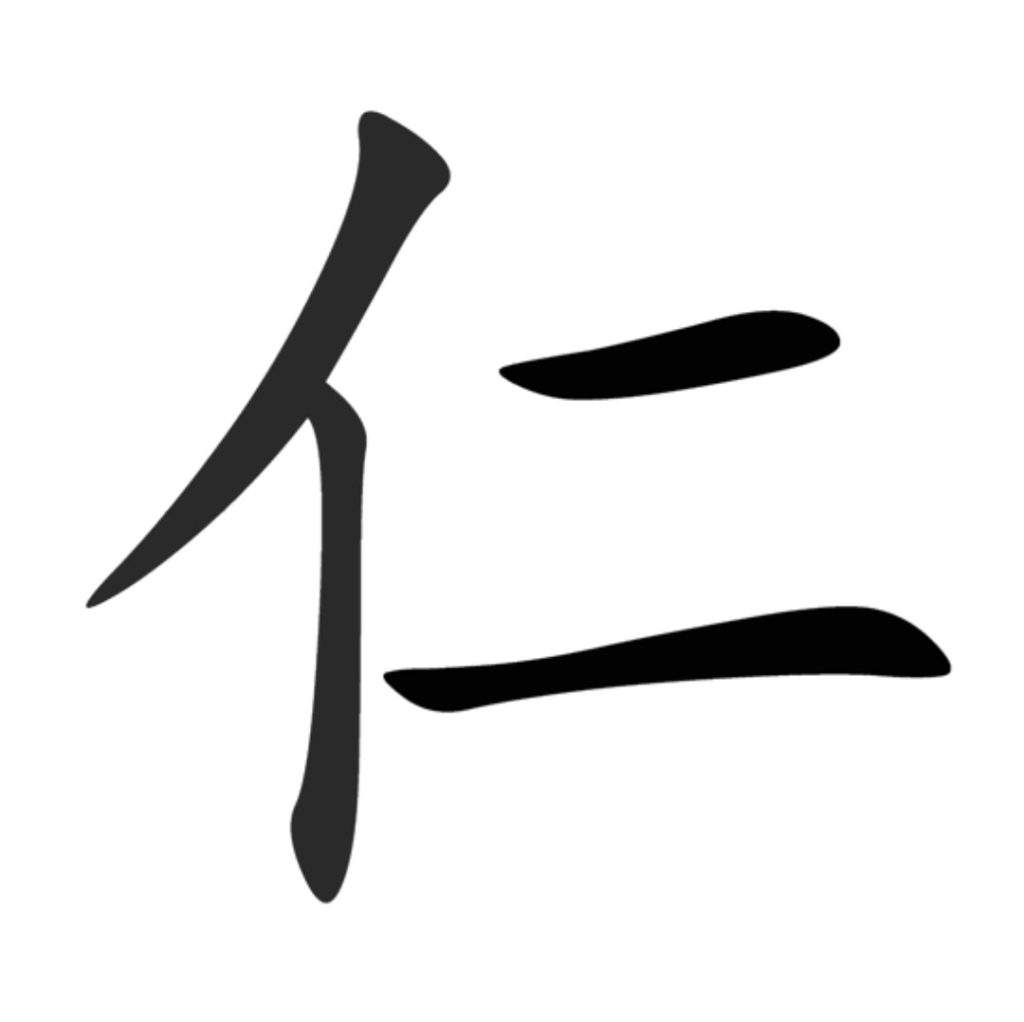
Chang-kung began writing rapidly on the paper. The advisors leaned closer to watch him writing. “But you are writing the same word over and over!” said one of the advisors in surprise.
“That is true,” said Chang-kung. He held up the paper so that the emperor could see it.
The same character was written over and over—the Chinese word rén — which in English can mean harmony or forbearance, but which is often translated as kindness.
One of the emperor’s advisors said, “It is as Confucius said in the Analects: ‘The person of perfect virtue, wishing to be enlarged, enlarges others.’ This is what is meant by kindness.”
“As to that, I cannot say,” said Chang-kung, bowing low. “You are all educated people and I am not. I can only say that in our family we respect the humanity of each other. And we do this by showing kindness.”
Source: The basic story comes from a book of maxims attributed to Emperor K’ang-hsi [Kangxi], who ruled China from 1661-1722, an early emperor of the Ch’ing [Qing] dynasty. These maxims appeared in English translation in 1817 as The Sacred Edict, Containing Sixteen Maxims of Emperor Kang-He, Amplified by his Son, the Emperor Yoong-Ching,trans. Rev. William Milne (London: Black, Kingsbury, Parbury, and Allen, 1817), pp. 51-52:
“Formerly, nine generations of Chang-kung-e inhabited the same house; and a Mr. Chin of Keang Chow had seventy persons who all ate together. Those who belong to one family, and are of one surname, should think of their ancestors; rather exceed, than be deficient in respect; rather surpass, than be wanting in kindness. When there is prosperity, rejoice mutually, by an interchange of social affections; when adversity, sympathize mutually, by affording reciprocal aids. In building a family temple to sacrifice to ancestors; in erecting a domestic academy for instructing youth; in purchasing a charity field for the supply of indigent brethren; and in correcting the family calendar, to interweave the names of the more distant relatives — let the same mutual aid be afforded.”
The Sun-Goddess Hides Her Light
Tales of Deities
Before Susano-o took up his duties as the ruler of the underworld, he asked his elder sister, Amaterasu, if he could come to heaven to take leave from her. She agreed. At first, all went well. But then Susano-o became rude and unseemly.
Susano-o broke down the divisions between the rice-fields belonging to his sister, sowed them over again, and let the piebald colt who lived in Heaven run through the fields, trampling them. Then Susano-o misbehaved in the great hall where Amaterasu was celebrating the solemn festival of the first fruits to be harvested. Finally, Susano-o killed a piebald colt of Heaven, skinned it, and threw the dead body into the sacred weaving-hall where the Sun-Goddess was at her loom weaving the garments of the deities.
Amaterasu was so offended by this last insult that she entered the Rock-cave of Heaven and left the world to darkness.
When Amaterasu hid herself in the Rock-cave of Heaven, the other deities grew worried, for there was no light any more. Everything was in complete darkness. All the other deities met on the dry bed of the River of Heaven to figure out a way to bring Amaterasu out of hiding.
First, Omoikane, the god of wisdom, brought roosters to the cave to crow, hoping to bring Amaterasu out that way.
Then Ame-no-Koyane, whom Amaterasu had put in charge of the divine mirror, and who was in charge of divine affairs in the palace, dug up a five-hundred branched Sakaki tree of Heaven. He hung strings of jewels on its higher branches, a mirror on its middle branches, and on its lower branches pieces of cloth. Then all the deities recited prayers in honor of Amaterasu.
Finally, Ame-no-Uzume, the goddess of Dawn and the Dread Female of Heaven, dressed herself in strange and fantastic clothing. She kindled a fire and pounded on a tub, danced wildly, and spoke inspired words. The Plain of High Heaven shook, and the eight hundred deities all laughed together.
The Sun-Goddess wondered how Ame-no-Uzume and the other gods could be so jolly while the world was wrapped in complete darkness. She peeped out from the half-opened door of the cave. She was at once seized by Ame-no-Tajikarao, or Heaven-Hand-Power. He kept her from slipping back into the cave, to the great joy of all the deities.
After the Sun Goddess was out of the cave and once more lighting up the world, a council of the deities put Susano-o on trial. He was found guilty, and caused to pay an enormous fine. They also pulled out the nails of his fingers and toes, and banished him to the land of the underworld.
Source: adapted from W. G. Aston, Shinto: The Way of the Gods (London: Longmans, Green, and Co., 1905), chapter VI — in the West, this is probably the best known story of these two deities.