Sermon copyright (c) 2023 Dan Harper. As delivered to First Parish in Cohasset. As usual, the sermon as delivered contained substantial improvisation.
Reading
The reading this morning is a poem by Lucille Lang Day. The poet says her “mother, who was one-quarter Wampanoag, was raised from age seven by a couple who taught her that Native American ancestry was something to hide.” The poem tells a little bit about how she found out about this family story that had been intentionally suppressed.
“I Always Knew It” — link to the full poem
Sermon — “What about Land Acknowledgements?”
I’d like to talk with you this morning about land acknowledgements. A land acknowledgement is one of those statements, which are now commonly given at the beginning of events, or which appear on websites of organizations, that go something like this: “We acknowledge we gather on land that is the traditional and ancestral homeland of the so-and-so people.” Sometimes these land acknowledgements consist of just a bare statement that Native Americans once lived wherever you are. But the more interesting land acknowledgements include some of the history of the Native Americans in question.
At this point, I could go into the ethical, moral, and political arguments for and against land acknowledgements — and there is real debate about their value. (1) Yet while these ethical, moral, and political arguments about land acknowledgements might be fascinating to some, I’d rather start with the stories of some of the individual Native Americans we’re thinking about acknowledging. So I’d like to tell you some stories about Native Americans from Cohasset.
(A word about terminology: Since we’ll be talking about the time before the United States of America was a country, it’s anachronistic to refer to “Native Americans,” because there was no country called America. Since the Native American groups that currently exist in our area often refer to themselves as “Indians,” I’ll use the term “Indian.”)
Our story begins in the early seventeenth century as Europeans first began to make contact with the Indians who lived in coastal Massachusetts. Some time in the years 1616 to 1619, a contagious disease wept through the Indians who lived here on the South Shore. Scholars continue to debate about what, exactly, the disease was. It could have been smallpox, measles, or some other highly contagious disease from Europe for which the Indians had no immunity. (2) A huge percentage of the coastal Indians of Massachusetts died — no less than four out of five Indians died, and in places as many as 19 out of 20 died.
Because so many of their people died, the Indians living along the coast found themselves vulnerable to attack by their traditional enemies from further inland. This helps explain why, in 1620, the Wampanoag Indians in the Plymouth area were keenly interested in allying themselves with the Pilgrims. That military alliance lasted for about fifty years, until King Phillip’s War in 1675. After that war, Indian military power in southeastern New England was essentially broken. The Indians who remained here had to figure out to adapt to European social norms.
By 1640, there were about 300 Europeans living in Cohasset — then called the Second Precinct of Hingham. (3) The history of Cohasset in the eighteenth century tends to focus on those Europeans. But Indians also continued to live here, and I’d like to tell you about three of them.
Mary Judah
First, I’d like to talk about Mary Judah.
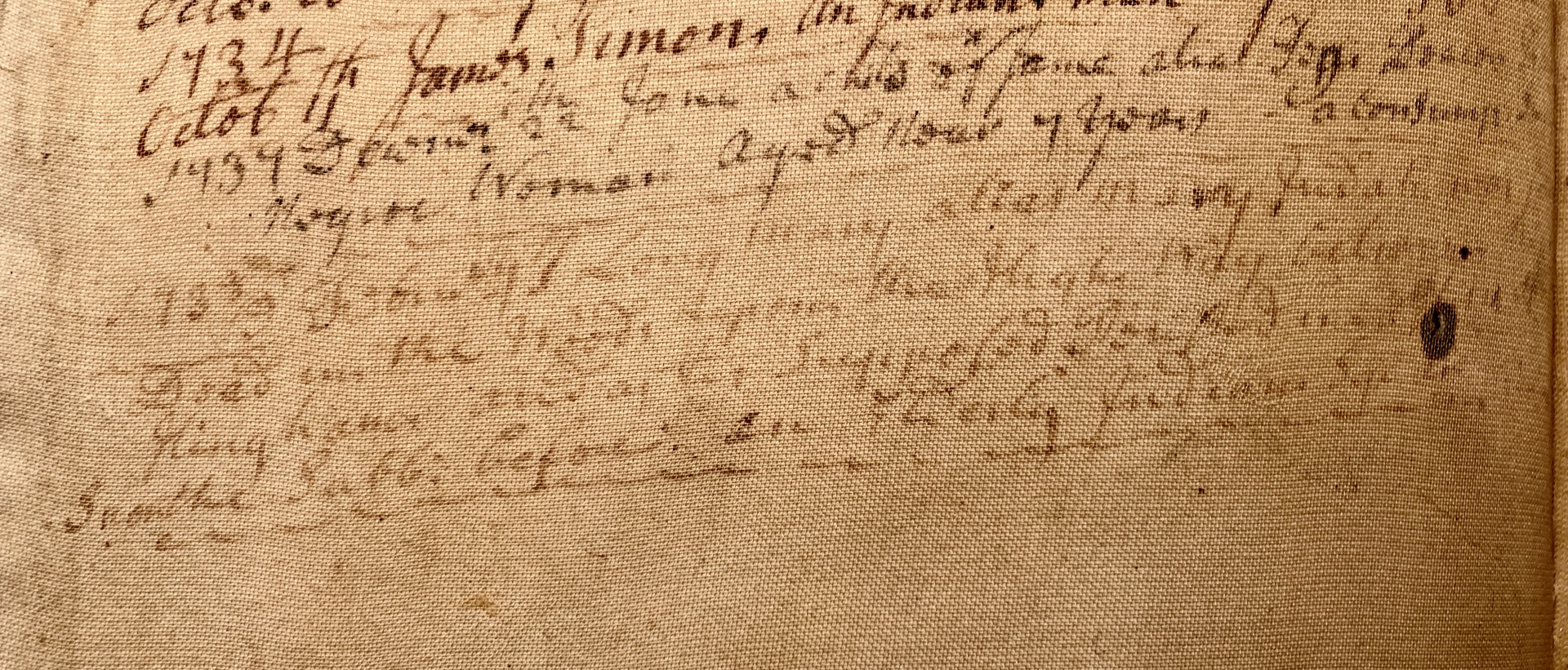
Our church was formally organized in 1721, and the first minister’s record book contains a sad entry for Mary Judah from which we can reconstruct a bit of her life: “Feb. 1, 1739 [New Style]. Long Mary, alias Mary Judah, was found Dead in the woods upon the High Way between this & Hingham and as tis supposed Perished in a storm of cold & snow the Sabb[ath] before. An elderly Indian [woman].” (4)
February 1, 1739, was a Sunday, meaning Mary Judah’s body wasn’t found for a whole week. If she had been enslaved, surely her enslavers would have noticed, and gone to search for her. Or if she had lived with someone else, again they would have noticed. So it seems she was an elderly woman living entirely alone. Since she was older, Mary Judah would have been born in the mid-seventeenth century, a time when the Indians of Cohasset were still living in the traditional way. Most likely, Mary Judah was keeping to the old Indian ways as best she could. As a result she wound up living on the margins of European society, both economically and politically — eking out a subsistence existence in the face of encroaching European agriculture, with essentially no political rights, though at least she was not enslaved.
Sarah Wapping
The second person I’d like to talk about is Sarah Wapping.
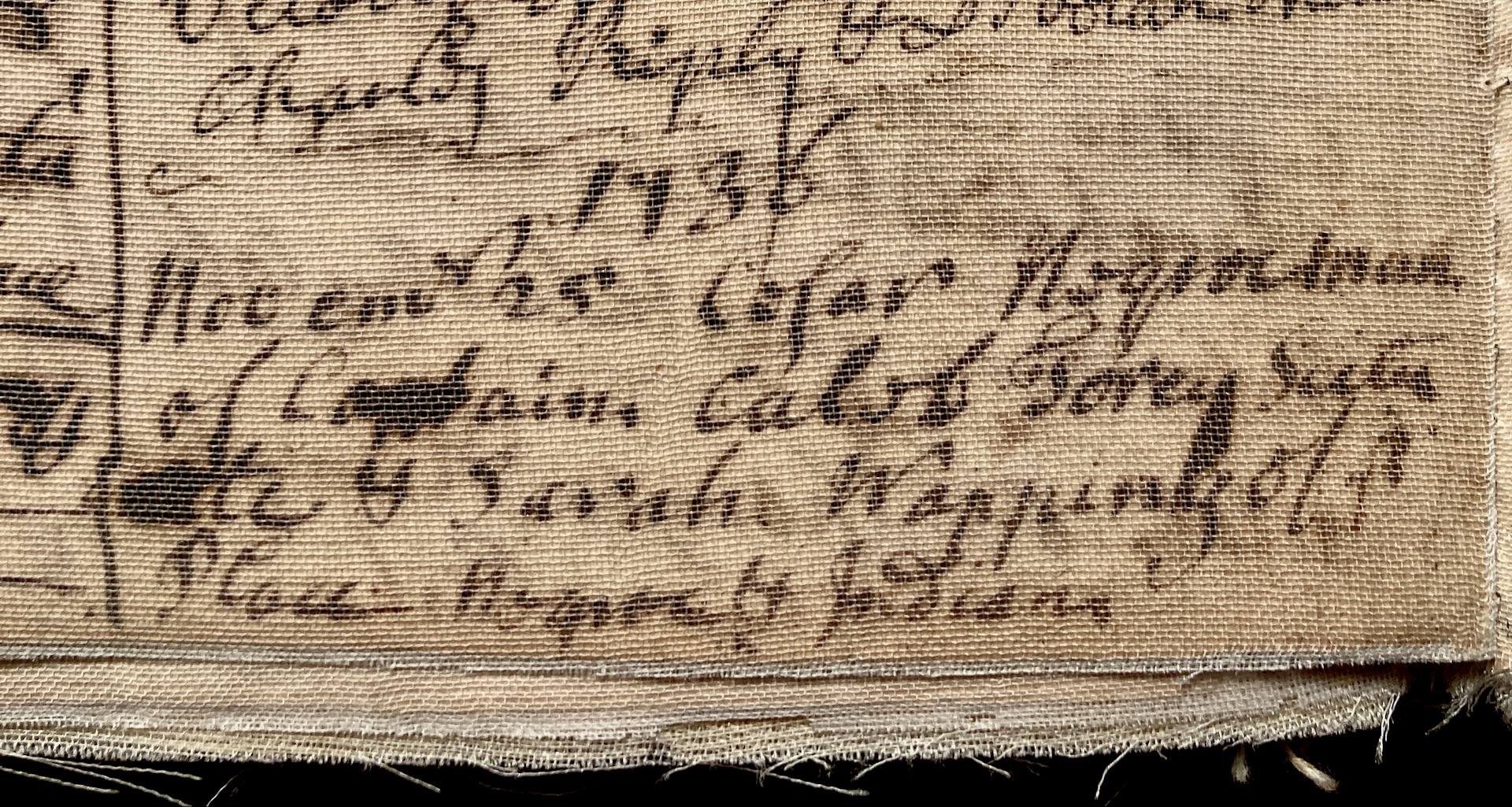
On November 25, 1736, the minister of our church wrote in his record book that he officiated at the marriage of Sarah Wapping, an Indian from Cohasset, and “Cesar,” a man of African descent (who, according to the custom of the time, was allowed no last name). Cesar was enslaved by Captain Caleb Torrey of Scituate, and his and Sarah’s marriage intention was recorded in the Scituate town records. (5) We can assume that Sarah was either enslaved, or functionally became enslaved upon her marriage.
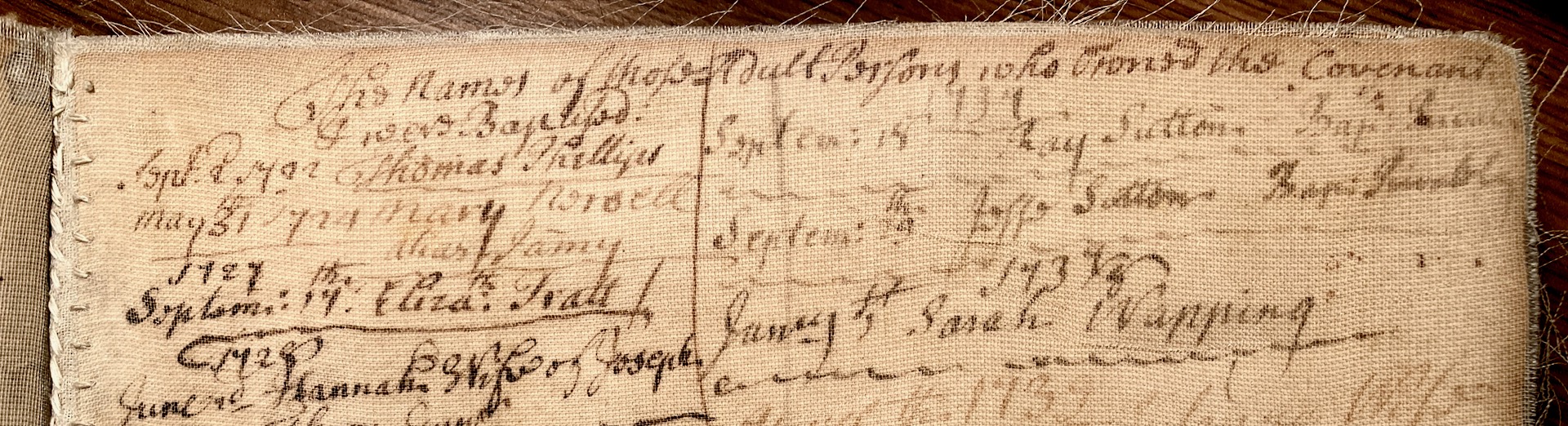
After her marriage, Sarah attended services at our church here in Cohasset; we can assume that she went to live with Cesar and his enslaver, but for some reason Sarah was willing to walk several miles to the Cohasset church each Sunday. Sometime in 1736, she decided to join our church. Remember that in 1736, this congregation was one of the established Christian churches of Massachusetts Bay Colony; we became Unitarian a century later, but back then we were a liberal Christian church.
There are many reasons why Sarah Wapping, an Indian living in Cohasset, might decide to become a Christian, that is, become a member of one of the established churches of Massachusetts Bay Colony. First and perhaps most obviously, Sarah Wapping probably felt genuine sympathy with the Christian ideals of the church. Beyond that, she may have been attracted to our church’s eighteenth century covenant. In that old covenant, church members promised to one another “that with all tenderness & Brotherly Love we will with all faithfulness watch over one anothers Soul.” To someone who was enslaved, perhaps that covenant offered a recognition of their essential humanity, or as we’d say today, their inherent worthiness and dignity.
More pragmatically, becoming a member of the church may have been a smart move for Sarah Wapping, in that it helped to raise her social status in the community. Many people in those days were reluctant to become members of the church, because they would be held to a higher standard of moral behavior; men, in particular, were likely to put off becoming church members until they knew they were dying, at which time they didn’t have much opportunity to engage in sinful behavior. Thus if you became a member of the church, you entered a morally elite group, which gave you a certain social status.
Sarah Wapping was baptized and formally joined the church on January 7, 1738 (N.S.) — 296 years ago today. The fact that Sarah Wapping had to be baptized before joining the church tells us that she probably didn’t come from a Christian family; otherwise she would have been baptized as a child. So it seems likely that she was raised in a traditional Indian family.
In the months before January 7, Sarah would have met with the minister at least once — probably more than once — as part of her preparation for baptism and full church membership. On January 7, she would have been required to stand up before the rest of the church and give a public statement of her moral failings. This would have happened in the old meetinghouse, which stood south of here on Cohasset Common, across from the present Parish House.
That’s all I was able to find out about Sarah Wapping. After this event, she apparently disappears from the historical record. But we can speculate that she probably had children. Her children would have been born into slavery, and they were might have been considered black, while also maintaining their connection with the Indian communities in southeastern Massachusetts. Sarah’s children, or at least her grandchildren, would live to see slavery abolished in Massachusetts in the late eighteenth century. It is entirely likely that at least some of her descendants live in southeastern Massachusetts to this day.

Naomi Isaac
The third person I’ll tell you about is Naomi Isaac.
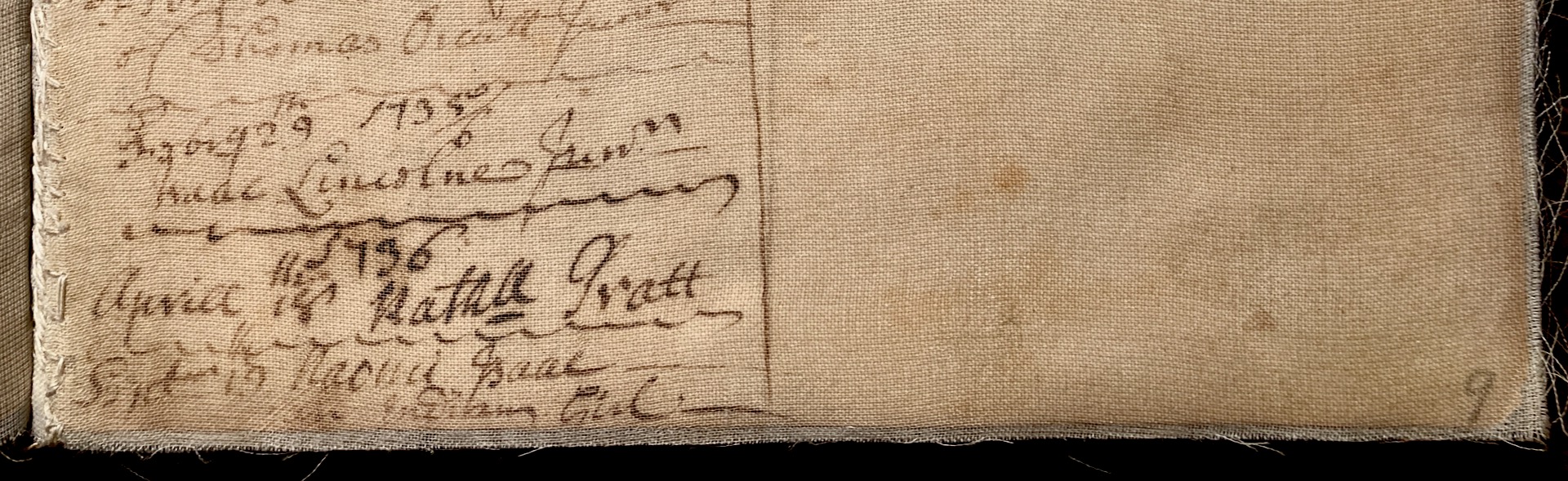
On September 19, 1736, Naomi Isaac, another enslaved Indian, became a member of our church. I was able to find out a bit more about Naomi Isaac, and based on some admittedly slender historical evidence, I’ve pieced together a hypothetical life story for her.
Naomi Isaac became a church member about the same time Sarah Wapping got married; the two women would have been rough contemporaries. When Naomi joined the church, the minister’s record book refers to her as “an Indian girl.” If we guess that she was roughly eighteen years old, she might have been born somewhere between 1716 and 1720. Since she did not need to get baptized before she joined the church, it seems probably that she came from a family of Christian Indians.
Assuming she had been raised as a Christian, her decision to join our church was not as big a step as it was for Sarah Wapping. Naomi Isaac must have liked the religion in which she had been raised, and wanted to commit more deeply to it. Then too, like Sarah Wapping after her, Naomi Isaac might have been attracted to our congregation by the wording of the covenant. She may also have desired the increase in social standing church membership would bring.
As did every church member, Naomi Isaac would stood in front of the hundred or more people who came to services each Sunday and confess her moral failings. Again, this was in the old meetinghouse. At about 25 by 35 feet, that first meetinghouse was smaller than our present meetinghouse, and more intimate. I like to think that Naomi Isaac served as an inspiration for Sarah Wapping. We can imagine that Sarah Wapping was in the congregation that day, looking down from the balcony where enslaved people and Indians had to sit (but no more than twenty feet away from the pulpit), watching as the young Naomi Isaac become the center of attention of the entire church.
On February 7, 1737, four and a half months after Naomi Isaac joined our church, someone named Naomi Isaac got married to a man named Caesar Ferrit in Dorchester. I could not confirm that this is the same Naomi Isaac. In fact, in the mid-nineteenth century, there was a romantic story told of how Naomi was the ward of a rich man in Boston who had arranged a wealthy marriage for her, but she chose instead to marry Caesar Ferrit, the coachman for the rich man; and some have interpreted this to mean that this second Naomi Isaac was White. (6)
I think there may be a tiny nugget of truth in that romantic story, some of which got covered over by later romance. Naomi Isaac of Cohasset was either enslaved or an indentured servant. I speculate that her master moved to Boston, taking her with him. Then she decided to marry Caesar Ferrit against the wishes of her master. I like to think my speculation is correct, because it shows both Caesar and Naomi to be resourceful and forceful people. I also imagine that Caesar managed to purchase Naomi’s freedom, for she was able to leave her master and go with him. While I believe my interpretation fits the historical evidence, I cannot say with complete certainty that Naomi Isaac of Cohasset is the same woman as Naomi Isaac who got married in Dorchester — yet I think later events in Naomi’s life bear out my interpretation.
After Naomi Isaac and Caesar Ferrit married, they lived in Milton, where their first children were born. Around 1750, they moved to Natick, where their youngest children were born. The town of Natick had been founded for the so-called “praying Indians,” that is, Indians who had become Christian. While Natick was intended to be an Indian town, in practice other non-White people wound up living there too — people like Caesar, Naomi’s mixed-race husband. But Caesar could also claim Indian ancestry. Although he had been born in the West Indies and came to Massachusetts later on, he said that he had two European grandparents — one Dutch, one French,— an African grandparent, and an Indian grandparent. (7)
Naomi Isaac Ferrit appears in the written record eight times — first when she joined our church, next when she got married, and then in the birth records for six of the seven or so children she had. After the birth of her children, she disappears from the historical record. But let’s assume that she lived until April 19, 1775. In the early morning of that historic day, she would have helped her husband Caesar, then aged 55, get ready to respond to the alarm that the British regulars were on the move. She would have watched as Caesar, and their youngest son John, marched down the road towards Lexington with the rest of the Natick militia company.
Caesar, John, and the rest of their company arrived in Lexington not long before British regular troops returned through the town on their retreat from Concord. The two Ferrits took cover in a house near the meetinghouse on Lexington Green, and from its cover fired upon His Majesty’s troops. The regulars searched the house to find those two snipers, and the Ferrits hid under the stairs in the cellar to avoid capture. In short, Naomi’s husband, and her child John, were two of the hallowed veterans of the Battle of Concord and Lexington, engaging in an act of bravery at great risk to their lives.
Caesar Ferrit proved to be quite a Patriot. Although many veterans of the Battle of Concord and Lexington went back to their farms, in late April Caesar enlisted for a tour of duty in the Massachusetts army. Then later in the war, he enlisted once again. His military service was remembered for the rest of his life. In 1796, three years before his death, the town of Natick petitioned the state for a pension for him. (8)
One of Naomi’s sons-in-law, Thomas Nichols, had a very different experience on April 19, 1775. Thomas was a free Black man who married Patience Ferrit, Naomi and Caesar’s second daughter. On April 19, 1775, Thomas was being held in the town jail in Concord, having been accused of “enticing” enslaved persons “to desert the service of their masters.” While his father-in-law and brother-in-law were firing at the British troops on Lexington Green, he witnessed the events of April 19 from the Concord jail. After being held for three months, the authorities found that there was no evidence to support the accusations against Thomas, so he was sent back to Natick. (9) The story of Naomi’s son-in-law shows how the Indian communities and the Black communities of Massachusetts became intertwined. And I wonder if Thomas really was helping other Black people liberate themselves, and managed to get away with it — if he was one of the early precursors to the conductors of the Underground Railroad. I like to imagine that he was.
That’s all I was able to find out about Naomi Isaac. After the birth of her children, she apparently disappears from the historical record. Yet her legacy may live on in a very literal way. In our own time, descendants of the Natick Indians gather each year for the Natick Praying Indians Powwow, held on the last weekend of September. I like to think that some of Naomi Isaac’s descendants are among them.
This brings us back to the topic of land acknowledgements.
I’ve spun out some stories for you about what might have happened to some specific individuals who were Cohasset Indians. I readily admit that my stories are partly speculative. Nonetheless, I believe there’s some truth in the stories I’ve just told. If we were to decide to offer a land acknowledgement, we might want to acknowledge the three women I’ve talked about this morning. And I’ll end this sermon with one of many possible land acknowledgements for our congregation:
“We gather on land that is the traditional and ancestral homeland of Mary Judah, Sarah Wapping, Naomi Isaac, and other Indians of Cohasset. We think it’s likely at least some descendants of Sarah Wapping and Naomi Isaac, former members of our congregation, are still alive today. We acknowledge the many contributions these women and their descendants have made to our society, including their children’s service in the Revolutionary War. And we wonder how we can ever repay them.”
Notes
(1) According to “So you began your event with an Indigenous land acknowledgment. Now what?” reported by Chloe Veltman on National Public Radio, All Things Considered, March 15, 2023
[https://www.npr.org/2023/03/15/1160204144/indigenous-land-acknowledgments] — some Native American leaders believe land acknowledgements are a waste of time, while others believe they are useful. It’s a complicated issue!
(2) The debate is very much alive among epidemiologists. E.g., in 2010, a new possibility was outlined by John S. MarrComments and John T. Cathey, in “New Hypothesis for Cause of Epidemic among Native Americans, New England, 1616–1619” (Emerging Infectious Diseases, vol. 16 no. 2, Feb. 2010 https://wwwnc.cdc.gov/eid/article/16/2/09-0276_article). The authors of this study say: “Classic explanations have included yellow fever, smallpox, and plague. Chickenpox and trichinosis are among more recent proposals. We suggest an additional candidate: leptospirosis complicated by Weil syndrome.”
(3) Bigelow, Narrative History of Cohasset, p. 106.
(4) Woody Chittick, “Slavery in early Cohasset,” n.d.
(5) Information from Family Search website.
(6) The romantic story is in the Natick Bulletin, “Local Centennial Events,” June 18, 1875; quoted by George Quintal, Patriots of Color (Boston Nat. Hist. Park, 2004), p. 102.
William Biglow, History of the Town of Natick, Mass. (1830) says this about Cesar Ferrit and his wife:
“April 19th. — On this memorable morning, as one of the survivors lately expressed it, every man was a minute man. The alarm was given early, and all marched full of spirit and energy to meet the British. But few had an opportunity to attack them. Caesar Ferrit and his son John arrived at a house near Lexington meeting house, but a short time before the British soldiers reached that place, on their retreat from Concord. These two discharged their muskets upon the regulars from the entry, and secreted themselves under the cellar stairs, till the enemy had passed by, though a considerable number of them entered the house and made diligent search for their annoyers.
“This Caesar was a great natural curiosity. He was born on one of the West India islands, and was accustomed to boast, that the blood of four nations run in his veins; for one of his Grandfathers was a Dutchman, the other a Frenchman; and one of his grandmothers an Indian, and the other an African. He married a white New England woman, and they had several children, in whose veins, if Cæsar’s account of himself be true, flowed the blood of five nations. His son John served through the revolutionary war, and is now a pensioner.”
While this story seems to argue against Naomi Isaac Ferrit being the same as Naomi Isaac of Cohasset, its claims must be weighed against its late date, nearly a century after Naomi would have left Cohasset. Biglow gives no source for this anecdotal evidence, but if this story were told to him by Naomi’s descendants it could well have been to their advantage to have their mother posthumously “pass” as White; many people in Massachusetts considered it shameful to have Indian ancestry, and persons with Indian ancestry were regularly discriminated against, right up through the twentieth century. (Note, too, that Caesar’s wife’s is not named in this account.) For all these reasons, I’m inclined to place little trust in Biglow’s account.
Also, I was unable to find anyone named Naomi Isaac anywhere in Massachusetts in the usual genealogical records, for this time period. This proves nothing in of itself, but is worth considering when evaluating other evidence.
(7) J. L. Bell, “Thomas Nichols of Natick,” Boston 1775 blog, April 28, 2016. (https://boston1775.blogspot.com/2016/04/thomas-nichols-of-natick.html). See also the previous footnote.
(8) J. L. Bell, “The Service of Caesar Ferrit,” Boston 1775 blog, April 30, 2016. (https://boston1775.blogspot.com/2016/04/the-service-of-caesar-ferrit.html).
See also: entry on Caesar Ferrit in George Quintal, Patriots of Color (Boston Nat. Hist. Park, 2004), pp. 102 ff.; and entry on Caesar Ferrit, Massachusetts Soldiers and Sailors of the Revolutionary War: A Compilation from the Archives, Volume 5, Commonwealth of Massachusetts, Office of the Secretary of State, 1899, p. 632.
(9) J. L. Bell, “Reviewing Thomas Nichols’s Case,” Boston 1775 blog, April 29, 2016. (https://boston1775.blogspot.com/2016/04/reviewing-thomas-nicholss-case.html)
More resources on land acknowledgements
“Beyond Land Acknowledgements: A Guide,” Native Governance Center website
One current organization of Native Americans in our area which may include descendants of Sarah Wapping and Naomi Isaac: Praying Indians of Natick and Ponkapoag
The Massachusett Tribe at Ponkapoag lists last names of tribal members in the 1800s. None of the last names mentioned in the sermon — Wapping, Isaac, Ferrit, or Nichols — appear on their list. However, the time frame they’re looking at is one or more generations later, and thus might include descendants of the people I mention.
Other Native American groups in our area include the Cothutikut Mattakeeset Massachusetts Tribe, with ancestral lands in Bridgewater
The indigenous people in Cohasset were most likely part of the Massachusetts people, not the Wampanoag people. There are several well-known Wampanoag groups in southeastern Massachusetts. Descendants of Cohasset Indians might have joined one or more of these Wampanoag groups, through marriage or in other ways.